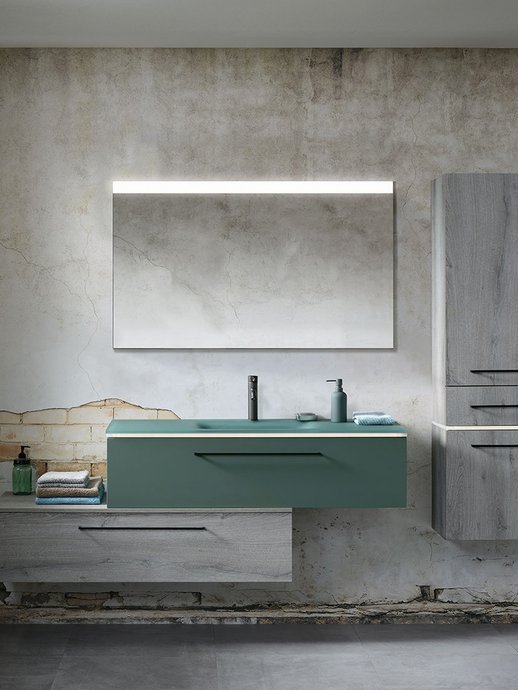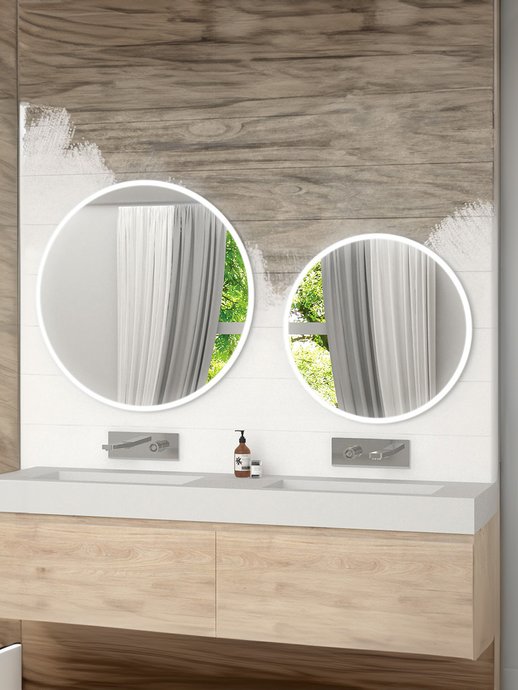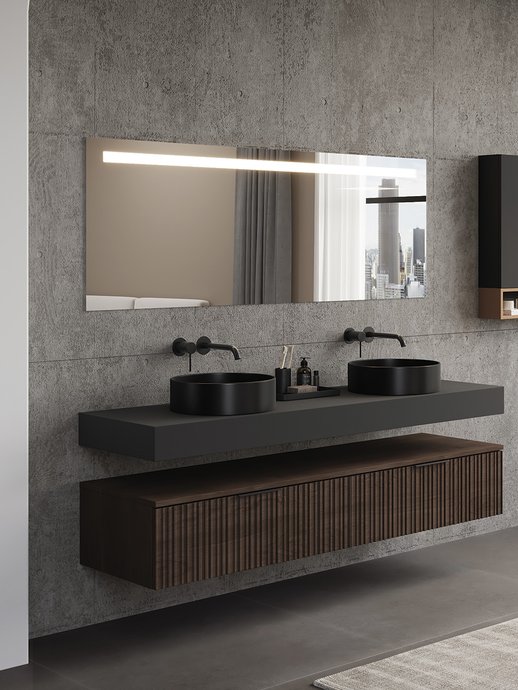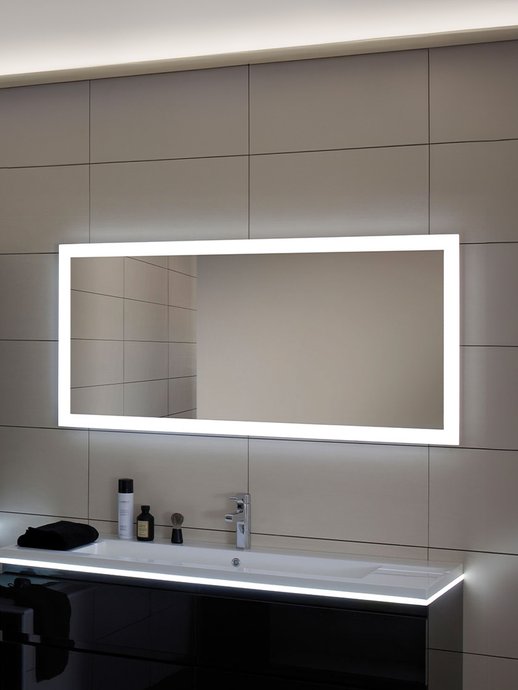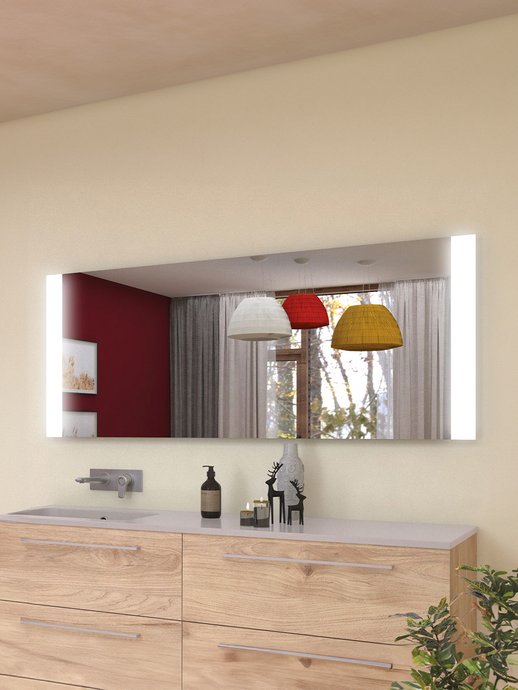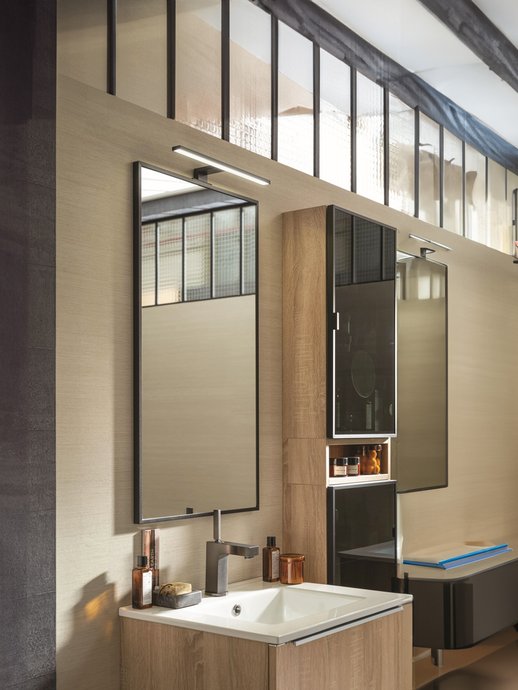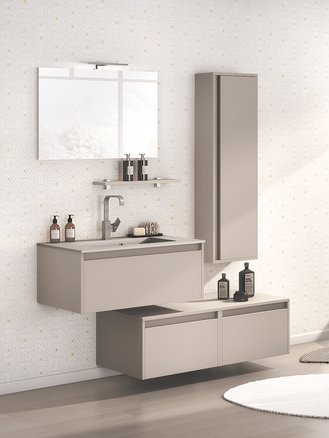
A round or rectangular mirror: which shape will help to make a room feel less cramped?

When a customer asks us at EXPOcenter which mirror to choose to ‘make their bathroom look bigger’, we first ask them another question: what makes it look small? A 4 m² room may seem narrow, low-ceilinged, dark or simply cluttered, and each of these issues calls for a different shape of mirror. Round and rectangular mirrors do not have the same effect.
Why does a bathroom seem small?
The eye judges the size of a room based on a few clues: the perceived distance to the opposite wall, the amount of light, and the number of lines and objects that obstruct the view. A mirror mainly affects the first two. It creates an illusion of depth (we ‘see’ the room extending beyond the wall) and reflects light from the window or spotlights into the dark corners.
When it comes to the third factor, visual clutter, a mirror can either help or make matters worse. A large rectangle reflecting an overloaded shelf, a towel rail and three bottles doubles the clutter. A smaller round mirror, hung on a clear wall, makes the clutter seem less noticeable. The choice between a round and a rectangular mirror largely comes down to this.
The rectangular mirror: the shape that makes the walls seem further away
For the same width of furniture, a rectangle reflects more of the room. In a small room, every square decimetre of reflection replaces a section of wall with a view of the rest of the room.
Mirror size | Reflective surface | Suitable vanity unit |
| Approx. Ø 50 cm | 0,20 m² | 60 cm |
| Approx. Ø 60 cm | 0,28 m² | 70 to 80 cm |
| Approx. Ø 80 cm | 0,50 m² | 100 cm and over |
| Rectangular, 50 × 70 cm | 0,35 m² | 60 cm |
| Rectangular, 60 × 80 cm | 0,48 m² | 70 cm |
| Rectangular, 80 × 70 cm (landscape) | 0,56 m² | 80 to 90 cm |
| Rectangular 120 × 70 cm (landscape) | 0,84 m² | 120 cm (double basin) |
On a 60 cm unit – a classic feature of small Belgian bathrooms – a 50 cm circle provides 0.20 m² of reflection. A 50 × 70 cm rectangle provides 0.35 m², which is 75 per cent more. The difference is immediately apparent.
The direction in which it is hung is just as important as the shape. A rectangle hung horizontally (landscape format) makes the room appear wider: it works well on the large wall of a narrow bathroom, where it gives the impression that the opposite wall is further away. When hung vertically, it elongates the height and is suitable for rooms with low ceilings or sloping ceilings, provided there is a straight section of wall at least 1.90 m long.
Our advice: in a room smaller than 5 m², go right to the edge of the furniture. A mirror that’s ‘a bit smaller, to keep it light’ ends up looking like a postage stamp stuck to the wall. Frameless models or those with polished edges, such as the Delpha rectangular mirror or the models in Sanijura’s Reflet range, blend into the background and let the reflection do the talking.
The round mirror: the shape that softens an overly angular room
It would be a mistake to do away with the circle. It serves a purpose that the rectangle does not: it breaks up the grid. A contemporary bathroom is full of right angles: 60 × 120 tiles, rectangular vanity units, a shower screen, a rail-style towel warmer, and the ceiling. Adding yet another rectangle is like piling on yet another line. A circle breaks up this repetition and draws the eye to it. The room feels calmer, and a calmer room feels less cramped.
A circular design also leaves some of the wall visible around it. On a narrow wall (less than 80 cm wide, between a door and a shower, for example), a rectangle that almost touches both edges gives the impression of filling the space. A circle measuring 50 to 60 cm, centred with 10 to 15 cm of bare wall on either side, looks more spacious.
It works particularly well when the bathroom already features curved elements : a round countertop washbasin, a bath with rounded edges, or a quarter-circle shower tray. If you’re still unsure about where to position the shower, our article on corner or recess showers to save space shows how a quarter-circle design frees up the centre of the room. With this type of shower, a round mirror echoes the curve, and the whole ensemble looks as though it were drawn in a single stroke.
Its limitation is simple: it doesn’t provide as much light. If your room is dark and narrow, the round light fitting on its own won’t be enough to make it feel more spacious. In that case, choose it for its style and compensate with lighting – either a backlit model or wall lights on either side.
Which shape should you choose for your bathroom?
Here we summarise the most common recommendations at EXPOcenter for the layouts we frequently see in Belgian houses and flats.
Configuration | What makes the room small | Recommended form | Why |
| Narrow bathroom (1.60 to 2 m wide), terraced house | Lack of perspective | Horizontal rectangle, width of the unit | It makes the wall opposite appear further away |
| Bathroom in the loft | Low ceiling, slope | A vertical rectangle on the right-hand side, or a circle if the wall is short | It makes the most of the available height |
| A 2 × 2 m square room, well-lit | An accumulation of angles and objects | Round, Ø 60 to 80 cm | He breaks the mould and brings everything together |
| Windowless bathroom (flat) | Lack of light | Large, bright rectangle | It amplifies artificial light |
| Guest toilet with washbasin | Very narrow wall | Round, Ø 40–50 cm, or small oval | It leaves some of the wall visible around it |
| Double washbasin, rooms of 6 m² or more | Rarely a problem with space | Two circles or one large rectangle | A question of style, first and foremost |
There are also intermediate shapes, which are often underestimated. The vertical oval, such as Clou’s ‘Look at Me’, combines the softness of a circle with the height of a rectangle: it works very well on a narrow wall in an attic. The rectangle with rounded corners and the arch (a rectangle with a rounded top) provide a good reflective surface whilst avoiding the ‘block-like’ effect. If you’re struggling to choose, this is often the right choice.
What size should the mirror be, and at what height should it be hung?
A well-designed layout is of no use if it is the wrong size. Here are the dimensions we use for a standard bathroom.
As for the width, a rectangle should be the same width as the vanity unit or 5 to 10 cm narrower; it should never be wider, unless it covers the entire wall from corner to corner. A circle should be chosen to be around 75 to 85 per cent of the width of the unit: 50 cm for a 60 cm unit, 60 to 70 cm for an 80 cm unit.
As for height, the bottom edge of the mirror should be positioned 15 to 25 cm above the spout of the mixer tap, to prevent splashing and leave room to rest your hand. The centre of the mirror should ideally be at eye level for the main user, around 1.60 to 1.65 m above the floor. The top edge is generally between 1.90 m and 2 m high. If the household includes people of very different heights, a tall vertical mirror will suit everyone. A round mirror, on the other hand, requires you to choose a centre height, and someone will always be a little too tall or too short.
Where should you place the mirror to really make it work?
There are two things to avoid in the mirror’s field of view: the toilet, for obvious reasons, and a shower screen covered in limescale marks. In an area with hard water, a poorly maintained shower screen appears twice in the room. We go into more detail about this sort of pitfall in our article on design mistakes to avoid when fitting out a shower area.
Conversely, a mirror that reflects a walk-in shower with a fixed transparent screen and a seamless floor gives the impression of a much larger room: the eye travels through the glass, follows the floor without interruption and encounters nothing. It is, in fact, this sense of continuity that causes many customers to hesitate between an ultra-low-profile shower tray and a tiled floor for their walk-in shower. In a small bathroom, the mirror and the shower floor work together.
Round or rectangular: our view
If your bathroom seems small because it is narrow, low-ceilinged or dark, choose a rectangle – the largest that the furniture will allow – and position it in the direction that corrects the problem: horizontally to make it appear wider, vertically to make it appear taller. If it looks small because it’s full of corners and clutter, a well-proportioned circle on a clear wall will do more to create a sense of space than a large rectangle that reflects all that clutter.
If you’re really unsure, an oval or a rectangle with rounded corners are good compromises. And be wary of catalogue photos taken in 12 m² bathrooms: seeing both shapes to scale, next to a unit the same width as yours, often settles the matter in a matter of seconds.
Frequently asked questions
Does a round mirror make a small bathroom look bigger?
A little, but less so than a rectangle of the same width, because it reflects less surface area: 0.20 m² for a 50 cm circle compared with 0.35 m² for a 50 × 70 cm rectangle. It is particularly helpful when a room appears small due to an excess of corners and objects. It soothes the composition rather than extending it.What size mirror should I choose for a 60 cm vanity unit?
A rectangle 50 to 60 cm wide (for example, 50 × 70 cm or 60 × 80 cm), or a circle 50 cm in diameter. Avoid making it wider than the piece of furniture, unless the mirror covers the entire wall.At what height should a bathroom mirror be hung?
The bottom edge should be positioned 15 to 25 cm above the tap spout, with the centre approximately 1.60 to 1.65 m above the floor. In a bathroom designed for people with reduced mobility, the bottom of the mirror should be no higher than 90 cm above the floor.Is an anti-fog mirror necessary in a small bathroom?
In a room smaller than 5 m², yes, this is the option we recommend first and foremost. Mist forms there within a few minutes and the heating film consumes only a few tens of watts whilst in use. Good ventilation is still necessary; the anti-mist feature is no substitute for it.Can you put a mirror opposite the shower?
Yes, provided the screen is transparent and well maintained: the reflection from an open walk-in shower makes the room appear significantly larger. With hard water and a marked screen, the effect is reversed, and the marks appear twice.