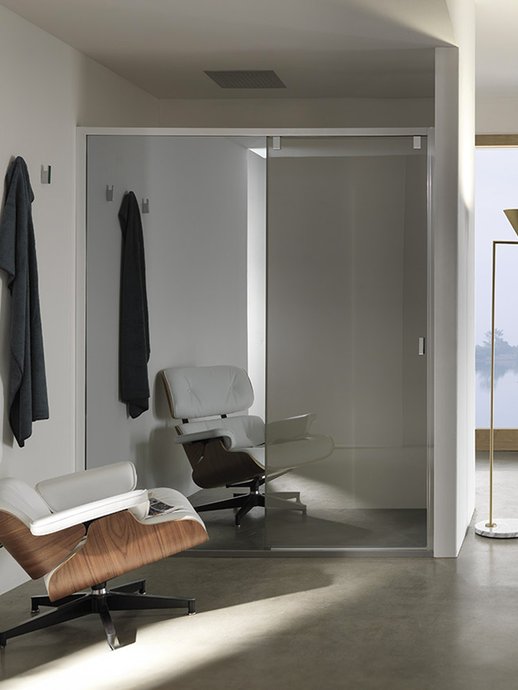
Corner shower or niche shower: which layout saves space in the bathroom?

In a bathroom where every centimeter matters, the choice between a corner shower and a niche shower directly affects ergonomics and circulation. The corner shower is installed in a corner of the room and frees up the central space, making it particularly suitable for small bathrooms. The niche shower, installed between three walls, integrates more discreetly into the architecture of the room. Depending on the available dimensions, the type of panel, the shower doors, and the shower tray chosen, each configuration can offer a practical, elegant, and functional solution to optimize the room layout.
Understanding possible shower layouts
In a modern bathroom, the shower is often the central element of the layout. Choosing its location is not only an aesthetic decision: it is primarily about optimizing every available centimeter to improve circulation and daily comfort.
Two configurations now dominate bathroom design projects: the corner shower and the niche shower. The first uses a corner of the room to create a compact and functional space. The second uses an existing or newly created recess to integrate the shower into the architecture of the bathroom.
Each solution has its advantages. Corner showers are often preferred in small bathrooms, while a niche allows a more discreet integration. The choice therefore depends on the shape of the bathroom, the available width, and the type of doors you want to install.
Corner shower: characteristics and configurations
What is a corner shower?
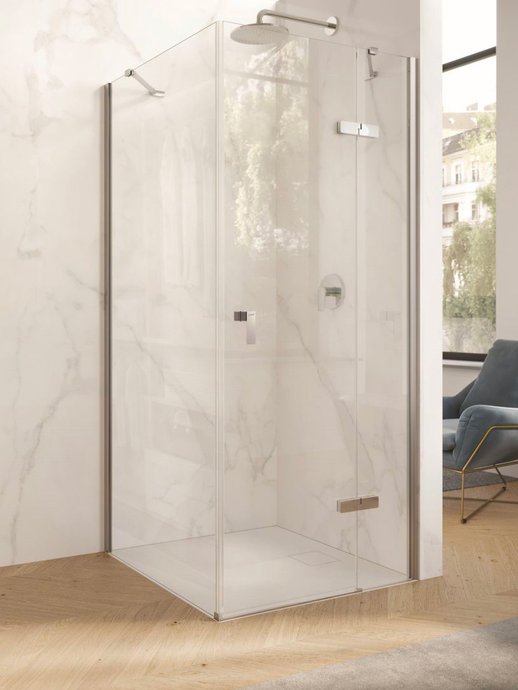
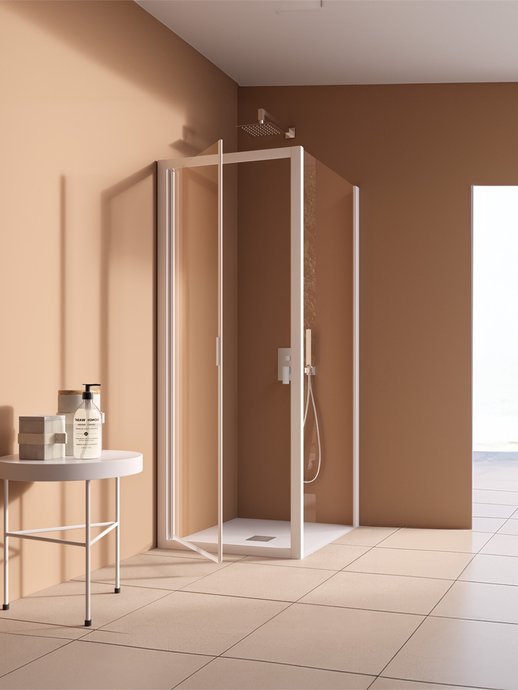
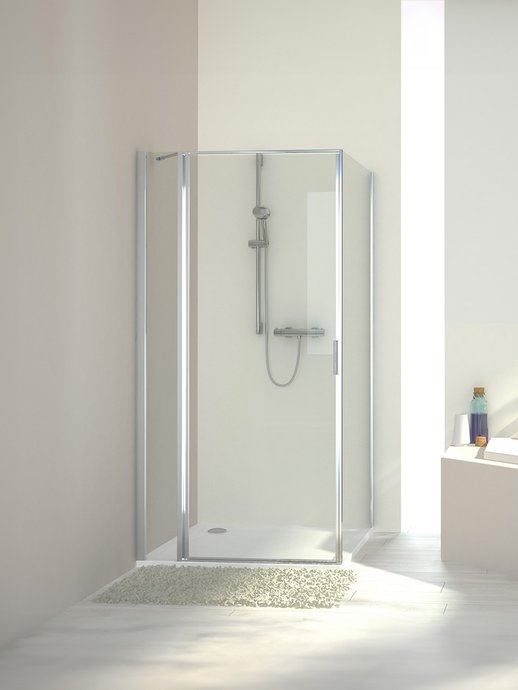
A corner shower is installed in a corner of the bathroom. It uses two existing walls to form the angle, while a glass shower panel and doors close the space to contain water and protect the rest of the room.
This layout makes it possible to place the shower in the corner of the room and free the central surface. It is a very effective solution when you want to optimize space without sacrificing comfort.
A shower installed in a corner can accommodate different types of panels, including a transparent glass shower panel, a fixed screen, or a complete cabin. Aluminum or chrome profiles provide a modern finish while ensuring good safety.
Shapes of corner shower cabins
Several shapes exist for a shower cabin installed in a corner. The choice depends on the bathroom size and the desired style.
- The quarter-circle shower is very common in small bathrooms. Its rounded tray removes sharp angles and improves circulation.
- The square cabin is a classic and balanced solution.
- The rectangular cabin suits larger spaces and offers additional comfort.
- The pentagonal shower cabin adapts to certain specific configurations.
Each shower cabin with corner entry reduces floor space while maintaining comfortable access.
Types of doors for a shower with doors
The choice of doors strongly influences the shower’s ergonomics.
Different door types allow the cabin to adapt to the bathroom layout:
- The sliding door is often the most practical solution in a small bathroom.
- The pivot door requires more space but offers wide access.
- The hinged door operates with a solid hinge and safety glass.
- Double sliding doors provide very comfortable central access.
These shower doors are generally made of transparent tempered glass in 5 mm, 6 mm, or 8 mm thickness. Some include nano or easy-clean treatment to limit limescale adhesion.
Standard dimensions: from 80x80 cm to x 100 cm
The size of the cabin is decisive for comfort.
The 80x80 cm size is the recommended minimum for a functional corner shower. This dimension is suitable for small bathrooms where every centimeter must be optimized.
The 90x90 cm shower is often the best compromise between comfort and space. It offers more room to move while remaining compact.
In larger bathrooms, it is possible to opt for a format of x 100 cm or even 140 cm width for a more generous shower area.
Niche shower: principle and installation
A shower between three walls
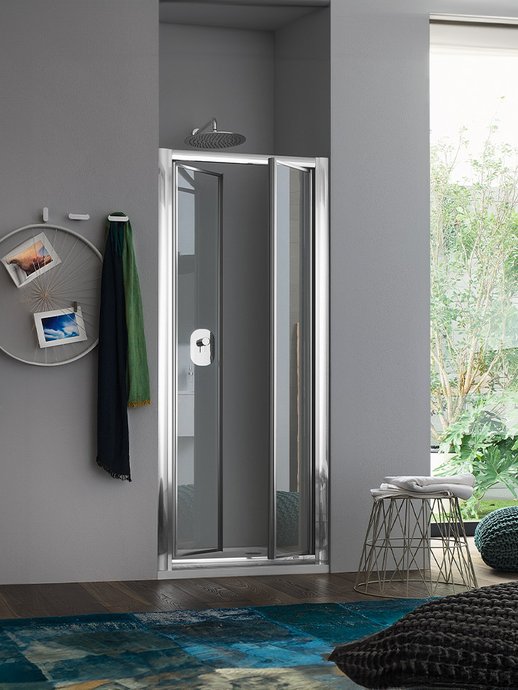
The niche shower follows a simple principle: placing the shower between three existing walls. The glass panel and door close the remaining opening.
This configuration allows the shower to integrate perfectly into the bathroom. The space appears more structured, and the shower becomes almost invisible in the overall architecture of the room.
A shower cabin with niche entry can receive different types of doors depending on the available width.
Choosing shower doors
Several options are possible:
- sliding door for narrow spaces,
- hinged door for wide opening,
- pivot door for simple installation,
- fixed panel with lateral access.
A fully transparent glass shower panel helps distribute light throughout the room and prevents a closed-off effect.
The walk-in shower in a niche
When the width exceeds 120 cm, it becomes possible to install a walk-in shower with a fixed panel. This configuration eliminates doors and creates a particularly elegant appearance.
The shower tray can be recessed into the floor to create visual continuity with the bathroom flooring.
Comparison: corner shower or niche shower
Space optimization
The corner shower generally occupies less floor space. It frees the center of the room and facilitates movement between the sink, storage units, and possibly the bathtub.
The niche shower makes better use of existing recesses. It is an interesting solution when the bathroom has an alcove or naturally defined space.
Circulation in the bathroom
A corner shower cabin keeps the central area open. Rounded trays are particularly suitable for small bathrooms because they avoid sharp angles.
The niche shower, on the other hand, maintains linear circulation along the walls. This layout works well in rectangular rooms.
Visual impact and design
Transparent glass panels create the impression of a larger space in the bathroom. A minimalist fixed panel accentuates this effect.
Aluminum or chrome profiles add a design touch while strengthening the structure of the cabin.
Which shower to choose for a small bathroom ?
In a small bathroom of less than 4 m², a corner shower is generally recommended.
An 80x80 cm or 90x90 cm cabin with two sliding doors is often the most practical solution. This configuration maximizes the available space while ensuring good comfort.
In some cases, a shower with corner entry can also simplify access and improve bathroom ergonomics.
Criteria | Corner shower | Niche shower |
| Installation | Corner of the room with 2 existing walls | Between 3 walls forming a C-shape |
| Possible shapes | Quarter-circle, square, rectangular, pentagonal | Square and rectangular only |
| Opening solutions | Hinged, sliding, fixed | Pivot, hinged, folding, sliding, fixed |
| Recommended dimensions | Minimum 80x80 cm – optimal 90x90 cm Up to 120x120 cm for large spaces | 70 cm to 180 cm depending on the space |
| Space optimization | Frees the center and improves circulation Quarter-circle: maximum space saving | Uses unused recesses Keeps the central passage clear |
| Visual impact | Glass panels visually enlarge the space Modernizes the whole room | Intimate and structured space Discreet integration |
| Bathroom < 4 m² | Recommended solution: 80–90 cm with sliding doors | Depends on the existing layout |
| Ideal configuration | Square and rectangular rooms Preserves space for other equipment | Rectangular rooms (short wall) Existing alcoves and recesses |
| Main advantages | Maximum space saving Easy access Optimized circulation | Custom integration Perfect discretion Organized layout |
| Walk-in shower | Compatible with fixed panel | Fixed panel for widths > 120 cm |
Technical criteria before buying a shower
Before buying a shower, several elements must be studied to avoid unpleasant surprises during installation.
- Measure precisely the available width and depth
- Check the position of the plumbing
- Identify structural wall constraints
- Choose the size of the shower tray
- Select the type of panel and doors
Manufacturers now offer many models available with different profiles, glass thicknesses, and anti-limescale treatments.
These options make it possible to adapt a shower cabin to almost any bathroom configuration.
Frequently asked questions
Q1. Does a corner shower really help optimize space in a small bathroom?
Yes. A corner shower is particularly effective for saving space. Installed in a corner, it frees the center of the room and improves circulation.Q2. What are the minimum recommended dimensions for a comfortable corner shower?
The 80x80 cm format is the minimum for comfortable daily use. However, 90x90 cm generally provides better comfort.Q3. What is the difference between a corner shower and a niche shower?
A corner shower is installed in a corner using two existing walls, while a niche shower is installed between three walls. The first optimizes central space, while the second integrates into an existing recess.Q4. Which type of door saves the most space?
The sliding door remains the most practical option because it does not require clearance to open.Q5. What solution is best for a bathroom smaller than 4 m²?
An 80x80 cm or 90x90 cm corner shower with sliding doors is usually the best solution to optimize every centimeter of a small bathroom.