Folding shower door: a good or a bad idea?

Folding doors have a reputation as a clever solution for small spaces: they fold up like an accordion, take up little space when opened and provide wider access than a conventional pivot door. All of this is true. What is less often mentioned is that, unlike a sliding door, they do not completely eliminate the swing-out clearance, and that they have more moving parts that are likely to wear out over time. Neither a good nor a bad idea in absolute terms, they are the right solution for a specific layout, but a questionable default choice in other cases.
How does a folding door actually work?
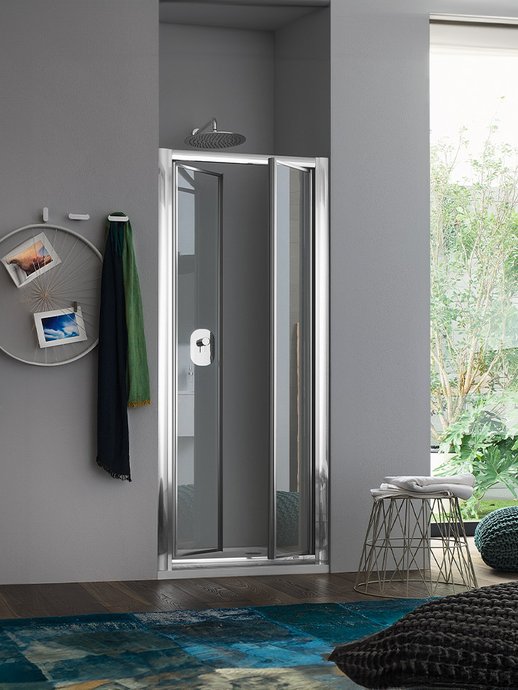
The principle has remained unchanged for decades: two or four panes of glass, connected by vertical hinges, fold in on themselves when opened, much like a folding screen. Unlike a pivot door, which swings as a single unit, a folding door concentrates its movement within a narrower width, usually one-third or one-half of its total width when folded.
Most models fold outwards from the shower, which still requires a little space in front of the opening. Newer versions allow the panels to fold inwards towards the shower cubicle, which completely frees up the space outside but reduces the usable area by the same amount whilst the door is open – a detail that matters if you need to move around in the shower whilst the door is folded away. Standard dimensions range from 70 to 100 cm in width, with a height of 180 or 200 cm.
The material used for the panels makes a real difference in the long run. Toughened glass, which is four to five times stronger than ordinary glass and is safe in the event of breakage, remains the gold standard for this type of door. Some entry-level models use PVC or acrylic instead of glass on one or more panels: whilst this makes the door lighter and cheaper, it loses out in terms of rigidity and durability, with a greater risk of clouding or yellowing after a few years of daily use.
What really makes it a good idea
Folding doors are at their most useful in narrow recesses, between 70 and 90 cm wide, where a sliding door lacks the necessary side wall for the moving panel to slide past. In this specific configuration, the folding door often becomes the only viable alternative to a conventional pivot door, with one clear advantage: a significantly wider opening than a quarter-round model or a double-leaf hinged door of the same width.
It is also ideal for renovation projects, when you wish to replace an old shower enclosure without altering the existing shower tray or enlarging the available opening. For corner access, some ranges combine a pivoting and folding mechanism, such as the Duscholux system, which combines both mechanisms to accommodate a shower installed in a corner without compromising the width of the access.
What you don’t often hear
The most overlooked aspect is the actual clearance required. An 80 cm sliding door reduces the space needed in front of the shower to around 60 cm, to stand and step in. A folding door of the same width reduces this clearance compared to a conventional hinged door, but never eliminates it entirely: there is always a manoeuvring space to allow for in front of the opening, however small. In a truly tiny bathroom, where every centimetre in front of the shower counts, the sliding door retains an objective advantage that the folding door cannot match.
The second point concerns the number of moving parts. A sliding door runs on a track and rollers, which is the only point of wear and tear to keep an eye on. A folding door features one or more vertical hinges between the panels, in addition to the wall fixings – all of which are points where limescale from Belgian water can build up and cause the door to jam if not maintained regularly. Cleaning the grooves and lightly lubricating the hinges, about twice a year, prevents most jams, but this is a maintenance task that sliding doors or fixed panels do not require to the same extent.
Finally, aesthetics remain a real point of discussion. Fixed-glass walk-in doors and sliding doors are currently the most sought-after designs, featuring very slim profiles or no frame at all. Folding doors, by their very nature, retain visible hinges and a more prominent frame, giving them a more functional than architectural appearance. This isn’t a deal-breaker, but it’s a compromise you should be prepared to accept rather than discover after purchase.
Folding, sliding or pivoting doors: which one should you really choose?
The rule of thumb is quite simple. If the shower opening is wider than 100 to 120 cm and there is sufficient space at the sides, a sliding door remains the best option for a small bathroom: it is the only type that requires no clearance. If the opening is narrower, between 70 and 90 cm, with no side wall available for a sliding door, the folding door has the edge over the pivot door thanks to its more generous access width. If space is not an issue, the pivot door remains the easiest to maintain in the long term, with just a single set of hinges and no tracks to clean.
Our comparison guide on pivot, sliding and folding shower doors: how to choose based on the space available sets out these three configurations according to the type of installation, whether in a recess or in a corner. Whilst a sliding door remains the go-to option for a small space, the guide sliding shower doors: ideal for small spaces explains exactly why, and in which situations it reaches its own limits. For a broader overview of all the possible configurations in a confined space, the guide shower doors for small bathrooms remains the go-to resource to consult before making a decision.
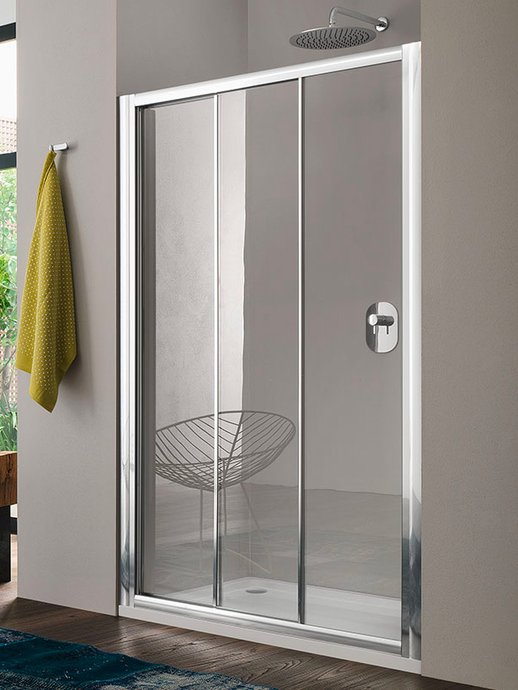
In practical terms, if the opening is wider than 80 cm and there is a side wall available for installing a fixed panel, a sliding door remains the safest option: the D-motion range with two panels, from Facq, covers most standard widths from €500 to €600 in a recess configuration, and its quarter-round version (from €1,015.26 including VAT) allows the same design to be installed in a corner without compromising on ease of entry. If, on the other hand, the space in front of the shower poses no constraints and waterproofing takes priority over space-saving, the hinged door remains the easiest to maintain in the long term: the Rapid range for recess or corner installation starts at around €440 including VAT, whilst the Urban swing door, with its 6 mm safety glass and anodised aluminium profiles, is a higher-end option offering a more refined finish on a wide opening. In both cases, the choice is based less on aesthetics than on the actual space available in front of the shower.
What about a walk-in shower?
In a walk-in shower, a folding door is almost never the first choice. In this type of project, the preference is either for a fixed screen, for its clean lines and the complete absence of any mechanism, or for a hinged door, which provides a better seal across wider openings. Folding doors are used less frequently, but are still a viable option for a narrow walk-in shower, as a complement to a fixed panel, when space does not allow for either a sliding door or the full swing of a hinged door.
Our comparison of fixed panels versus hinged doors for walk-in showers sets out the two most common options in this context and the criteria that tip the balance in favour of one or the other.
Fit it properly so you don’t end up regretting it
A folding door is less forgiving of imperfections than a fixed door: every misaligned hinge affects the entire mechanism, and a panel that rubs will eventually wear out prematurely or put strain on the glass. Ensuring the wall profiles are level, checking that the wall is plumb, and testing the opening mechanism about ten times before first use will help identify any points of friction before they become a real problem.
The toughened glass used in these doors is robust, but remains vulnerable at its edges and corners: it is still important to ensure that two people handle the glass and that it is protected during transport, as with any glass shower door. Our guide Installing a shower door: 5 mistakes to avoid so as not to break the glass goes through these points one by one, from preparing the mounting surface to the final watertightness test, and applies equally to folding doors and any other system.
Frequently asked questions
Q1. Does a folding shower door really take up less space than a hinged door?
Yes. Its accordion-style mechanism concentrates the opening into a narrower width – approximately one-third or one-half of the total width – as opposed to the full width of a conventional pivot door. However, unlike a sliding door, it does not completely eliminate the swing radius.Q2. Folding door or sliding door for a small bathroom?
Sliding doors remain the standard choice whenever the opening exceeds 100 to 120 cm and there is a side wall to allow the panel to slide. For openings under 90 cm, or where there is no side wall, folding doors are the better option thanks to their more generous access width.Q3. Does a folding door wear out more quickly than a sliding door?
It has more hinges, so there are more places where limescale can build up and cause the mechanism to jam. Cleaning the grooves and applying a light coating of grease about twice a year is usually enough to prevent it from jamming.Q4. Can a folding door be fitted to a walk-in shower?
It is possible, but it is not the most common solution for this type of shower, where a fixed panel and a hinged door are still the preferred options. A folding door remains a viable option for a narrow walk-in shower, as a complement to a fixed panel.Q5. How much does a folding shower door cost in Belgium?
Expect to pay between €250 and €600 for a standard built-in model, and €600 to €900 for models with a higher-quality finish. A pivot-and-fold system for corner access, such as those in the Duscholux range, tends to start at around €750 to €1,000 per side.