Pivoting, sliding, folding shower doors – how to choose based on space?

Analysing your bathroom space
Choosing the right shower door begins with a crucial step: accurately assessing the space available in your bathroom. This analysis will determine not only the type of door that will suit your layout, but also your everyday comfort for many years to come.
Three possible configurations for your shower
We help you identify the configuration of your shower space from three main types:
The niche shower is installed between two parallel walls. This configuration requires only one door and is ideal for sliding doors or pivoting doors, depending on the space you have available.
The corner shower utilises a corner of the bathroom with two perpendicular walls. This layout generally requires a quarter-round door or a fixed wall with a pivot door.
The free-standing shower is installed along a single wall. This option offers you more freedom in terms of layout but requires more space and several walls to delimit the shower area.
Take measurements accurately
Accurate measurements are essential to make the right choice:
The width of the opening directly influences your choice of door. Allow at least 70 cm for a pivot door, while a sliding door can be adapted to narrower openings.
The ceiling height influences the model selected. Most standard shower doors are between 185 and 200 cm high.
Be aware of wall irregularities! Perfectly straight walls are rare and may require adjustments during installation.
Calculate clearance space
Each type of door has its own space requirements:
A pivot door requires a space in front of the shower that is equal to its width. This can be a problem in small bathrooms.
A sliding door does not require any external clearance as it slides along the wall. This is why it is ideal for confined spaces.
A folding door offers an excellent compromise: its accordion system reduces the opening space while maintaining comfortable access.
Also consider the location of your other fixtures: washbasin, toilet, radiator. These items must not obstruct the door opening. Maintain a minimum distance of 70 cm between the shower and other fixtures to allow for easy movement.
These spatial parameters will guide you towards the most suitable shower door for your particular configuration.
3 types of shower doors we recommend
Choosing the ideal shower door depends on your available space and preferences. We have selected the three models best suited to different bathroom configurations for you.
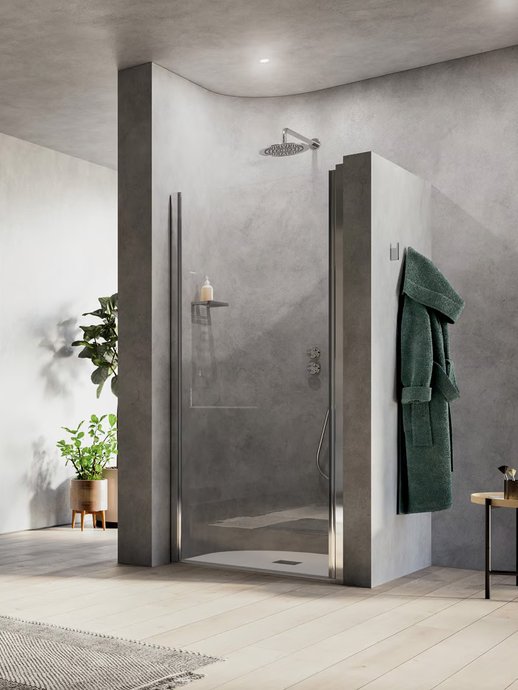
Pivot door: comfort above all else
The pivot door opens like a conventional door thanks to its hinge system. This simple and effective mechanism gives you generous access to your shower.
Perfect for spacious bathrooms, this door requires approximately 70 cm of free space to open comfortably.
Its strengths:
- Wide opening for easy access, ideal for people with reduced mobility
- No floor rail: easier to clean
- Elegant design, available with or without frame
Its weak point: it is not suitable for small bathrooms because it requires a lot of space to open.
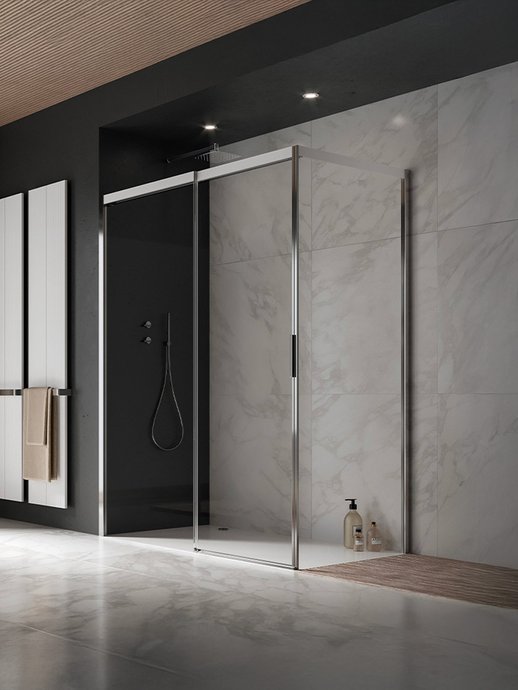
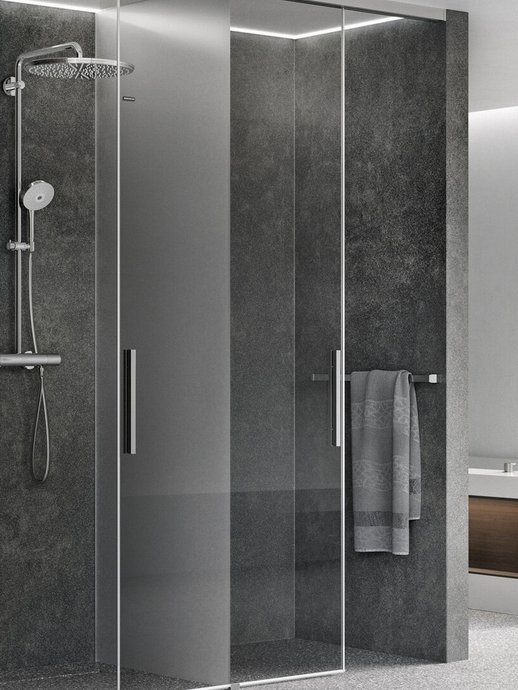
Sliding door: the space-saving solution
The sliding door glides along a rail, without taking up any space in your bathroom. This clever system solves space issues in compact bathrooms.
Why we recommend it:
- No clearance space required
- Excellent watertightness thanks to the rail
- Can be installed even in the smallest spaces
- Wide range of finishes available
Rail maintenance is still necessary to prevent dirt build-up, but this remains very manageable on a daily basis.
Folding door: the smart compromise
The folding door, also known as an "accordion" door, combines the advantages of the two previous models. It folds back on itself, taking up minimal space when opened.
This solution is particularly well suited to small bathrooms and niche installations.
Its strengths:
- Full opening without external clearance
- Perfect for very confined spaces
- Simple and smooth handling
Each type has its own specific characteristics. Please consider your available space first and foremost in order to make the right choice.
Adapt your choice to the configuration of your shower
Your shower space determines the most suitable type of door. Each configuration has its advantages depending on the layout of your bathroom.
Niche shower: keep it simple
Is your shower being installed between two walls? There are two solutions available to you, depending on the space available.
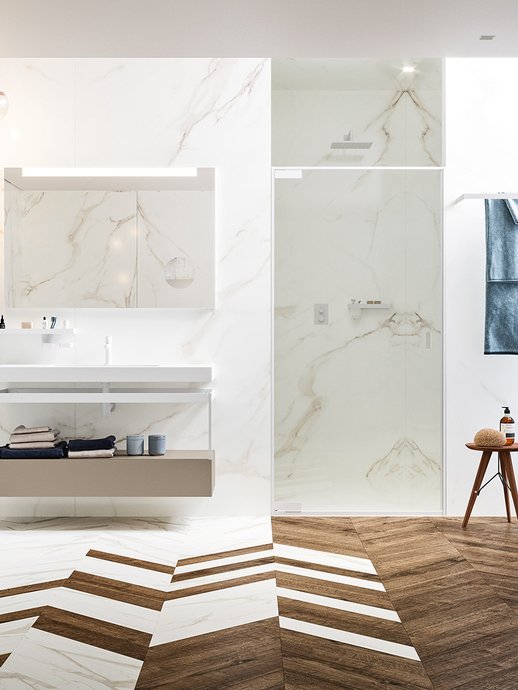
The pivot door is ideal for wide alcoves (minimum 70-80 cm). It provides full access and optimal watertightness. Just make sure you have enough space in front of the shower to open it.
Sliding doors are ideal for spacious recesses (120 cm or more) in smaller bathrooms. They save space without obstructing movement. The opening remains partially concealed by the fixed panel, but this does not hinder everyday access.
Corner shower: make the most of every inch
The corner installation makes clever use of the two perpendicular walls in your bathroom.
The quarter-round door maximises interior space thanks to its curved shape. It avoids right angles and is particularly well suited to small bathrooms. The floor space remains limited while offering a generous shower area.
The folding door is an attractive alternative for very tight corners. Its accordion system allows it to open fully without protruding into the outdoor space. The entrance is often wider than with quarter-round doors.
Italian shower: go for elegance
For a walk-in shower, there are two distinct approaches:
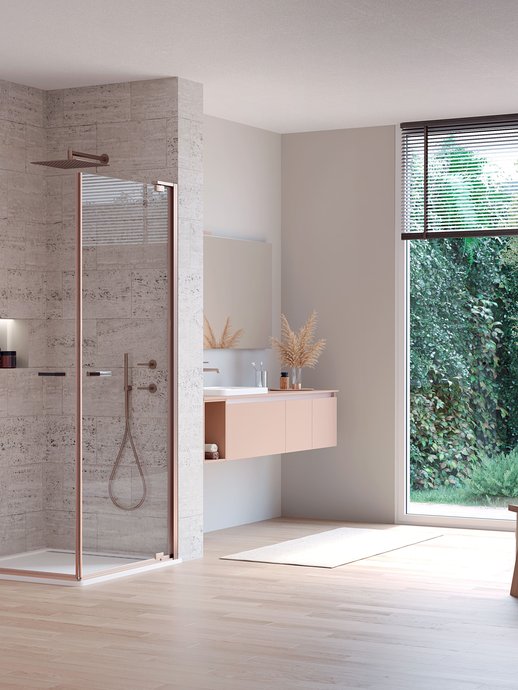
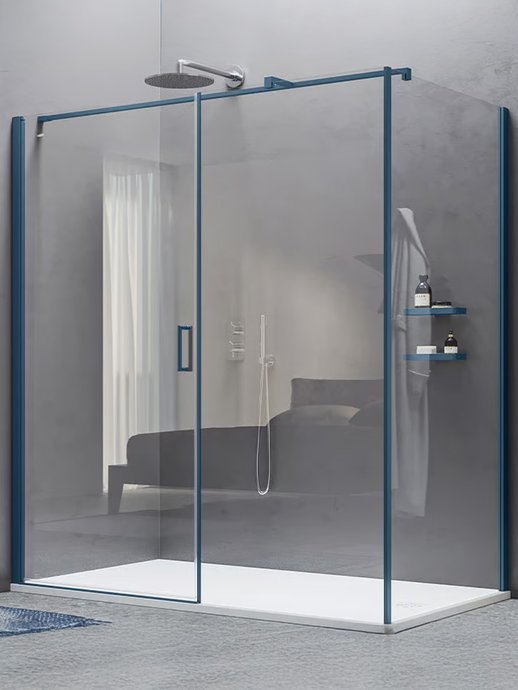
The fixed wall creates a minimalist, contemporary style. One or more glass walls simply enclose the shower area. This open solution requires a well-designed floor slope to prevent splashing.
The sliding door is ideal for large walk-in showers. It keeps heat and humidity inside the space while providing easy access. This splash protection is particularly practical in family bathrooms.
Materials and finishes: we guide you in your choices
Choosing the right materials for your shower door directly affects your daily comfort and maintenance budget. We help you make the right choice based on your priorities.
Tempered glass: guaranteed safety and durability
Tempered glass is the gold standard for shower doors. Five times stronger than ordinary glass, it is resistant to everyday knocks and scratches. If an accident occurs, it breaks into non-sharp fragments, protecting your family.
Acrylic remains an economical option, but requires more care. It scratches easily and can yellow over time, reducing its lifespan.
Finishes: transparency or privacy according to your needs
Can't decide between different finishes? Clear glass visually enlarges your bathroom and highlights your tiling. Frosted glass preserves your privacy while maintaining brightness. Decorative versions add a personal touch to your space.
Profiles: choose aluminium
Aluminium is highly resistant to moisture and does not corrode, unlike PVC, which can warp. Choose a finish that matches your taps: chrome for a classic style, matt black for a contemporary touch, or brushed nickel for added character.
Save time with anti-limescale treatment
Opt for an anti-limescale treatment when you purchase your door. This protection forms an invisible barrier that repels water and prevents limescale deposits. The result: your door stays clean longer and cleaning becomes a breeze.
Find the shower door that suits you
Choosing a shower door that suits your space significantly improves your everyday comfort. We have presented the three main types – pivot, sliding and folding – each of which meets specific needs depending on your layout.
Your space dictates your choice. A spacious bathroom is ideal for a pivot door, which opens wide. Smaller spaces benefit from sliding doors, which save valuable space. Folding doors offer the best compromise when every centimetre counts.
The materials you select determine the durability of your installation. Tempered glass withstands years of daily use, while an anti-limescale treatment greatly simplifies maintenance.
Take the time to assess your space, your habits and your budget. A well-chosen shower door will serve you well for many years, combining functionality and aesthetics. Visit your nearest Facq showroom to discover our solutions and make the choice that will transform your bathroom into an optimal wellness space.
Frequently asked questions
Q1. What is the best shower door for a small bathroom?
For a small bathroom, a sliding shower door is ideal. It does not require additional space to open and provides a good seal. A folding door is also an excellent option, as it folds back on itself and takes up minimal space.Q2. How do I choose the right size sliding shower door?
To choose the right size sliding door, measure the width of your shower opening precisely. Ensure that the rail is twice as wide as the door itself. It is preferable to choose a door that is slightly wider than too narrow for optimal comfort.Q3. What is the minimum recommended width for a shower entrance?
The minimum recommended width for a shower entrance is 60 cm. However, in extreme cases, a passage of 50 cm may be acceptable. For a comfortable shower, aim for an opening of at least 70 cm if space allows.Q4. What are the advantages of a tempered glass shower door?
A tempered glass shower door offers several advantages: it is highly resistant to impact and scratches, it is safe because it breaks into small, non-sharp pieces in the event of an accident, and it adds a modern and elegant aesthetic to your bathroom.Q5. How can I make it easier to maintain my shower door?
To make it easier to maintain your shower door, choose a model with an anti-limescale treatment. This coating forms a water-repellent barrier that prevents limescale deposits and simplifies daily cleaning. In addition, choose corrosion-resistant aluminium profiles for increased durability.