Shower doors for small bathrooms: the complete guide

Designing a shower in a small bathroom requires making the right choices. In a space of 2 to 3 m², every decision matters for daily comfort. A poorly chosen door can quickly turn your morning routine into an obstacle course.
Sliding shower doors are the most practical solution for optimising space. They improve circulation while providing comfortable access to the shower. Folding doors are also an excellent alternative, particularly well suited to very tight spaces. Corner configurations deserve special attention, as they make smart use of available angles. Even pivot doors can work well in certain layouts. Keep this simple rule in mind: allow at least 80 x 80 cm, ideally 100 x 200 cm, for optimal comfort.
We guide you in choosing the ideal shower door for your small bathroom. Discover the different available types, their specific advantages and our practical advice to help you make the right choice for your layout.
Types of shower doors suitable for small bathrooms
Each door type responds to specific space constraints. Your choice depends entirely on the layout of your bathroom and your daily usage priorities.
Sliding shower door: guaranteed space saving
This is the reference solution for small spaces. The sliding door glides along a fixed panel without any outward swing. The result: up to 60 cm of free space recovered in front of the shower.
This system offers a major advantage: smooth and quiet operation. The moving panel runs along a discreet rail, allowing easy access even in the tightest spaces.
However, be mindful of two points: the opening is limited to half of the total width, and the rails require regular cleaning to prevent limescale build-up.
Folding shower door: ideal for very tight spaces
This clever solution folds like an accordion. When closed, it takes up only a few centimetres in depth. Recent models even allow the panels to fold inward into the shower area.
The main advantage? A wider opening than with a sliding door, making access easier. This option is particularly suitable for bathrooms where every centimetre truly counts.
Pivot shower door: a balance between comfort and space
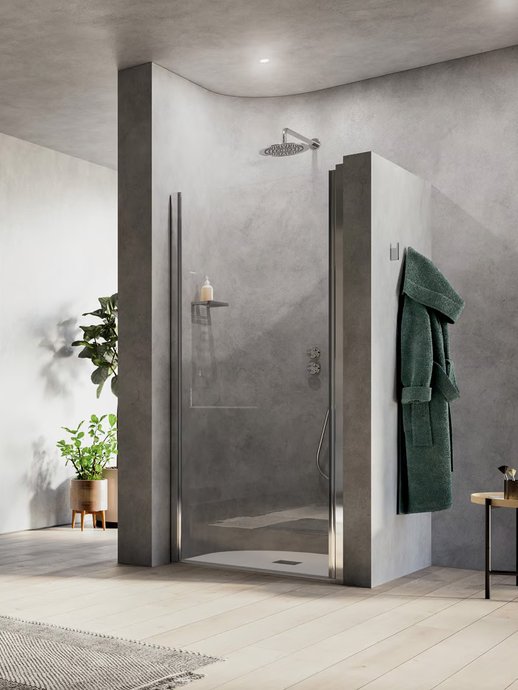
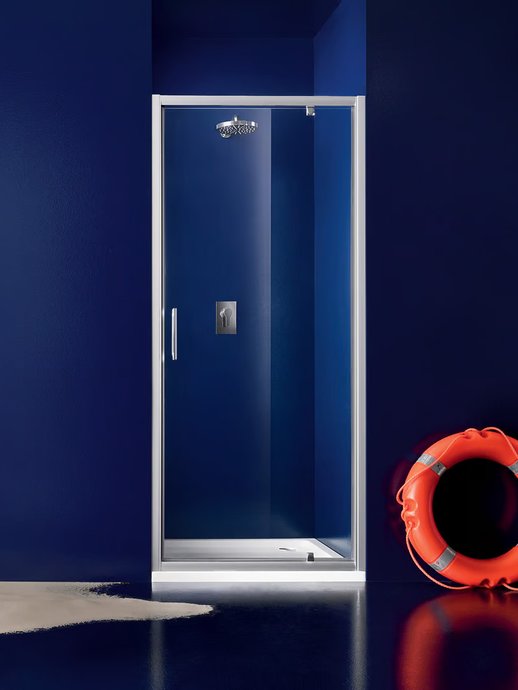
Mounted on a central axis, this door opens in both directions. Only half of the glass surface extends into the outer space. This simple mechanism offers excellent durability, with fewer moving parts to maintain.
The pivot system strikes a good balance: more comfort than a sliding door, less bulk than a traditional hinged door.
Hinged shower door: best reserved for larger spaces
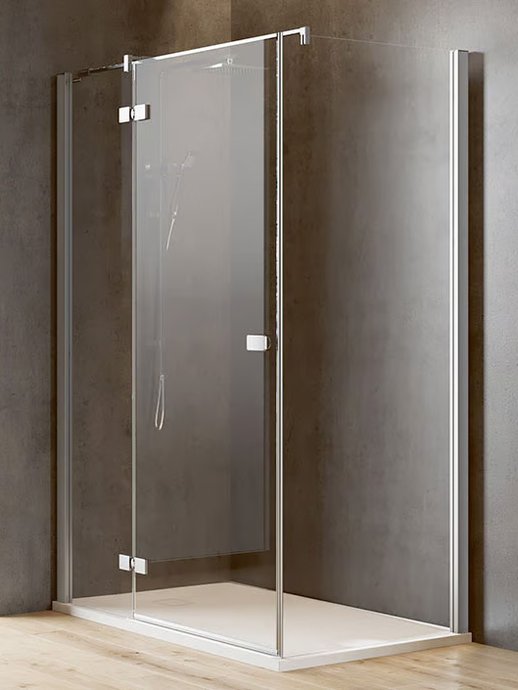
This traditional door opens outward like a standard room door. It provides the widest opening but requires at least 70 cm of clearance in front of the enclosure.
Choose this solution only if your bathroom offers sufficient space to allow full opening without obstruction.
How to choose the right door for your layout
Your spatial configuration determines the best shower door choice. We help you identify the solution best suited to your situation to enhance your daily experience.
Alcove shower: adapt your choice to available space
Is your shower installed between three walls with a front opening? This layout offers several interesting options. For smaller alcoves, first assess the available swing space. Pivot doors are commonly used, but they require enough clearance to open without obstructing circulation.
Do you have a square shower tray measuring 70 to 90 cm? A double-panel hinged door can be a smart option. Its smaller panels reduce bulk while making access easier. For very tight spaces, opt for a folding door: its panels fold completely away, fully clearing the opening.
Corner shower: make smart use of angles
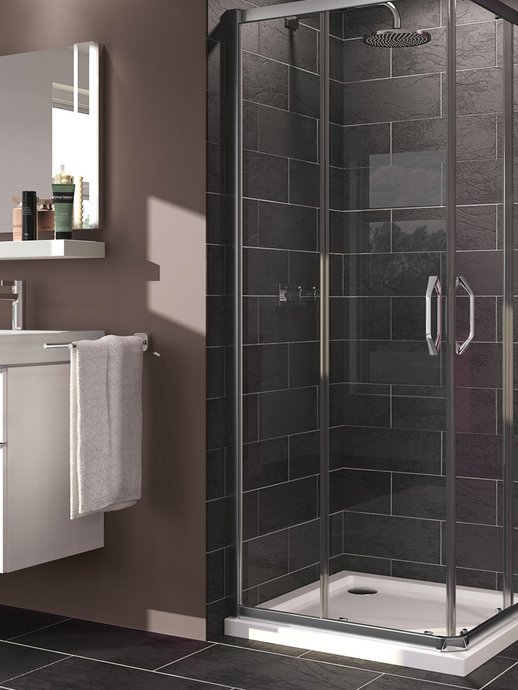
Corner showers maximise the use of available space. With a tray positioned in a corner and two supporting walls, several layouts are possible. An open shower area with a simple fixed panel provides easy access and a sense of openness. For more privacy, add a sliding or hinged door depending on the available space.
A quarter-round shower tray offers a specific advantage: it fits perfectly into the corner while optimising circulation. A panel with a door effectively prevents water splashes, an important detail in small bathrooms where every drop matters.
Walk-in shower: elegance and practicality in small spaces
Even in a small bathroom, you can enjoy the elegance of a walk-in shower. This configuration requires a movable panel to contain water splashes. A sliding panel is the most practical option: it glides along a fixed panel and provides full access to the shower area.
Plan for a fixed panel slightly wider than the sliding door to prevent it from hitting the wall when opened. A folding accordion-style panel is another effective space-saving alternative, although it may be less convenient for some users.
Materials, finishes and maintenance for a durable door
The durability of your shower door largely depends on the chosen materials. In a small bathroom, these decisions influence not only longevity but also the perception of space.
Tempered glass or acrylic: making the right choice
Tempered glass is the reference material for shower doors. This safety glass is 4 to 5 times stronger than standard glass. In case of breakage, it shatters into small non-sharp pieces, reducing the risk of injury. It also provides valuable visual lightness in small spaces.
Acrylic is more affordable and easier to install. This lightweight synthetic material requires a minimum thickness of 2.2 mm. However, it scratches easily and may yellow over time, especially under the effects of light and humidity.
Glass finishes: transparency and privacy
Clear glass maximises light, ideal for visually enlarging a small bathroom. Prefer more privacy? Frosted or sandblasted glass allows 86% of light through while preserving discretion. Other options include screen-printed, smoked, textured or mirror-effect glass.
Profiles: choose aluminium
Aluminium remains the reference material for profiles. It combines strength and long-term aesthetics. Corrosion-resistant, it ensures stability without adding visual weight. Chrome or black finishes bring a contemporary touch. PVC is a more economical option but less durable.
Glass thickness: a matter of safety
Respect a minimum thickness of 3 mm for safety. Sliding or hinged doors require at least 6 mm, while frameless fixed panels need a minimum of 8 mm. Glass between 5 and 6 mm offers the best balance between strength and weight for small bathrooms.
Easy maintenance: a few effective habits
Anti-limescale treatment creates a protective layer that helps water run off. Avoid abrasive products, bleach and strong acids. Instead, adopt these simple habits: use a squeegee after each shower, spray a diluted white vinegar solution, and clean weekly with baking soda.
Installation and practical advice for small spaces
Installing a shower door in a compact space requires method and precision. Careful preparation ensures a durable and functional result.
Take accurate measurements
- Measure precisely before purchasing
- Take width measurements at three heights for alcove showers to anticipate out-of-plumb walls
- Allow at least 130 cm of opening space for comfortable access
- Carefully check dimensions for corner showers
- Choose a shower tray of at least 80 to 90 cm for comfortable use
Installation: DIY or professional help?
Installation is accessible for experienced DIYers. Gather the necessary tools: drill, tile-specific drill bits, spirit level, screwdrivers, masking tape, measuring tape, silicone gun and bathroom-grade silicone. Sliding doors are easier to install than pivot doors, which require perfect hinge alignment. If your layout is complex or if you prefer peace of mind, a professional installer remains the best option.
Ensure perfect watertightness
- Watertightness ensures the longevity of the installation
- Apply bathroom-grade (fungicidal) silicone to the back of wall profiles
- Seal only the exterior joints (wall and shower tray)
- Never apply silicone on interior edges to allow proper water drainage
Smart accessories to optimise space
The right accessories can transform a small shower. Suction-cup corner shelves make use of unused areas. Wall-mounted bottle holders free up floor space while keeping products within reach. A transparent silicone bottom seal directs water back inside and prevents puddles. A slim rolling cart provides flexible additional storage.
Small space, great comfort: find the ideal shower door
Choosing the right shower door transforms a small bathroom into a functional and pleasant space. Sliding doors remain the best ally for optimising space without swing constraints. Folding doors also deserve attention, especially in very tight layouts.
Your configuration determines the final choice. An alcove shower works perfectly with a pivot or folding door, while a corner layout benefits from a sliding solution. Even a walk-in shower fits into a small space with a well-chosen fixed panel and mobile section.
Clear tempered glass visually enlarges the space while ensuring safety. For more privacy, opt for frosted glass that preserves light. Aluminium profiles guarantee durability without weighing down the design.
Measure accurately before purchasing. Careful installation and smart accessories complete your layout. Do not hesitate to consult a professional for complex configurations.
In a small bathroom, every detail contributes to daily comfort. Choose the solution that suits your needs and enjoy a fully optimised shower space.
Frequently asked questions
Q1. What is the best shower door option for a small bathroom?
Sliding shower doors are generally the best option for small bathrooms. They save space and optimise circulation without requiring swing clearance.Q2. What is the minimum recommended size for a comfortable shower enclosure?
For optimal comfort, a minimum surface of 80 x 80 cm is recommended, ideally 100 x 200 cm.Q3. Which material is best for shower doors in a small bathroom?
Tempered glass is the reference material. It is safe, durable and provides visual lightness in compact spaces.Q4. How can proper watertightness be ensured during installation?
Apply bathroom-grade silicone to the back of wall profiles and on exterior joints. Avoid sealing interior edges to allow water to drain properly.Q5. Which accessories help optimize space in a small shower?
Suction-cup corner shelves, wall-mounted bottle holders and slim rolling carts help save space and improve storage in small showers.