Multi-split: one outdoor unit for the whole house?

Key points
1. Definition. A multi-split system connects a single outdoor unit to several indoor units, usually between 2 and 5 depending on the model. Each room maintains its own temperature.
2. Who is it for? The logical solution for cooling or heating 2 to 5 rooms without having to install multiple units on the façade, typically in terraced houses.
3. Limitations. A single outdoor unit means a single point of failure, limited refrigerant line lengths and, on most domestic models, the same operating mode (heating or cooling) in all rooms at the same time.
4. In Belgium. Position the outdoor unit with consideration for the neighbourhood (in Flanders, 45 dB(A) during the day and 40 dB(A) at night at the boundary of the plot), have it installed by a certified refrigerant technician and benefit from the 6 per cent VAT rate on heat pumps from 1 January 2026.
What is a multi-split system?
A multi-split system is an air-conditioning system – or, more precisely, an air-to-air heat pump – in which a single outdoor unit supplies several indoor units.
One outdoor unit, several indoor units
Outside, the outdoor unit houses the compressor and the fan. Inside, each room has its own indoor unit, connected to the outdoor unit via its own refrigerant lines. Each indoor unit can be controlled separately: 26 °C in the office, 24 °C in the bedroom, and nothing at all in the guest room.
Indoor units come in a variety of forms depending on the range: wall-mounted, floor-standing, ceiling-mounted cassette units, or ducted units concealed within a false ceiling. As we explain in our guide “Home air conditioning: how to choose the right system?”, the type of indoor unit should be chosen on a room-by-room basis.
Multi-split, single-split, reversible: what’s the difference?
The terminology can be confusing. A monosplit system combines one outdoor unit with a single indoor unit. A multi-split system combines several indoor units. And ‘reversible’ is not a type of unit: it refers to the ability to heat in winter and cool in summer, a feature found in most modern split systems. For a single room, a monosplit is sufficient: the Samsung Windfree Comfort monosplit pack, 2.5 kW, can be controlled via the SmartThings app, whilst the Bosch Climate 3000i pack has an A+++ energy rating. For more details, read our article “Reversible air conditioning: what is it?”.
| Criterion | Monosplit | Multi-split |
| Indoor units | 1 | 2 to 5, depending on the model |
| Outdoor units for 3 rooms | 3 | 1 |
| Room-by-room control | Yes | Yes |
| Simultaneous heating and cooling mode | Yes (one room per unit) | No, on most domestic models |
| In the event of a fault with the outdoor unit | Only one room affected | All connected rooms |
How many units can be connected to a multi-split system?
The answer depends on the model of the outdoor unit: most domestic multi-split systems can accommodate between 2 and 5 indoor units. This figure is always stated in the technical specifications.
Between 2 and 5 indoor units, depending on the model
At FACQ, the Bulex VivAIR Multi SDH1-050MNA2O outdoor unit is a good example: it can be paired with up to two indoor units. It has a rated heating capacity of 5.65 kW and a cooling capacity of 5.3 kW, uses R32 refrigerant and can heat when the outside temperature is as low as -15 °C.
For four or five rooms, choose a more powerful outdoor unit, or two multi-split systems (one per floor), which spreads the risk of a breakdown and shortens the pipework.
Correct sizing: power requirements room by room
Start with the room, not the unit. The standard guideline is 100 to 130 W per m², to be adjusted according to the insulation, orientation and glazed area. A 12 m² bedroom therefore requires around 1.2 to 1.6 kW, whilst a 30 m² living room requires around 3 to 3.9 kW.
The capacities of the indoor units are then added together. Manufacturers often allow for a total slightly higher than the capacity of the outdoor unit, as not all units are running at full capacity at the same time. The exact guidelines vary by brand: the installer checks these.
The pitfall of oversizing
A multi-split system that is too powerful for a poorly insulated house is more expensive to buy, runs in short cycles and does not dehumidify effectively. The right approach: a room-by-room thermal assessment before deciding on the number and capacity of the units.
What are the advantages and limitations of a multi-split system?
A multi-split system resolves the issues of façade design and comfort on a room-by-room basis. In return, the whole system relies on a single outdoor unit.
What you gain
You only have one outdoor unit to install, connect and maintain, rather than three or four. The façade looks neater, which is important in terraced houses and blocks of flats.
Each indoor unit retains its own thermostat, night mode and programming: comfort remains independent from one room to another. And as most multi-split systems are reversible, they cool in summer and take over from the central heating in the mid-season.
What you have to accept
In most domestic models, all rooms operate in the same mode – either heating or cooling. And if the outdoor unit switches off, all connected rooms switch off with it.
Each manufacturer also specifies a maximum length for refrigerant lines and a maximum height difference. Finally, the installation must be planned from the outset: adding a room at a later date is only possible if the outdoor unit still has available outlets and capacity.
Where should the outdoor unit be installed in Belgium?
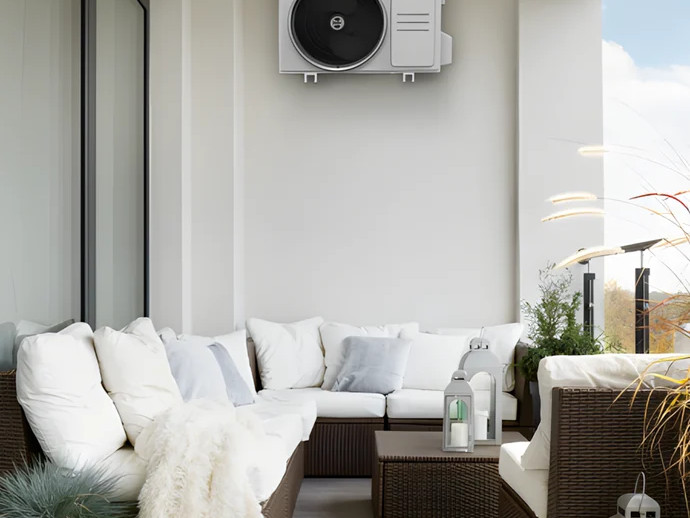
The location must be decided before the equipment, taking into account three constraints: noise, the space around the unit, and local council regulations.
Noise and the neighbourhood
As outlined in our article “Air-to-air heat pumps: how they work, advantages and limitations”, an outdoor unit produces noise levels of between 55 and 65 dB in the immediate vicinity. What matters to neighbours is the noise level at the boundary of the plot: in Flanders, this is 45 dB(A) during the day and 40 dB(A) at night, as we explain in detail in our guide “Heat Pumps and Older Homes”. The VivAIR Multi, for example, has a sound power level of 65 dB. Best practice: position the fan towards a solid wall rather than a window, use anti-vibration mounts, and activate night mode.
The indoor units, on the other hand, are discreet: the Bulex VivAIR SDH20-025NWI has a noise level of 24 dB(A), which is suitable for a bedroom.
Facade, flat roof or garden: practical considerations
Allow for approximately 1 m² of clear space, with 40 to 50 cm between the unit and the wall to allow air to circulate. Shield it from prevailing winds and ensure that condensate can drain away in winter. A flat roof or a garden is often more suitable than a street-facing façade.
Planning: check with your local council
There is no single rule in Belgium: a unit that is visible from the street or close to the boundary of the property may be subject to certain conditions, depending on the local authority. Check with the town planning department before placing an order and, in the case of a block of flats, consult the general meeting.
What budget should you set aside, and what financial support is available in Belgium?
The cost depends on the number of rooms, the capacity and the installation. Our “air-conditioning guide” gives a rough estimate of between €3,000 and €10,000 excluding VAT, including installation, for a multi-split system covering 2 to 5 rooms.
Price guides on facq.be
For the equipment alone, the prices shown on facq.be serve as a guide: approximately €1,500 (including VAT) for the VivAIR Multi outdoor unit and approximately €550 (including VAT) for a VivAIR SDH20 indoor unit, excluding installation. Installation and commissioning are charged separately: these costs are determined solely by the installer’s quote.
6 per cent VAT and regional grants
From 1 January 2026 and for a period of five years, the supply and installation of heat pumps in residential properties will be subject to a 6 per cent VAT rate, as announced by the federal government. A reversible multi-split system is an air-to-air heat pump: your installer will confirm the applicable rate.
As regards grants, the rules vary by region. In Flanders, the Mijn VerbouwPremie supports air-to-air heat pumps, but as of 1 March 2026, it no longer covers units intended primarily for air conditioning. In Wallonia and Brussels, heating subsidies are mainly aimed at other systems: check the conditions on the official websites before signing.
For a comprehensive overview, see our article “Heat pump grants in Belgium 2026: what has changed”.
| Facq Advice |
| If you’re torn between a multi-split system and an air-to-water heat pump, start by considering your main requirement. For cooling a few rooms and heating during the mid-season, a multi-split system is simple and effective. To replace a boiler and provide hot water, you should look into an air-to-water system instead, with units such as the Vaillant AroVAIR floor-standing unit, a water-based fan coil unit that both heats and cools. |
Your multi-split system: from choosing the right one to having it fitted correctly
A successful multi-split system depends on three decisions, taken in the right order: which rooms to cool, the capacity required for each, and then the location of the outdoor unit. If your project also involves heating the whole house, our comparison guide “air-to-air or air-to-water heat pumps” will help you make up your mind.
At our EXPOcentres, our advisers will show you the different types of indoor units and help you plan your project room by room. Book an appointment to discuss your requirements. For installation and commissioning, which require a certified refrigerant technician, the Install+ service will put you in touch with an installer near you.
Frequently asked questions
It depends on the outdoor unit: most domestic models can accommodate between 2 and 5. The Bulex VivAIR Multi, for example, can accommodate two.
A multi-split system reduces the number of units on the façade and makes maintenance easier. Several single-split units remain independent: a fault affects only one room, and each unit can heat or cool independently of the others.
It can heat the rooms fitted with the system, even in cold weather: the VivAIR Multi heats when the outside temperature is as low as -15 °C. However, it does not produce domestic hot water: an air-to-water heat pump is more suitable for replacing a boiler.
Not with most domestic multi-split systems: all indoor units operate in the same mode.
There is no single rule in Belgium. Depending on your local authority, a unit that is visible from the street or close to the boundary of your property may be subject to certain conditions. Please check with the town planning department.
It is subject to the 6 per cent VAT rate applicable to heat pumps from 2026. As for grants, it all depends on the region: in Flanders, a unit intended primarily for air conditioning will no longer be eligible for the Mijn VerbouwPremie from March 2026. In Wallonia and Brussels, please check the current conditions on the official websites.