How do you choose a large bathroom cabinet?

Set the width according to the space actually available
Before being tempted by a model that looks particularly wide in a photograph, the first step is to measure the available space in the room accurately, taking into account anything that might reduce that apparent width.
Don’t rely solely on the width of the wall
The width of the available wall space alone is not sufficient to determine the size of the unit. You must also take into account the location of water supply and drainage points, the possible presence of an electrical socket, a radiator or skirting boards that might hinder installation, and, above all, the space required for movement, which must remain clear in front of the unit. A clearance of at least 70 centimetres in front of the unit is recommended so that you can stand there comfortably, without having to contort yourself to open a drawer or reach the washbasin.
Why can a piece of furniture that’s too big detract from a room?
A large bathroom cabinet is only an asset if it is in proportion to the size of the room it is in. Placed in a space that is too small, it creates a feeling of confinement rather than spaciousness, restricting movement and visually overwhelming the rest of the décor. The simplest rule is to leave a comfortable gap between the edges of the unit and the other fixtures in the room – such as the shower, bath or toilet – rather than trying to make use of every available centimetre on the wall.
Choosing between wall-mounted and floor-standing units
For a large piece of furniture, this choice is particularly important, as it directly affects the stability of the installation – a more critical consideration than with a more compact and lighter model.
The benefits of wide wall-mounted units
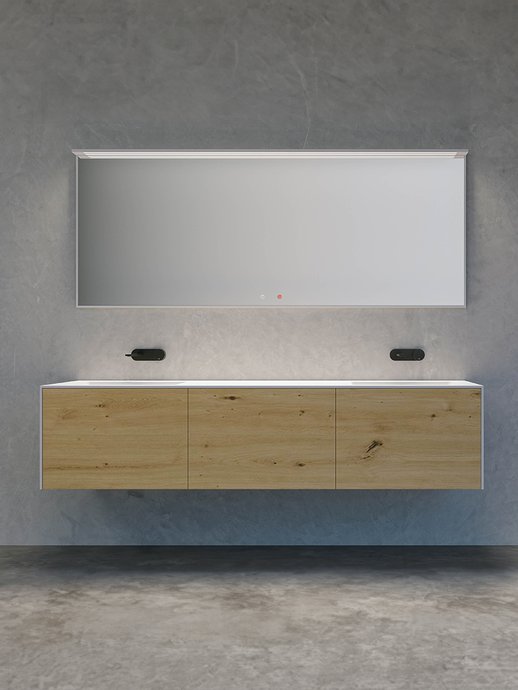
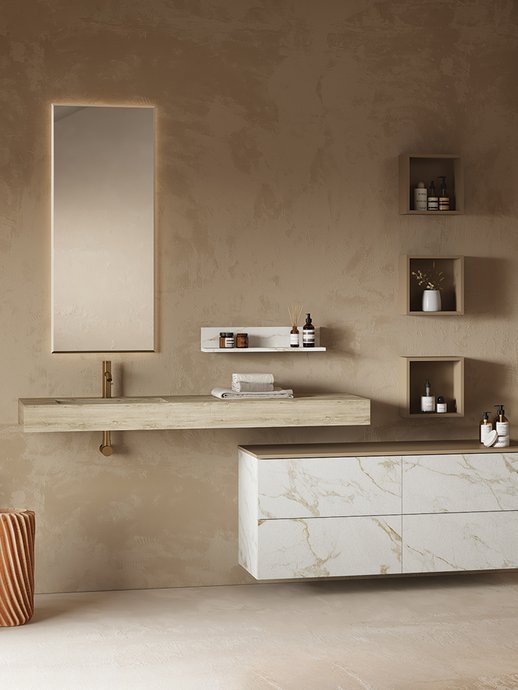
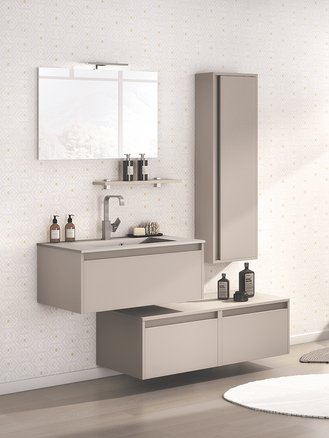
In a bathroom, a wall-mounted unit leaves the floor clear, making cleaning easier and giving the room a sense of lightness – an effect that is all the more noticeable as the unit is wide and might appear imposing if it were placed directly on the floor. This option is well suited to bathrooms where an airy look is desired, despite the generous storage space offered by the unit.
Why does the wall need to be checked before choosing a wall-mounted model?
The wider a unit is, the more likely it is to accommodate a wide washbasin or a double washbasin, and therefore to support a significant weight once filled with everyday products and accessories. For a wall-hung model, this load rests entirely on the wall fixings, which requires a sufficiently sturdy wall – either brickwork or plasterboard reinforced with suitable fixings – to ensure long-term stability without any risk of tipping. On a lightweight, unreinforced partition wall, a large floor-standing unit is often the safest option, particularly if there are young children in the home who might lean against the unit.
A floor-standing unit, which is more reassuring for wider units
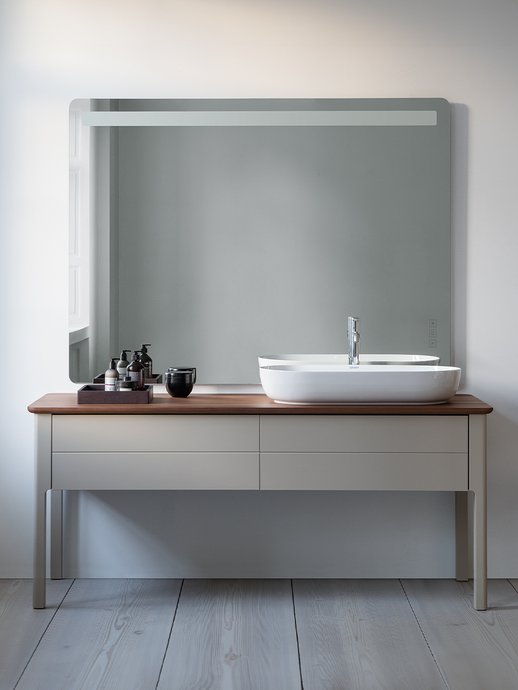
A piece of furniture that stands on the floor, with or without legs, generally offers greater stability across a wide area, as the weight is distributed directly onto the floor rather than via wall fixings. This solution is also recommended for renovation projects, where the strength of the existing wall is uncertain or difficult to assess without carrying out preliminary work.
A single wide washbasin or a double washbasin: a choice that depends on the width of the unit
With a large vanity unit, the choice of washbasin is approached differently than with a more compact model, as the available width makes it possible to seriously consider a double washbasin without the compromises that would be necessary with a narrower unit.
How wide does a double washbasin need to be to be comfortable?
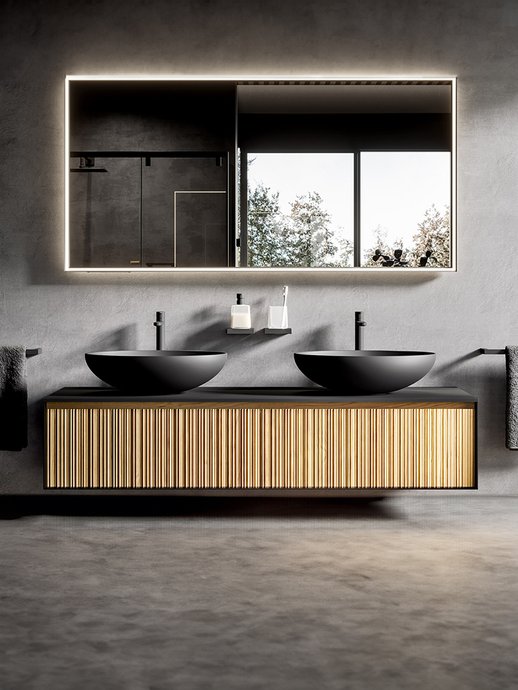
A truly comfortable double washbasin, with generous basins and sufficient space between the two taps, generally requires a width ofat least 120 centimetres, or even more for optimum comfort. Below this width, the two basins become narrower and closer together, which reduces the comfort of simultaneous use that a double washbasin is supposed to provide.
The single, wide washbasin – an option not to be overlooked, even on a large vanity unit
Even in a spacious bathroom, a single, wide washbasin remains a sensible option, particularly for a single person or a couple who do not get ready at the same time. This choice allows you to make the most of a very generous countertop area on either side of the washbasin for everyday accessories, rather than dividing this space between two taps that will not always be used at the same time.
Storage – a feature that really comes into its own on a large piece of furniture
The size of a large bathroom cabinet offers plenty of scope for storage, provided you give careful thought to how you organise it rather than simply settling for the first layout suggested in the shop.
Drawers, doors or compartments: which storage solution should you choose?
Drawers generally offer a better view of their contents and more direct access than traditional doors, making it easier to organise toiletries on a daily basis. In a large unit intended for several users, providing separate compartments – either by drawer or by half of the unit – allows everyone to keep their own belongings without them getting mixed up with those of other members of the household.
Don’t sacrifice storage space for the sake of the layout alone
With a large unit, it can be tempting to opt for a spacious, open display area rather than closed storage, to create a more airy feel. However, everyday items quickly pile up in a family bathroom, and a unit that doesn’t offer enough closed storage often ends up with its worktop cluttered with objects, which negates the effect originally intended. It’s better to anticipate this need when choosing the unit rather than discovering it after a few months’ use.
The material: a key factor when it comes to the humidity in the room
Regardless of the size of the unit, the bathroom remains a demanding environment for materials, due to the ambient humidity and direct splashes of water near the washbasin. On a large unit, this challenge affects a larger surface area, which is why it warrants special attention.
Solid wood, composite panels or lacquer: how do they react to water?
Solid wood, particularly exotic species such as teak or eucalyptus, is naturally resistant to damp, but requires regular maintenance to preserve this resistance over time. MDF or melamine-faced panels, which are more economical, remain more susceptible to moisture if the surface finish is not completely waterproof, particularly along the edges and cut-outs. Lacquered, matt or satin finishes offer good water resistance whilst providing a wide range of colours to match the rest of the décor.
Why does the location of the furniture also influence the choice of material?
A large unit placed right next to the shower or bath is exposed to more splashes than one situated further away. In this situation, it is best to opt for a material and finish that are particularly resistant to moisture, rather than untreated solid wood, which is likely to deteriorate more quickly in this specific location.
A decision that is made on a criterion-by-criterion basis
Choosing a large bathroom unit is about more than just comparing widths in centimetres. It is the combination of the space actually available, the strength of the wall, the type of washbasin suited to the household’s needs, the storage required for everyday use and the choice of material that can withstand damp that guarantees a satisfactory result in the long term, rather than simply an aesthetic preference at the time of purchase.
To check these various criteria against the exact layout of your bathroom, and to see which combinations of materials and basins suit your project, the Facq teams are on hand at the EXPOcenter to help you make your choice.
Frequently asked questions
Q1. At what width is a piece of furniture considered to be large?
There is no official threshold, but 120 centimetres generally marks the transition to large-format units, with models ranging up to 160 centimetres or more for the most spacious bathrooms. Below this width, the term ‘standard units’ is used, typically measuring around 80 to 100 centimetres.Q2. Can a large wall-mounted unit always be fitted to any wall?
No, the strength of the wall directly determines whether this is possible. A solid brick or block wall can generally support a large wall-mounted unit with suitable fixings, whilst a lightweight partition wall without specific reinforcement requires extra precautions, or even the installation of a floor-standing model for safety’s sake.Q3. Should you always opt for a double washbasin on a large vanity unit?
No, it’s not a requirement based on width. A single, wide washbasin is still perfectly suitable for a large vanity unit, particularly if it’s rarely used by two people at the same time. The choice depends first and foremost on the actual layout of the home, rather than the available width.Q4. How can you prevent a large piece of furniture from looking too imposing in a room?
Opting for a wall-mounted model rather than a floor-standing one makes the whole piece look lighter, as does a light colour that reflects more light. Keeping a generous amount of space for movement all around the unit, rather than placing it right up against the other furniture in the room, also helps to maintain a sense of space despite its size.Q5. How much storage space should a family with several children allow for?
For a large family, opting for a large piece of furniture with several drawers or separate compartments allows everyone to have their own space, which helps prevent items from getting mixed up and makes day-to-day organisation easier. Supplementing this piece of furniture with a storage unit nearby is also a good option if the room is spacious enough.