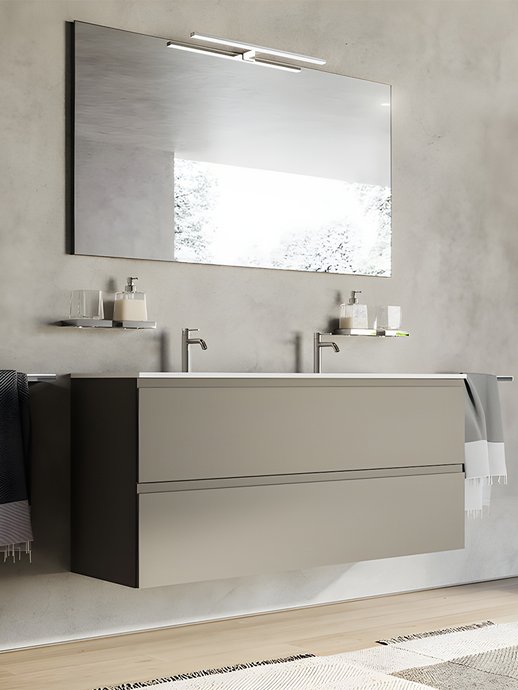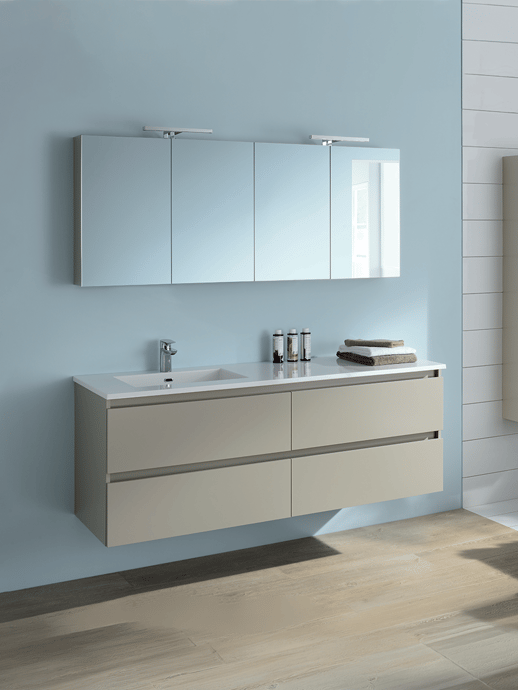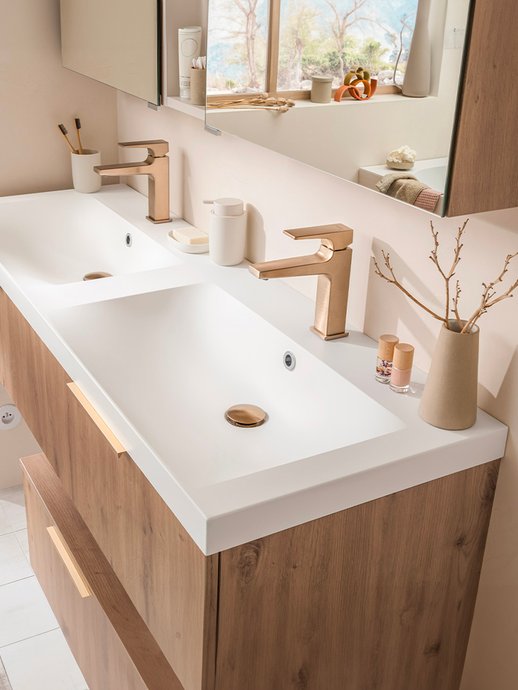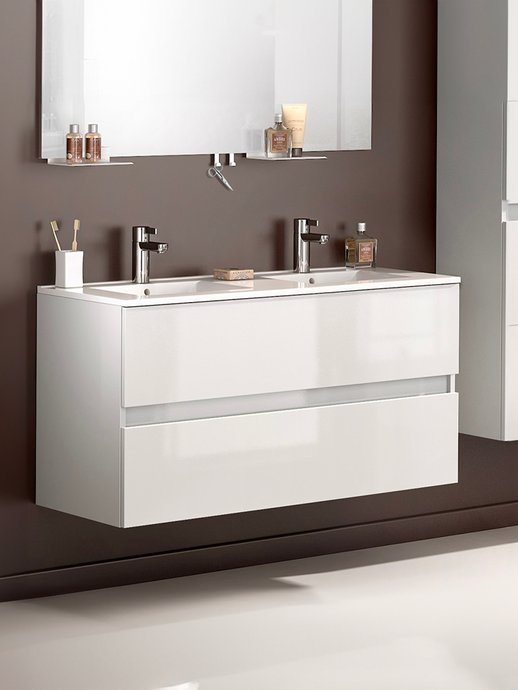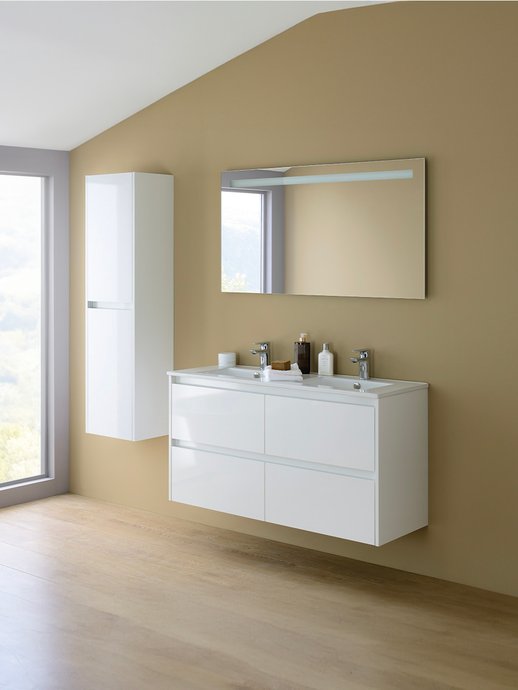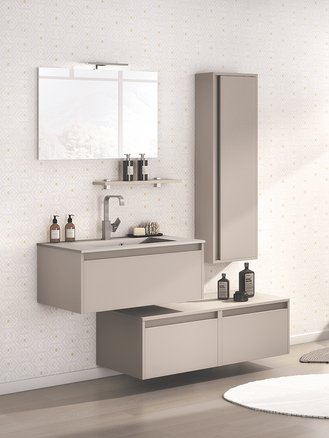
Double basin: what dimensions should you plan for to avoid the morning rush?

Standard dimensions: key references for smooth everyday use
Minimum width and ideal dimension
Your unit requires a minimum width of 120 cm to accommodate two separate basins. This dimension is the standard reference used by most manufacturers and ensures sufficient space between the two water points. The standard lateral dimension generally varies between 120 and 160 cm, offering you an optimal balance between functionality and space usage. Premium models reach 180 cm or even 200 cm for large bathrooms. The decision depends directly on your available space and the number of people using it simultaneously.
Depth adapted to your configuration
The depth of your unit varies depending on the installation you choose. For a recessed basin, allow between 40 and 50 cm in depth. This compact format adapts perfectly to smaller spaces while maintaining smooth circulation.
Counter-top basins require more space, with a depth of between 50 and 60 cm. This additional dimension compensates for the height of the basin that protrudes above the worktop. For particularly narrow washstands, reduced models offer 40 cm or even 35 cm in depth. Standard depths of 46 cm or 55 cm represent a sensible compromise between space saving and practicality.
Recommended height for ergonomic use
European standards set the standard height of a basin unit at between 82 and 87 cm from the floor to the upper rim. This measurement ensures ergonomic use, suited to the majority of adults of average height. The average installation height is 83 cm according to these standards.
For a unit with an integrated or recessed basin, aim for a position of 85 to 87 cm. If you choose a counter-top basin, position the under-basin unit lower, between 75 and 82 cm, to compensate for the height of the basin itself (generally 10 to 15 cm). Taller individuals can adjust it up to a maximum of 90–92 cm without compromising ease of use.
Choosing the right width for your bathroom
120 cm: the essential minimum
A 120 cm unit is the starting point for a successful double basin installation. This width represents the most common standard on the market, with models available between 120 and 135 cm. Your bathroom must be at least 5 m² to comfortably accommodate this configuration.
The spacing between the centres of the two basins reaches 60 to 90 cm, allowing two people to get ready simultaneously without getting in each other's way. This dimension provides the essentials for everyday family use, even if the worktop space remains limited.
140 cm: the balanced choice
A width of 140 cm provides you with a noticeably superior level of comfort. You have more surface area for your everyday toiletries. The gap between the basins increases naturally, improving your morning comfort when using them simultaneously.
This size is perfectly suited to families looking for a balance between functionality and reasonable footprint. Even in a medium-sized bathroom, this configuration remains accessible without compromising circulation.
160 cm and above: generous space
From 160 cm onwards, you enter the category of large installations. These generous dimensions allow for an optimal zone between the basins. Some models even reach 180 cm or 200 cm for high-end projects.
With this width, you have a choice: two well-separated basins or a single basin with double taps. The second option offers you maximum worktop surface while retaining the practicality of a double station.
Measure before you buy
Take the exact measurements of your available wall space and circulation area. Allow a minimum of 70 cm in front of the unit to open drawers and move around freely. In more restricted areas, you can reduce this to 50 cm, but also allow 20 cm on either side of the basin.
Mark out the dimensions on the floor using adhesive tape. This simple technique immediately reveals whether it will integrate harmoniously into your configuration. Check that shower doors do not interfere with the installation.
The circulation space required for optimal everyday use
Why is clearance space essential?
The space in front of your double basin unit determines your daily comfort of use. A clearance of 70 cm is the recommended standard for moving freely and accessing drawers. This distance allows you to open your drawers fully without hitting the walls or other equipment in the room.
Some configurations accept 60 cm in front of the unit, but this measurement limits drawer opening and complicates circulation when two people are using it simultaneously. The main passageway in a bathroom is ideally between 70 and 90 cm, ensuring optimal comfort for all users.
Solutions for small spaces
Is your bathroom compact? Compromises exist. The passageway can be reduced to a minimum of 50 cm, although this dimension represents the absolute threshold for maintaining acceptable circulation. To compensate for this constraint, prioritise shallow models, between 35 and 40 cm, rather than the standard front dimensions of 45 to 50 cm.
These shallower units free up an additional 10 to 15 cm in front of the washbasin, significantly improving circulation comfort. The worktop surface is admittedly reduced, but wall-mounted models accentuate the feeling of floor space and visually lighten the room.
Test before installing
Simulate the footprint of your future unit using adhesive tape or cardboard. This simple technique immediately reveals whether your dimensions suit your configuration. Trace the exact outline, then add the 70 cm clearance in front of it.
Check that the bathroom, shower or cupboard doors do not conflict with each other. Simulate the opening of the drawers using cardboard to test their maximum travel. This concrete visualisation avoids unpleasant surprises during installation and guarantees a functional layout in the long term.
Centre-to-centre spacing between basins: the key to harmonious use
Ideal distance between two water points
The distance between the centres of your basins directly determines morning comfort of use. We recommend a centre-to-centre spacing of between 60 and 90 cm. This measurement allows people to get ready simultaneously without getting in each other's way during their daily routines.
Below 50 cm, the space quickly becomes a source of morning friction. You will soon find it difficult to brush your teeth or shave without bumping into the other user.
Adapt the spacing to the width of your unit
A 120 cm unit offers a minimum centre-to-centre spacing of 60 cm, sufficient for occasional use. With 140 cm, you gain in ease thanks to a spacing of 70 to 80 cm. Models of 160 cm and above allow for the optimal spacing of 90 cm, ideal for large families.
Working with your existing water supply
Your existing pipework sometimes conditions the positioning of the basins. Multi-spacing adapters allow you to connect wall-mounted taps even if the spacing does not match the standard. This solution avoids costly plumbing work while preserving your comfort.
Avoid these layout mistakes
Installing basins on a 100 cm surface makes simultaneous use uncomfortable. Prioritising aesthetics at the expense of spacing is another common mistake. Practicality must take precedence over visual effect to guarantee lasting family harmony.
Create your ideal morning space
A well-dimensioned double basin unit transforms your mornings into calmer moments. Follow the key measurements: a minimum width of 120 cm, 60 to 90 cm between taps and 70 cm of clearance in front of the unit.
Put it to the test: mark out the dimensions on the floor using adhesive tape before making your purchase. This simple check avoids unpleasant surprises and guarantees a functional layout. Your bathroom thus becomes a space where everyone finds their place, even during the busiest morning hours.
Discover in our EXPOcenters the solutions that perfectly match your configuration and daily habits.
Frequently asked questions
Q1. What is the minimum width required to install a double basin unit?
120 cm is sufficient to comfortably accommodate two separate basins. This dimension allows two people to get ready simultaneously without getting in each other's way. For optimal comfort, opt for a width of 140 to 160 cm, which offers more space between the basins and on the worktop.Q2. How much space should be left in front of a double basin unit?
A clearance of 70 cm in front of the unit is the recommended standard for moving freely and opening drawers without difficulty. In smaller bathrooms, this passageway can be reduced to a minimum of 50 cm, although this dimension represents the absolute threshold for maintaining acceptable ease of use.Q3. What distance should separate the two basins to avoid bumping into each other?
The ideal centre-to-centre spacing between the two basins is between 60 and 90 cm. This distance allows two users to get ready at the same time without getting in each other's way. Below 50 cm, the space becomes restrictive and limits simultaneous use of the unit.Q4. What depth should I choose for a double basin unit?
For a recessed basin, allow a depth of 40 to 50 cm. If you opt for counter-top basins, allow between 50 and 60 cm to compensate for the height of the basin protruding above the worktop. In restricted spaces, models of 35 to 40 cm allow you to save space.Q5. Is a double basin unit suitable for a small bathroom?
A bathroom of at least 5 m² is required to install a 120 cm unit comfortably. In a smaller space, opt for a single basin unit that will offer more worktop surface and facilitate circulation, while still providing good storage space.