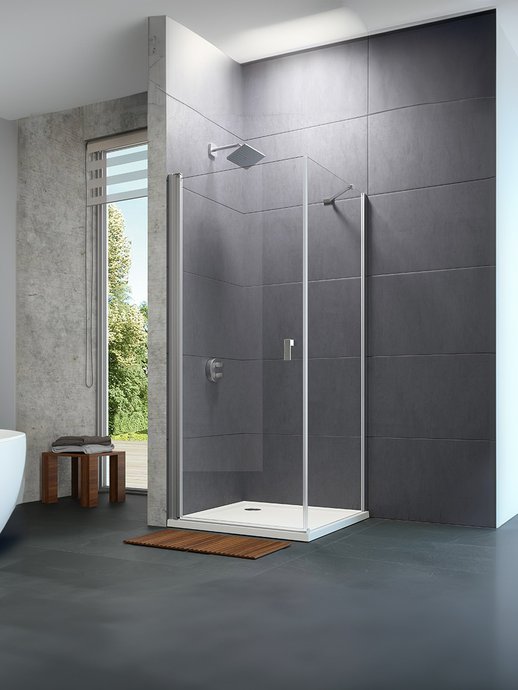
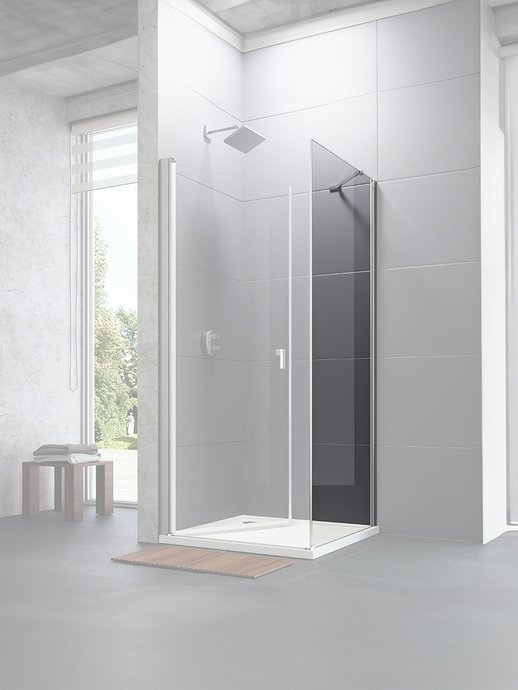
Glass shower doors: why choose this material?

Toughened glass, PVC, fabric screens, acrylic: each option has a different purchase price, lifespan and level of safety. Glass dominates the Belgian shower market by a wide margin, and this is no mere passing fad. Here’s what really sets it apart from other materials, along with the standards in force in Belgium and price guides from Facq.
Glass, PVC, curtains, acrylic: what really sets these materials apart
On paper, there are four options for enclosing a shower area. In practice, the choice narrows quickly once you consider the actual lifespan.
A fabric or PVC shower curtain remains the cheapest option to buy. It goes mouldy within a few months if the ventilation in the bathroom is not ideal, so it needs replacing regularly, and looks unsightly after six months of daily use. Acrylic (sometimes sold as Plexiglas) mimics the appearance of glass at a lower price and is lighter, making it easier to install. However, it scratches quite easily with an abrasive sponge or a ring, and yellows under the combined effect of hot water, light and cleaning products. Its useful life is around five to eight years with daily domestic use.
Toughened glass, on the other hand, does not scratch under normal use, does not yellow and retains its original appearance for decades. This explains why it is used in almost all the doors and partitions sold in Belgium today, at Facq as elsewhere.
Material | Durability in everyday use | Sensitivity to limescale | Estimated service life | Indicative budget |
| Curtain (fabric/PVC) | Weak, tears easily and goes mouldy | High; visible traces appear quickly | 1 to 2 years | €15 to €50 |
| Acrylic | Average, scratches easily | Average | 5 to 8 years old | €100 to €300 |
| Toughened glass | Very high, virtually scratch-proof | Low with appropriate treatment | Aged 20 and over | €320 to €1,700 (including VAT) |
There remains one question, separate from that of the material: the opening mechanism. Once you have chosen the glass, you still need to decide between a pivot, sliding or folding door, depending on the space available in front of the shower – a topic we cover in detail in our guide pivot, sliding and folding shower doors.
Toughened glass: the safety standard applicable in Belgium
The term ‘toughened glass’ refers to glass heated to approximately 620 °C and then rapidly cooled using compressed air. This tempering process creates internal stresses that make it four to five times stronger than ordinary glass of the same thickness. In the event of a violent impact, it does not shatter into sharp shards like conventional glass: it breaks into small, blunt pieces.
This property is not left to the manufacturer’s discretion. The European standard EN 12150 sets out the requirements for thermally toughened safety glass, and its Belgian equivalent, NBN EN 12150-2, is listed by Buildwise, the leading body for construction standards in Belgium. For shower screens specifically, the EN 14448 standard imposes a precise fragmentation criterion: a 50 x 50 mm sample must produce at least 40 fragments if broken, and no fragment may exceed 100 mm in length. Compliant toughened glass also bears an engraved mark in one corner, featuring the manufacturer’s logo and a reference to the standard: this is a legal requirement in Belgium, as it is throughout the rest of the European Union, and not merely a marketing ploy.
This regulatory framework explains why glass remains the required material in domestic settings, where there are children or elderly people: the risk of serious cuts should the glass shatter against a wall is objectively lower than with non-tempered glass.
What thickness of glass should be used for a shower screen or door?
The thickness of the glass depends on two factors: the type of installation (sliding door or fixed panel) and the height of the panel.
For hinged, sliding or pivot doors, 6 mm remains the standard thickness in Belgium: it provides the necessary strength without adding unnecessary weight to the hinges or tracks. This is, for example, the thickness used for Huppe’s Design Pure hinged door, made from transparent safety glass, with a height of 200 cm.
For a fixed, frameless shower screen, the principle is different: without a upright to support it, the panel must be thicker to remain rigid. Up to a height of 2 metres, 8 mm is the standard. Above that, 10 to 12 mm is required to prevent any flexing. The Viva shower enclosure from Duscholux, for example, uses 8 mm glass and is available in heights of up to 2,500 mm.
Configuration | Recommended thickness | Why |
| Hinged or pivoting door | 6 mm | Sufficient; reduces the strain on the hinges |
| Sliding door | 6 to 8 mm | The rail bears the weight; rigidity is less of a priority |
| Fixed, frameless panel, up to 2 m | 8 mm | Stiffness without a support strut |
| Fixed, frameless panel, over 2 m | 10 to 12 mm | Avoid bending at great heights |
For a walk-in shower with a large fixed panel, this choice of thickness should, in fact, be decided at the same time as the choice of access mechanism: we discuss this in our guide to the pivot door for walk-in showers.
Hygiene and maintenance: the real test is Belgian water
No material is immune to limescale. The question is which one copes best, and Belgian water is no pushover: hardness exceeds 20 °fH in most provinces, with peaks of 25–35 °fH depending on the region. On a curtain, this limescale becomes embedded in the fibres and causes irreversible damage within a few weeks. On acrylic, it settles into the micro-scratches that the material accumulates over time, making cleaning increasingly difficult year after year.
Glass is also a non-porous material that does not harbour bacteria, which is a significant consideration in a damp room where air circulation is poor for much of the year in Belgium. Another useful, yet often overlooked, tip is to air the bathroom after every shower, which helps to prevent mould from growing on the grouting, regardless of the material used for the walls.
In small spaces, where sliding doors are often chosen to avoid taking up space when opened, particular attention should be paid to the maintenance of the track: we cover this in detail in our guide to sliding doors for small spaces.
Toughened glass, laminated glass, safety glass: are they the same thing?
The terminology can be confusing. ‘Securit’ was originally a registered trademark but has, through common usage, become a common synonym for toughened glass: in a bathroom, the two terms refer to the same thing.
Laminated glass, on the other hand, is a different material. It consists of two layers of glass bonded together with a PVB (polyvinyl butyral) interlayer. If it breaks, it does not shatter: the fragments remain stuck to the film, and the pane retains its shape. This property makes it suitable for very large fixed panels, where it is preferable to avoid an entire pane of glass collapsing all at once; however, its higher cost and greater weight make it a niche option for shower enclosures, reserved for bespoke projects involving large dimensions. For the majority of doors and panels sold in Belgium, standard toughened glass remains the best choice.
This technical distinction is particularly relevant for large spaces or unusual layouts. For a small bathroom, where the dimensions are relatively compact, our comprehensive guide to shower doors for small spaces covers the most common sizing issues.
An investment that pays off in the long run
At Facq, the price of a glass shower door depends mainly on the design, the frame and the finishing options, rather than on the thickness itself.
Model | Brand | Guide price (including VAT) |
| Rapid | Inda | From €321.21 |
| A 16 2.0 | Inda | From €462.04 |
| Claire Design | Inda | From €592.90 |
| Design Pure side panel | Huppe | From €746.57 |
| Individual 2.0 | Vigour | From €990.60 |
| Klar | Inda | From €1,051.49 |
| Trendy Design | Inda | From €1,556.06 |
| H Art | Novellini | From €1,691.46 |
One final point to bear in mind when selling a property: a well-maintained tempered glass screen, still clean and scratch-free after fifteen years, reassures a potential buyer far more than a yellowed acrylic screen or a sagging shower curtain. It’s a detail that doesn’t appear on any technical specifications, but which makes a difference during a viewing.
Frequently asked questions
Q1. Can a tempered glass shower door shatter on its own?
It is rare, but possible: this is known as spontaneous breakage, usually caused by the presence of nickel sulphide inclusions in the glass during manufacture. The risk remains very low for products from recognised brands that comply with the EN 12150 standard, which imposes strict manufacturing controls. In the event of breakage, whatever the cause, the glass shatters into small, non-sharp pieces.Q2. What thickness should I choose for my shower door?
6 mm is sufficient for a hinged, pivot or sliding door. For a frameless fixed panel, allow 8 mm for heights up to 2 metres, and 10 to 12 mm for heights above that, to ensure the panel remains rigid without a supporting mullion.Q3. How can you tell if a glass complies with Belgian standards?
A compliant toughened glass pane bears an engraved mark in one corner of the pane, featuring the manufacturer’s logo and a reference to standard EN 12150. This engraving is a legal requirement, not an option: its absence should raise concerns about the product’s compliance.Q4. Does glass require more maintenance than acrylic when it comes to Belgian limescale?
No, in fact the opposite is true in the medium term. Limescale builds up on both materials, but it comes off in one go with a squeegee on smooth glass, especially with a water-repellent treatment such as Duscholux’s CareTec® Pro. On acrylic that has been scratched by years of use, limescale lodges in the micro-scratches and becomes increasingly difficult to remove.Q5. Is glass really an environmentally friendly choice for a shower?
In theory, it can be recycled indefinitely, but flat glass (windows, mirrors, shower screens) cannot be recycled in the glass recycling bins in Belgium: it must be taken to a recycling centre, where it is sorted separately from packaging glass. Its main environmental benefit remains its longevity, which is far greater than that of acrylic or shower curtains, thereby limiting the need to replace the product over the lifetime of a bathroom.