Pivot door: is it a suitable solution for a walk-in shower?

What sets a walk-in shower apart from the rest
An open-space philosophy
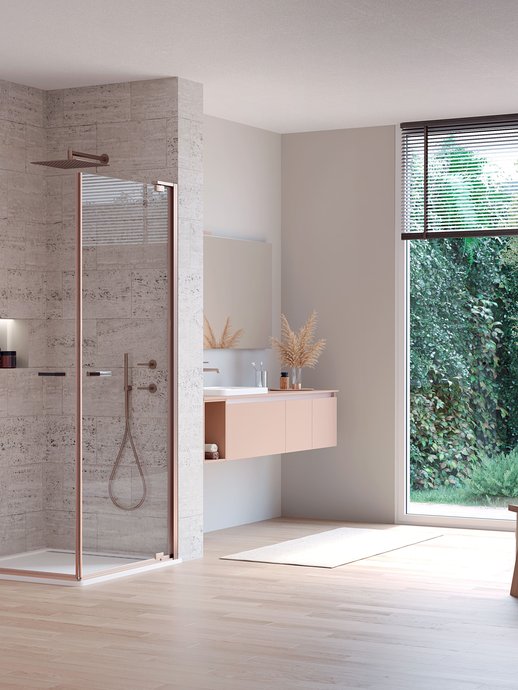
The walk-in shower is characterised first and foremost by the absence of any visual break with the rest of the bathroom: a flush-to-floor shower tray, a continuous floor, and often a single glass panel rather than a closed cubicle on several sides. This approach naturally leads to minimalist solutions, such as a fixed panel on its own, which leaves the space completely open without any doors to open and close.
This desire for an open feel explains why so many walk-in shower designs initially opt for a single fixed panel, sometimes even without any enclosure at all for large-format showers. The idea remains to maintain visual continuity between the shower and the rest of the room, a principle which, at first glance, seems to run counter to the addition of a door, however discreet it may be.
Mais pas toujours sans besoin de fermeture
This fully open design is ideal for a large, spacious shower, where water splashes are naturally contained by the size of the space. In a more modest layout, or when the walk-in shower is situated in the immediate vicinity of other fixtures, a partial or complete enclosure becomes necessary again to prevent water from spreading across the rest of the floor.
Why might a pivot door be a suitable option after all?
Effective protection against splashes and heat loss
Unlike a fixed screen on its own, a pivot door completely encloses the shower area once in use. It retains heat and steam inside more effectively, an advantage that is particularly significant in a large walk-in shower where the opening remains wide. This is a point that is sometimes overlooked in purely aesthetic considerations regarding walk-in showers, even though it has a direct impact on the level of comfort experienced on a daily basis, especially during the coldest months of the year.
This heat retention is particularly noticeable in large bathrooms where the walk-in shower takes up a significant portion of the room. Without a door, the steam quickly disperses throughout the space, which increases the time required for the shower itself to heat up. A door – even a hinged one, which is not completely airtight – already significantly reduces this heat loss compared with a completely open layout.
A wide opening that captures the Italian spirit
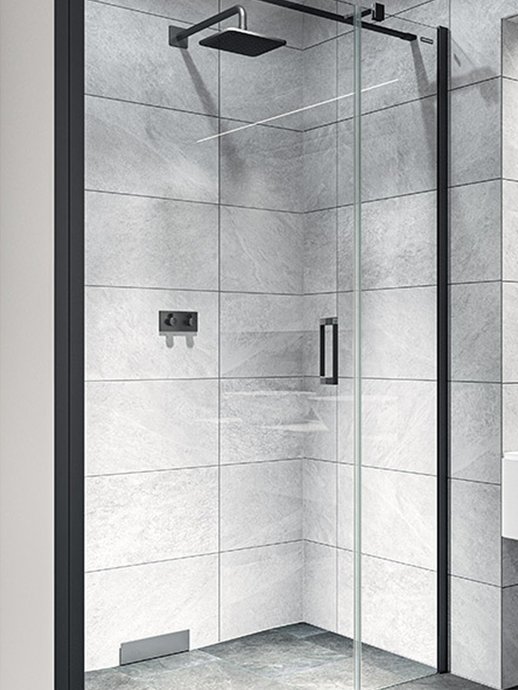
Today’s pivot doors, such as the Rapid or D-motion models, can be fitted in a recess or corner, with widths that more than cover the dimensions of a spacious walk-in shower. Their transparent safety glass, without any bulky frames, visually extends the open space sought after in this type of shower, without giving the impression of a traditional enclosed cubicle.
Things to bear in mind before fitting a pivot door to a walk-in shower
Travel: the key issue
A pivot door opens inwards or outwards from the shower, which means you need to allow for a clearance equal to its width. In a large walk-in shower, this space is usually available without any problems. In a more compact bathroom, the issue arises differently and warrants separate consideration depending on the specific constraints of each small space.
Compatibility with an extra-shallow shower tray or a walk-in shower
The pivot door can be installed without any particular difficulty on an ultra-low-profile shower tray or a fully level-access shower, provided that the fixing rail at the bottom, where present, remains compatible with the absence of a threshold. Some models, such as the Rapid ranges, offer adjustments of a few centimetres on either side, which make it easier to adapt to a threshold-free configuration.
The models best suited to an Italian layout
Reversible door; suitable for recessed or corner installation
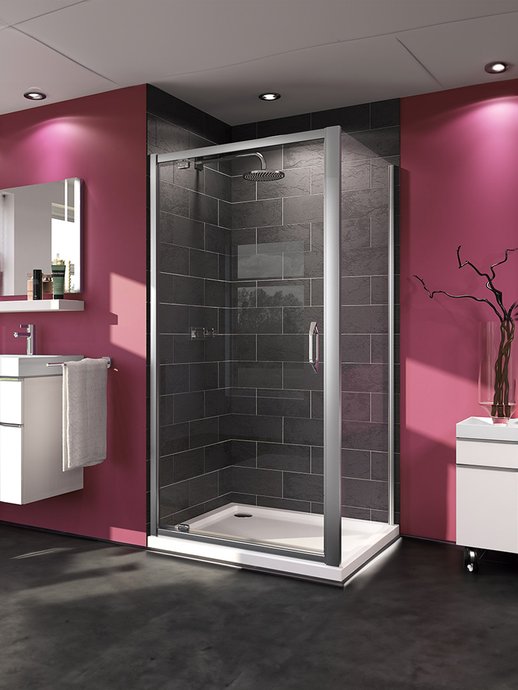
The D-motion and Mars models, available in a pivoting version for installation in a recess or corner, offer good flexibility to suit a walk-in shower, whether it is positioned against a single wall or in a corner of the room. Their reversibility allows the opening direction to be reversed depending on the exact layout of the bathroom, a significant advantage when the space around the shower presents particular constraints. For corner installation, these models are combined with a fixed side panel, which provides a complete enclosure whilst still requiring only a single door to be operated for access.
This reversibility is particularly useful in a refurbishment where the position of the shower changes from the previous layout. Rather than having to order a different model depending on the desired opening direction, a single product can be adapted to both configurations, which greatly simplifies the choice at the time of purchase.
Off-centre door for an asymmetrical opening
For less standard layouts, an off-centre door such as the Praia model, with its off-centre hinges, allows for a wider opening on one side than the other. This design is well suited to walk-in showers where there is an obstruction on one side – such as a wall that is too close – whilst still allowing for a comfortable opening to get in and out.
Glass and profiles: choices that matter, even for a walk-in shower
Glass thickness varies depending on the range
Pivoting doors are available in several thicknesses of safety glass, generally between 4 and 6 mm depending on the range. A model such as Rapid features 4 mm glass and a height of 190 cm, whilst more upmarket ranges such as Allegra F go up to 6 mm thick and 210 cm high, with a lift-and-lower mechanism that makes opening and closing easier on a day-to-day basis. In a walk-in shower, where the door is often more visible than elsewhere due to the spacious layout, this glass thickness directly influences the perceived sense of quality.
Discreet profiles to ensure the sense of openness is not compromised
The choice of profiles deserves just as much attention. Finishes such as titanium or matt white, available across several ranges, remain discreet enough not to visually weigh down a shower designed to appear open. Conversely, a profile that is too prominent or a colour that contrasts too sharply can artificially recreate the effect of an enclosed cubicle – precisely what a walk-in shower seeks to avoid.
Maintenance that is similar to that of a conventional cabin
Limescale prevention treatment: a long-term solution
The glass in pivot doors is usually treated with an anti-limescale treatment which reduces the build-up of soap scum and limescale. In a walk-in shower, where the glass surface is often more visible than in a corner-mounted enclosed cubicle, this treatment is doubly important for preserving the transparent effect intended from the outset.
A simple step after every shower
Running a scraper along the glass panel after use, combined with a more thorough weekly clean, is sufficient to maintain the glass’s original appearance for several years. This maintenance routine is identical to that required for a door fitted to a more conventional shower, so it does not present any particular obstacle to choosing a pivot door for this type of installation.
A fixed panel on its own or a pivoting door: how to decide
A question of configuration rather than taste
The choice between a simple fixed panel and a pivot door depends mainly on the actual size of the shower and its proximity to the rest of the fittings. A large walk-in shower, situated in a corner of the room, works perfectly well with a fixed panel alone. A shower situated closer to the washbasin or the toilet, on the other hand, benefits from being completely enclosed, which makes a pivot door a sensible choice even in a walk-in shower design.
A technical detail that should not be overlooked during assembly
Whichever model you choose, fitting a shower door made of safety glass requires a certain degree of care to avoid any risks during installation, in particular by adhering to the fixing points specified by the manufacturer rather than improvising additional drill holes. This is an important point that warrants further consideration before attempting the installation yourself.
A pivot door is therefore well suited to a walk-in shower, but not in every configuration. In a large open space, a fixed panel on its own is often sufficient and more in keeping with the spirit of the design. As soon as the shower is situated closer to the rest of the room, or when thermal comfort becomes a priority, the pivot door comes into its own, provided you choose a reversible or off-centre model capable of adapting to the exact layout of the space.
Key points to remember
A pivot door is neither the default solution nor a misfit for a walk-in shower: it is a choice that depends directly on the actual layout of the space. In a large, freestanding shower, a fixed screen often remains the option that best captures the spirit of the design. If the shower is closer to the rest of the room or if you need to retain heat, a pivot door becomes a viable option again, provided you choose a reversible or off-centre model that fits the existing layout precisely.
Frequently asked questions
Does a walk-in shower necessarily need a door?
No, a fixed screen on its own is often sufficient, particularly in a large shower cubicle that is separate from the rest of the room. A door becomes more useful when the shower is situated close to other fixtures or when you want to retain heat more effectively. The choice therefore depends mainly on the layout of the room rather than on a general rule that applies to all projects.Does a pivot door work with an extra-flat shower tray?
Yes, most models are compatible with this type of shower tray, although they may need to be adjusted by a few centimetres to accommodate the lack of a raised edge. However, it is still advisable to check the compatibility of the mounting rail before purchasing to avoid any unpleasant surprises during installation.How much space should be left in front of a pivot door on a walk-in shower?
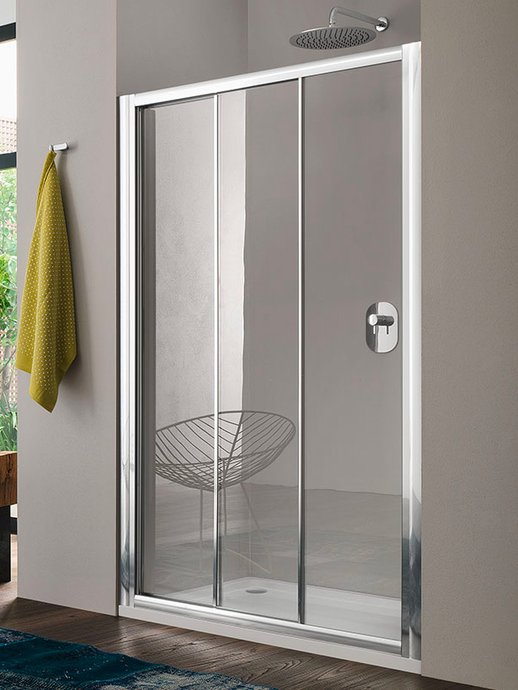
A clearance equal to the width of the door is still required to open it fully; this is something to check before choosing this type of system over a sliding door. In a small bathroom, this clearance may well lead you to opt for a different opening system.Are there any pivot doors suitable for unusual layouts?
Yes, offset models such as the Praia allow for asymmetrical opening, which is useful when a wall or fixture restricts the space on one side of the shower. This solution ensures that ease of access is not compromised, even in the most confined spaces.Can a corner pivot door be fitted to a walk-in shower?
Yes, ranges such as D-motion and Mars can be fitted in either a recess or a corner, provided you combine them with a side panel to enclose the unit. This combination means you only have to open one door, whilst ensuring the space is completely enclosed.