Ceramic or glazed stoneware: why does this material never go out of style?

Ceramic, porcelain, glazed stoneware: what are we talking about?
In a shop or on a product page, several words describe very similar materials. Telling them apart helps you understand why they age so well.
Clay that is shaped, then fired at high temperature
Ceramic refers to a family of materials made from clay and minerals, shaped and then fired in a kiln. Firing turns the paste into a hard, stable body that no longer deforms and is unaffected by the water and heat of the bathroom.
That is why it has been used in wet rooms for generations: a ceramic washbasin or toilet pan keeps its shape for its entire life.
Glaze, the layer that makes all the difference
The surface you touch is not the clay itself. Sanitaryware receives a layer of glaze, a kind of glass that melts during firing and fuses to the body. It forms a smooth, sealed, coloured skin.
This vitrified finish gives ceramic its main strengths: a non-porous surface that absorbs neither water nor stains, and an appearance that does not yellow over the years.
Vitreous china and stoneware: two families, one principle
Everyday language talks about porcelain, earthenware or stoneware. For sanitaryware, you mainly find vitreous china, which is very dense and used for washbasins and WCs, and stoneware, which is thicker and used for certain large pieces.
Glazed stoneware is also very common for tiles, on both floors and walls. Whatever the family, the principle is the same: a fired body protected by a vitrified layer.
Why does ceramic never go out of style?
Bathroom trends change quickly. Ceramic, however, spans the decades without looking dated, for very practical reasons.
A surface that ages well
Our guide to choosing a shower tray in acrylic, ceramic or resin sums it up: ceramic withstands everyday knocks and scratches and keeps its original appearance for decades. Its non-porous surface also resists limescale and stains.
Well-maintained ceramic sanitaryware does not lose its shine. That is a real advantage in a room you rarely renovate.
An asset against hard water
In Belgium, much of the tap water is high in limescale. In Brussels, the water is "moderately hard" to "hard" depending on the municipality, according to Vivaqua (the Brussels water operator). In Wallonia, the SWDE (Walloon water company) classifies water above 30 °f as very hard and points out that very hard water causes scale build-up in installations.
On a smooth, glazed surface, limescale clings less and is easier to remove than on a porous material. To find out more, discover why a water softener is essential for a wellbeing bathroom.
A hygienic surface for a wet room
In a bathroom, humidity and heat encourage deposits and unpleasant odours. A sealed surface such as glaze does not let water seep in: dirt stays on the surface and rinses away.
That is why ceramic remains the reference material for WCs and washbasins, the most heavily used fixtures in the home. It also tolerates everyday cleaning products, as long as you avoid abrasives, and rinses clean easily.
Shapes and colours that follow the trends
Ceramic is no longer synonymous with glossy white. Manufacturers are working on thinner rims, organic shapes and matt colours that meet today's tastes.
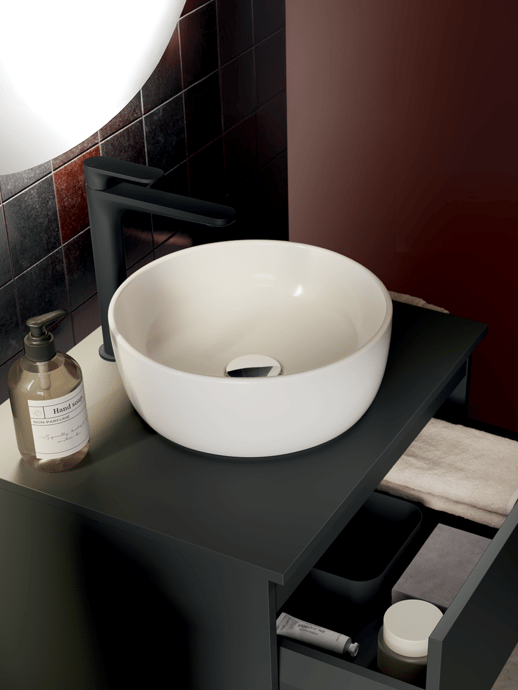
Ideal Standard's Ipalyss round countertop basin is a good example. Its product page describes a fine Diamatec ceramic with rims just 3.8 mm thick, for a diameter of 40 cm. The description specifies that Diamatec washbasins come in ten matt colours; the model shown is in gloss white.
Ceramic for the shower: where to use it around the shower area?
Around the shower, ceramic can play a part at three levels: the shower tray, the wall and floor coverings, and the nearby fixtures. Each has its own rules.
The ceramic shower tray: sturdy, but heavy
The ceramic shower tray has recognised qualities: strength, scratch resistance and easy cleaning. Our materials guide also points out its limits. It weighs between 30 and 50 kg, needs a solid floor, may require reinforcement on an upstairs timber floor, feels cold to the touch and is slippery when wet unless it has an anti-slip treatment.
It is often limited to standard sizes. For large formats or walk-in showers, our shower trays section offers models in acrylic, Quaryl, solid surface, resin or steel.
Glazed stoneware on floors and walls
In a walk-in shower, it is often the tiling that plays the role of ceramic. Glazed stoneware offers the same water resistance and great freedom of formats and colours.
The weak point lies in the grout joints, which are more exposed to dirt and limescale. Our article ultra-flat shower tray or tiled screed compares the two solutions for a walk-in shower.
Washbasins, countertop basins and cloakroom basins: ceramic throughout the room
Away from the shower, ceramic dominates the water points. Our washbasins section offers them in every shape: wall-hung, countertop or built-in.
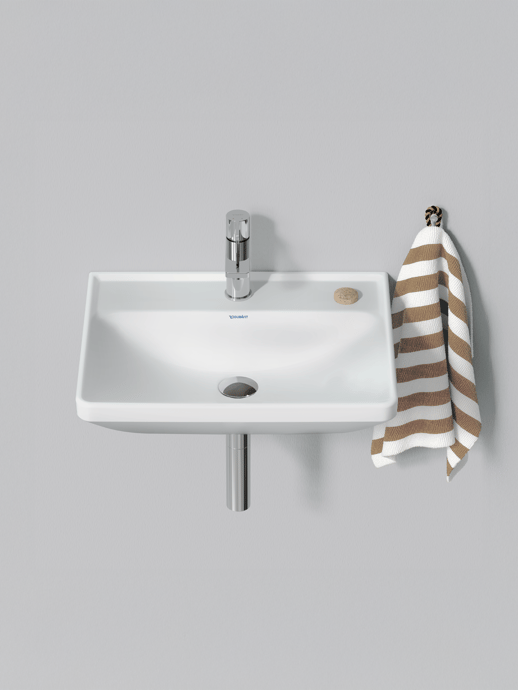
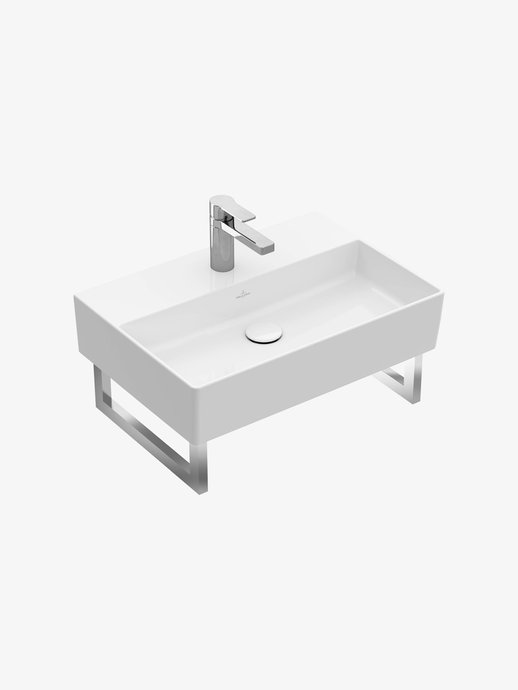
Duravit's D-Neo wall-hung washbasin, in white ceramic measuring 45 x 35 cm, even has a glazed underside, a careful finish for a piece that is visible from every angle. For a family, Villeroy & Boch's Memento 2.0 wall-hung washbasin offers a rectangular 60 x 42 cm format. In the toilet, the Luv countertop cloakroom basin measures 42 x 27 cm and can be fitted either way round.
How to choose and care for ceramic sanitaryware?
Choosing ceramic sanitaryware is a long-term choice. A few checks are enough to make sure it suits your use and keeps its shine.
Check the material on the product page
A product's name does not always tell you what it is made of. On our product pages, the "Material" line in the specifications clearly states "Ceramic" when that is the case.
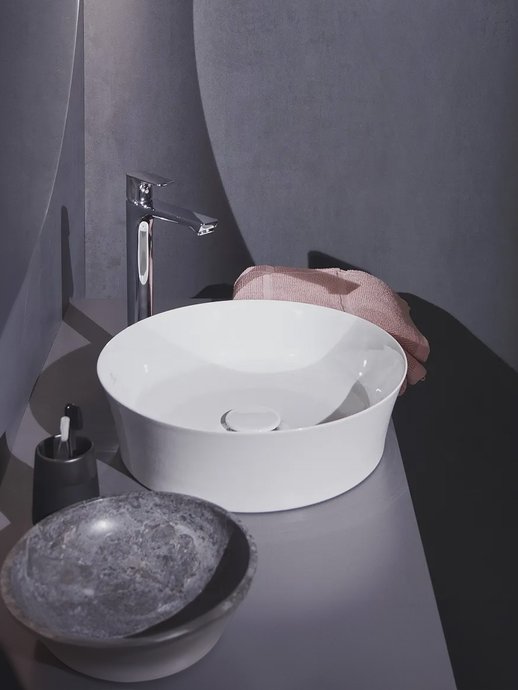
Take the opportunity to look at the other useful information: dimensions, and whether or not there is an overflow and a tap hole. Geberit's Caluna round countertop basin, for example, measures 35 cm in diameter and 13 cm high, with no overflow or tap hole: it therefore pairs with a deck-mounted or wall-mounted tap.
Choose the finish: gloss or matt
Gloss white remains the most timeless choice and the easiest to match. Matt and coloured finishes bring a more contemporary touch, in line with the warm, mineral shades described in our article on 2026 shower tray trends.
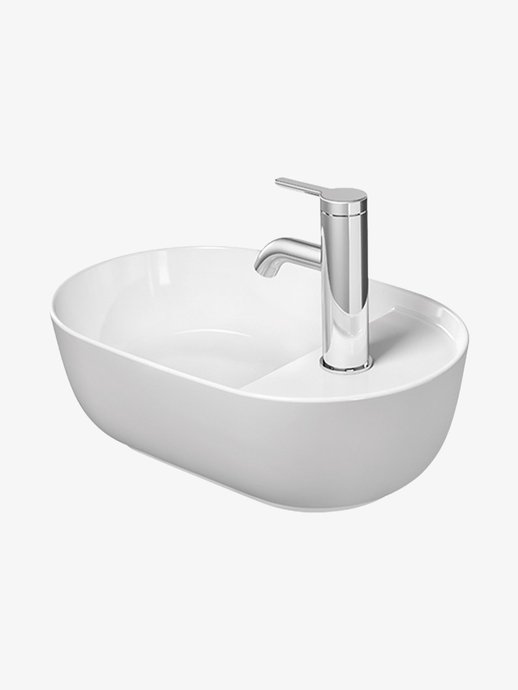
Duravit's Luv countertop basin illustrates this combination: designed by Cecilie Manz, this 50 x 35 cm oval basin combines, according to its description, pastel tones of matt lacquer and glaze.
Plan ahead for weight and installation
A countertop basin sits on a solid worktop, a wall-hung washbasin is fixed to a wall or a suitable frame, and a ceramic shower tray needs a slab able to bear its load.
These points should be checked before you buy, especially in a renovation or upstairs. An installer checks the support, the water supply and the drainage before fitting.
Ceramic, a safe choice for a bathroom that lasts
Ceramic does not win through fashion, but because it meets the demands of a bathroom: water, limescale, cleaning products and the passing of time. Its glaze gives it a smooth, hygienic surface, and its new matt shades allow it to keep up with décor trends.
Around the shower, it can be combined with other materials to suit your project: shower tray, tiles, washbasin or countertop basin. To see and touch the finishes, book an appointment at one of our EXPOcenters: our advisers will help you combine the right materials. For installation, the Install+ service puts you in touch with a partner installer.