Waterproof wall cladding: the alternative to tiles in the shower
Why replace your tiles rather than renovate them?
The problem with grout: the real weakness of tiled floors
The tiles themselves age well, but their grout does not fare nearly as well. After a few years of daily exposure to damp, they become encrusted with limescale and mould, even with regular maintenance. Re-grouting the entire surface is time-consuming and does not prevent the problem from recurring. A joint-free wall covering, installed in large panels, simply eliminates this structural weakness: there is nowhere for damp to accumulate between two surfaces.
A project that will take just a few days
Removing existing tiles, re-waterproofing and laying a new floor covering: this typical renovation project can easily take one to two weeks, with dust throughout the house and a bathroom that’s out of use for the entire duration of the work. A system such as Hüppe’s EasyStyle is installed directly over the old tiles, allowing the shower area to be completely transformed in 48 hours, without the noise and dust associated with a full demolition. For a household with just one bathroom, this time saving often carries more weight in the final decision than the price itself.
This speed also changes the nature of the project. A traditional renovation of tiled surfaces is often planned well in advance, involving the coordination of several trades. A waterproof wall covering is easier to plan, which explains why more and more households see it as an accessible solution even without a major renovation project in mind, simply to refresh an ageing shower area without disrupting the rest of the bathroom.
How does a waterproof wall covering work?
Laying directly onto the existing tiles
The principle remains the same from one system to another: the panels are fixed directly to the existing wall using silicone, adhesive tape or a specialised adhesive, depending on the manufacturer. It is therefore not necessary to remove the existing tiles, provided they are still securely fixed and in good condition. It is this stage – usually the longest and messiest part of a shower renovation – that is completely eliminated from the project.
Large-format panels with no joints
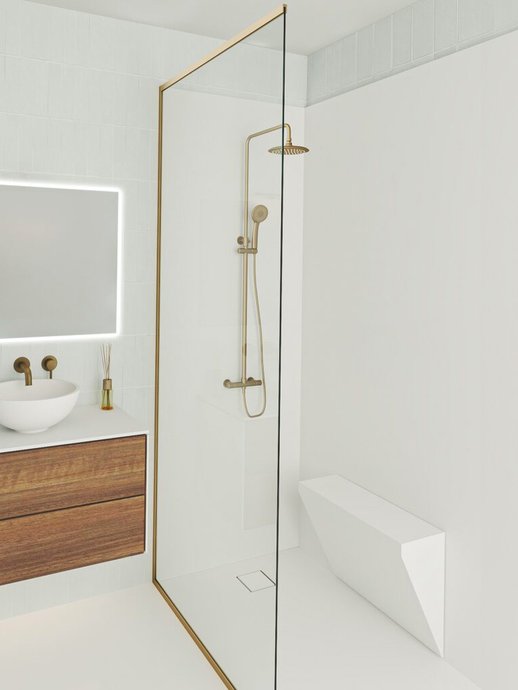
The panels are fitted edge-to-edge or with a discreet corner profile, leaving no visible joints between them. Many of the design flaws found in a poorly planned shower enclosure stem precisely from the use of a variety of materials and finishes that do not complement one another: a large-format cladding minimises this risk by unifying the entire surface in a single sweep, from floor to ceiling if required.
The two reference systems
PanElle, the rigid foam that mimics all materials
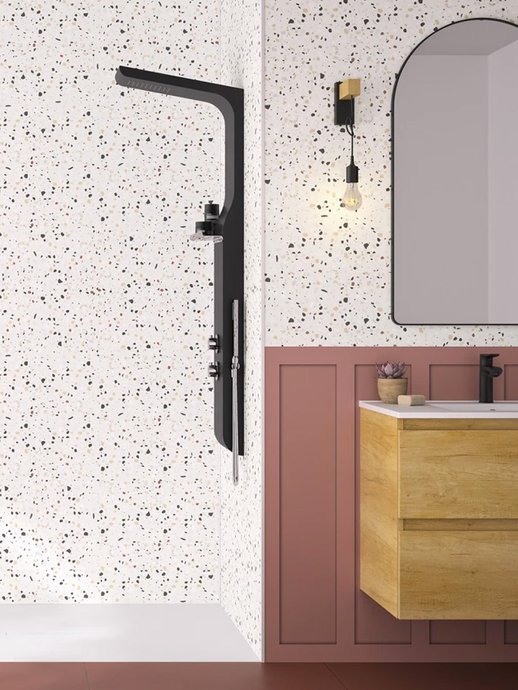
PanElle, developed by Duscholux, is based on a rigid foam core covered with an acrylic coating or a textured surface. The catalogue features over 40 different finishes, divided into several collections: Stone for a highly realistic natural stone look, Marble for a marble effect, Trend for concrete or vintage wood finishes, and Haptics for surfaces with a deliberately tactile texture. An Eco version is also available for projects seeking a more affordable option without compromising on watertightness.
EasyStyle, the ultra-thin aluminium composite
EasyStyle, Hüppe’s solution, features aluminium composite panels just 3 mm thick, with a digital print protected by a UV varnish. Available in large sizes, up to 1.50 x 2.55 m, they can be easily cut to size on site to fit the exact layout of the shower. The finishes range from light wood to raw concrete, including more elaborate designs such as the Catalan style or an Italian stone look.
A much simpler process
No grout, no limescale build-up
The absence of joints remains the key selling point of these systems from a maintenance perspective. With no gaps for water, soap or limescale to accumulate, the surface remains hygienic for much longer than conventional tiling, even when well maintained. This is a factor that counts for double in a shower used daily by the whole family, where the choice of shower tray and taps is already a key consideration when designing the space.
Cleaning that involves nothing more than a cloth
The surface treatment – whether it’s EasyStyle’s UV varnish or PanElle’s acrylic finish – prevents dirt and limescale from becoming ingrained. A simple soft cloth, used with a standard cleaning product, is all it takes to maintain the original appearance, without the scrubbing that is sometimes necessary on grouting that has turned grey over time.
Which finishes should you choose depending on the style you’re going for?
Stone or marble effect for a high-end finish
PanElle’s Stone and Marble collections replicate the texture and veining of natural stone with a realism that is striking at first glance, whilst avoiding the maintenance requirements associated with genuine porous stone. This is a particularly suitable option for projects seeking a high-end look without the budget or the precautions that a natural material would entail.
Wood and concrete for a contemporary feel
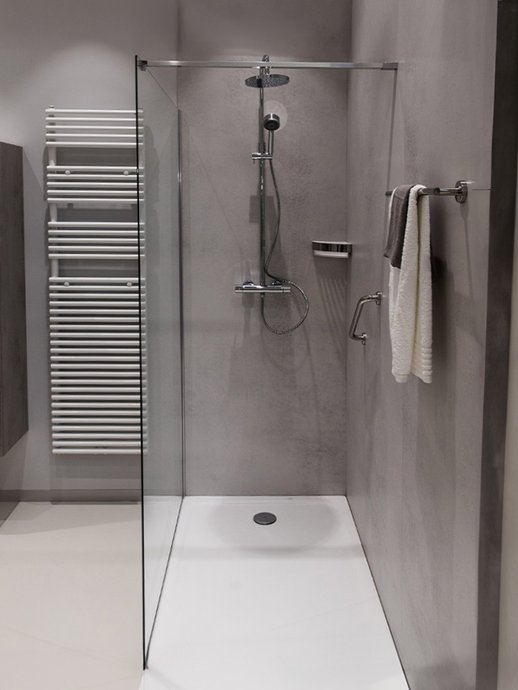
For a cosier atmosphere, EasyStyle’s wood finishes, such as limed pine or fir, add an unusual natural touch to a shower. Conversely, the concrete finishes, available from both manufacturers, fit in with a more urban and minimalist aesthetic, which is often sought after in recent renovations. The choice of shower layout – corner or recess – also directly influences the amount of surface area to be covered and therefore the number of panels required to clad the space without unsightly cut-outs.
What does the installation process actually involve?
Minimal surface preparation
Before laying the tiles, the fitter checks the condition of the existing tiling, fills in any holes left by old taps or fittings that have been removed, and ensures that the surface remains level. This step is much quicker than a complete demolition, as it simply involves levelling the surface rather than rebuilding the substrate.
On-site cutting: a real practical advantage
The panels, supplied in large formats, are cut on site to the exact dimensions of each wall. This bespoke cutting allows for the neat integration of water supply pipes, tap fittings and any storage niches, without leaving any unsightly edges. The joint between the panels and the shower tray is then sealed with silicone sealant or a specialised waterproofing profile to ensure a seamless transition between the floor and the wall.
A system designed to accommodate taps and fittings as well
Precise cut-outs around the mixer tap
Unlike traditional tiling, where the tiles are laid first and then holes are drilled for the taps, a waterproof wall covering requires the exact final position of the mixer tap to be known before the panels are cut. The standard height of the taps, generally between 100 and 120 cm depending on the intended use, must therefore be confirmed before work begins to avoid any last-minute adjustments once the panels have been fitted.
Seamless integration of shower accessories
Soap dishes, shower rails and shelves can be fixed directly to the cladding using suitable fixing systems, without unnecessarily drilling into the waterproof surface. Some manufacturers even offer specialised profiles designed to accommodate these accessories without compromising the overall watertightness of the system, thereby avoiding the need to fill in a poorly positioned hole a few years down the line.
Things to bear in mind before you get started
The substrate must remain sound
A waterproof wall covering is bonded to an existing surface, which means that this surface must remain stable and dry. A wall that is already showing signs of water ingress, or tiles that are coming away in places, must be treated before installation, otherwise the entire system may be compromised in the medium term. This point warrants careful consideration before opting for this solution rather than a full renovation.
An investment that is comparable to high-end tiling
The cost of a waterproof wall covering is generally in the same price range as high-quality tiles fitted by a professional, with the added saving of not having to remove the old covering. Some manufacturers offer a multi-year guarantee on their panels, a mark of confidence in the long-term durability of the protective coating and its resistance to the daily wear and tear of a family bathroom.
For the best possible finish, it is worth pairing this type of cladding with a matching shower tray in a coordinating colour, whether it is made of acrylic, ceramic or resin. Some manufacturers even offer shower trays specifically designed to match their own range of wall panels, which simplifies the choice and ensures the floor and walls of the shower look perfectly harmonious at first glance.
Key points to remember
The waterproof wall cladding meets a real need: to modernise a shower without having to endure a long and messy building project, whilst providing a long-lasting solution to the problem of grout that turns black over time. With the range of finishes available from PanElle and EasyStyle, there is a very wide choice of styles, making this solution suitable for both a quick refurbishment and a more meticulous project where every detail of the bathroom matters.
Frequently asked questions
Can waterproof wall cladding be fitted directly onto old tiles?
Yes, that is precisely how these systems work. The existing tiling serves as a substrate, provided it remains securely fixed and is watertight, which means there is no need for any prior demolition work.How long does a renovation take with this type of flooring?
According to the manufacturer, a system such as EasyStyle can transform a shower area in 48 hours, compared with one to two weeks for a traditional tiling project involving complete demolition.Does waterproof wall cladding require any special maintenance?
No, a soft cloth and a standard cleaning product are all you need. The absence of grout prevents limescale and mould from becoming ingrained, unlike with traditional grouting.What finishes are available for this type of flooring?
There is a wide range to choose from: natural stone, marble, concrete, light or dark wood finishes, as well as more graphic patterns from the PanElle or EasyStyle collections, with the option in some cases to print a personalised design.Is this lining suitable for all shower set-ups?
Yes, whether the shower is installed against a wall, in a corner or in a recess. The large panels are cut to size on site to fit the existing layout precisely.