Why choose wall-mounted units? Aesthetic, hygiene and technical benefits

At EXPOcenter, the question ‘wall-mounted or freestanding?’ is being asked less and less. The vast majority of customers undertaking a refurbishment arrive with the idea of a wall-mounted unit in mind, and they are often right. If you’re still really torn between the two, our comparison freestanding or wall-hung bathroom units: which to choose? sets out the criteria side by side. Here, we’ll assume you’re leaning towards a wall-hung unit and look at what it actually offers you, what it requires, and in which cases we wouldn’t recommend it.
Aesthetic benefits: what the eye gains
A floor that runs right up to the wall
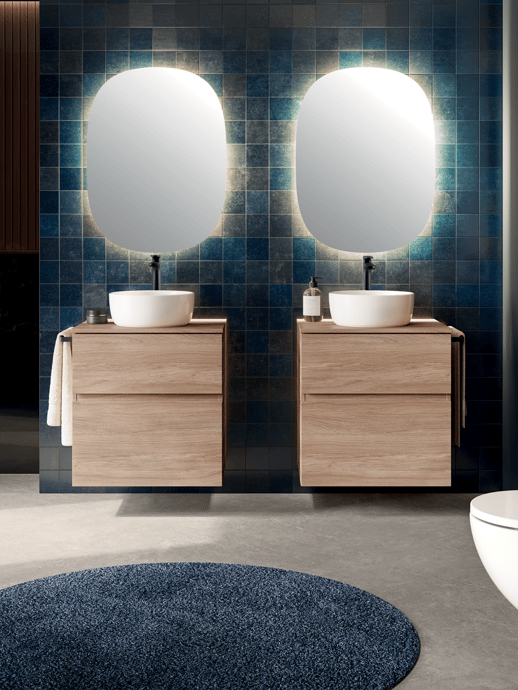
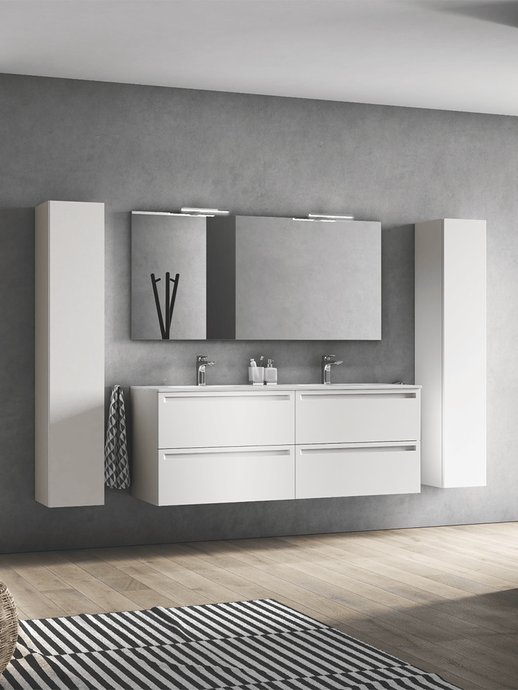
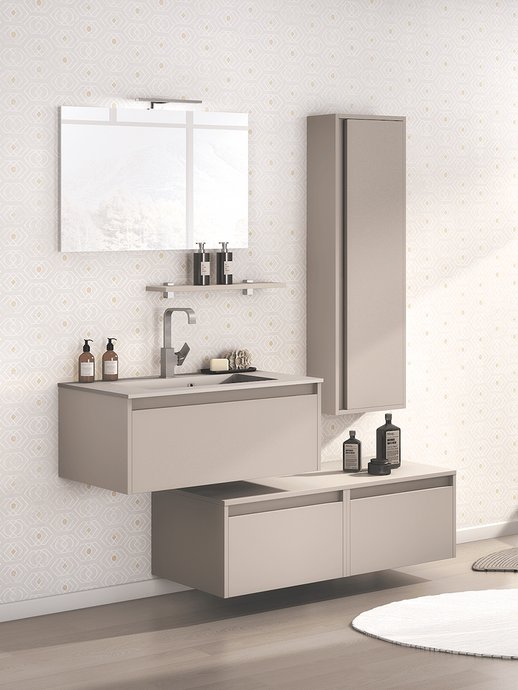
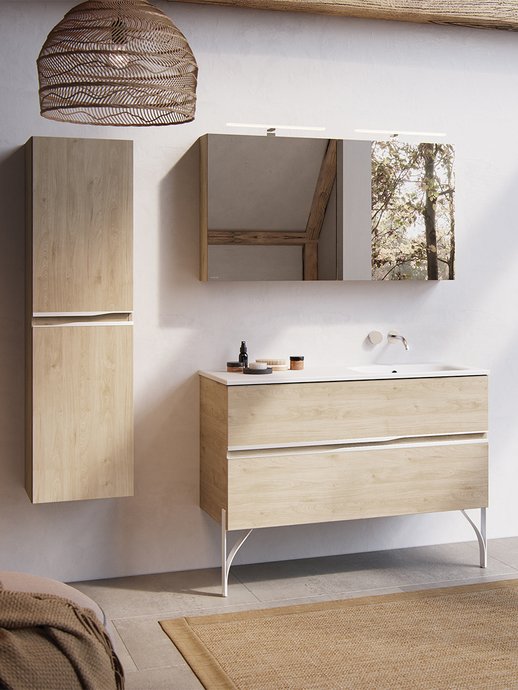
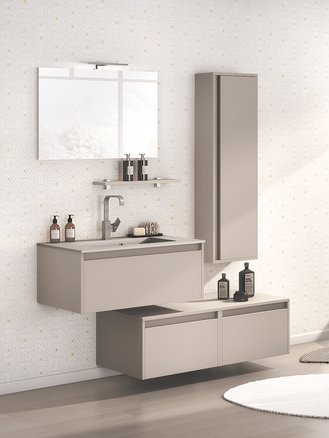
The best-known effect is also the simplest to explain. When the tiling runs under the furniture and up to the wall, the eye perceives the room in relation to its actual walls, rather than the front of the furniture. The floor area appears larger, because, visually speaking, it is.
Let’s work it out for a typical small Belgian bathroom. A floor-standing unit 80 cm wide and 45 cm deep covers 0.36 m² of tiled floor. In a 4 m² room, that’s 9 per cent of the floor hidden beneath a single unit. When suspended, this section of floor re-enters the field of vision. With large-format tiles (60 × 60 or 60 × 120 cm), the effect is even more striking: fewer grout lines, creating a surface that appears as a single, unbroken expanse.
A slimmer figure
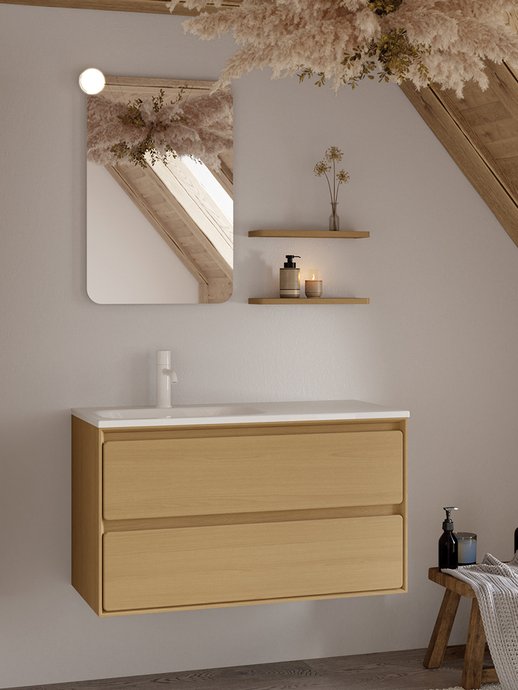
A wall-mounted unit is generally lower than a floor-standing unit: the cabinet is often 45 to 60 cm high, compared with 80 cm or more for a floor-standing model. This reduces its visual bulk accordingly. Add smooth, handle-free fronts and the unit becomes a simple horizontal line beneath the washbasin. We explain why this works so well in our article on push-pull and handle-free units.
The space beneath the unit also lends itself to a detail we really like: a discreet LED strip underneath the unit. It serves as a night light, without waking the whole house with the ceiling light, and it accentuates the ‘floating’ effect.
A bathroom that speaks with one voice
A wall-hung unit blends seamlessly with a wall-hung toilet, a wall-hung washbasin or a wall-mounted column. Anything that touches the floor disappears, and the room takes on a sense of cohesion that you notice without being able to explain it. If you’re already installing a toilet frame, now is the time to plan the rest of the bathroom along the same lines.
Health benefits: the gains for hygiene
No more nooks and crannies where water and dirt build up
A piece of furniture on legs means four legs that you have to mop around, or a plinth where the joint with the tiles turns black over time. A wall-mounted unit means a quick wipe with a squeegee or mop from one wall to the other. Robot vacuum cleaners, which are generally 8 to 10 cm high, can pass underneath without difficulty if the unit is installed at standard height.
It may seem trivial until you actually count: in a family bathroom, this is the place where hair, dust and splashes accumulate the quickest. Being able to clean under the vanity unit in ten seconds makes a world of difference to keeping the room tidy.
Better protection in the event of a leak
This is the advantage people talk about the least, and yet it is the one that prevents the worst surprises. A hose that comes loose, a poorly tightened trap, a shower that overflows: water spills onto the floor. A freestanding unit catches it from below, along the edge of the panels. However, most cabinet bodies are made of water-resistant particle board or MDF, which withstand ambient humidity well but are far less resistant to standing water. A panel that has swollen will never return to its original shape: the doors no longer close properly, and the veneer peels away.
When suspended, the base unit remains out of reach. Any leaks are also spotted more quickly, as the floor beneath the unit is visible. We set out in detail which materials are truly suitable for a damp room in our guide to furniture materials that are truly resistant to damp.
Technical benefits: improvements in comfort and installation
A height chosen, not imposed
A piece of furniture installed at a height specified by the manufacturer. A wall-mounted unit is installed at a height that suits those who use it. The washbasin top is generally positioned between 85 and 92 cm above the floor. These few centimetres make all the difference every morning, especially in Belgium, where the average adult height is amongst the highest in Europe. A couple where one partner is 1.85 m tall does not have the same needs as a family with young children.
This same flexibility also benefits accessibility. For a wheelchair user, a shallow wall-mounted unit, positioned slightly lower with space for the knees, is often easier to use than a floor-standing model.
Underfloor heating that also heats the space beneath the furniture
This is a very practical argument for the many renovation projects in Belgium that are switching to underfloor heating, often combined with a heat pump. Underfloor heating works by radiation. Beneath a piece of furniture, the covered surface emits almost no heat into the room, and the heat builds up beneath the cabinet, which is not good for wooden panels.
When suspended, the unit allows the entire floor surface to radiate heat. In a small bathroom, where every square metre of underfloor heating needs to be utilised, this is no minor detail: the 0.36 m² occupied by an 80 cm unit accounts for around one-tenth of the heat-emitting surface area of a 4 m² room.
A continuous tiled surface that makes future changes easier
With a wall-mounted unit, the floor tiles are laid across the entire floor, from wall to wall. Should you ever decide to change your unit – even for a narrower or wider model – there are no un-tiled areas to deal with. You’ll simply need to fill in the gaps and reattach the wall fixings, which is much simpler. If you’re unsure about the width, our article on the dimensions of 60, 80 or 120 cm vanity units will help you decide based on the room and the number of users.
What wall-mounted furniture requires from the wall
An 80 cm wall-mounted unit with a ceramic basin often weighs between 35 and 60 kg when empty. Fill the drawers, add someone leaning on the worktop to look in the mirror, and the load easily exceeds 100 kg, pulling the unit forwards. The wall has to support that for 15 or 20 years.
Type of wall (common in Belgium) | Is it possible to fit wall-mounted units? | What to expect |
| Solid brick or terracotta | Oui | Suitable wall plugs – be careful with hollow bricks |
| Concrete block | Oui | Standard expansion anchors |
| Cast concrete | Oui | The most secure fastening |
| Aerated concrete | Yes, with due care | Special anchors for aerated concrete or chemical anchoring |
| Plasterboard partition on a stud frame | Only reinforced | Support frame for a washbasin or reinforcement built into the partition wall; to be fitted before the partition is closed |
| Old wall with a ceiling, condition unknown | To be checked | Pre-purchase survey; additional support may be required |
For lightweight partitions, the neatest solution is a washbasin support frame, to which the unit is fixed and through which the water supply pipes run. It is fitted before the partition is closed off, i.e. at the start of the project. This is typically something that needs to be sorted out at the first meeting, not once the tiling has been completed.
When it comes to plumbing, wall-mounted units also have their own requirements. Water supply and drainage pipes must emerge from the wall at a height compatible with the unit – generally between 50 and 60 cm from the floor – as specified in the technical data sheet for the chosen unit. A space-saving trap frees up the top drawer, which would otherwise need to be cut out. Choosing the unit before the plumber installs the pipes avoids having to open the wall a second time.
In short, why choose wall-mounted furniture?
For a bathroom smaller than 6 m², with a solid wall or a partition that can be further reinforced, we recommend the suspended system almost without hesitation. It creates a sense of space, makes maintenance easier, and the protection it offers in the event of a leak alone is worth the slight extra cost of installation. With underfloor heating, this becomes a truly decisive factor.
We take a more nuanced approach when it comes to a large family bathroom where storage is a priority, or when the wall isn’t straight. In such cases, it’s better to discuss it with an advisor, with the floor plan to hand, before placing an order, rather than discovering the problem on the day of installation.
Frequently asked questions
What are the advantages of wall-mounted bathroom furniture?
It makes the room appear larger by leaving the floor visible, makes cleaning easier, protects the cabinet in the event of a leak onto the floor, and allows air to circulate. It can also be fitted at the desired height and allows the underfloor heating to operate beneath it.How much weight can a wall-mounted unit support?
It depends mainly on the wall and the fixings. An 80 cm unit with a washbasin often weighs between 35 and 60 kg when empty and can easily exceed 100 kg when fully loaded, including the contents of the drawers and the weight of a person leaning on it. On brick, block or concrete walls, suitable fixings are sufficient. On a lightweight partition, reinforcement or a support frame is required.Can you mount a wall-mounted unit on a plasterboard partition?
Yes, provided it is reinforced: either with a washbasin support frame or with reinforcement built into the framework, fitted before the partition is closed off. Wall plugs for hollow partitions alone are not sufficient to support a heavy vanity unit.At what height should you hang wall-mounted furniture?
The vanity top is usually positioned between 85 and 92 cm above the floor, depending on the height of the users. This leaves 20 to 30 cm of clearance beneath the vanity unit, which is enough to clean easily and to allow a robot vacuum cleaner to pass underneath.Is a wall-mounted unit compatible with underfloor heating?
Yes, and that’s actually an advantage: the floor remains exposed and continues to give off heat into the room. Underneath a piece of furniture, the covered surface heats the underside of the unit rather than the bathroom.