Water softener or water filter: what are the differences?

Identify problems with your domestic water supply
Hard water: a daily challenge for your home
Your water naturally contains calcium and magnesium carbonate, minerals that have accumulated as it flows through rock formations. The hardness of your water is measured in French degrees (°f): above 15°f, it is considered hard.
These minerals pose no risk to your health, but they cause limescale build-up in your pipes and on the heating elements of your household appliances. If you have sensitive skin, very hard water can cause irritation and make your hair brittle. Your taps and household appliances gradually become encrusted with limescale, which reduces their energy efficiency and increases your bills.
Contaminants found in tap water
In Belgium, as elsewhere in Europe, tap water is subject to strict controls, but it may nevertheless contain, in low concentrations, certain residues originating from the environment or human activities. For example, traces of pesticides are found, for which the regulatory limit is set at 0.1 µg/L per substance. PFAS, used for their non-stick properties, are also monitored with very low thresholds to ensure public health safety.
Other compounds may be detected, such as nitrates, which originate mainly from agriculture, or certain by-products associated with pipework materials. In certain specific areas, historical or industrial pollutants may also require increased vigilance. These elements generally remain below regulatory limits, but their presence can affect the taste, smell or overall perception of your tap water.
How can you find out about the quality of your water?
We recommend that you test your water to determine exactly what you need. Test strips offer a quick solution: they change colour when immersed, giving you an immediate reading. The drop-by-drop test provides greater accuracy; each drop added before the colour changes corresponds to 1°f of hardness.
For a comprehensive analysis, laboratory tests can provide a detailed breakdown of your water’s composition. You can also consult the official data provided by your local water supplier, which is available online or on request, to gain a better understanding of the quality of the water supplied in your area.
Recognising the signs of problematic water
There are several signs that can alert you to the quality of your water. Limescale appears as white or yellowish deposits on your taps, shower heads and bath walls. Your household appliances lose efficiency and consume more energy due to limescale build-up.
After a shower, your skin feels tight and dry. Your hair becomes dull and difficult to style. Even though you use fabric softener, your laundry comes out of the wash feeling rough. A drop in water pressure is a sign of limescale build-up in your pipes.
The water softener: the solution to limescale
How does a water softener work?
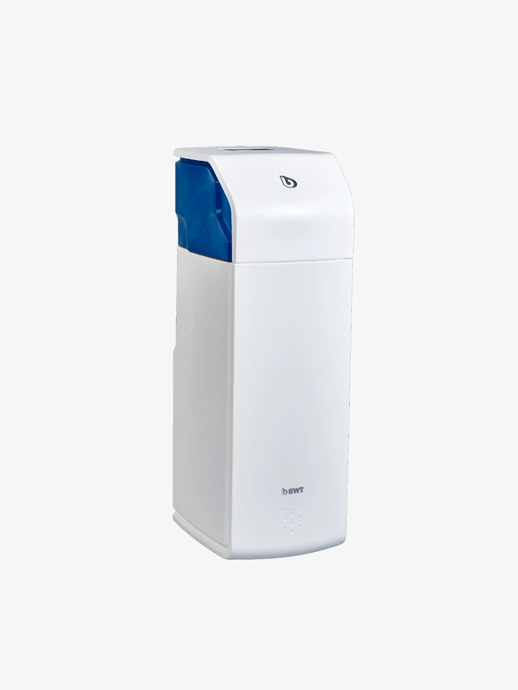
The water softener removes limescale using a particularly effective ion exchange process. The system uses a resin made up of small porous beads that capture the calcium and magnesium ions responsible for water hardness. These minerals are automatically replaced by sodium ions, thereby transforming your hard water into soft water.
When the resin reaches saturation, the system automatically regenerates using a saline solution. This process flushes the accumulated calcium and magnesium into the drain and recharges the resin with sodium for a new treatment cycle.
Protect your equipment and save energy
Installing a water softener significantly extends the lifespan of your household appliances. The heating elements in your water heater operate without limescale build-up, which directly reduces your energy consumption. Bear in mind that just one millimetre of limescale increases energy consumption by 12 to 16%!
Your pipes retain their original diameter and maintain a constant pressure. No more limescale problems in your washing machine, dishwasher or coffee machine. It’s not only convenient, but also cost-effective in the long run.
Daily comfort for your skin and hair
Soft water transforms your daily routine. No more tight, dry skin after a shower! Your skin retains its natural moisture and balance. People suffering from eczema or psoriasis generally notice a significant improvement.
Your hair regains its natural shine and softness. The absence of limescale makes styling easier and keeps your hair looking its best.
Simple and effective maintenance
Maintaining a water softener is straightforward. Check the salt level every 2 to 3 months and replace the pre-filter cartridge twice a year when it changes colour. An annual professional clean ensures your system performs at its best.
The resin beads only need to be replaced every 10 to 20 years, depending on how often you use them.
The water filter: a solution for purifying your drinking water
Technologies tailored to every need
There are several filtration systems available to improve the quality of your tap water. Activated carbon captures the organic molecules responsible for unpleasant tastes thanks to its microporous structure. Reverse osmosis uses an ultra-fine 0.0001-micron membrane to block contaminants and minerals. Sediment filters mechanically trap solid particles. UV sterilisation destroys bacteria and viruses without the use of any chemicals.
Filter jugs combine activated carbon and resin for convenient everyday use.
Effective removal of unwanted particles
Sediment filter cartridges remove sand, rust and suspended particles. We recommend choosing the appropriate filter rating to suit your needs: 50 microns for large particles, 20 microns for standard filtration, and 5 to 1 micron for the finest impurities.
Wound filters provide progressive deep filtration. Pleated models increase the filter surface area and extend the service life. Replace the cartridges every 6 to 12 months, depending on your water quality.
Say goodbye to the taste of chlorine and heavy metals
Activated carbon effectively removes the chlorine responsible for the unpleasant taste of tap water. A study by Duke University shows that these filters remove around 73% of PFAS. Reverse osmosis achieves a purification rate of 95% for PFAS, whilst also removing lead, mercury and aluminium.
Please note: this system discharges 2 to 10 litres of water for every litre purified.
Special case: rainwater filtration
Microfiltration is ideal for rainwater or well water that is chemically safe but contains bacteria. It preserves the natural mineral composition. Reverse osmosis removes 85 to 99% of mineral salts, producing water similar to micro-filtered rainwater.
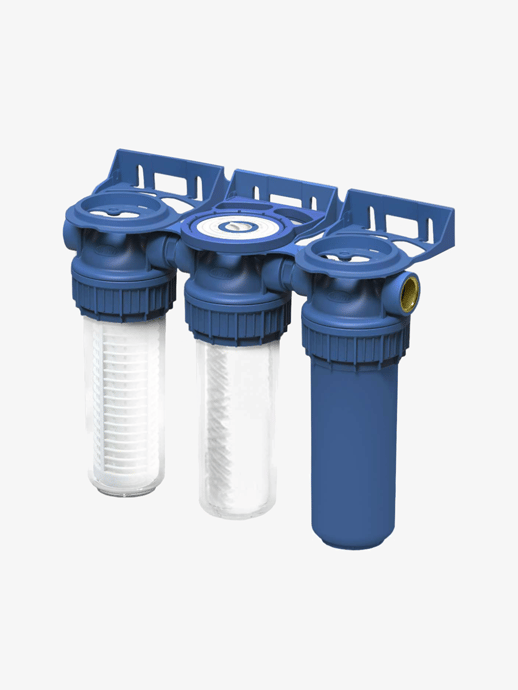
A triple-stage system combines a sediment filter, activated carbon and ultrafiltration for comprehensive purification.
Reliable solutions for your peace of mind
At Facq, we select water treatment systems renowned for their reliability and performance. Our filtration solutions are suitable for both drinking water and domestic use, utilising proven technologies such as activated carbon, microfiltration and reverse osmosis.
To ensure the highest quality, it is recommended that you choose equipment that complies with current European standards, as this effectively reduces certain pollutants whilst preserving the essential qualities of your water.
Our experts will help you choose the solution best suited to your system and your needs, so that you can enjoy better-tasting water every day, with complete peace of mind.
Choose the solution that best suits your needs
A water softener is essential for tackling limescale
Is your water hardness above 15°f? A water softener is essential. This solution is particularly suitable for areas where limescale builds up quickly on plumbing fixtures. The system effectively protects boilers, hot water tanks and household appliances from limescale build-up.
Please note: ensure that the residual hardness remains at a minimum of 15°f to prevent corrosion of the pipes.
The filter addresses issues relating to taste and contamination
A water filter is essential if your water has a strong chlorine taste or contains pesticides or heavy metals. This solution improves the quality of your drinking water without altering its mineral content.
Activated carbon filters are suitable for everyday use, whilst reverse osmosis treats significant contamination.
Combine the two for comprehensive protection
The water softener-filter combination offers a complete solution. The water softener treats limescale upstream on the main water supply, whilst the filter purifies drinking water downstream. These 2-in-1 systems, which incorporate activated carbon and resin, ensure soft, pure water throughout the home.
A detailed comparison of the two solutions
We have put together this comprehensive analysis to help you make the right choice between these two technologies. This table summarises the key features of each system.
| Criterion | Water softener | Water filter |
| Main objective | Removing limescale (calcium and magnesium carbonate) | Remove contaminants (pesticides, PFAS, chlorine, heavy metals) |
| Technology | Ion exchange using cation exchange resin | Activated carbon, reverse osmosis, sediment filtration, UV |
| How it works | The resin binds calcium and magnesium, replacing them with sodium ions | Absorption/filtration of organic molecules and particles using this technology |
| Installation | Main water supply | Main supply point or specific point of use |
| Area of operation | The whole house | Local or general, depending on the system |
| Maintenance frequency | Check the salt levels every 2–3 months; have it professionally cleaned once a year | Replace cartridges every 6–12 months |
| Component lifespan | Resin: 10 to 20 years, pre-filter: 6 months | Varies depending on the type of filter: 6–12 months |
| Effectiveness | Removes limescale | Activated carbon: 73% of PFAS, Reverse osmosis: 95% of PFAS, 85–99% of mineral salts |
| Key benefits | Protects household appliances, reduces energy consumption (by 15%), improves the condition of skin and hair | Improves the taste of water, removes chemical contaminants and heavy metals |
| When to use it | Hard water (over 15°f), limescale problems | A taste of chlorine, the presence of pesticides, heavy metals, chemical contaminants |
| Possible combination | Yes, treat limescale at source | Yes, it purifies the drinking water downstream |
This comparison allows you to quickly see the specific features of each solution. The two technologies address different issues but can complement each other perfectly in a domestic installation.
Make the right choice for your water
First, test your water quality to identify your actual needs. If your water is too hard, you’ll need a water softener to protect your appliances and improve your day-to-day comfort. If your water tastes of chlorine or contains contaminants, a filtration solution is what you need.
The two systems complement each other perfectly: the water softener treats limescale throughout the house, whilst the filter purifies your drinking water. This approach ensures water of the highest quality and protects your plumbing in the long term.
We’ll help you choose the solution best suited to your needs. Visit your nearest Facq EXPOcenter to discover our water treatment systems and get advice from our experts.
Frequently asked questions
Q1. What is the main difference between a water softener and a water filter?
One specifically treats limescale by replacing calcium and magnesium ions with sodium ions using a resin, whilst the other removes contaminants such as chlorine, pesticides, heavy metals and other impurities found in tap water.Q2. How do I know whether I need a water softener or a water filter?
If your water has a hardness level above 15°f and you notice limescale build-up on taps and appliances, opt for a water softener. If you notice a chlorine taste, unpleasant odours or wish to remove chemical contaminants, a filter will be more suitable.Q3. Can both a water softener and a filter be installed?
Yes, combining the two systems provides comprehensive protection. The water softener treats limescale upstream on the main water supply, whilst the filter purifies drinking water downstream.Q4. What maintenance is required for these systems?
A water softener requires regular monitoring to ensure it works properly: the salt level should be checked every few months and routine maintenance carried out to maintain the unit’s performance over time. As for a filter, this mainly involves replacing the cartridges at regular intervals, usually every 6 to 12 months depending on usage and water quality. An occasional check of the system also helps to ensure optimal filtration on a daily basis.Q5. Can different water qualities be treated in the same house?
Yes, a water softener can be installed on the main water supply to reduce limescale throughout the house, whilst a specific filter can be fitted in the kitchen to improve the quality of drinking water. This approach allows the water treatment to be tailored to each specific use, providing a more comprehensive solution for everyday life.