Kitchen mixer taps and sinks: how to get the right combination?

Why choose the tap and sink as a set?
In most kitchen projects, the sink is chosen early on, along with the worktop. The tap comes next, often chosen for its appearance. Yet the two form a single workstation. A spout that is too high above a shallow bowl causes splashing every time it is turned on. A spout that is too short sends water onto the back edge of the bowl. A lever that pivots backwards cannot be opened if the tap is pressed up against the splashback.
None of this is apparent from a single product specification sheet on its own. You need to compare two specification sheets – one for the sink and one for the tap – and look at three or four figures. If you haven’t yet chosen the type of mixer tap (high spout, wall-mounted, mixer, hand shower), start with our guide which mixer tap to choose for the kitchen. Here, we’re assuming you have an idea of the style, and we’ll look at how to make it work perfectly with your sink.
Spout height and bowl depth: the first consideration
It is this setting that determines whether your sink splashes. The water falls from the spout to the bottom of the bowl. The longer the drop, the harder the stream bounces off the surface, especially if there is a plate or spoon resting at the bottom.
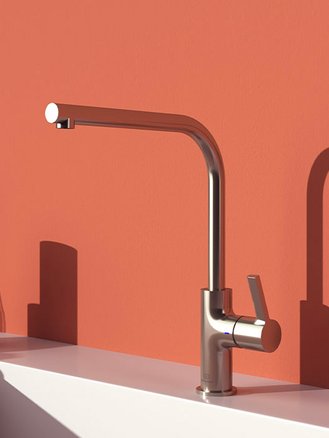
On a tap’s technical specification sheet, the figure to look out for is the spout height: the distance between the worktop surface and the water outlet. This ranges from around ten centimetres for a low spout to over 25 cm for a swan-neck spout. Hansgrohe even includes this in the names of its models: the Talis M54 210 offers a spout height of around 210 mm, whilst the Focus M41 280 offers around 280 mm.
Depth of the tank | A headroom that works well | Type of tap |
| 13 to 16 cm (half-tub, small sink) | 15 to 20 cm | Low or medium spout, aerated spout |
| 18 to 20 cm (standard sink) | 20 to 25 cm | L-shaped or C-shaped spout |
| 20 cm and over (large bowl, under-counter, stamp) | 25 cm and over | Gooseneck, semi-professional nozzle |
These are general guidelines, not a standard. With a good-quality aerator, which mixes air with the water, you can fill the sink a little higher without splashing. And if you often fill large saucepans, a high spout is more practical, even if it means choosing a deeper sink.
A special case: a sink under a window. Here, the total height of the tap is just as important as the height of the spout. Measure the distance between the worktop and the bottom of the window sash, taking the handle into account. A tap 40 cm high under a window sill that is 35 cm high will mean the window can no longer be opened.
The range of the spout: where does the water fall?
The second figure, which is often overlooked: the reach, that is, the horizontal distance between the tap spindle and the water outlet. It is generally around 20 cm on a kitchen mixer tap, and slightly more on swan-neck taps.
The spray should fall roughly in the centre of the sink, slightly in front of the drain. If the spray range is too short, the water runs down the back wall and you’ll bump your hands against the tap whilst rinsing. If it’s too long, the spray hits near the front edge, and the water ends up on your jumper.
To check, measure the distance on the sink plan between the centre of the tap hole and the centre of the bowl. On a built-in sink with a tap ledge, the hole is behind the bowl, and this distance generally matches the reach of a standard mixer tap. On an undermount sink, you drill the hole in the worktop yourself: you therefore have some flexibility, provided you leave enough space for the tap handle (see below).
Matching colours and finishes
Once the measurements have been approved, it’s down to personal judgement. There are no hard and fast rules, but some combinations stand the test of time better than others.
A stainless steel sink naturally calls for a brushed stainless steel tap. Polished chrome works too, but when placed next to a satin-finish stainless steel sink, the difference in sheen is noticeable. A matt black Fragranit sink pairs well with a matt black tap for a seamless look, or with stainless steel for a softer contrast that’s easier to maintain. Finally, a white ceramic sink goes with almost anything: chrome for a classic kitchen, matt black for a contemporary kitchen, or brass or a gold finish for a country or retro style.
Sink | Reliable agreement | A more pronounced agreement | One to watch |
| Inox | Brushed stainless steel tap | Matt black | High-gloss chrome: different reflections |
| Light Fragranit (grey, champagne and white stone) | Stainless steel or chrome | Matt black | Few constraints |
| Black or anthracite Fragranit | Matt black or stainless steel | Gold finish | Limescale visible on both |
| White ceramic | Chrome | Matt black, brass | Tap style (retro or minimalist) |
Not all finishes are created equal when it comes to maintenance, especially with our hard water. We’ve compared the three most common finishes in our article Chrome, stainless steel or matt black for a kitchen mixer tap. A piece of advice we often give: before deciding on a dark tap for a dark sink, look at the two side by side at the EXPOcenter, under lighting similar to that in your kitchen. Two matt black finishes from different brands are almost never exactly the same shade of black.
Should I just change the tap, or just the sink?
In many projects, the whole kitchen isn’t refurbished. You keep the sink and replace the leaky tap, or vice versa. The design is then adapted to what’s already there.
If you’re keeping the sink, start by counting the holes. Older two-handle mixers often required three holes, or two. A modern mixer tap uses just one: the others are concealed by a rosette or a cover plate, which are sold for this purpose. Also check the thickness of the sink. An old, thin-walled stainless steel sink may bend under the weight of a high-spout mixer tap or a pull-out spray, which you’ll be using all day long. Most manufacturers supply or offer a reinforcement plate to slide under the sink: ask for it when you buy. Finally, measure the depth of the bowl before falling in love with a swan-neck tap you’ve seen in a photo.
If you’re keeping the tap, the approach is the opposite. Note the height beneath the spout and its reach, and look for a sink with a bowl that matches these measurements. This is often the case when the tap is new and of good quality, or when it’s a boiling-water tap connected to its own tank. With an undermount sink, the tap moves from the sink to the worktop: you may need to drill a hole in the worktop and check that the fixing spindle is long enough.
In both cases, bear in mind that the supply hoses and stop valves under the sink can sometimes be as old as twenty years. When you’re replacing one part, it’s a good time to replace them too – for just a few euros.
Three successful arrangements, using real-life examples
To illustrate this, let’s look at three common combinations, made up of products available at FACQ. The prices are inclusive of VAT, as quoted on facq.be, excluding installation.
The first is the family-friendly, hassle-free option: a Franke stainless steel sink for under-mount installation with a drainer, and a high-spout mixer tap such as the GROHE Eurosmart with Eco pull-out spray (€284.73) or the GROHE Minta with pull-out spray (from €398.13). Stainless steel is very forgiving, drilling is straightforward, and the spray makes up for a bowl that can sometimes be a bit on the small side.
The second option focuses on colour: a Fragranit sink from Franke’s Basis range (from €568.70), in graphite or white, with a mixer tap from the same brand such as the Franke Eos Neo (from €502.15). Buying both from the same manufacturer makes it easier to ensure the drill holes and colours match.
The third option focuses on the material: a Villeroy & Boch ceramic sink, for example a Subway built-in model (from €1,772.65), with a Hansgrohe Talis M54 210 with sBox (from €574.63). The deep basin is compatible with a high spout, and the sBox stores the shower hose under the washbasin.
For those looking for a matching set, Franke offers its Mythos Masterpiece range of sinks and taps (Mythos Masterpiece mixer tap, from €1,203.95), designed to complement one another.
Accord | Évier | Mixer tap | Indicative budget (including VAT) |
| Family-oriented | Franke built-in stainless steel | GROHE Eurosmart or Minta with hand shower | Taps from €285 to €400 |
| Colour | Fragranit Franke Basis | Franke Eos Neo | Around €1,070 for both |
| Subject | Villeroy & Boch Subway Ceramics | Hansgrohe Talis M54 210 sBox | Around €2,350 for both |
Frequently asked questions
What height of tap spout should you choose for a kitchen sink?
It depends on the depth of the sink. For a standard sink measuring 18 to 20 cm deep, a spout height of 20 to 25 cm works well. For a half-size sink or a small sink measuring 13 to 16 cm deep, aim for between 15 and 20 cm to minimise splashing. Large, deep basins and bell-shaped sinks are suitable for swan-neck spouts and semi-professional taps.Can you fit any tap to any sink?
Almost all mixer taps fit into a standard 35 mm hole. True compatibility depends on other factors: the height of the spout in relation to the depth of the bowl, the reach of the spout in relation to the position of the bowl, the number of holes available, and the thickness of the worktop if the sink is under-mounted.Where should the tap be positioned with an undermount sink?
On the worktop, behind the sink, at a distance that ensures the water stream falls in the centre of the basin. Leave a few centimetres of space between the tap and the wall or splashback so that the lever can swing freely. Also check that the tap’s mounting spindle is long enough for the thickness of your worktop.Should the colour of the tap match that of the sink?
It isn’t essential. A tap in the same shade as the sink creates a very cohesive look, whilst a stainless steel tap on a coloured sink creates a softer contrast. If you have hard water, avoid combining a dark sink with a matt black tap unless you want to be wiping it down every day.Can you add a hole to an existing sink?
In a stainless steel sink, yes, this is no great difficulty for a fitter. In a Fragranit sink, the pre-drilled holes provided by the manufacturer can be easily removed; elsewhere, it’s trickier. In a ceramic sink, drilling holes after the fact is risky: it’s better to choose the right version (with or without a hole) when placing your order.