How do you choose the right power rating for your towel warmer?

Key points
The standard formula: allow 100 W per m² for standard comfort at around 20 °C, 120 to 130 W per m² for a higher level of comfort or average insulation, and always add 100 W for the towel-drying function itself.
For a 6 m² bathroom, this works out at around 700 W for standard comfort, up to 900 W in an older or less well-insulated house. A heater with high thermal mass (thick steel, cast iron) is often more efficient at the same power output – or even lower – than a responsive model without thermal mass.
At Facq, the electric models available range from around €750 (Muna) to over €980 (Zehnder), depending on power output and finish.
How do you choose the right power rating for your towel warmer?
Power remains the most underestimated factor when buying a towel warmer, far ahead of design or finish. A model that is too weak runs continuously without ever really warming the room, which leads to it being abandoned in favour of a portable heater. An oversized model heats up too quickly, switches off just as quickly, and does not dry towels as well as a unit that stays warm for longer. A simple calculation, taking just a few minutes, avoids both pitfalls.
The basic formula: how many watts per square metre?
The calculation used by most manufacturers and in our own sales guidelines is based on a simple principle: the power required depends on the area to be heated, the desired level of comfort, and a fixed reserve for the drying function. Allow 100 W per m² for standard comfort at around 20 °C, and 120 to 130 W per m² if you are aiming for a higher level of comfort, 21–22 °C, a temperature often recommended for young children or the elderly. To this total, always add 100 W – the amount of power used to dry the towels themselves, independently of the room heating.
Bathroom area | Standard comfort (~20 °C) | High comfort or moderate insulation (21–22 °C) |
| 3 m² | 400 W | 500 W |
| 4 m² | 500 W | 650 W |
| 5 m² | 600 W | 750 W |
| 6 m² | 700 W | 900 W |
| 7 m² | 800 W | 1,000 W |
| 8 m² | 900 W | 1,150 W |
| 10 m² | 1,100 W | 1,400 W |
These guidelines are based on a standard ceiling height of around 2.50 m. A room in the loft with a sloping ceiling, or conversely one with an unusual ceiling height of 2.80 m or more, requires the calculation to be adjusted to take account of the actual volume rather than just the floor area.
Let’s take a practical example: a 7 m² bathroom in a house built in the 1990s that is properly insulated, where the towel warmer is used as a supplementary heating source alongside the central heating. The calculation gives 7 × 100 + 100, or 800 W. In the same room, if the insulation is of average standard or if the towel warmer has to heat the room on its own without any additional heating, it is better to aim for 7 × 130 + 100, which is approximately 1,000 W. In between these two figures, a model rated at 850 to 900 W remains a reasonable compromise if there is still uncertainty about the actual insulation of the external wall.
The three factors that affect this calculation
The intended use is also a factor. A towel warmer used as a supplementary heater, alongside central heating that already keeps the room at a comfortable temperature, may be sufficient at the lower end of the range. A model intended to provide the room’s main heating on its own – which is common in small bathrooms with no other heat source – would be better off aiming for the upper end of the range, or even slightly exceeding the figures in the table.
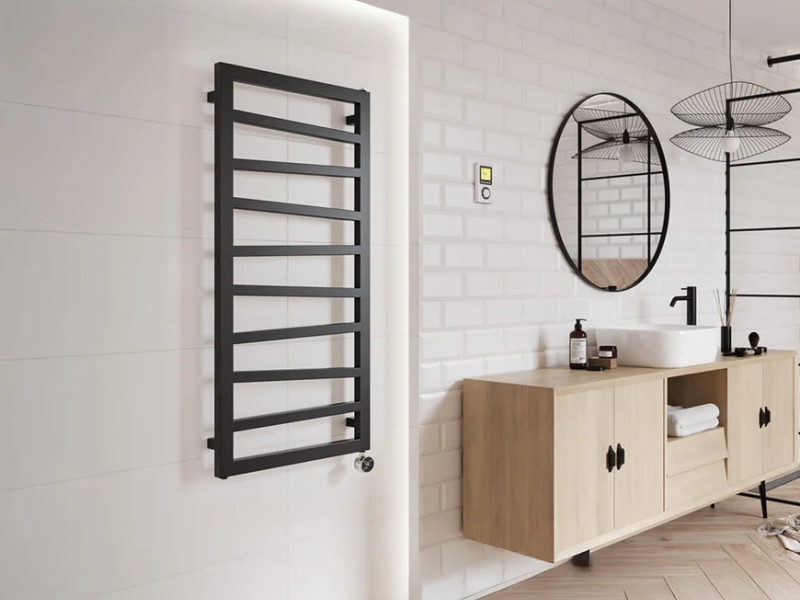
The third factor, which is less obvious, relates to the power supply. For an electric model, the power rating in watts is stated directly on the product specification and can be compared as such. For a hot-water model, the heating power depends on the temperature of the water in the central heating circuit, which makes a direct comparison in watts less relevant: it is the heat exchange surface area of the heating element and the boiler’s flow temperature that matter. Our comparison electric or hot-water towel warmers: which is more economical? explains this difference and its real impact on energy bills in Belgium.
Why do two appliances with the same power rating not heat up in the same way?
The thermal inertia of the material is also a key factor, a point that few product specifications highlight. A 500 W model made of thick steel or cast iron, which stores heat within its mass, can remain warm long after the heating element has switched off and may prove more efficient in use than a 900 W model with low thermal inertia, which cools down almost immediately once the thermostat is switched off. This difference is particularly significant for those who programme their towel warmer to run at specific times rather than leaving it on continuously.
Conversely, some models feature an auxiliary fan that blows the hot air produced by the heating element – a useful solution when speed is prioritised over thermal inertia, for example to quickly warm up a room before a morning shower. This type of function sometimes means that a lower rated power output is sufficient than the basic calculation would suggest, as the fan partially compensates for the pure watts per square metre calculation.
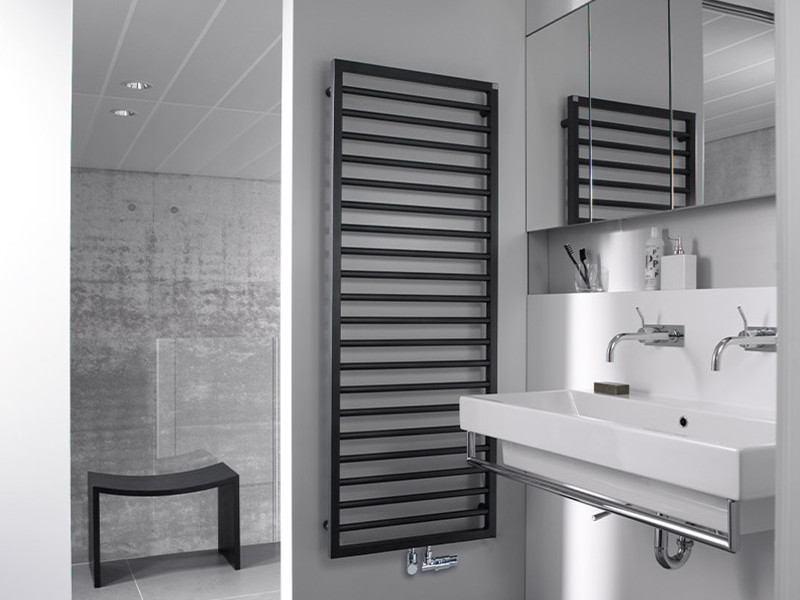
Our models at Facq to help you visualise your future
At Facq, the electric range covers a large proportion of the requirements calculated above. The Muna electric towel radiator, by Radson, costs between €750 and €860 (including VAT) depending on the finish; it is a versatile model that meets the needs of a medium-sized bathroom. For a more stylish look, the Solis towel radiator features an ultra-slim 40 mm depth and a mirrored or lacquered front available in 39 colours, with infrared technology that heats without drying out the air in the room. The Zehnder Vitalo Spa towel radiator, which is three times lighter than a traditional model of comparable power, is a fine example of recent advances in the balance between weight, size and heating performance.
The entire Facq range of towel warmers – whether electric, hot-water or combination models – can be compared side-by-side at the EXPOcenter, where our advisers can confirm the correct power rating for your bathroom before you make a purchase. For an overview of the three power supply types and their respective uses, our guide ‘Which towel warmer to choose for your bathroom’ remains the go-to resource to consult alongside this power calculation.
Frequently asked questions
Q1. What power rating should a towel warmer have for a 5 m² bathroom?
Allow for around 600 W for standard comfort in a well-insulated room, and up to 750 W if the insulation is average or if you want a higher temperature. A model with a built-in thermostat allows you to fine-tune this setting on a day-to-day basis.Q2. Should we calculate the area or the volume of the room?
The standard calculation is based on the floor area, assuming a standard ceiling height of approximately 2.50 m. If the ceiling is higher than this, or in a room with an unusual layout (attic, mezzanine), it is recommended that the calculation be adjusted upwards.Q3. Can a 500 W towel warmer be more efficient than a 900 W model?
Yes, provided the 500 W model has high thermal inertia (thick steel, cast iron), which allows it to retain heat for a long time after being switched off. A model with a higher power rating but low thermal inertia cools down more quickly, which may make it less efficient in practical use, particularly when operated via a timer.Q4. Does the formula in watts per square metre also apply to a hot-water towel warmer?
Not directly. The output of a hot-water model depends on the temperature of the water in the central heating circuit and the heat exchange surface area of the heating element, not on a wattage figure that is directly comparable to that of an electric model. Calculating in watts per square metre is nevertheless useful for estimating the room’s overall heating requirement.Q5. Is it better to choose a slightly larger towel warmer?
Slightly oversizing the system, combined with a good thermostat, rarely causes problems: the appliance heats up more quickly and runs for shorter periods at full power. Significant oversizing, on the other hand, leads to frequent on-off cycles, which are less comfortable and not necessarily more economical.