Which towel warmer should you choose for your bathroom?

Key points
1. The type of supply : electric for a simple installation, hot water if your boiler can supply the bathroom, or a combination of both.Book an appointment
2. Power between 500 W and 1,500 W for an electric heater, calculated based on the room’s volume and insulation.
3. The design : wall-mounted for a standard installation, built into a cabinet to save space, or a more discreet option for smaller rooms.
1. Electric, hot-water or combination towel warmers: understanding the three types
Before comparing models, it is important to first understand what fundamentally sets them apart: their power supply. It is this initial choice that determines your installation, your energy consumption and your flexibility in terms of installation.
The electric towel warmer
Powered directly from a mains socket, it requires no connection to your central heating system. It is the most flexible solution in terms of installation: it can be fitted in any bathroom, even without a hot-water boiler or plumbing nearby.
It heats up quickly and can be controlled independently via a thermostat, a timer or even a connected app. It is easily suited to occasional use, and its energy consumption depends directly on its power rating and the duration of use.
Good to know
In Belgium, any fixed electrical appliance installed in a damp area (zone 1 or 2 according to the RGIE) must comply with the relevant IP protection standards. A towel warmer in zone 1 must have a minimum IP rating of IP44. Have the installation checked by a qualified electrician.
The hot-water towel warmer
Connected to your central heating system, it works just like a radiator: hot water from your boiler circulates through it, giving off a gentle, steady heat. It uses virtually no electricity of its own — it runs on the same energy as the rest of your heating system.
Installation requires a plumber to connect the system, and its output depends on the temperature of the water in the circuit. It cannot operate independently of your heating system — when the boiler is switched off, it stops heating.
The dual-source towel warmer (hot water + electric backup)
This is the hybrid solution: the main unit is connected to the hot water circuit, but a built-in electric heating element allows it to be used outside the heating season. This means that transitional periods such as May – when it’s too chilly to do without warm towels, but too mild to turn on the boiler – are handled perfectly.
The dual-purpose towel warmer is often touted as the best compromise for Belgian homes, where central heating is used seasonally.
Criterion | Electric | Hot water | Mixte |
Installation | Simple — electrical socket | Plumbing connection required | Plumbing + electrical work |
Stand-alone use | ✅ Yes, all year round | ❌ Depends on the boiler | ✅ Yes (auxiliary heating element) |
Consumption | Depends on how it is used | Very few own goals | Low to moderate |
Off-season comfort | ✅ Ideal | ❌ Limited | ✅ Excellent |
Installation cost | Low to moderate | Medium to high | Élevé |
2. How do you choose the right power rating for your towel warmer?
Power is probably the most overlooked factor when buying a towel warmer. If it’s too low, it won’t heat the room — or will do so so slowly that you’ll stop using it. If it’s too high, it will overheat unnecessarily and consume energy unnecessarily.
The heat output is calculated by taking three variables into account: the volume of the room (floor area × ceiling height), the building’s insulation, and the intended use — supplementary heating or main heating.
The basic rule: power in watts per cubic metre
As a general rule, the following guidelines apply to a standard bathroom with adequate insulation:
Old Belgian houses
In homes built before 1980, bathrooms are often less well insulated and located on the front of the building. Increase the estimated power output by 20 to 30 per cent to compensate for heat loss. A tiled external wall without internal insulation can cause the perceived temperature to drop by several degrees.
Power and response time: what the product specifications don’t tell you
A 500 W towel warmer with good thermal mass (made of steel or cast iron) can sometimes be more efficient than a 900 W model with low thermal mass, as it retains heat for longer after being switched off. This is particularly important if you use it with a timer — the stored heat continues to radiate long after the thermostat has cut off the power supply.
The rated power shown corresponds to the maximum heating power. With the thermostat set correctly, an appliance operating normally never reaches this power level continuously — which means that energy consumption calculations are more favourable than they appear.
3. Designer towel rails: finding the right model to suit your bathroom
Trendy finishes for 2026
Whilst white remains the best-selling finish — thanks to its versatility and affordability — the trends for 2026 are moving towards bolder finishes:
Matt black: understated and elegant, it pairs perfectly with trendy black taps and dark tiles. Particularly popular in industrial-style or wabi-sabi renovation projects.
Anthracite: a softer alternative to black, adding a touch of depth without excessive contrast. Ideal against a light-coloured tiled background.
Brushed and chrome-plated stainless steel: a classic, high-end choice, perfect for Art Deco interiors or contemporary bathrooms where metal is the dominant feature.
Custom colours: Some brands offer custom RAL finishes — an option that allows you to achieve a truly consistent colour scheme with your accessories.
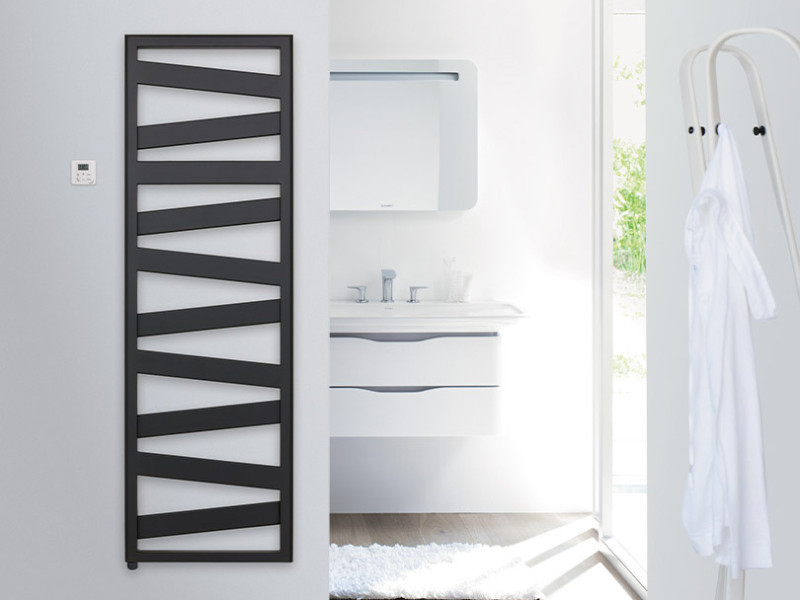
Shape and geometry: horizontal and vertical bars, and sculpted designs
The classic horizontal-bar design remains the most common — practical, versatile and compatible with all types of towels. But designers have explored many other forms: vertical bars for narrow walls, asymmetrical grids, serpentine shapes and slim, flat panels.
Particularly for small bathrooms, space-saving models — less than 40 cm wide — can be fitted into awkward wall configurations without compromising on heating capacity.
4. Freestanding or built-in: which installation method should you choose?
The question of installation is often determined by the existing layout of the bathroom. However, it is worth considering this right from the design stage, as it influences the choice of model, the installation budget and the final aesthetic result.
The wall-mounted towel warmer
This is the classic and most common option: the towel warmer is mounted directly on the wall, where it is visible and easily accessible. It is easy to maintain, offers maximum accessibility for hanging towels, and is quick to install.
When installed as a freestanding unit, it can be positioned strategically — opposite the shower, next to the washbasin, or in a corner — to maximise its heating efficiency in the room. It can also be installed at an adjustable height to suit different uses.
The towel warmer built into a cabinet
Although less common, this option is growing in popularity and allows a towel warmer to be integrated into an open or semi-open bathroom cabinet. The result is extremely discreet (barely visible) and fits perfectly into minimalist bathroom designs where every technical element must blend seamlessly into the furniture.
This integration requires the furniture to be designed with this in mind, and hot-water models are generally more suitable as they do not generate concentrated heat at a single point.
5. Towel warmers for small bathrooms: the most discreet models
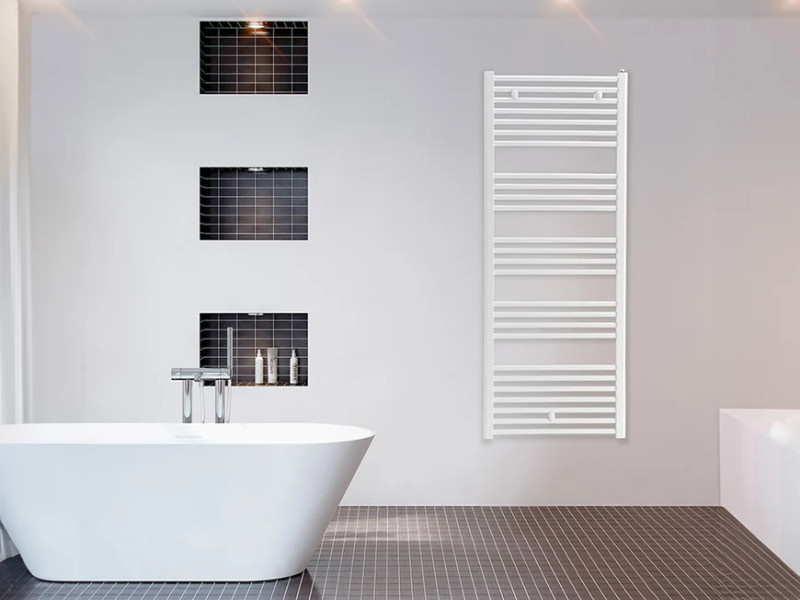
Key considerations for a small space
In a small bathroom, the towel warmer must meet additional requirements:
- Less than 40 cm wide, so it can fit between existing equipment
- Low-profile design (projecting less than 10 cm) so as not to obstruct traffic
- Compact power — a small room heats up quickly, so there’s no need to go for a larger model
- Mounted high on the wall to free up space at eye level and at floor level
Recommended formats
Compact models (approx. 40 × 80 cm) or vertical towel warmers with a minimal projection are ideal. Some brands offer corner models — specially designed to be fitted into a wall corner — which make clever use of space that is often left unused.
Tip for small bathrooms
In a room smaller than 4 m², a 400–600 W towel warmer is often sufficient if the walls are well insulated. Choose a model with a built-in thermostat to prevent overheating in a small space.
6. Electric towel warmer vs hot water: which option is more economical?
This is the question homeowners ask most often when buying a property. And the answer is (as is often the case) ‘it depends’.
How much energy does an electric towel warmer actually use?
A 750 W electric towel warmer used for 4 hours a day (morning and evening) for 8 months a year consumes around 720 kWh per year. At the average Belgian electricity tariff in 2026 (around €0.30/kWh), this amounts to approximately €216 per year.
With a thermostat and smart programming, this consumption can be reduced by 30–40% — bringing the annual cost down to €130–150. This is a perfectly acceptable level given the everyday comfort it provides.
Hot-water towel warmers: real savings, but with certain conditions
A hot-water towel rail uses almost no electricity. The cost is included in your boiler’s gas or fuel oil bill. If your heating system is efficient and your energy contract has been well negotiated, the running costs are inherently lower.
But the benefit becomes apparent over time: the higher installation costs (plumbing connections, bypass work) can take 3 to 5 years to pay for themselves compared to a well-designed electric system.
The Belgian context
Electricity prices in Belgium are among the highest in Europe, which makes hot-water solutions more cost-effective in the long term — provided that a water connection is already in place or can be installed without major building work.
7. Installation and RGIE standards: what you need to know before installation
Wetlands according to the RGIE
In a Belgian bathroom, there are three distinct areas:
Zone 0: inside the shower or bath — no electrical appliances permitted
Zone 1: above the shower/bath up to 2.25 m — IP44-rated fixtures are mandatory
Zone 2: 0.6 m around Zone 1 — IP44 recommended; some IP21 devices permitted
Outside designated areas: the rest of the bathroom — standard appliances permitted with precautions
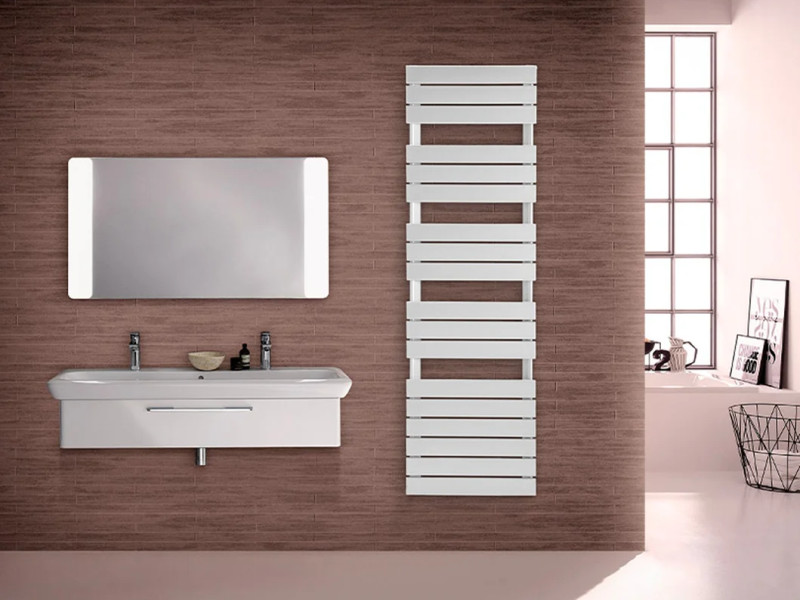
Legal requirement in Belgium
Any new fixed electrical installation in a bathroom must be inspected by an approved body (Vinçotte, Bureau Veritas, Socotec, etc.). This inspection is mandatory prior to the final handover of the works and is the installer’s responsibility.
Hot-water towel rails: plumbing requirements
For a hot-water model, the installation must be carried out by a qualified plumber. The connections must be accessible for maintenance, and shut-off valves are recommended to allow the unit to be removed without draining the entire system.
In Belgium, plumbing work on the central heating system does not require planning permission, but it must comply with the technical standards of the existing installation and be compatible with the system’s pressure.
8. Our 5-question guide to choosing
To help you make your decision, here is a quick guide to browse through before making a purchase.
Your situation | Our recommendation |
No boiler or flat without access to the system | Electric towel warmer with programmable thermostat |
A house with a boiler and a plumber who is easily accessible | Hot-water towel rail designed for economical everyday use |
A region with long winters, where heating is needed outside the usual heating season | Combined towel warmer — the best of both worlds |
Small bathroom (< 5 m²) | Slim electric model, 400–600 W, flat profile |
Low budget, simple installation | Electric, standard model with thermostat, surface-mounted |
9. Facq’s support for your project
Choosing a towel warmer seems simple enough. But fitting one properly into a renovated bathroom or one you’re planning to renovate, whilst taking into account technical constraints, electrical standards, the room’s style and the overall budget — that’s another matter entirely.
At Facq, a towel radiator is never treated as a standalone purchase. It forms part of a wider project — whether it’s a complete bathroom renovation, a one-off replacement or a first-time installation in a new-build home. Our advisors at the EXPOcenter are accustomed to addressing these issues by combining technical considerations (connections, power, RGIE zones) with aesthetic ones (finish, size, and harmony with the rest of the room).
Are you torn between an electric model and a hot-water connection? Do you have a tricky wall, a small space or an unusual layout? Are you looking for a towel warmer that matches matt black taps or industrial-style furniture? These are exactly the kinds of questions where a visit to the EXPOcenter makes all the difference — because a screen can’t replace the chance to see the finishes in real life, compare sizes side by side and get tailored advice for your specific setup.
And if you’d like to go beyond simply choosing a product, the Facq Install+ service allows you to coordinate the entire project — from selecting the model and planning the installation to putting you in touch with a qualified partner installer. You’ll have a single point of contact, a quote covering both equipment and installation, and a professional installation carried out in accordance with best practice, including compliance with RGIE standards.
Book an appointment at your local Facq EXPOcenter
Our technical advisors will help you choose the right model — type, power rating, finish — and can coordinate the installation via Facq Install+Book an appointment
Frequently asked questions
What is the ideal power rating for a towel warmer in a 6 m² bathroom?
For a 6 m² bathroom with a standard ceiling height of 2.50 m, giving a volume of around 15 m³, a power rating of 500 to 750 W is generally sufficient if the room is properly insulated. In an older or poorly insulated house, increase this to 750–900 W to compensate for heat loss. A model with a built-in thermostat will allow you to fine-tune the settings and reduce actual energy consumption.Can you install an electric towel warmer yourself in Belgium?
Technically, installing a fixed electric towel warmer in a bathroom constitutes an electrical installation in a damp area, subject to the RGIE regulations. If you are a skilled DIYer and connect the appliance to an existing socket outside zones 0 and 1, the installation is feasible. However, if a new circuit is required, a qualified electrician must be used — and inspection by an approved body remains mandatory for any new fixed installation.Can a hot-water towel rail work without a boiler in the summer?
No — in its standard version, a hot-water towel warmer is entirely dependent on your boiler. When the boiler is switched off, the unit produces no heat. It is precisely to overcome this limitation that the hybrid version exists, featuring a backup electric heating element, which allows for independent operation all year round.What is the difference between a towel warmer and a bathroom radiator?
A towel radiator is a radiator specifically designed for use in damp areas, featuring horizontal bars for hanging and drying towels. A bathroom radiator can come in various forms (flat panel, storage) but is not necessarily suitable for this purpose. The difference also lies in the IP rating: a genuine bathroom towel radiator must be certified for the area in which it is installed.Is it better to choose a white towel warmer or one in a trendy colour?
White remains the safest bet in terms of price, compatibility and availability. But if your bathroom is decorated in a bold style — matt black, industrial, wabi-sabi, Art Deco — a matching finish creates a real sense of visual cohesion. Coloured finishes generally cost 20 to 40 per cent more than white, but they contribute to the attention to detail that distinguishes a beautiful bathroom from a functional one.