Choosing the right bathroom basin: shapes, materials and installation
Three types of washbasins: find the one that suits you
The basin becomes the centrepiece of your bathroom. But be careful: each type of installation meets different needs. Make the right choice from the outset to avoid regrets.
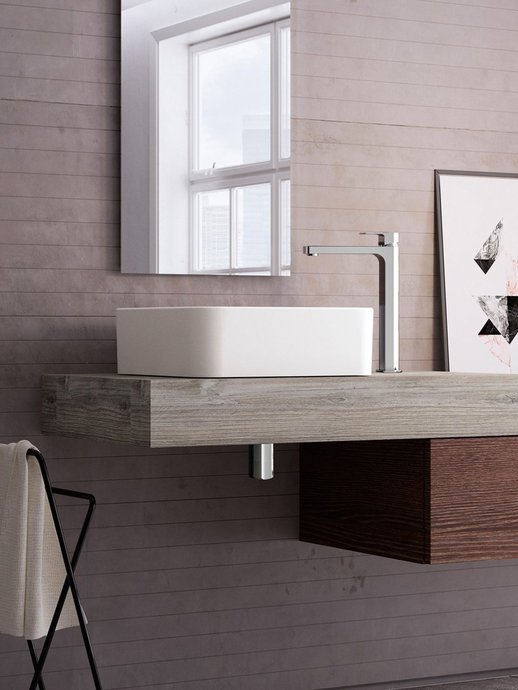
Countertop basin: the ultimate decorative feature
This basin simply sits on top of your bathroom cabinet or vanity unit. It immediately catches the eye and adds character to your space. Installation is straightforward: all you need to do is cut out a hole for the drain.
When it comes to aesthetics, the possibilities are endless. Classic ceramic, authentic natural stone, modern resin or designer glass – you are spoilt for choice. Round for softness, square for a contemporary look, each shape creates its own atmosphere.
Built-in basin: the practical solution
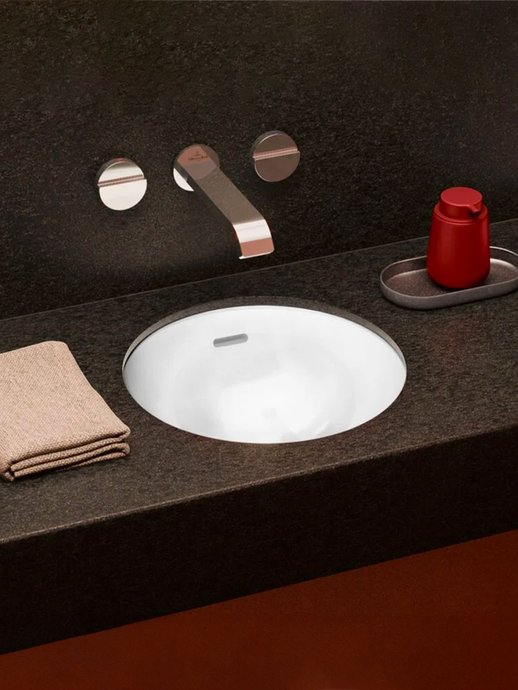
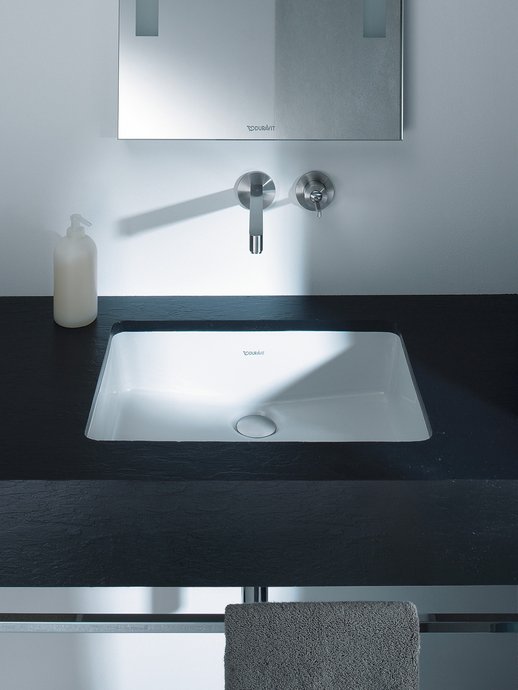
More discreet, this basin is partially integrated into your cabinet. Only its edges remain visible after the support has been precisely cut.
The main advantage? Simplified maintenance. No hard-to-reach corners, quick and efficient cleaning. Storage space around the water point remains optimised.
However, installation requires precision cutting – it is best to call in a professional. This option is ideal for families where practicality takes precedence over aesthetic originality.
Washbasin top: ready to install
The basin top eliminates visible joints. The basin is moulded directly into the top – resin, ceramic or composite stone, depending on your preference.
Directly installed on your cabinet or wall-mounted, the taps are fitted in the same way as on a traditional washbasin. Available in single or double versions, this system limits the risk of water infiltration.
Shape and size: find the perfect balance
Your washbasin should complement your bathroom and suit your daily habits. Its shape, dimensions and configuration determine how comfortable it is to use and how it looks in your bathroom. We will help you make this important choice.
Four shapes for four atmospheres
Each basin shape creates a distinct atmosphere in your bathroom.
The round basin brings softness and fluidity to your space. With a diameter ranging from 30 to 60 cm, it is perfectly suited to delicate or Zen styles. Its only drawback is the limited space around the rim for your toiletries.
The oval option combines elegance and practicality. Its dimensions (width 35–55 cm, length 50–90 cm) make it ideal for medium-sized bathrooms. It maximises storage space while maintaining a refined aesthetic.
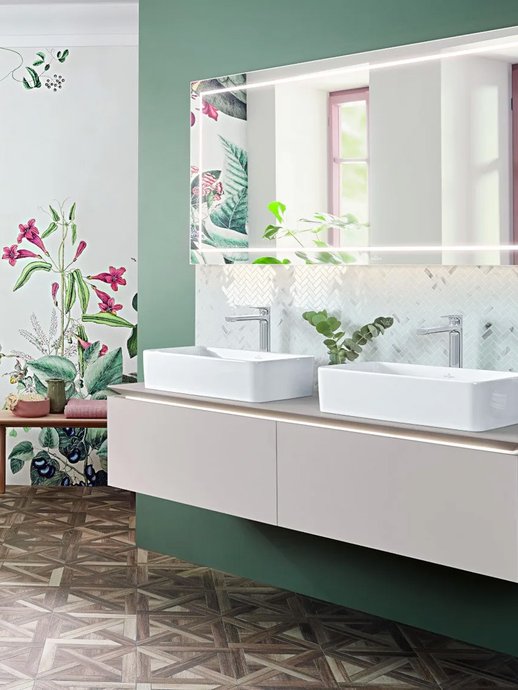
For a contemporary style, the square basin is a must with its clean geometric lines. Generally available in sizes between 35 and 50 cm, it fits perfectly into minimalist settings. Be careful, however: it can look imposing in a small space. Think carefully about your choice, especially if you want to fit out a small bathroom.
The rectangular shape remains the most versatile. Suitable for all styles, it offers an excellent practical compromise with its dimensions (width 35–55 cm, length 50–120 cm). This is why it remains the most popular choice.
One or two basins: adapt to your lifestyle
Your choice depends mainly on your family situation and your habits.
A single basin is suitable for single people or couples with different schedules. Allow for a minimum width of 70 cm for comfortable use. This solution has the advantage of being more economical to purchase and install, while also simplifying maintenance.
A double basin is essential for families or couples who are in a hurry in the morning. It requires a minimum of 120 cm for two separate basins, or 100 cm for a double basin with two taps. Bear in mind that this configuration also doubles the cost of equipment and connection.
Adjust the dimensions to suit your space
The available space naturally guides your choice of dimensions.
In a small bathroom (less than 5 m²), opt for compact washbasins measuring around 30 cm. Corner or wall-mounted models free up floor space. Choose shallow units (35–38 cm) rather than standard sizes (48–50 cm).
For a standard bathroom (approximately 5.5 m²), a single basin with a countertop measuring 70 to 120 cm is ideal. Ensure there is sufficient clearance: at least 70 cm in front of the unit and 20 cm on either side.
Large bathrooms allow for bold designs. With XXL or double sinks, dimensions can reach 150 to 200 cm in width.
What material should you choose for your washbasin?
Your washbasin will be with you for many years to come. So you might as well make the right choice from the outset! Each material has its advantages and minor drawbacks. We can help you see things more clearly so you can choose the one that really suits your needs and your budget.
Ceramic: reliable and accessible
Ceramic remains the classic choice for bathrooms, and with good reason. Timeless, it comes in a wide range of finishes and colours. Its smooth, non-porous surface makes it remarkably resistant to scratches, stains and corrosive products. Economical and easy to maintain, ceramic is resistant to acidic household products and cosmetic pigments.
If you have children, this option is particularly wise: it effectively withstands everyday knocks without deteriorating. The only slight drawback is that it feels cold to the touch, but this does not affect its performance in any way.
Natural stone: unrivalled authenticity
Natural stone basins add an incomparable touch of authenticity to your bathroom. Marble, with its distinctive veining, offers timeless elegance but requires periodic sealing to prevent staining. Granite guarantees exceptional durability thanks to its resistance to impact, high temperatures and acids.
For a zen atmosphere, river pebble basins create a striking natural effect. But beware of their considerable weight: make sure your support is sturdy enough!
Synthetic resin: the smart compromise
Synthetic resin, also known as "Solid Surface", combines natural minerals and acrylic resins. This contemporary material allows for great freedom in terms of shapes and colours, and can even imitate other materials such as marble or wood. Non-porous and resistant to impact and scratches, it also has a pleasant feel to the touch.
However, it is sensitive to harsh detergents and solvents. Depending on the quality chosen, some resins may yellow over time despite regular maintenance.
Glass, wood, stainless steel: dare to be original
These alternative materials allow you to create a truly unique bathroom. Glass brings light and elegance, but requires regular maintenance to prevent limescale marks. Its relative fragility is worth considering if you have children.
Wood, warm and authentic, is mainly available in teak or fossilised wood to resist humidity.
Stainless steel is ideal for contemporary styles. Lightweight and modern, it is susceptible to scratches: use only mild detergents.
Master the technical aspects of your installation
A properly installed washbasin ensures your daily comfort and the durability of your equipment. We outline the key points to consider for a successful and functional installation.
Find the perfect height for your needs
The installation height determines your everyday comfort of use. The European standard recommends approximately 83 cm between the floor and the drain for a wall-mounted washbasin. For a vanity unit, aim for a height of 85 to 87 cm.
This standard measure can be adapted to your specific needs:
- Taller individuals: a height between 90 and 92 cm prevents you from slouching.
- Family use with children: allow between 50 and 70 cm in a dedicated room, or install a step stool[212].
- Optimal comfort: never exceed 92.5 cm in height
Do not forget to subtract the height of your countertop basin (approximately 12 cm) from your calculations.
Optimise depth and circulation
The available space determines your choice of vanity unit. The depth generally varies between 40 and 60 cm depending on your layout:
- Built-in basin: 40 to 50 cm is sufficient
- Countertop basin: allow 50 to 60 cm for greater ease of use.
To move around comfortably, observe these minimum distances: 70 cm in front of the sink and shower, ideally 100 cm in front of a bathtub. In a small bathroom, you can reduce this to a minimum of 50 cm.
Your ideal washbasin awaits you
Choosing the right washbasin can truly transform your daily life. This choice affects your comfort and the harmony of your personal space.
Form is as important as function. A round basin adds softness and elegance, while a rectangular model offers practicality and modernity. The available space determines your options: compact basin for small spaces, double basin for families.
When it comes to materials, you now have all the information you need to make your choice. Ceramic remains a reliable and economical classic. Natural stone appeals for its authenticity. Resin combines modernity and durability at an affordable price.
Technical aspects should not be overlooked. The installation height, suitable fittings and space for plumbing determine your everyday comfort. A vanity unit optimises space while concealing technical elements.
Take the time to assess your needs before purchasing. A well-chosen washbasin will last for years and contribute to the well-being of your bathroom.
Visit an EXPOcenter Facq to discover our solutions and benefit from the advice of our experts.
Frequently asked questions
Q1. What is the difference between a basin and a washbasin?
A basin requires a support and its taps are connected to the countertop or cabinet, while a washbasin can be fixed directly to the wall or supported by a pedestal. Washbasins are generally taller (85-90 cm) than basins.Q2. What are the advantages of a countertop basin?
A countertop basin offers a wide range of aesthetic options, adapts to all decorative styles and allows for extensive customisation of the bathroom. It is relatively easy to install but may require more careful maintenance around its base.Q3. What is the ideal height for installing a washbasin?
The optimal height for a washbasin unit is generally between 85 and 87 cm. For taller people, it can be up to 90-92 cm. It is important not to exceed 92.5 cm for optimal comfort of use.Q4. What materials are recommended for a durable washbasin?
Ceramic is a classic choice that is durable and easy to maintain. Natural stone offers robustness and unique aesthetics. Synthetic resin combines modernity and resistance. The choice depends on your aesthetic preferences, your budget and your maintenance needs.Q5. How do I choose the right size washbasin for my bathroom?
The size of the washbasin should be adapted to the available space. For a small bathroom (less than 5 m²), opt for compact washbasins measuring around 30 cm. In a medium-sized bathroom (5.5 m²), a washbasin measuring between 70 and 120 cm is suitable. For large bathrooms, you can consider XXL formats up to 200 cm wide.