Why are shower toilets more hygienic?

In Japan, more than 80 per cent of households were fitted with a bidet toilet seat in 2018. In Belgium, they are still a rare sight, and many visitors who mention them at the EXPOcenter arrive with the same question, asked somewhat sheepishly: is it really cleaner, or is it just a luxury gadget? The short answer is yes, it is more hygienic. The full answer requires a few nuances that manufacturers’ brochures fail to mention, and these are set out below.
How does a shower toilet work?
Once seated, you press a button on the remote control or the side panel. A thin nozzle extends from beneath the seat, rinses itself, then directs a stream of lukewarm water towards the area to be cleaned. You can adjust the temperature, pressure and position of the jet. More fully-featured models include a specific jet for women, hot-air drying, a heated seat, automatic lid opening or odour extraction. At the end, the nozzle rinses again and retracts into its housing.
The idea did not originate in Japan. Geberit launched its first toilet with a built-in bidet in Switzerland in 1978. Japan simply adopted the concept on a large scale.
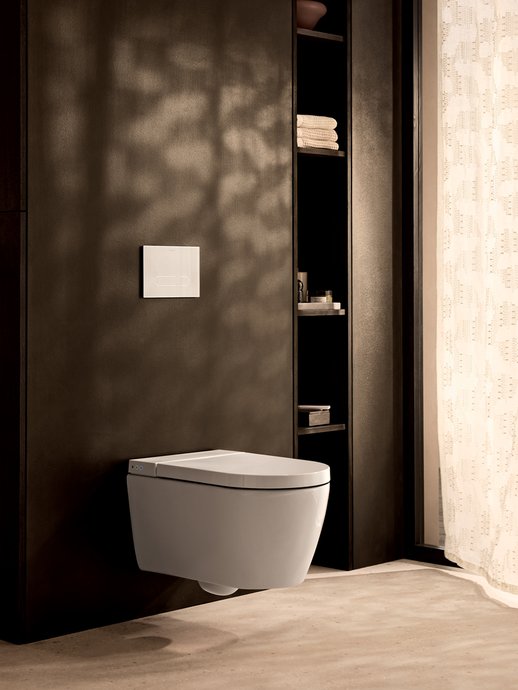
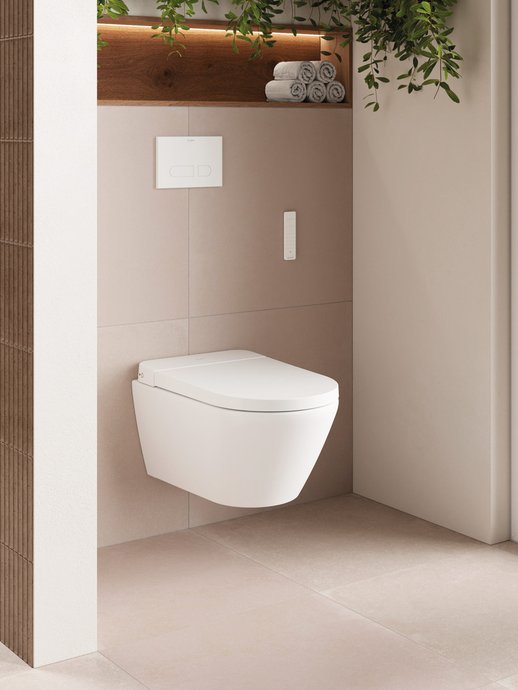
There are two main types. The all-in-one shower toilet combines the bowl, the electronic controls and the shower head in a single unit, mounted on a support frame. This is the solution used in most models sold at Facq, such as the Geberit AquaClean Tuma Comfort or the Villeroy & Boch ViSoul 2.0. The bidet seat, on the other hand, is fitted onto an existing toilet bowl. It is cheaper but does not integrate as well, and the toilet bowl has not always been designed for this type of use.
A cleaner toilet bowl – not just for the user
The hygiene of a shower toilet also depends on the ceramic. Almost all recent models feature a rimless bowl, eliminating that recessed rim where limescale and bacteria accumulate out of reach of the toilet brush. The Geberit AquaClean Alba, for example, combines a rimless bowl with KeraTect enamel, which is less prone to dirt build-up.
There is also a less obvious benefit. As little or no toilet paper is used, the flush clears the contents of the bowl more easily, without the need to flush twice. And on models where the lid closes automatically, you get into the habit of flushing with the lid closed, which reduces the spread of fine droplets around the room. This applies to any toilet.
The shower toilet: tackling Belgian hard water
This is the point that websites never mention, and yet it is very important here. A nozzle just a few millimetres in diameter quickly becomes clogged with limescale when the water is hard, and a limescale-clogged nozzle cleans less effectively and traps more deposits. In Belgium, water hardness varies greatly from one region to another.
Region | Medium hardness | Implications for a toilet with a shower |
| Ardennes (Namur, Luxembourg) | 5 to 12 °fH | Occasional descaling |
| Liège, Hainaut | 12 to 22 °fH | Descaling in accordance with the appliance’s alerts |
| Brussels-Capital | 20 to 28 °fH | Regular scaling – keep an eye on this |
| Walloon Brabant, Flemish Brabant | 22 to 35 °fH | Frequent descaling; consider installing a water softener |
Manufacturers have taken the issue seriously. The Geberit AquaClean Alba, for example, features a descaling programme that alerts the user and guides them step by step. When comparing models at the EXPOcenter, ask how descaling is carried out, how often it needs to be done, and what product is used. If your home already has a water softener, the shower toilet will benefit directly from this.
Rainwater tank: take care with the connection
Another Belgian peculiarity. In Flanders and Brussels, a rainwater tank is compulsory in most new builds, and the toilet is the first appliance to be connected to it. For flushing, there’s no problem. For the bidet, however, this is not permitted: the water used for personal hygiene must be potable water from the mains supply. Your plumber must therefore provide two separate water inlets at the building structure – rainwater for the flush and mains water for the bidet – or connect the entire toilet and bidet unit to the mains supply. This detail can be sorted out easily before the work begins. Afterwards, the casing will need to be reopened.
For whom does the shower toilet make the biggest difference?
First and foremost, for older people. Wiping oneself with toilet paper requires flexibility in the shoulders and back, and this is often one of the first tasks that becomes difficult with age or osteoarthritis. A shower toilet helps people retain their independence in the toilet for longer, without needing outside help. For a home-care solution, combine it with a seat height of between 45 and 50 cm and a grab rail: you’ll find this equipment in the comfort toilets section at Facq. You should also find out about home adaptation grants (AVIQ in Wallonia, Iriscare in Brussels, Vlaamse aanpassingspremie in Flanders), the eligibility criteria for which change regularly.
For people with reduced mobility or those recovering from an operation, the argument is the same. For families, it is primarily a question of everyday comfort and hygiene, with a significant reduction in paper usage. In a home where several generations share the same toilet, everyone can save their settings on models that support user profiles, which means they don’t have to reconfigure everything every time they use it. And for those who have none of these constraints, it is often a habit picked up whilst travelling in Japan, or whilst staying with friends, that makes them want to take the plunge.
Three common misconceptions we often hear
“The spray is cold and it splashes.” That used to be true of the first cheap bidets. Today’s models heat the water before washing, to an adjustable temperature, and the nozzle targets a specific area beneath the seat. You stay dry, apart from the area being washed. The first time you use it, it’s a bit of a surprise; by the third time, it’s much less so.
“You need a large bathroom.” No: a toilet-shower unit that takes up the same space as a wall-hung toilet. The Geberit AquaClean Alba or the Grohe Sensia Pro are fitted onto the same type of support frame as a standard toilet bowl, and fit easily into the ground-floor toilet. The only thing that needs to be planned in advance is the location of the electrical socket.
‘The electronics are going to break down. ” A shower toilet contains a pump, a heating element and an electronic circuit board, so yes, it is a more complex appliance than a ceramic toilet bowl. Most of the faults we encounter are caused by limescale, which is why regular descaling is important. Choose a brand that provides after-sales service in Belgium and ensures the availability of spare parts; you can ask your sales adviser about this before making a purchase.
Installing a shower toilet in Belgium: what you need to bear in mind
A shower toilet is fitted onto a standard support frame, just like a conventional wall-hung toilet. It also requires two additional things: a water supply connected to the frame, and a 230 V mains supply right next to it, concealed behind the plasterboard. In Belgium, this power supply is installed by an electrician, in accordance with the RGIE, on a circuit protected by a 30 mA residual current device, as is the case in a bathroom. If you are renovating without buying a shower toilet straight away, make sure you have the cable laid anyway: it will cost a few dozen euros whilst the work is in progress, but much more once the tiling has been laid.
In terms of energy consumption, the differences are minimal. A wash cycle uses a small amount of water, which is nowhere near as much as a 3 to 6-litre flush. Geberit states that its AquaClean models consume 0.5 W in standby mode. The built-in water heater and the heated seat are the biggest energy consumers, and these can be programmed or switched off.
How do you choose a shower toilet?
At Facq, the shower toilet range includes several models from five brands. Prices are determined more by the level of features than by the quality of the wash itself: even the entry-level models wash effectively.
Gamme | Models at Facq (including VAT, October 2026) | What you gain by moving up the range |
| Access | Geberit AquaClean Alba 1 083,56 €, Vigour Aquawash 1 884,30 €, Grohe Sensia Pro 2 161,85 € | Adjustable spray, self-cleaning nozzle, flangeless bowl |
| Intermediate | Duravit SensoWash D-Neo 2 €635.38, Villeroy & Boch Tivo 2 €775.86, Grohe Sensia Arena 2 €971.07, Geberit AquaClean Tuma Comfort from €2,980, Geberit AquaClean Sela from €3,359.84 | Drying, heated seat, feminine wash, user profiles |
| Top-of-the-range | Villeroy & Boch Supreo €4,394.12, Villeroy & Boch ViSoul 2.0 from €4,983.99, Geberit AquaClean Mera Classic from €5,046.29, Mera Comfort from €6,154.50, Duravit SensoWash Starck f Pro €8,420.15 | Automatic lid, odour extraction, ambient lighting, designer look |
To decide between two models, look at the hygiene features over the long term: nozzle cleaning (automatic, manual, or both), the descaling method, whether the nozzle can be removed, and how easy it is to clean under the seat. Then consider the comfort settings: the number of pressure and temperature levels, oscillating spray, and drying. Our advice: try out the remote control at the EXPOcenter. A shower toilet where you don’t understand the buttons will end up being used just like a standard toilet.
Frequently asked questions
Does a shower toilet completely replace toilet paper?
On models with hot-air drying, many users do without it altogether. On other models, people still use a little paper to dry their hands, but in much smaller quantities. In all cases, paper consumption falls significantly.Is the nozzle on a shower toilet hygienic?
Yes, provided you look after it. It rinses itself automatically before and after each use, but a weekly manual clean is still recommended. The studies that found bacteria on the nozzles looked at hospital devices shared by many patients, not those used in the home.Can a shower toilet be connected to a rainwater tank?
The flush can operate using rainwater, but the shower head must be supplied with drinking water from the mains. Your installer will provide two separate water inlets at the support frame, or connect the entire unit to the mains water supply.Do you need to descale a shower toilet?
Yes, particularly in Brussels and the two Brabants, where the water often exceeds 25 °fH. Most recent models have a descaling programme that alerts you when it needs to be run. A water softener significantly reduces the frequency of this.Does a shower toilet use a lot of electricity?
No. Geberit states that its AquaClean models consume 0.5 W in standby mode. The power consumption mainly comes from heating the water and the toilet seat, two functions that can be programmed or switched off.