Which heating system should you choose for your renovated home?

The essentials
1. The choice of your heating system depends first and foremost on how well your home is insulated. In a well-insulated home (PEB rating C or better), an air-to-water heat pump is currently the most efficient and cost-effective solution in the long term. In a poorly insulated or older home, a condensing boiler remains the most sensible choice until you are able to insulate the property properly.
2. Radiators and underfloor heating are not alternatives to a heat pump or boiler: they are heat emitters that distribute the heat produced by these heat generators. The combination of a heat pump with underfloor heating or low-temperature radiators offers the best efficiency, but requires a well-insulated home. In a renovation project involving existing radiators, it all depends on whether they are compatible.
3. In Belgium in 2026, regional grants provide substantial support for heat pumps, and a 6% VAT rate applies to renovations in homes over 10 years old. A smart thermostat can reduce your energy bill by 10–20% without altering the existing installation. Our Facq experts are on hand to help you put together a coherent system, tailored to your setup, at the EXPOcenter.
First step: assess the insulation before choosing a heating system
Every professional will tell you this, but few really explain why: your home’s insulation determines which heating system you can install effectively. It’s not a question of environmental principles or fashion; it’s purely a question of efficiency.
A heat pump works most efficiently when it can heat at low temperatures (35 to 45 °C). If your home loses heat through the roof, walls or poorly insulated windows, the system will have to increase the temperature to compensate, and at that point, its efficiency plummets. You end up paying a high electricity bill for mediocre comfort.
Conversely, in a well-insulated home, a heat pump produces three to four times more energy than it consumes. It is this difference that makes it the most cost-effective solution over a 10- to 15-year period, despite a higher initial investment than a boiler.
How can you tell if your insulation is adequate?
The PEB (Building Energy Performance) certificate is the official indicator in Belgium. If your home is rated level C or higher, it is suitable for a heat pump. At level D, it’s borderline: it needs to be assessed on a case-by-case basis, often with the help of an auditor. At level E, F or G, it’s better to insulate first, or stick with an efficient boiler for the time being.
If you don’t have a recent energy performance certificate, there are a few simple signs that speak for themselves: feeling cold near windows or external walls even when the heating is on, abnormally high heating bills (over €2,500 per year for a 150 m² house in Belgium), condensation on windows in winter, uninsulated lofts, or insulation less than 15 cm thick.
Belgian landmark
Insulation grants (for roofs, walls, floors and windows) are often better value for money than heating grants. In Wallonia, Brussels and Flanders, the amounts vary, but the principle remains the same: insulating first means you can then install a less powerful – and therefore cheaper – heating system.
Heat pumps: the dominant solution by 2026, but not for everyone
In Belgium, air-to-water heat pumps have become the go-to choice for energy-efficient renovation projects and new builds. The reasons are clear: superior efficiency, eligibility for regional grants, compliance with the new PEB standards, and added value for resale.
The principle is simple: the pump extracts heat from the outside air (even at -10 °C, the air still contains thermal energy) and transfers it to the heating water circuit. For every 1 kWh of electricity consumed, it produces 3 to 5 kWh of heat. This is known as the COP (coefficient of performance).
In what situations is a heat pump really a viable option?
An air-to-water heat pump is the obvious choice in three situations:
- Extensive renovation with full insulation: roof, walls and windows. You’re starting with a sound foundation, heating requirements are low, and the heat pump can operate at low temperatures throughout the season. It’s the ideal scenario.
- Replacing an old boiler in a partially insulated house (energy rating C to D), provided that the existing radiators are adapted or replaced. An engineering consultancy can quickly assess whether your current radiators are compatible or whether they need to be replaced with low-temperature models.
- Whether it’s a new build or an extension: the building envelope is energy-efficient from the outset, and you can choose the heat emitters (underfloor heating, radiators) to work in harmony with the heat pump.
Things to bear in mind before you start
Another point to bear in mind is noise. An air-to-water heat pump has an outdoor unit that runs continuously. It’s not as loud as an air conditioning unit, but it is audible, especially at night in a quiet garden. The location must be chosen carefully: not next to a bedroom, and not too close to the neighbours if possible.
Finally, the installation cost. Between €12,000 and €18,000 for a house of 120 to 150 m² in Belgium, depending on the complexity of the project. Regional grants may cover 30 to 50% of the cost, depending on your region and your income, but you will need to pay the costs upfront.

Condensing boilers: still a viable option in certain cases
Condensing boilers (natural gas or oil) are still very much in use in Belgium, and for good reason: they remain the most suitable solution for older, poorly insulated homes, where heat pumps would reach their technical limits.
How it works: it recovers heat from the combustion flue gases (which used to be released into the atmosphere) to preheat the return water in the system. Efficiency: > 90%, compared with 70–80% for a standard older boiler. This is a real improvement if you’re replacing a system that’s over 20 years old.
When should you choose a boiler over a heat pump?
Three situations where a condensing boiler remains the most sensible choice:
Poorly insulated house (EPC grades E, F, G) with existing high-temperature radiators. The boiler operates without any issues at 70–80 °C, whereas a heat pump would be constantly overheating with a disastrous COP.
Urgent replacement in the middle of winter, with no time to wait for a full energy audit. The boiler can be replaced with an identical model within 1 to 2 days, whereas a heat pump requires further assessment and installation work.
A limited budget and an older house where full insulation would be too expensive in the short term. The condensing boiler already reduces the bill by 20 to 30 per cent compared to the old one, without the need for major building work.
The limits of the boiler in 2026
Gas condensing boilers have been banned in new buildings in Belgium since 2024 (EPBD Directive). They are still permitted in renovation projects, but regional grants are providing less and less support for them.
Another drawback is the reliance on gas or oil. Fossil fuel prices fluctuate significantly, and over a 15-year period, the cumulative costs can far exceed those of a heat pump, even with a higher initial investment.
Finally, resale value. A house fitted with a heat pump has a better energy performance certificate and attracts more buyers than a house with a gas boiler, particularly in the upper-middle market.
Belgian landmark
Oil-fired boilers are gradually being phased out across all three Regions. In Wallonia and Brussels, the installation of new systems is being discouraged (no subsidies, phased-in bans). In Flanders, the timetable for phasing out oil-fired boilers has already been set for the coming years.
Radiators: design, performance and compatibility with your generator
Radiators are the units that distribute the heat generated by the boiler or heat pump. However, not all radiators work in the same way, and your choice will have a significant impact on the overall efficiency of your system.
High-temperature vs low-temperature radiators: what’s the difference?
High-temperature radiators (70–80 °C) are the standard models found in older homes. They are designed to work with a boiler that generates a high heat output. The problem is that a heat pump cannot reach these temperatures without losing efficiency.
Low-temperature radiators (45 to 55 °C), also known as large-surface-area radiators, are designed to deliver the same amount of heat at a lower temperature. They are larger (to compensate), but are much better suited to a heat pump.
Inertia radiators (made of cast aluminium, natural stone or ceramic) store heat and release it gradually. They provide consistent comfort without sudden temperature fluctuations and work well with a heat pump if correctly sized.
How can you tell if your existing radiators are compatible with a heat pump?
A professional can work this out in a matter of hours: they measure the current output of your radiators, assess the room’s actual heating requirements (taking into account any insulation work you’ve had done), and determine whether they can operate at 45–50 °C.
In a renovation project involving improved insulation, heating requirements often fall by 30 to 40 per cent. As a result, your existing radiators – even high-temperature ones – may be sufficient when operating at half capacity. But this is not always the case.
If the calculations show that your radiators are undersized for a heat pump, you have three options: replace them with larger low-temperature radiators, add radiators in the coldest rooms, or install underfloor heating in the main areas and keep the radiators as a backup.
Designer radiators: style and performance in 2026
At Facq, you’ll find over 50 specialist brands at the EXPOcenter, with advisors on hand to help you choose the right model based on your heating requirements, the space available, and the style of your home. A well-chosen designer radiator becomes a decorative feature in its own right, not just a technical appliance.
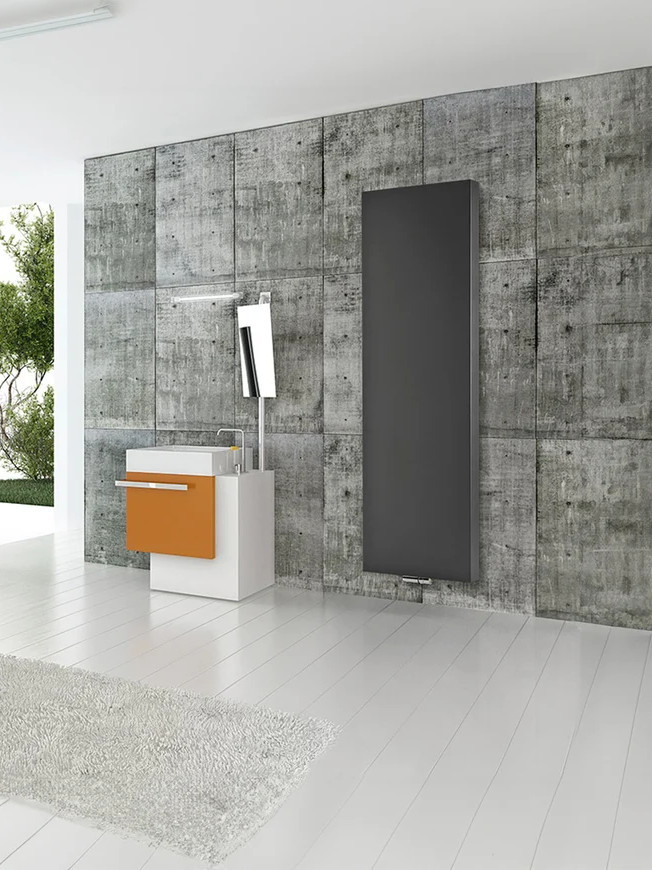
Underfloor heating: maximum comfort, but not always an option in renovation projects
Hydraulic underfloor heating (hot water) is often regarded as the ultimate in thermal comfort. It provides even heat throughout the room, eliminates the need for bulky radiators, and operates at a low flow temperature (28–35 °C), which is ideal for a heat pump. On paper, it is the ideal system.
Why is underfloor heating so effective when used with a heat pump?
Because it operates at very low temperatures. A heat pump supplying underfloor heating at 35 °C has a COP of 4 to 5. The same heat pump supplying high-temperature radiators at 70 °C has a COP of 2 to 2.5. That is almost half as efficient.
The level of comfort is also superior: the heat rises gently and evenly from the floor, with no draughts or cold spots. You can set the temperature 1 to 2 °C lower than you would with radiators and still feel just as comfortable. This means even greater savings.
Is that really possible when renovating?
Yes, but not in all cases. Underfloor heating requires either a screed (6–8 cm thick) or a dry-lay system using pedestals (2–4 cm thick). In both cases, this raises the floor level, which means:
- Adjust the door thresholds
- Replace the skirting boards
- Check the ceiling height (especially in flats or loft conversions)
A dry underfloor heating system is much better suited to renovation projects than a wet screed: there’s no drying time, installation is quicker, and there’s less load on the existing floor. But it’s still a major structural project, not just a simple replacement of radiators.
In which rooms should underfloor heating be installed as a priority?
If you can’t install underfloor heating everywhere, prioritise:
- The living room: this is the main living area, where thermal comfort matters most.
- The bathroom: warm floors after a shower – lovely to walk on barefoot.
- The rooms: quiet and comfortable, with no visible radiators.
The other rooms (study, hallway, laundry room) can easily keep their radiators. A combined system (underfloor heating + radiators) makes perfect sense and helps keep costs down.
Belgian note
Underfloor heating may be eligible for regional grants for comprehensive energy-efficiency renovations (the ‘renovation package’ in Wallonia, ‘Rénopack’ in Brussels), provided it is combined with a heat pump or a high-efficiency condensing boiler.
Smart thermostat: immediate savings without any installation work
A smart thermostat learns your habits, automatically adjusts the temperature according to the time of day, and can be controlled remotely via your smartphone. The result: savings of between 10% and 20% on your heating bill, depending on your occupancy pattern.

How does it actually work?
The thermostat detects when you are away (using your smartphone’s geolocation or presence sensors) and automatically lowers the set temperature by 2 to 3 °C. It raises the temperature 30 minutes before you return so that the house is at the right temperature when you arrive.
You can also set fixed time slots (night, day, weekend) and adjust them in real time via the app if your plans change. There’s no need to heat your home all day if you’re at work, or all night if you prefer to sleep in a cooler room.
Is it compatible with all systems?
Almost all of them. Smart thermostats are compatible with gas and oil boilers, heat pumps, and even some electric heating systems. Installation takes between 30 minutes and an hour for a professional, and the return on investment is usually less than two years.
Please note: not all thermostats are compatible with all systems. Before purchasing, check that it is compatible with your boiler or heat pump make and model. Facq advisors can help you choose the model best suited to your setup.
High-temperature vs low-temperature heating: understanding the difference
This distinction often comes up in discussions, but it is not always fully understood. Yet it completely changes the way your system works.
A high-temperature system operates at temperatures between 60 and 80 °C. This is the standard for older systems with gas or oil-fired boilers and conventional radiators. It heats up quickly and responds rapidly, but it consumes a lot of energy.
A low-temperature system operates between 35 and 55 °C. This is the ideal operating range for heat pumps and underfloor heating. It heats more slowly, but with much higher efficiency and more consistent comfort.
Is your home suitable for low-temperature heating?
If you’re torn between upgrading your insulation and replacing your heating system, the answer is always the same: insulate first. Once your building envelope is well insulated, you can install a low-temperature system (heat pump plus underfloor heating or suitable radiators) that will operate at its best.

What type of heating is best for an extension or a conservatory?
Extensions and conservatories raise a specific question: should the new area be connected to the existing central heating system, or should a separate system be installed?
If your boiler or heat pump still has spare capacity, and the extension is well insulated, connecting it to the existing system is often the simplest and most cost-effective solution. You simply add one or two radiators (or an underfloor heating circuit), and that’s it.
If your current system is already operating at full capacity, or if the extension is poorly insulated (such as a conservatory with large windows), it is best to install a separate auxiliary heating system: an air-to-air heat pump (reversible air conditioning), an electric storage heater, or a wood pellet stove.
The specific case of the conservatory
A conservatory loses a lot of heat through its windows, even with double glazing. Heating it using the house’s central heating system is expensive and yields poor results. The most effective solution is often a reversible air-to-air heat pump (air conditioning): it heats in winter, cools in summer, and does not draw on the boiler or the main heat pump.
Another option is not to heat the conservatory continuously, but only when you are using it, using a portable electric heater or an infrared space heater. This is much more economical than maintaining a constant temperature of 20 °C in a poorly insulated space.
Dehumidifier or heating: managing humidity in winter
In Belgium, indoor humidity in winter is a real problem in poorly ventilated or poorly heated homes. Condensation on windows, mould in corners, and a musty smell: these are all signs of excessively high humidity levels (>60–65%).
Heating alone does not solve the problem. Proper ventilation (either a DIY system or a mechanical ventilation system) is needed to remove the moisture produced by the kitchen, the bathroom and breathing. If ventilation is inadequate, an electric dehumidifier can help in the short term, but it is not a long-term solution.
Please note: a dehumidifier uses electricity (between 200 and 400 W continuously) and does not actually heat the room. It is a supplementary appliance, not a heating system.
Belgian landmark
The NBN D 50-001 standard stipulates a minimum ventilation rate for residential properties in Belgium. In major renovation projects, the installation of a mechanical ventilation system (single-flow or dual-flow CMV) is often mandatory, depending on the local authority.
Thermal insulation and heating: the direct link to the bill
We’ve already mentioned this several times in this article, but it bears repeating: your heating bill depends far more on the quality of your insulation than on the type of heating system you have installed.
A poorly insulated house with a state-of-the-art heat pump uses more energy than a well-insulated house with an old condensing boiler. It’s simple maths: if heat escapes through the roof, walls and windows, the system has to run constantly to make up for it.
Insulation priorities in Belgium:
1. The roof (30% of heat loss): insulation of at least 20 to 30 cm.
2. External walls (25% of heat loss): external or internal insulation, depending on the layout.
3. Windows (15% of heat loss): high-performance double glazing (Ug ≤ 1.1 W/m²K).
4. The floor (10% of heat loss): insulation of the cellar or crawl space.
Once you’ve addressed these four points, you can halve your heating bill without changing your system. And if you then switch to a heat pump, you’ll achieve maximum efficiency.
Towel radiators in the bathroom: performance and design
The towel radiator is a special case within a home’s heating system. It must both heat the room (especially in winter) and dry towels quickly after a shower. These two functions require different levels of power.
To heat a bathroom measuring 6 to 8 m² properly, you need around 800 to 1,000 W. To dry towels quickly, the temperature needs to rise rapidly, which makes electric or combination models (hot water + electric) the best choice.
Electric towel warmer vs hot water vs combination
The electric towel warmer operates independently. You can switch it on whenever you like; it heats up quickly, and you can even use it in summer to dry towels without turning on the central heating. Downside: it uses electricity continuously in winter.
The hot-water towel rail is connected to the central heating system (boiler or heat pump). It does not use electricity for heating, but it only works when the heating is on. In summer, it cannot be used for drying.
The dual-system towel warmer combines both: it is connected to the central heating system in winter and features an electric heating element for use in summer or between seasons. It is the most versatile option, but also the most expensive to buy.
Design and finishes: they matter in the bathroom
A towel rail is often the focal point of a bathroom’s décor. Manufacturers are well aware of this: finishes include matt black, glossy white, chrome and brushed gold, with designs ranging from straight to curved, and from slimline to more substantial models.
At Facq, you’ll find over 50 models on display at the EXPOcenter, with advisors on hand to help you choose the right one based on your power requirements, the space available, and the style of your bathroom.
Condensing boilers vs heat pumps in 2026: how to decide?
This is the most frequently asked question when it comes to energy-efficient renovations. Both technologies are mature, tried and tested, and widely available on the Belgian market. So how do you choose?
The answer boils down to a single factor: the condition of your home.
If your home is well insulated (PEB C or better) and fitted with low-temperature heating systems (underfloor heating or suitable radiators), a heat pump is the best choice. It offers superior efficiency, lower running costs, regional grants and improved resale value.
If your home is poorly insulated (PEB D-E-F-G) and has existing high-temperature radiators, a condensing boiler remains the most sensible choice. It’s easy to replace, the installation costs are reasonable, no work is required on the radiators, and you retain the option of switching to a heat pump later on, once you’ve improved the insulation.
The hybrid system (heat pump + backup gas boiler) is the middle ground: the heat pump runs most of the time, and the boiler kicks in on the coldest days or when demand is too high. It is more expensive to install, but it allows you to enjoy the benefits of both technologies.
Benefits and financial assistance in Belgium: what matters in 2026
Energy renovation grants change every year, and the amounts vary by region (Wallonia, Brussels-Capital, Flanders). However, a few key principles remain the same:
Air-to-water heat pumps are automatically eligible for grants in all three regions, provided they meet the performance thresholds (minimum COP, minimum SCOP depending on the region).
A 6% VAT rate applies to renovations in homes over 10 years old in Belgium. This covers the installation of heat pumps, radiators and underfloor heating, as well as all associated work (plumbing, electrical work and screeding).
Grants are often subject to a prior energy audit, particularly for larger sums. A certified auditor draws up a report which forms the basis of the application.
These incentives can be combined: regional grants + federal tax relief + reduced VAT rate. A certified energy advisor (CEA) can provide you with a comprehensive overview.
Belgian landmark
In Wallonia, grants are administered through Mywallonia. In Brussels, they are administered through Bruxelles Environnement (Energy Grants and Rénopack). In Flanders, they are administered through the Vlaams Energiebedrijf (grants). The amounts and conditions change every year. A Facq advisor can guide you during your appointment at the EXPOcenter.
Frequently asked questions
Q1. What is the best heating solution for a renovated house in Belgium in 2026?
There is no one-size-fits-all solution, but there is a clear rationale. In a well-insulated home (PEB C or better), an air-to-water heat pump combined with low-temperature radiators or underfloor heating is the most efficient and cost-effective solution over a 15-year period. In a poorly insulated home, a condensing boiler remains the more suitable option and is less expensive to install. A smart thermostat can reduce your bill by 10 to 20 per cent without altering the existing system, whatever it may be. The key is to assess the insulation before choosing the system, because a heat pump in a poorly insulated house consumes as much energy as a boiler, without offering any real benefit.Q2. Are my existing radiators compatible with a heat pump?
It depends on their size, type, and, above all, your home’s insulation. A thermal engineering firm can carry out the calculations in a matter of hours: they measure the current output of your radiators, assess the actual requirements following insulation, and determine whether they can operate at 45–50 °C (low-temperature mode). In a renovation with improved insulation, heating requirements often fall by 30 to 40 per cent, which sometimes allows you to keep the existing radiators. If this isn’t the case, you can replace them with larger low-temperature radiators, or install underfloor heating in the main rooms and keep the radiators as a backup.Q3. Is it really possible to install underfloor heating during a renovation?
Yes, in most cases. The dry system using raised panels allows you to install underfloor heating with a floor height increase of just 2 to 4 cm, without the need for a wet screed. This is much better suited to renovation projects than a wet screed (6 to 8 cm + drying time). You simply need to plan for adjustments to door thresholds and skirting boards. If certain rooms are unsuitable for underfloor heating (mezzanines, converted attics, rooms with low ceilings), you can install low-temperature radiators in these areas. A combined underfloor heating and radiator system is entirely feasible and helps to optimise your budget.Q4. Does a smart thermostat really help you save on your energy bill?
Yes, you can expect savings of between 10% and 20% on average, depending on your usage patterns. The smart thermostat learns your habits, automatically lowers the temperature when you’re away, and raises it again before you return. You can also control the heating remotely from your smartphone. This is the quickest and most cost-effective solution if you’re not ready to replace your entire system: the investment (€150 to €300 depending on the model) pays for itself in 1 to 2 years. Just check compatibility with your boiler or heat pump before buying. Facq advisors can help you choose the model best suited to your setup.Q5. Condensing boiler or heat pump: how to choose in 2026?
The answer depends primarily on your home’s insulation and your budget. If your home is well insulated (PEB C or better) and you can invest between €12,000 and €18,000 (after subsidies), a heat pump is the most cost-effective choice over a 10- to 15-year period. If your home is poorly insulated (PEB D-E-F-G) and you need to replace your boiler soon, a condensing boiler remains the most sensible solution: simple replacement, moderate cost, and no work required on the radiators. A hybrid system (heat pump + gas boiler) is the middle ground for homes that fall somewhere in between. A Facq advisor can help you assess your situation during a free appointment at the EXPOcenter.