What sort of taps are best for a freestanding bath?

The essentials
1. There are three types of taps for a freestanding bath: floor-mounted on an offset column, wall-mounted, or mounted directly on the bath rim. The choice depends primarily on the position of the water supply, not just on the desired style.
2. In renovation projects, the number one constraint is the screed that has already been laid. Floor-mounted taps require a water supply that runs up to the exact point where the riser pipe will be fixed; this must be decided before any tiling takes place, never afterwards.
3. The 2026 trends confirm the popularity of matt black and brushed brass, but the real novelty is the mixer tap designed like a piece of jewellery: knurled details, sculptural shapes, and finishes that match the bath itself.
A freestanding bath raises a question that a built-in model does not
With a built-in bath, the taps are fitted to the wall or the rim, in a position determined in advance by the layout of the room. With a freestanding bath, none of this is standard. It can be positioned in the centre of the room, against a wall, or somewhere in between, which means that the water supply must be customised on a room-by-room basis.
This explains why so many freestanding bath projects run into this snag during the build: the bath is chosen, delivered and admired in photos, and it is only when it comes to connecting it that the question of the taps arises – too late for certain options. It’s best to sort this out right from the start.
The three types of taps, and what really sets them apart
The floor-mounted tap, on an offset column
This is the most visually striking option, and the most technically demanding. The mixer tap is mounted at the top of a column fixed to the floor, either next to the bath or set back slightly. The hot and cold water supplies come up through the floor, which means the pipework must be laid before the screed is poured, or the floor covering will need to be completely removed if the project is already underway.
The advantage is that no drilling is required on the bath itself: any model, even one without a pre-drilled hole, becomes compatible. The downside lies in the budget and the timetable: on a slab that has already been poured, running a supply pipe up to the right spot involves breaking up the floor in that area, which quickly drives up the cost of what was thought to be a simple job.
The wall-mounted tap
Fitted to the wall at a height calculated in relation to the edge of the bath, the wall-mounted tap is suitable for freestanding baths positioned against or near a wall. The water supply remains concealed within the wall, leaving the area around the bath completely clear and making it easier to clean.
This is often the most sensible option for a renovation, as it makes use of an existing or easily adaptable wall-mounted water supply, without needing to alter the floor. The only limitation is that the bath must be positioned at a specific distance from the wall, which slightly reduces the freedom of placement that is the main appeal of a freestanding bath.
The tap fitted to the bath
Some freestanding baths are supplied pre-drilled, with one or more holes in the rim to accommodate a standard mixer tap directly. This is the simplest and most cost-effective solution to install, as it requires no plumbing modifications beyond the standard connection.
The trade-off to bear in mind: the holes are permanent. A bath delivered without pre-drilled holes cannot be fitted with this type of tap retrospectively without risking the manufacturer’s warranty; conversely, a pre-drilled bath requires this method of installation, even if you change your mind about the style partway through the project.
Comparison | On the ground (column) | Mural | On the bath |
| Drilling a hole in the bath | Non | Non | Yes, required |
| Position of the bath | Available, central location possible | Against or close to a wall | Free, depending on the hole size |
| Complexity of plumbing | High (floor feeding) | Average (mains power) | Low |
| Ideal for renovation projects | If groundworks have already been planned | In most cases | If you’re on a tight budget |
| Visual effect | Maximal, highly architectural | Understated, uncluttered | Understated, classic |
| Budget for taps and fittings only | €600 to €2,000 | €400 to €1,200 | €250 to €900 |
Decisions to be made before the tiling, not afterwards
If you are considering a floor-mounted tap, the water supply must be installed and tested before the screed or new floor covering is laid, at the exact point where the riser pipe will be fixed, measured to the nearest centimetre once the bath itself has been positioned in the room. Deciding on the position of the bath, then the taps, then the floor, in that order, avoids the most costly rework: having to break up a finished floor because the water supply has been routed to the wrong place.
With a wall-mounted tap, the margin for error is greater: a wall supply pipe can be moved by a few centimetres with minimal disruption, unlike when work involves the floor slab.
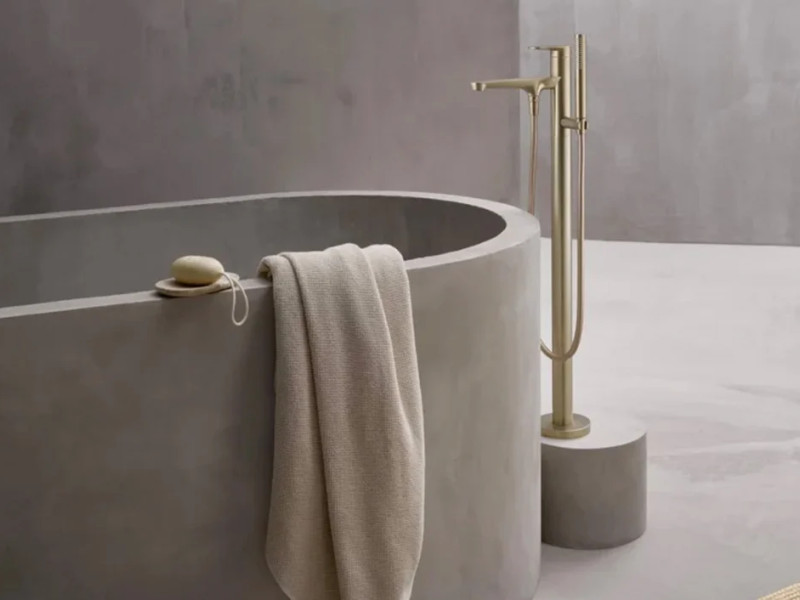
Styles and trends for 2026: what’s really changing
What’s really changing this year is the way manufacturers are approaching the design itself. The freestanding bath mixer is no longer just a bent tube: recent ranges feature knurled finishes, chiselled edges and proportions reminiscent of fine jewellery. Taps are becoming objects to be admired, not just a source of water to be used. Satin anthracite grey (sometimes called gunmetal) is also establishing itself as an alternative to matt black, offering a slightly softer visual appeal.
A trend to bear in mind before committing to it: tone-on-tone taps, matching the colour of the bath or the tiles. The effect looks spectacular in photos, but requires a high degree of consistency between suppliers to ensure that the shades actually match from one material to another – something that isn’t guaranteed between two different brands.
Which layout suits which style of bathroom?
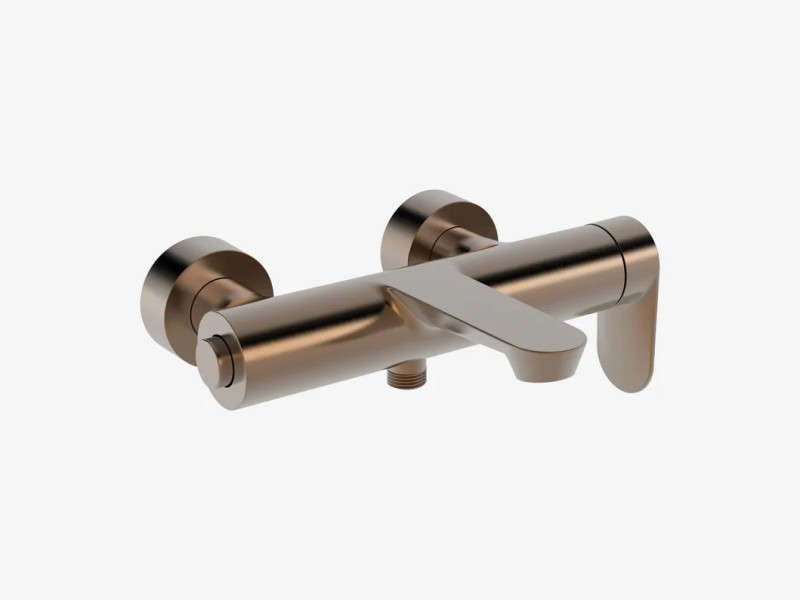
Minimalist contemporary: wall-mounted tap, straight design, available in matt black or brushed stainless steel. This combination creates the most visually striking effect around the bath, complementing large-format tiles and a minimalist aesthetic.
Vintage or retro: floor-mounted pillar tap with two cross-shaped handles, in a brushed brass or antique bronze finish. This is the option that most faithfully recreates the spirit of a freestanding bath, even on a contemporary freestanding bath.
Minimalist or spa-style: a tap mounted on the bath, with a waterfall-style spout and a single lever. The discreet installation allows the shape of the bath itself to take centre stage, in a minimalist style.
Features that shouldn’t be overlooked in favour of style
A freestanding bath often holds between 180 and 250 litres, which is considerably more than a standard built-in bath. If the flow rate is too low, filling the bath becomes an interminable wait: aiming for a flow rate of at least 20 to 24 litres per minute avoids this problem – a point that few product specifications highlight, even though it makes all the difference to day-to-day use.
A thermostatic mixer tap, already recommended for showers, is just as suitable for a bath: it maintains the selected temperature despite fluctuations in water pressure, providing real comfort whilst the bath is filling, a process that can take several minutes. Some models feature a built-in hand shower, which is handy for rinsing the bath or washing your hair without needing a separate unit.
What Facq offers in this range
Facq stocks a range of configurations for freestanding baths, starting with the Edition 90 floor-mounted bath/shower mixer, designed specifically for this type of bath, as well as wall-mounted and countertop models by Hansgrohe and Axor, Grohe (including the four-hole Essence range), Duravit (the Tulum series in a pillar-mounted mixer version), Ideal Standard and Villeroy & Boch. In terms of finishes, the catalogue covers chrome, matt black, brushed brass and stainless steel, with the necessary PVD coatings to ensure long-lasting resistance to Belgian hard water. Keuco completes the range for high-end projects seeking total consistency between taps and accessories.
Once you’ve chosen your bath, deciding on the taps is an integral part of the same project, not a separate step. Our guide Which bath should I choose based on my space and preferences? lays the foundations for choosing the bath itself, before going into detail about the taps.
The most common mistakes in this role
- Choosing the taps after the bath has been permanently installed, without having checked the distance to the wall or access to a floor-mounted water supply.
- Ordering a pre-drilled bath without having decided on the style of taps you want, which rules out all other options.
- Underestimating the flow rate required for a large tank, based solely on aesthetic considerations.
- Mix and match the finishes of the bath taps with those of the washbasin or shower in the same open-plan room.
- Failing to apply a PVD coating to a coloured finish, given that Belgium’s hard water quickly wears away low-quality coatings.
Frequently asked questions
Q1. Can floor-mounted taps be fitted to a freestanding bath during a renovation?
Yes, but this requires the water supply to be rerouted to the exact location intended for the riser, which often involves breaking up part of the floor. For a minor renovation project where the floor does not need to be broken up, wall-mounted taps remain the simplest solution.Q2. Should you choose the taps before or after the bath?
Both decisions are made together. If the bath is pre-drilled, this dictates the type of taps that are compatible. If it is not, you are free to choose any taps, provided you plan the position of the water supply before any tiling is carried out.Q3. What flow rate should you choose to fill a freestanding bath quickly?
A flow rate of 20 to 24 litres per minute is sufficient for a bath with a capacity of 180 to 250 litres. Below this, it can easily take 12 to 15 minutes to fill the bath, which most users find too long for everyday use.Q4. Is matt black a good long-term choice for bath taps?
Yes, provided the finish is PVD-coated, a treatment that is resistant to household cleaning products and hard water. A black finish that is simply painted or lacquered will flake off within a few years, whereas a high-quality PVD coating will last fifteen to twenty years.Q5. Do wall-mounted taps restrict the positioning of a freestanding bath?
Yes, the bath must be positioned at a specific distance from the wall where the tap is fitted, usually between 5 and 15 cm depending on the model. This is the compromise you have to accept in exchange for simpler plumbing than a floor-mounted supply.Q6. Which taps should you choose for a freestanding bath in a vintage-style bathroom?
A floor-mounted pillar tap, with two handles and a brushed brass and antique bronze finish, best captures the spirit of period taps, even on a freestanding bath with a contemporary design.