Which bath should I choose based on my space and preferences?

Key points
Choosing a bath comes down to four key questions: - Which type suits my space and the level of renovation work I’m willing to undertake? - What kind of bathing experience am I looking for on a daily basis? - Which materials and fittings ensure durability and aesthetic consistency? - And have I considered long-term accessibility?Book an appointment
In Belgium, the bathtub is making a notable comeback in ambitious renovation projects. Walk-in showers remain the dominant choice for everyday use, but freestanding bathtubs, claw-foot bathtubs and built-in bathtubs with raised edges are broadening the range of design options, even in spaces much smaller than one might think.
Facq supports you in making this choice at its 17 EXPOcentres across Belgium, with a free, no-obligation consultation.
First and foremost: is a bathtub really right for you?
The first question isn’t ‘which bath?’, it’s ‘why a bath?’. The answer determines everything that follows.
Is taking a bath a daily habit or just a passing fancy?
In Belgium, the majority of homeowners who have a bathtub admit to using it only once or twice a month. That’s no reason to do without one; it’s a reason to choose a different kind. A bathtub that’s only used occasionally doesn’t need to be the centrepiece of the bathroom.
Conversely, if you take a bath several times a week – whether for relaxation, to soothe muscle aches, or as part of your evening routine – the bathtub becomes a key practical investment. In this case, factors such as depth, length, a whirlpool system and accessibility take on real significance.
Bathtub or walk-in shower: the real choice to make
In standard-sized Belgian bathrooms (8 to 9 m²), the choice between a bath and a walk-in shower is often a binary one. The two only coexist comfortably in spaces larger than 10–11 m². In smaller spaces, it’s a decision you have to make: either maximise everyday comfort with a spacious walk-in shower, or choose a bath for ritual and sensory experience.
A rule of thumb: if you take a bath less than twice a week, a walk-in shower is almost always the best investment. If you do so more often, or if you anticipate use by children, elderly people or for therapeutic purposes, a bathtub is the obvious choice.
Belgian feature: In Belgium, houses built before 1970 often have bathrooms designed around a built-in bath with a skirting. Renovation is an opportunity to rethink how the space is actually used — and often to gain 0.8 to 1.5 m² by switching to a shower. But it’s also a chance to finally install the freestanding bath you’ve been dreaming of for years.
The 5 types of bathtubs: finding the one that suits your project
Each type of bath suits a different layout, level of renovation and style. Here’s how to choose the right one for your specific situation.
Type | Ideal for… | Construction work | Visual effect |
Freestanding bath | Large spaces (≥ 9 m²), an ambitious project | Moderate (underfloor plumbing) | Maximum — sculpture in space |
Built-in bath with apron | Standard renovation, constrained spaces | Lightweight (replacement in situ) | Clean and integrated, decorative apron |
Freestanding bath (lion's paw legs) | High ceilings, vintage or Art Deco style | Moderate (stand-mounted power supply) | Stylish and sculpted |
Whirlpool bath | Intensive relaxation profile, frequent use | Important (electricity in zone 2) | Functional and contemporary |
Corner or asymmetrical bath | Room corners, small areas < 8 m² | Mild to moderate | Smart, maximises space |
The freestanding bath: the piece that transforms a space
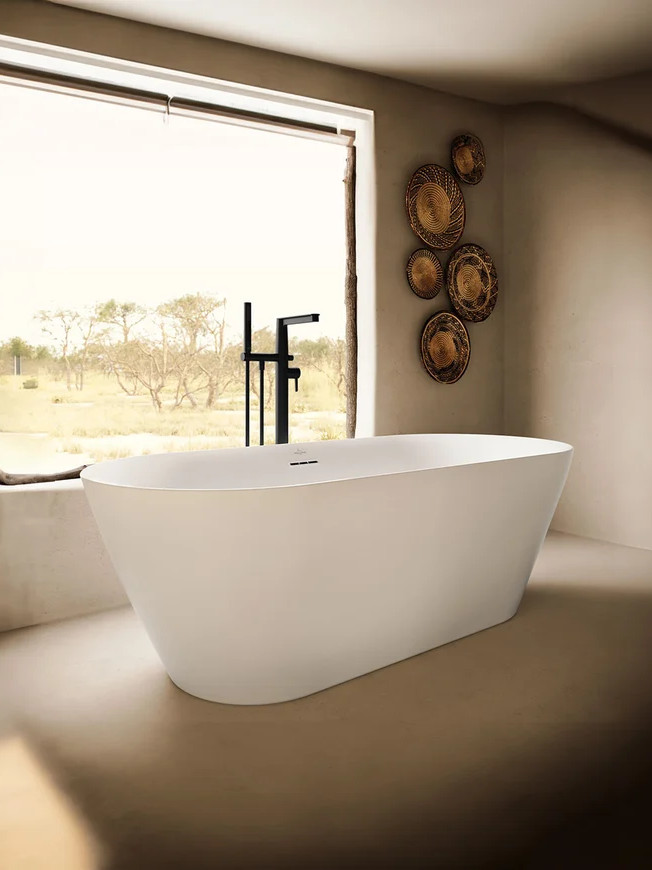
Freestanding baths are no longer the preserve of the spacious bathrooms featured in magazines. They can be fitted into a space as small as 9 m², provided they are the right size (compact models are as short as 140 cm in length) and the water supply is connected at floor or ceiling level. They make an immediate architectural statement; they are the feature that gives the whole room its character.
The taps for a freestanding bath are a topic in their own right. There are three options: a tap mounted directly on the bath (requiring a rim or a base plate), a wall-mounted tap (installed in the wall, with concealed pipework), and a floor-mounted tap (on a freestanding column, with a highly architectural look). Each option has its own plumbing requirements and visual impact.
The detail that’s often overlooked: A freestanding bath in a small space (7–8 m²) is possible — on one condition: don’t combine it with a separate shower. You must choose between the two. Many homeowners forget this and end up with a room where everything fits but nothing breathes.
The freestanding bath: more than just a vintage trend
The freestanding bath is often seen as a purely aesthetic choice, even a nostalgic one. This view is perhaps a little too simplistic. Contemporary models from Duravit, Kaldewei and Villeroy & Boch incorporate modern features (optimised depth, wear-resistant enamel coating, integrated drainage) in designs ranging from unapologetically retro to minimalist styles on slender legs.
Its main advantage is that it leaves the floor unobstructed, making the room feel more spacious. And it is often easier to install than a built-in bath. There’s no need to build a surround or redo the screed.
The whirlpool bath: when water works for you
The real comparison to make isn’t ‘whirlpool or no whirlpool’, but ‘a whirlpool used regularly’ versus ‘a whirlpool that will end up as an expensive ordinary bath’. If your lifestyle includes frequent baths, muscle pain or therapeutic use, a whirlpool bath is a worthwhile investment. Otherwise, opt for a high-quality bath with an optimal depth.
Materials: acrylic, enamelled cast iron or composite resin?
The material of the bath determines three factors at once: weight (and therefore structural loads), texture and heat retention, and long-term durability. All too often, this choice is made based solely on price.
Material | Poids | Heat retention | Sustainability | Relative price |
Reinforced acrylic | Lightweight (15–25 kg) | Average | Correct — prone to scratches | Accessible |
Enamelled cast iron | Very heavy (100–200 kg) | Excellent | Decade after decade | Élevé |
Enamelled steel (Kaldewei) | Medium (30–60 kg) | Bonne | Very high — Kaldewei guarantee | Medium to high |
Composite resin (solid surface) | Medium (40–70 kg) | Very good | Very high — can be repaired by sanding | Upgraded to premium |
Natural stone / terrazzo | Very heavy | Excellent | Maximum | Premium |
Acrylic: the sensible choice, properly understood
Acrylic accounts for the vast majority of bathtubs sold in Belgium. It is lightweight, easy to install, available in all shapes and sizes, and affordable. Its main drawback is that it scratches more easily than other materials, and its appearance deteriorates more quickly with heavy use.
Reinforced acrylic (with a fibreglass layer) is significantly stronger than standard acrylic. If you choose acrylic, always opt for this version. And look for brands that offer a substantial shell thickness — a simple test: the shell should not bend under finger pressure.
Enamelled cast iron and Kaldewei steel: an investment that lasts
Enamelled cast iron is the material of choice for a bathtub that will last a lifetime. Its heat retention is unrivalled: the water stays warm for much longer than in an acrylic bathtub. Its enamelled surface is resistant to scratches, household cleaning products and yellowing. Its only real drawback is its weight (100 to 200 kg depending on size), which means the floor’s load-bearing capacity must be checked before installation.
Kaldewei enamelled steel occupies an interesting middle ground: it is lighter than cast iron (30 to 60 kg), yet features an enamelled surface of the same quality. Kaldewei is the only manufacturer in the world to offer a guarantee on the surface of its enamelled steel baths. This is a compelling selling point in a market where guarantees are rare.
Composite resin (solid surface): the architect’s material
Solid surface is the material of choice for contemporary freestanding bath projects. Its matt finish and warm-to-the-touch surface create a unique sensory experience. It is repairable — a scratch or mark can be removed by sanding, unlike acrylic. And it allows for organic shapes that cast iron or steel cannot achieve.
Although they are expensive, the cost is justified in ambitious projects where the bath is the focal point of the room. At Facq, the brands Duravit and Villeroy & Boch offer freestanding solid surface baths with a level of finish that rivals the finest architectural designs.
Dimensions: what size bath is right for your space and comfort?
The size of a bath isn’t just a question of available space. It’s also a question of physical comfort, particularly depth – a factor that many people underestimate when making a purchase.
Standard-length vs. large bath
Standard bathtubs are between 150 and 170 cm long. This is sufficient for a person of average height (up to 1.75 m). For taller people, or for regular use where being able to lie down fully is important, models measuring 175–180 cm or more are the standard. Anything over 180 cm falls into the category of large baths or two-person baths.
Depth: the key factor for a proper bath
This is the most important factor in the bathing experience, and yet it is often overlooked. A bath with an internal depth of 35 to 40 cm is considered shallow: you sit rather than lie down in the water. A bath with an internal depth of 45 to 55 cm is the depth at which you are truly immersed and the warmth envelops your body.
Japanese bathtubs (or deep soaking tubs) take this concept to the extreme: 60 to 70 cm deep, with an upright seated position and full immersion. They take up less floor space but require vertical clearance. They are still rare in Belgium but are beginning to appear in the most contemporary designs.
Good to know: To check the actual depth of a bath, don’t look at the external depth — look at the internal depth (from the bottom to the drain). This is what determines the actual water level. Some baths are listed as having a total height of 45 cm but only 38 cm of usable internal depth.
A bathtub for two: what you really need to consider
The minimum dimensions for a two-person bath are 180 cm long and 90 cm wide. L-shaped or asymmetrical models allow you to combine two distinct relaxation areas in a single unit. Certain Villeroy & Boch and Duravit models feature configurations with two opposing backrests and a built-in whirlpool — a premium investment, but a far cry from the traditional shared bath.
Bathroom taps: the choice that makes all the difference
Bathroom taps are one of the areas where the investment is most visible and most noticeable. A beautiful tap on a beautiful bath is the combination that brings the room to life. A generic tap on a premium bath is the detail that leaves you regretting your choice.
Wall-mounted tap, bath-mounted tap or floor-mounted tap: three installation options
A wall-mounted tap is the most common choice for built-in baths and wall-mounted baths. The supply pipe is concealed within the wall, with only the tap body and spout remaining visible. It is the most visually streamlined option and the easiest to maintain.
A bath tap mounted on the bath (on a rim or a base plate) is the classic choice for standard built-in baths. It is easier and cheaper to install than a wall-mounted tap. It is available in single, double or integrated column versions for baths with a rim.
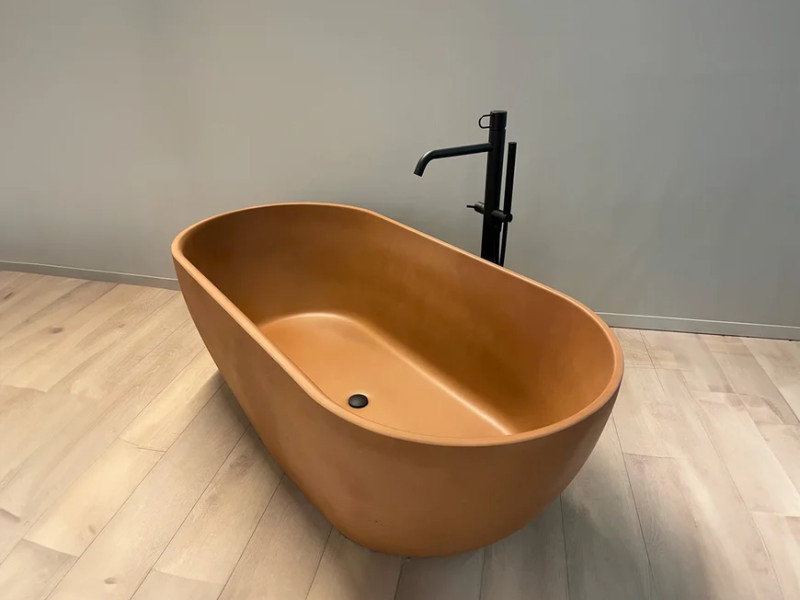
The floor-mounted tap (on an offset column) is the architectural choice for freestanding baths. The supply column is visible, often decorative, and contributes to the visual composition of the bath within the space. It is the most technically demanding option (the supply runs under the floor), but also the most visually striking.
Thermostatic or conventional: everyday comfort
A thermostatic mixer is even more useful for a bath than for a shower. Filling a bath takes time, and having to adjust the temperature manually each time is both inconvenient and potentially dangerous when there are children around. A thermostatic mixer remembers your preferred temperature and maintains it regardless of what happens elsewhere in the system. It offers real comfort, which you’ll notice from the very first use.
The Hansgrohe and Grohe brands offer thermostatic bath taps in a range of finishes, from classic chrome and matt black to brushed brass and bronze. At Facq, our advisors will help you find the finish that complements the rest of your bathroom.
Facq Install+
Facq Install+ helps you choose the right taps for your type of bath and your existing setup — and coordinates the installation with a qualified partner fitter. A single quote covering both materials and installation, with no hidden costs.Discover the service
Finishing and integration: apron, edge and recess
A built-in bath leaves a visible section known as the apron. This apron can be tiled, painted, panelled with wood, or replaced with a removable panel. It is a decorative feature in its own right, and a choice that also determines access to the pipework.
Tiled, panelled or timber cladding: choose the option that suits your style
A tiled bath surround is the most common and seamless solution: the room’s tiling continues onto the front of the bath. The result is a clean, durable and easy-to-maintain finish. However, this makes it more difficult to access the pipework should repairs be needed. It is advisable to include an access panel at the design stage.
Removable panels (made from treated wood, solid surface or lacquered MDF) are currently all the rage. They offer a clean finish, easy access to pipework and stylistic flexibility. Panels made of teak or natural treated oak bring an organic warmth that blends beautifully with wabi-sabi, spa or biophilic styles. It is also the easiest option to replace if you wish to change the atmosphere of the room.
The built-in bath with a rim: making a comeback
The built-in bath with a rim – that is, a lip protruding 10 to 20 cm around the tub – is one of the key trends in bathroom design for 2026. This rim is not merely an architectural feature: it is the space where you place candles, a book, a glass of wine and bath products. It recreates the atmosphere of bathing as an intimate and deliberate ritual.
This type of layout requires sufficient space around the bath: the rim must be accessible from both sides or at least on three sides. In a bathroom measuring 8–9 m², this usually means either doing without a separate shower or completely reworking the layout.
Accessibility and sustainability: planning ahead rather than reacting
Designing a bathroom in 2026 without considering accessibility means designing a bathroom for the next decade only. Anticipating long-term use – for yourself, your loved ones, or a future buyer – is a sensible decision that costs almost nothing at the design stage.
Baths and accessibility for people with reduced mobility: options that don’t compromise on design
A bathtub isn’t immediately the go-to choice for people with reduced mobility; that role is typically filled by a walk-in shower. However, several modifications can make a bathtub much more accessible without compromising its appearance: a lower rim height (36–38 cm instead of 50–55 cm), a discreet grab rail in brushed stainless steel, and an integrated or retractable step.
In Belgium, financial assistance is available in all three regions for accessibility modifications (up to €8,000 excluding VAT in Wallonia via the AVIQ, with similar grants available in Flanders and Brussels). This assistance can cover part of the cost of an adapted bath, provided that the application is submitted before work begins.
Long-term durability: choices that stand the test of time
Three factors determine how long a bathtub will last:
- The materials used for the bowl – enamelled steel, cast iron or solid surface – age gracefully without yellowing or scratching easily.
- Taps and fittings: PVD (physical vapour deposition) finishes are far more resistant to household cleaning products and Belgian limescale than traditional chrome plating. Matt black PVD, in particular, remains flawless for years after installation.
- Maintaining the seals: the silicone seals around the bath are the weak point of any installation. High-quality silicone, applied correctly and replaced every 8–10 years, is enough to prevent leaks and mould.
Good to know: Belgian water is hard in most provinces (TH > 20°fH in Brussels, Walloon Brabant and Flemish Brabant). A water softener protects thermostatic taps, reduces limescale marks on the bath and extends the lifespan of your fittings. This is a decision to be made before installation, not after.
Brands available at Facq: a guide to help you find your way
Facq works with a carefully selected range of partner brands, all of which can be explored at the EXPOcenter. Here’s a guide to understanding what each one specialises in.
Brand | What it offers | Why choose it? |
Kaldewei | Guaranteed enamel-coated steel — the most durable on the market | For those who want a bathtub that stands the test of time. The only manufacturer to guarantee the surface. |
Endured | Signature design, solid surface, organic shapes | For projects where every piece is conceived as an object. Designed by Philippe Starck and Christian Werner. |
Villeroy & Boch | Full range — bathtubs, spa systems | Versatility and proven quality. Ideal for combining with bathtubs and other fittings from the same brand. |
Hansgrohe | Premium taps and fittings — thermostatic, PVD finishes | The global benchmark for quality taps and fittings. Choosing Hansgrohe means investing in something you use every day. |
Grohe | Wide range of taps and fittings, thermostatic mixer taps | The best combination of quality, durability and finish. Ideal for a cohesive project from start to finish. |
Keuco | Accessories and grab rails for people with reduced mobility — elegance | The brand that combines affordability with style. Every grab rail is a design piece. |
Budget and financial support in Belgium: what you need to know in 2026
A bath isn’t just about the price of the product itself. It’s about the total cost of the project: the bath itself, installation, plumbing, and possibly electrical work for a whirlpool bath, a bath screen, and taps. Here are some realistic price ranges for the Belgian market.
Project type | Estimated cost (materials + installation) | Applicable VAT |
Replacement of a built-in bath (budget acrylic) | 1 500 – 3 000 € | 6% (properties over 10 years old) |
Built-in bath with tiled surround (mid-range) | 3 000 – 5 500 € | 6% (properties over 10 years old) |
Freestanding or freestanding bath (steel or resin, mid-range) | 4 000 – 8 000 € | 6% (properties over 10 years old) |
Whirlpool bath with electrical installation | 4 500 – 9 000 € | 6% (properties over 10 years old) |
Premium freestanding bath (solid surface, high-end taps) | 8 000 – 18 000 €+ | 6% (properties over 10 years old) |
6% VAT: a benefit available to everyone
For properties over 10 years old, the VAT rate applicable to renovation work — including materials and labour — is reduced to 6% instead of 21%. On a project costing €6,000 excluding VAT, the saving amounts to €900. Condition: the work must be invoiced by a professional contractor. This is one of the reasons why working with a qualified installer is not only a guarantee of quality: it is also a direct tax benefit.
Situation as at 1 April 2026 — please check before starting any project. Renovation grants are subject to rapid change. In Wallonia, a temporary scheme is in place until 30 September 2026. In Brussels, Renolution grants are currently suspended. In Flanders, bathroom fixtures have been excluded from the Mijn VerbouwPremie since July 2025. Always check the current situation with your regional authority or ask a Facq advisor.
6 mistakes to avoid when planning a bathroom
These errors have been identified based on feedback from Facq advisers at EXPOcenter. Almost all of them stem from a lack of foresight during the design phase.
- Choose the bath before finalising the plumbing plan. The position of the water supply and drainage points determines the installation requirements. Some freestanding baths require a floor-level water supply — something that cannot be fitted retrospectively without breaking up the screed.
- Underestimating the weight of a cast iron or solid surface bath. An old wooden floor may need structural reinforcement. Always have the load-bearing capacity checked before purchasing.
- Don’t forget the power socket for a spa bath. A socket in Zone 2 (at least 60 cm from the edge) must be installed before the tiling is laid. Cutting into a tiled wall after the fact is expensive and spoils the finish.
- Neglecting the taps. A premium bath with entry-level taps: the mismatch is glaringly obvious. Taps often account for 15 to 25 per cent of the total budget for a beautiful bath, so this is not an area where you should cut corners.
- Covering up a damp problem without fixing it. Mould under the skirting board won’t disappear beneath the tiles. It will come back, often worse than before.
- Forgetting to check eligibility for the 6% VAT rate before signing. Once the work has been invoiced, it is too late to change the rate.
Frequently asked questions
Which bath should you choose for an 8 m² bathroom in Belgium?
In an 8 m² bathroom, the bath must be precisely integrated into the layout. Corner-mounted baths measuring 150 to 160 cm make the most of the space without overwhelming the room. A compact freestanding bath (140 cm) is possible if it is the only wet area — without a separate shower. A shower and bath can coexist comfortably in a space of at least 10–11 m². A 6% VAT rate applies to installation work for properties over 10 years old.What is the difference between a whirlpool bath and a standard bath?
A whirlpool bath features air (or water) jets for hydrotherapy massage. It offers a superior level of comfort whilst bathing but requires a suitable electrical installation (a Zone 2 socket in accordance with the RGIE), regular maintenance of the circuits, and frequent use to be cost-effective. A standard bath with an optimised depth (45–50 cm) can provide a very satisfying soaking experience without these constraints. The real deciding factor is how often you plan to use it.Is it possible to install a freestanding bath in a Belgian flat?
Yes, provided you check three things: the strength of the floor (a solid-surface bath filled with water can weigh between 300 and 400 kg), whether the water supply can be routed under the floor (often tricky in flats with concrete slabs), and the minimum space required around the bath (80 cm on at least two sides). In many flats in Brussels or Liège, this is entirely feasible with a compact 140 cm bath and a wall-mounted water supply.Which type of bath is the easiest to maintain in Belgium?
Kaldewei enamelled steel and enamelled cast iron are the easiest materials to maintain: their non-porous surface is resistant to household cleaning products, does not yellow and is not easily scratched. Solid surface is also very easy to maintain and has the advantage of being repairable in the event of marks. Acrylic is more susceptible to scratches and certain harsh cleaning products. In areas of Belgium with hard water (Brussels, Brabant), a water softener significantly reduces limescale marks and the maintenance required.Are there any grants or subsidies available for installing a bathtub in Belgium in 2026?
The 6% VAT rate is the most widely applicable subsidy: it applies to all work carried out in homes over 10 years old, including both materials and labour. For adaptations for people with reduced mobility (grip bars, low-threshold baths), specific grants are available: up to €8,000 excluding VAT in Wallonia via the AVIQ, the Vlaamse Aanpassingspremie in Flanders (50% of invoices up to €2,500), and Iriscare in Brussels. General bathroom renovation grants will be limited in all three regions by 2026. Check the current situation before starting the work.