System C or System D mechanical ventilation: which should I choose for my home in Belgium?

Key points
1. Single-flow mechanical ventilation (System C) is the most common solution in Belgian homes. Fresh air enters through vents in dry rooms, whilst humid air is mechanically extracted from the kitchen, bathroom and toilets.
2. The dual-flow mechanical ventilation system (System D) mechanically supplies and extracts air, using a heat exchanger that recovers 85 to 95 per cent of the heat from the outgoing air. It reduces heating bills by €300 to €500 a year and filters the incoming air.
3. In new-builds and major refurbishments, a compliant ventilation system is mandatory in order to obtain the PEB certificate. Dual-flow ventilation is often required in low-energy homes. When refurbishing an existing home, the humidity-controlled C system remains the best value for money.
In Belgium, they say ‘system C’ and ‘system D’
The first point to clarify, as it causes a great deal of confusion, is that the term ‘VMC’ comes from France. In Belgium, the residential ventilation standard, NBN D 50-001, does not refer to single- or dual-flow systems, but to four systems, labelled A to D, depending on how air enters and leaves the dwelling.
System | Fresh air supply | Exhaust of stale air | Equivalent current |
| A | Natural (grids) | Natural (ducts) | Natural ventilation |
| B | Mechanical (insufflation) | Natural | A rarity in the residential sector |
| C | Natural (grids) | Mechanics (extractor) | Single-flow mechanical ventilation system |
| D | Mechanics | Mechanics + heat recovery | Dual-flow mechanical ventilation system |
When a Belgian installer refers to a ‘single-flow’ system, they are talking about a System C. When they refer to a ‘double-flow’ system, they mean a System D. System A (natural ventilation) and System B almost never meet current PEB requirements, so in practice the choice comes down to System C or System D. The rest of this article uses both terms side by side.
The principle of air circulation is the same in all cases: fresh air enters the dry rooms (living room, bedrooms, study), flows through the home via the corridors and under the doors, and then exits via the damp rooms (kitchen, bathroom, toilet, utility room). It is this circulation that prevents the stagnation of moisture-laden air, the main cause of mould in Belgian homes.
Single-flow mechanical ventilation (System C): how does it work?
Outdoor air enters through adjustable grilles, often built into the window frames, located in dry rooms. An extraction unit, usually installed in the loft, draws humid air from the wet rooms and expels it through the roof. This extraction creates a slight negative pressure, which draws in fresh air through the grilles. A single fan, a single duct network.
There are three levels of sophistication. The self-regulating system maintains a constant airflow, regardless of humidity or the number of people present. The humidity-controlled system opens and closes the vents according to the measured humidity level: it only ventilates at high speed when necessary, thereby limiting heat loss. The C+ system takes this a step further with sensors for humidity, CO₂ and odours (VOCs) that control extraction on a room-by-room basis. Given Belgium’s climate, which is humid for much of the year, the humidity-controlled or C+ systems are almost always worth the small additional cost compared to the self-regulating system.
The weakness of System C: the incoming air is neither heated nor filtered. In winter, cold air enters through the vents, which your heating system then has to warm up. In a poorly insulated house, this is acceptable. In a very well-insulated house, however, this influx of cold air adds to your energy bill and can create a draughty feeling near the windows.
Dual-flow mechanical ventilation (System D): how does it work?
In practical terms: when it’s 2 °C outside and 20 °C inside, the fresh air entering your rooms isn’t 2 °C but around 17 to 18 °C. Your heating system has much less work to do. This is where the annual savings of €300 to €500 on heating an average house come from, representing a reduction of around 15 per cent in heating costs.
The dual-flow system also filters the incoming air, which System C does not do. For someone with a pollen allergy living in a house near a main road or in a town, this is a real advantage. In summer, the bypass allows the heat exchanger to be switched off at night so that cool air can enter without being heated.
There are two constraints to bear in mind. Running the air ducts is the real challenge in renovation projects: space is needed in false ceilings or casings, which is not always straightforward in an existing house. And maintenance is more demanding: the filters need to be changed once or twice a year; otherwise, efficiency drops and air quality deteriorates.
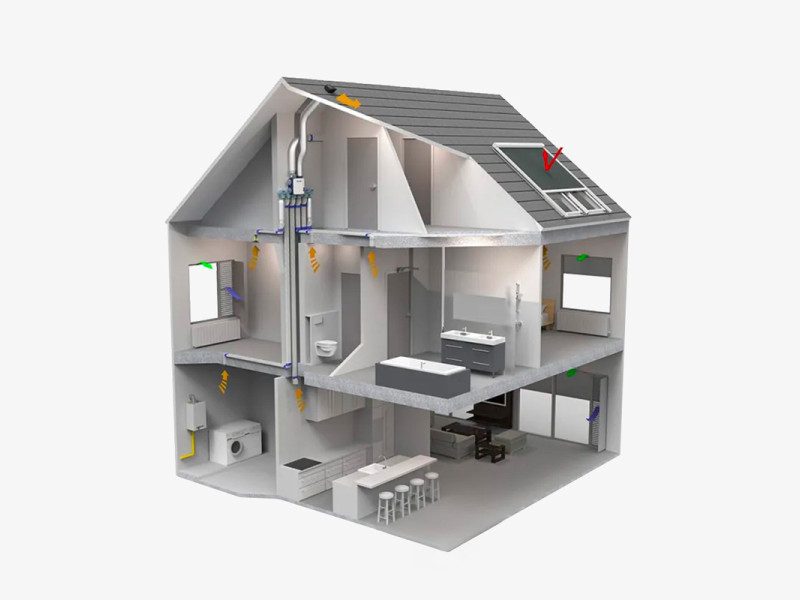
System C or System D: a comparison based on figures
Criterion | Single-flow (System C) | Dual-flow (System D) |
| Fixed price (in-house) | €1,500 to €3,500 (including VAT) | €4,000 to €9,000 (up to €15,000 for thermodynamic systems) |
| Heat recovery | None | 85 to 95 per cent |
| Heating savings | Nulle | €300 to €500 per year (~15 per cent) |
| Filtration of incoming air | Non | Oui |
| Duct network | One (extraction) | Two (inhalation + exhalation) |
| Installation as part of a refurbishment | Simple | More complex (routing of ducts) |
| Interview | Cleaning the grilles once a year | Change filters 1 to 2 times a year |
| Power consumption of the unit | Low (one fan) | Slightly higher (two fans) |
| Ideal for | Renovation, existing house, tight budget | New-build, low-energy, major refurbishment, allergies |
Power consumption warrants some clarification. The dual-flow system operates with two fans, so it uses more electricity than the single-flow system. However, the heating energy it recovers far outweighs this additional electricity cost in a well-insulated house. The situation is reversed in a draughty house: in such a case, the dual-flow system recovers heat that you would lose through the walls anyway, and its benefits are significantly reduced.
So, which one should you choose?
If you’re renovating an existing house on a modest budget and have a loft that’s difficult to access, the humidity-controlled C or C+ system is the right choice. It regulates humidity, complies with regulations, and avoids the headache of installing air ducts. It offers the best value for money for the majority of older properties.
If you are building a new home or carrying out a major renovation (where more than 75 per cent of the building envelope is being replaced), a ‘DIY’ solution is almost always the best option. A very well-insulated house loses little heat through its walls, so the heat recovered by the dual-flow system really makes a difference, and the target energy performance rating is often unachievable without it.
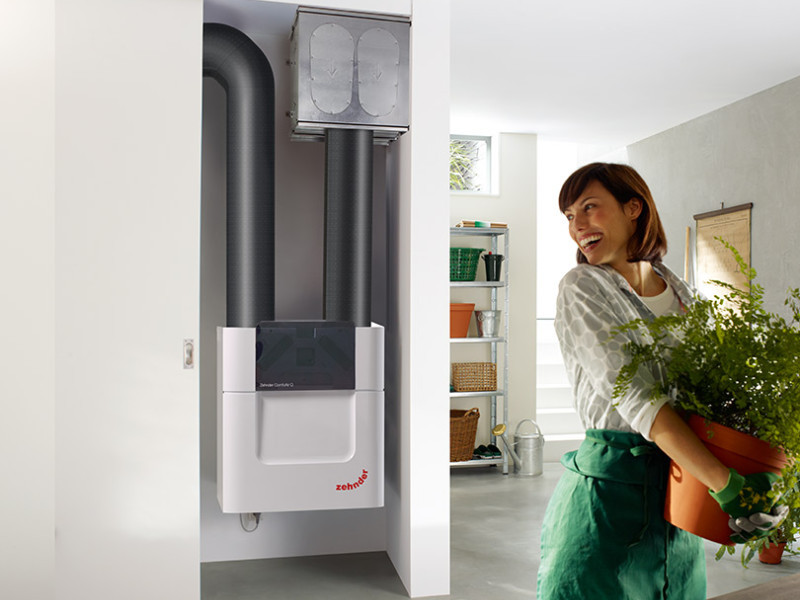
You’re somewhere in between, with decent insulation and a long-term plan: a dual-flow system becomes a viable option if the ducts can be installed without major building work and if you plan to stay in the property for more than ten years. Otherwise, a well-designed Class C system will do the job.
This is not a decision to be made in isolation. The choice of ventilation is part of a wider consideration of a home’s insulation, heating and energy efficiency — a topic we cover in detail in our guide How to make your home more eco-friendly and energy-efficient? , which you should read before deciding between the two systems.
Ventilation brands at Facq
Facq stocks several ventilation brands as part of its Maison Verte range, which you can explore and compare at the EXPOcenter.
Brand | What it offers |
| Renson | The Belgian ventilation specialist. Demand-controlled C+ systems, façade grilles, expertise in local climate conditions. |
| Soler & Palau | Reliable extractor fans and ventilation units, a wide range for System C. |
| Vasco | Systèmes D and integrated ventilation solutions, a brand also known for its radiators. |
| Atlantic | Ventilation and thermal comfort: affordable ranges for houses and flats. |
Frequently asked questions
Q1. System C or System D: which one should you choose in 2026?
It depends on your home. In an existing, well-insulated house that you plan to keep for a long time, or in a new-build, the dual-flow system (System D) is the most suitable: it recovers heat and filters the air. In a renovation project with a limited budget or a complex loft, the single-flow humidity-controlled system or C+ (System C) is sufficient and costs two to three times less. The dual-flow system is not worthwhile in a poorly insulated house, where the recovered heat is lost through the walls anyway.Q2. Is a mechanical ventilation system compulsory in Belgium?
Yes, in new-builds and major refurbishments. Ventilation that complies with the NBN D 50-001 standard is required to obtain the PEB certificate; without this, the sale or letting of the property cannot be finalised at the notary’s office. Ventilation is, in fact, the most common area of non-compliance during PEB inspections. In partial refurbishments, it is not always mandatory, but is still strongly recommended.Q3. How much does it cost to have a mechanical ventilation system fitted in Belgium?
For a house with 3 to 4 bedrooms: approximately €1,500 to €3,500 for a Type C (single-flow) system and €4,000 to €9,000 for a static Type D (double-flow) system. A thermodynamic version costs between €8,500 and €15,000. A 6 per cent VAT rate applies to properties over ten years old, which significantly reduces the bill. Regional grants, which you should check with your local authority, can significantly reduce the net cost.Q4. Does a dual-flow system really save on heating costs?
Yes, in a well-insulated house. By recovering 85 to 95 per cent of the heat from the extracted air, it reduces heating costs by around 15 per cent, which amounts to €300 to €500 a year for an average house. In a poorly insulated house, the savings are lower, as heat is lost mainly through the walls and windows, not through ventilation. That is why a dual-flow system and good insulation go hand in hand.Q5. Can a dual-flow system be installed during a renovation?
Yes, but routing the two duct networks is the main obstacle. Space is needed in false ceilings or casings, which is not always feasible in an existing house without major building work. When the ducts cannot be routed, a humidity-controlled C or C+ system is the most realistic solution. An installer will assess the feasibility on site before providing a quote.