How can you make your home more eco-friendly and energy-efficient?

This guide answers the real question: where to start, and in what order to proceed?
Key points:
1. The order in which the work is carried out is more important than the work itself. First you insulate, then you sort out the heating, and finally you install the solar panels. Reversing this order is costly: you end up oversizing a heat pump for a house that you’ll be insulating the following year.
2. An airtight house needs to breathe. The more insulation you add, the more critical ventilation becomes; without it, moisture and pollutants build up. A dual-flow mechanical ventilation system recovers 85 to 90 per cent of the heat from the outgoing air.
3. In Belgium, the PEB is no longer merely informative. Since 2026, selling or buying a property classified as E, F or G in Wallonia triggers a renovation requirement. The issue is therefore no longer just the cost; it is also the value of the property.
Making your home more eco-friendly isn’t just about piling up green gadgets. It involves a series of decisions carried out in a specific order, where each step paves the way for the next. A heat pump installed in a poorly insulated house uses just as much energy as an old boiler. Solar panels on a roof that lets heat escape won’t solve anything.
This guide answers the real question: where to start, and in what order to proceed?
1. Where to start: the rule on the order of business
This is the most common mistake – and the most costly one. People start with what’s visible (solar panels, a brand-new heat pump) rather than what really matters: the building envelope. As a result, they end up paying twice.
The logical sequence is based on a simple idea: first we reduce our needs, then we meet the remaining demand with an efficient system, and finally we generate energy. This approach has a name in the industry: the ‘moderation, efficiency, renewables’ pathway. We avoid waste before we generate clean energy. In practical terms:
| Step | Work | Why this order? |
|---|---|---|
| 1 | Energy audit (PAE in Wallonia) | It provides a cost estimate and makes access to various grants conditional upon it. |
| 2 | Roof insulation | Best return on investment. Heat escapes first from the top. |
| 3 | Wall and floor insulation + window frames | Further reduces heat loss and the cold-wall effect. |
| 4 | Ventilation (mechanical ventilation, ideally dual-flow) | Essential as soon as you waterproof your home. |
| 5 | Heating (heat pump, water heater) | It is designed for a house that is already insulated, so it is smaller and cheaper. |
| 6 | Solar panels | We are meeting already reduced needs — the installation is more cost-effective. |
The calculation that is often overlookedInsulating a property before installing a heat pump means you can choose a smaller unit. In a poorly insulated 150 m² house, a heat pump may need to be twice as powerful (and twice as expensive) as it would be for the same house once it has been insulated. Doing it the other way round means buying an oversized unit that will run inefficiently for the rest of its life. |
2. Insulation: the foundation for everything else
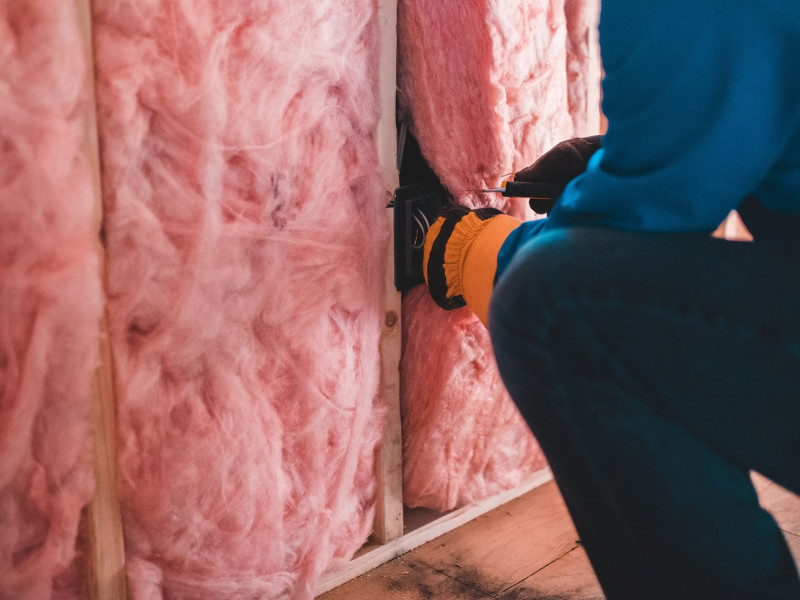
The roof comes first because that is where most of the heat escapes, and because the cost per square metre is the lowest. Next come the walls (inside or outside, depending on the layout), the floor, and replacing single-glazed windows with double or triple glazing.
Insulation has a direct impact on your heating system. A well-insulated house only needs water at a low temperature (35 to 45 °C), which is precisely the range in which a heat pump performs best.
From the inside or the outside?
When it comes to walls, there are two approaches. External insulation wraps around the house without reducing the living space and eliminates thermal bridges, but it alters the façade and is more expensive. Internal insulation is less expensive and is carried out room by room, but it takes up a few centimetres of space and requires careful attention to airtightness to prevent condensation in the wall. The choice depends on the building structure, the budget and local planning regulations, particularly where the façade is listed.
The floor is often the neglected part of a renovation project. However, a floor laid directly over a basement or an uninsulated crawl space allows the cold to seep up, leaving you with freezing feet in winter. It’s also an opportunity, when you’re opening up the floor, to install underfloor heating, which works wonderfully with a heat pump.
As for the window frames, switching from single glazing to double or triple glazing significantly reduces heat loss and eliminates that cold draught near the windows. But be careful: replacing window frames without ensuring proper ventilation can turn a house that used to breathe through its draughts into an airtight box. Hence, once again, the importance of planning ventilation at the same time.
Belgian reference — PEBThe PEB (Building Energy Performance) rates your home on a scale from A to G. In Wallonia, from 1 July 2026, the purchase of a property rated E, F or G will require the new owner to achieve at least a D rating within five years. In Brussels, the Renolution Ordinance aims to phase out energy-inefficient properties. Improving your EPC is no longer just a matter of comfort. |
3. Ventilation: the link that’s always overlooked
It has become a real health concern. We spend most of our time indoors, and the air in a poorly ventilated home traps moisture from the kitchen and bathroom, chemicals from cleaning products, and CO₂ from breathing. This is the subject of ‘Mechanical ventilation and indoor air quality: why it has become essential’.
Single-flow or dual-flow?
Both remove stale air from damp rooms. The difference lies in the incoming air.
| Criterion | Single-flow mechanical ventilation | Dual-flow mechanical ventilation |
|---|---|---|
| Principle | Stale air is extracted, and fresh air enters through the vents | Removes stale air AND circulates fresh, filtered air |
| Heat recovery | None (the incoming air is cold in winter) | 85–90% of the heat from the exhaust air |
| Savings on heating | Low | 10–30% depending on the insulation |
| Installed budget (3–4 rooms) | More accessible | Between €4,000 and €9,000 excluding VAT |
| Ideal for | Tight budgets, poorly insulated homes | Complete renovation, well-insulated house |
A dual-flow system is more expensive to install, and routing the ducts is the real challenge in renovation projects — false ceilings or ducts often need to be fitted. But in a well-insulated home, it recovers a significant amount of heat that would otherwise have been wasted.
4. Heating and hot water: producing more efficiently, not more
Once the house has been insulated and ventilated, heating becomes easier to manage — because energy requirements have dropped significantly. Now is the right time to replace an old boiler with a more energy-efficient system.
The heat pump has become the gold standard
In a well-insulated home, an air-to-water heat pump is currently the most efficient solution. It extracts heat from the outside air and produces 3 to 5 kWh of heat for every 1 kWh of electricity consumed. When combined with underfloor heating, which operates at a low temperature, it achieves its best efficiency.
Two questions always come up. Firstly, does it really work in winter? Yes: current models operate down to -20 °C, and in Belgium temperatures rarely drop below -5 to -8 °C for any length of time. Secondly, should you get rid of your condensing boiler? Not necessarily. In a home that is still poorly insulated or where urgent replacement is needed, it remains a sensible option, and the hybrid system (heat pump + gas backup) allows for a gradual transition.
Domestic hot water: the often-overlooked aspect
Heating tap water and shower water accounts for a significant proportion of the bill, especially once the heating has been optimised. Two solutions are often suggested.
A thermodynamic water heater works like a mini heat pump designed specifically for water: it extracts heat from the air to heat the tank, reducing energy consumption by two-thirds or three-quarters compared to a conventional electric boiler.
The solar water heater, meanwhile, uses roof-mounted collectors to preheat water free of charge for much of the year. When combined with photovoltaic panels, it forms a coherent system.
The right instinctBefore switching to a different boiler, always check that your insulation is up to scratch. A heat pump in an F-rated home almost always falls short. In cases where the building’s energy efficiency is somewhere in between, a hybrid system (heat pump plus gas backup) allows for a smooth transition without compromising on comfort during the coldest weather. |
5. Water management: an often-overlooked environmental issue
Rainwater harvesting is the most cost-effective measure. A rainwater tank supplies water for toilet flushing, the garden and, in some cases, the washing machine — accounting for nearly half of a household’s water consumption, using water that was previously paid for at the mains rate. In Belgium, where rainfall is plentiful and regular, a cistern fills up easily for most of the year. In several municipalities, it is actually mandatory for new builds.
Whether you need a water softener depends on where you live. In areas with hard water, it protects your pipes, water heater and household appliances from limescale.
As for domestic reverse osmosis systems, which filter tap water for drinking, that’s a whole other debate. Useful in some cases, unnecessary in others.

6. Control systems: does home automation really make a difference to the bill?
Smart thermostats, motorised shutters, real-time energy monitoring: home automation promises savings. The reality is more nuanced. A smart thermostat that turns the heating down when no one is home makes a real difference. However, simply adding more smart devices without changing your habits won’t reduce your bills — it just shifts the cost to the purchase of the equipment.
The best use of home automation is to optimise an already efficient system: running the washing machine when the solar panels are generating power, turning off the heating in unoccupied rooms, and identifying unusual energy consumption.
7. Bonuses, PEB and taxation: what matters in 2026
The framework for Belgian state aid is set to change significantly in 2025–2026. Before embarking on any project, you should check the situation in your region, as the rules have changed in all three.
Things to check before starting any projectSubsidies and requirements change quickly. The information below is correct at the time of writing but is subject to change. Always check with your regional authority (SPW Énergie in Wallonia, Renolution in Brussels, Fluvius in Flanders) or ask a Facq advisor for a full update. |
| Region | Situation 2026 | Key points |
|---|---|---|
| Wallonia | New bonus scheme from 1 October 2026; transitional scheme until 30 September 2026 | An Energy Performance Certificate (EPC) is mandatory within five years for properties rated E, F or G sold from 1 July 2026. A combination of insulation, a heat pump and a mechanical ventilation system is possible. |
| Brussels | Renolution premiums under review | A reduction in stamp duty of up to €25,000 for each jump in the PEB energy efficiency class (≥ 2 classes in 5 years). Financial assistance for ventilation systems when combined with insulation. |
| Flanders | My Renovation Grant; PEB grant until 30 June 2026 | Premiezoeker tool by postcode. The PEB grant can be claimed in addition to other grants and must be applied for before the deadline. |
| The 3 regions | 6% VAT for properties over 10 years old | On labour and materials invoiced by a contractor. 6% VAT reintroduced on heat pumps. |
For a combination of energy-efficiency improvements, the total grant amount may exceed €20,000, depending on your income and the scale of the project. This is precisely why the order in which the work is carried out and the schedule are so important.
8. A real-life example: a house built in 1975 in Wallonia
Let’s take a 150 m² detached house, built in 1975, with an EPC rating of G, and heated by gas. The aim: to achieve a C rating and be exempt from the renovation requirement.
- PAE audit to bring the project into line and release the grants.
- Roof insulation, followed by wall and floor insulation, then double-glazed windows.
- Installation of a dual-flow mechanical ventilation system once the house has been made airtight.
- Replacement of the gas boiler with an air-to-water heat pump, sized to suit the now-insulated house.
- Rainwater tank for the toilet and garden.
- Solar panels last, to meet the reduced demand.
In this type of scenario, the annual savings on heating costs are often between €1,500 and €2,500 per year. The return on investment depends on the total amount of grants received and the number of energy efficiency rating improvements achieved. As for comfort, the benefits are immediate: a house that is evenly heated, with no cold spots, and healthy air.
Frequently asked questions
Which project should I start with if I’m on a tight budget?
Roof insulation. This offers the best value for money: most heat escapes through the roof, and insulating a square metre there is the cheapest option. Everything else becomes more effective once this is done.Is mechanical ventilation really necessary after insulating?
Yes. A well-insulated house is airtight: without ventilation, damp builds up and mould starts to grow. A mechanical ventilation system – ideally a dual-flow system – is not a luxury; it is essential for healthy insulation.Will a heat pump work in an older house?
Provided you insulate first. In a poorly insulated house with old high-temperature radiators, it uses a lot of energy and is disappointing. Once the house has been insulated, or with a hybrid system, it becomes a viable option.Solar panels: first or last?
Last but not least. First, we reduce energy consumption (through insulation and efficient heating), then we scale the generation capacity to meet the remaining demand. Installing solar panels on a draughty house is like generating energy only to let it escape.Can the PEB really force me to carry out building work?
In Wallonia, yes, from 1 July 2026: if you buy a property rated E, F or G, you must bring it up to class D within five years. In Brussels, the Renolution roadmap is moving in the same direction. It’s better to plan ahead than to be caught out.
Build your project with a Facq expert
Insulation, ventilation, heat pumps, hot water, rainwater management: every home has its own starting point. At one of our 17 EXPOcentres in Belgium, our advisors will assess your situation, present you with suitable solutions and support you right through to installation. Free, no-obligation appointment.Book an appointment