Smart thermostats: are they really useful for saving money?

Key points
A smart thermostat helps you save money because it heats less when nobody is there to benefit from it: at night, when you’re away, and in empty rooms. According to data from Brussels Environment, every degree the temperature is lowered reduces heating consumption by around 7 per cent.
The actual saving is around 5 to 15 per cent for most households, and can reach 20 per cent for those who have previously heated their homes without a programme. Households that are already disciplined, where people are at home all day, or which are fitted with a heat pump and underfloor heating, see little benefit. With a condensing boiler, a modulating thermostat (OpenTherm or the manufacturer’s own control system) provides an additional saving.
At FACQ, branded smart thermostats (Vaillant, Bulex, Honeywell Home) cost between approximately €300 and €400 including VAT, excluding installation. There is no regional grant specifically for thermostats alone in 2026. Our advisers will check compatibility with your boiler or heat pump at any of our 17 EXPOcentres, by booking a free appointment.
Where do the savings from a smart thermostat come from?
A thermostat, whether smart or not, does not generate heat. It does not make the boiler more efficient, nor does it insulate the walls. It does just one thing: decide when to heat the home, and to what temperature. The savings therefore come solely from the hours when it heats the home less than before.
The key point to remember is simple. Lowering the temperature by one degree saves around 7 per cent on heating costs, according to figures from Brussels Environment. A house kept at 21 °C instead of 19 °C therefore consumes significantly more energy, without anyone realising it. Lowering the temperature to 16 or 17 °C at night and whilst you’re at work, then raising it again before you get home – that’s where the biggest savings are made.
A standard programmable thermostat already does this. A smart thermostat adds three features: you can control it from your phone, it can detect when the house is empty (using smartphone location data), and it can manage each room separately if combined with smart valves on the radiators. Some models, such as the Honeywell Home Lyric T6, also take the weather into account to switch the heating on at the right time.
How much do we actually save?
This is the thorny issue. Manufacturers are quick to claim savings of 25 to 40 per cent. Test-Achats examined these claims in January 2026 and points out that they are based on an unrealistic assumption: a house where every room is heated to 20 °C all day long. Nobody lives like that. The magazine even points out that a thermostat that is too ‘smart’ can actually increase energy consumption, for example by keeping the living room warm in the morning because it detects someone is there.
In our guide to the heating system in a renovated home, we mention savings of 10 to 20 per cent. This is a realistic range for a household that has, until now, heated its home without a programme, using a thermostat set once and for all. For a household that already turned the heating down in the evening and when leaving for work, savings of around 5 per cent are more realistic. A smart thermostat doesn’t create new savings: it automates the ones you weren’t making, or that you forgot to make.
To put this into perspective, let’s convert it into euros. This is just a rough estimate: it assumes a thermostat costing around €500.
Annual heating bill | 5 per cent gain | 10 per cent gain | 15 per cent gain | Return on €500 (at 10 per cent) |
| €1,200 (detached house or flat) | 60 € | 120 € | 180 € | about 4 years |
| €1,800 (average terraced house) | 90 € | 180 € | 270 € | under 3 years old |
| €2,500 (large house with poor insulation) | 125 € | 250 € | 375 € | 2 ans |
The higher the bill, the quicker the thermostat pays for itself. But a bill of €2,500 often indicates a problem with insulation, and in that case, the thermostat treats the symptom, not the cause.
A word about flats with central heating. If the boiler is shared across the building, an individual room thermostat often has no effect on it. Smart valves, on the other hand, work on your radiators. They only offer financial benefits if your consumption is measured individually, via meters or heat cost allocators; otherwise, the savings are shared amongst all the occupants.
Boilers, heat pumps: which thermostat is best for which system?
This is the point that most comparison guides overlook. A smart thermostat doesn’t communicate with all boilers in the same way, and that affects the result.
With a gas or oil-fired boiler
The simplest thermostats operate on an on/off basis: they close a contact, the boiler starts running at full power, then switches off when the set temperature is reached. This works with almost all boilers, but it is not the most energy-efficient way to run a condensing boiler.
A modulating thermostat, compatible with the OpenTherm protocol or the brand’s own control system, tells the boiler how much to heat, not just when. The boiler then runs for longer at a lower output, with less hot water, and condenses more: this is what makes it so efficient. The Honeywell Home Evohome is OpenTherm-compatible and manages multiple zones. From Vaillant, the MultiMATIC VRC 700 operates with an outdoor sensor and is also suitable for hybrid boiler and heat pump systems; it can be connected via the brand’s internet module.
Before you buy, check the exact make and model of your boiler, as shown on the rating plate. This is the first thing our advisers will ask you for.
With a heat pump
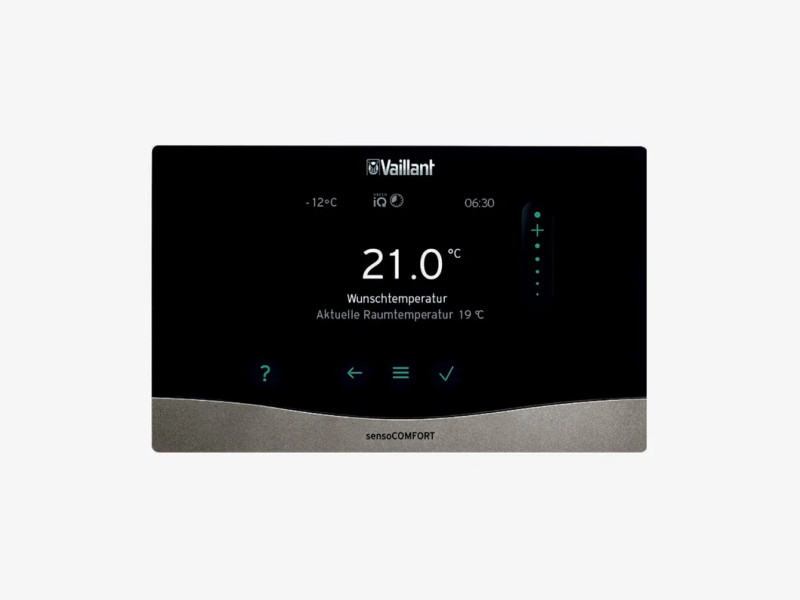
Here, we almost always recommend the controller supplied by the heat pump manufacturer. It is programmed with the unit’s water control logic (the water temperature to be produced based on the outdoor temperature) and adjusts output accordingly. The Vaillant SensoCOMFORT VRC 720 is designed for aroTHERM heat pumps and multi-circuit systems, whilst the Bulex Genia Air thermostat is designed to work with the heat pump of the same name. A universal on/off thermostat connected to a heat pump can disrupt its control and cause it to lose some of its efficiency.
With radiators or a branded underfloor heating system
Some radiator manufacturer have their own systems. Radson, for example, offers the Gateway Unisenza Plus control unit, which controls its radiator heads and thermostats via an app.
The right settings to really save money
At night, turn the thermostat down about an hour before going to bed: the house will retain its heat for a while, so you won’t notice the difference. In the morning, raise the temperature half an hour to an hour before you get up, depending on the thermal inertia of the house. A well-insulated house or one with underfloor heating reacts slowly; an older house with cast-iron radiators does too, but for different reasons. The thermostat learns this delay after a few days, and this is one of its real advantages over a programmable model.
For short absences of two or three hours, lowering the temperature by two degrees is sufficient. For a working day, turn it down to 16 or 17 °C. For a week’s holiday in winter, keep the temperature between 12 and 15 °C rather than switching everything off. Our damp climate plays a role here: in a Belgian home that is left too cold for too long, moisture condenses on the cold walls, with the risk of mould forming in corners and behind furniture. Turn it down, yes; switch it off completely in the middle of winter, no.
Finally, switch off the heating whilst you’re airing the room. Many smart valves detect a sudden drop in temperature and shut off the radiator automatically whilst the window is open. Ten minutes of airing a day, with the heating switched off, costs less than leaving a window ajar all day above a radiator that’s on.
Play or moment | Recommended temperature |
| Living room, during the day when you’re there | 19 to 20 °C |
| Rooms | 16 to 17 °C |
| Bathroom, whilst having a shower | 21 to 22 °C |
| One day’s absence | 16 to 17 °C |
| Winter holidays | 12 to 15 °C |
Our view: where to start?
To be honest, a smart thermostat won’t work miracles. It’s still one of the cheapest heating purchases that can actually help reduce your bill. Our advice consists of three steps.
Firstly, take a look at how you heat your home at the moment. If your thermostat hasn’t been reprogrammed for years and the house is kept at 21 °C day and night, you’ll see a noticeable saving from the very first winter. If you already turn the heating down every evening, the saving will be more modest.
Next, start with your existing system. Condensing boiler: a modulating thermostat compatible with your boiler. Heat pump: the manufacturer’s controller. Radiators in rooms that are often empty: a few smart valves, starting with the bedrooms.
Finally, keep your priorities straight. If your home is poorly insulated or your boiler is over twenty years old, the thermostat should be part of a wider project, not a replacement for it.
Frequently asked questions
How much can you save with a smart thermostat?
For most households, this represents between 5 and 15 per cent of the heating bill, and up to 20 per cent for those who used to heat their homes without a programme. Every degree lower reduces heating consumption by around 7 per cent. The figures of 30 to 40 per cent quoted by some manufacturers are based on a house that is heated continuously to 20 °C in every room.Is a smart thermostat compatible with my boiler?
It’s almost always in ‘all or nothing’ mode. To make the most of the modulation – which allows a condensing boiler to operate more efficiently – you’ll need an OpenTherm-compatible thermostat or the control unit supplied by your boiler manufacturer (Vaillant, Bulex, Remeha, etc.). Make a note of your boiler’s make and model before you buy.Do you need a smart thermostat with a heat pump?
It is better to use the manufacturer’s controller, connected via its internet module, such as the Vaillant SensoCOMFORT VRC 720 or the Bulex Genia Air thermostat. With underfloor heating, the aim is to maintain a stable temperature: significant drops in temperature during the day offer little benefit and may even lead to higher energy consumption.Smart thermostats or smart valves: which should you choose?
The thermostat controls the temperature of the house from a single room. The smart valves control each radiator individually. In a house with rooms that are often unoccupied, the valves offer the greatest savings; the most effective approach is to combine the two, as with the Honeywell Home Evohome system and its HR 92 valves.Does the smart thermostat work without an internet connection?
Most branded models continue to follow their programme and regulate the temperature in the event of an internet outage. You simply lose the ability to control the device remotely via your smartphone whilst the outage lasts. Make sure you ask about this specifically before buying, as this is not the case with all entry-level models.