Shower head: rain shower, massage or water-saving – which one should you choose?

Key points
Three types of shower heads cater to three different preferences: the rain shower effect for an immersive, spa-like experience; the multi-function massage jet for varying sensations; and the water-saving option to reduce water consumption. 1 In Belgium, two factors often go unnoticed:
water pressure (a large overhead rain shower head requires 2 to 3 bar, which is rare in homes built before 1980)
water hardness, which causes the nozzles to become blocked within a few months in areas with a hardness of 30 °fH.
For a family of four, reducing the flow rate from 12 to 7 l/min saves around 60,000 litres of water a year. A shower head remains the cheapest and quickest way to improve a bathroom.
Why is the shower head the best value-for-money upgrade for the bathroom?
A shower head can be unscrewed by hand and refitted in five minutes. No need to break through a wall, no tiles to break, and no need to book a plumber three weeks in advance. On a hand-held shower head, the connection is standard throughout Belgium (15 x 21 thread, or ½ inch), so any model can be screwed onto any hose. That’s why it’s the first change our advisers recommend when someone wants to upgrade their shower without undertaking major building work.
And the difference is immediately noticeable. You might have a beautiful shower screen, an ultra-slim shower tray and immaculate tiling: if the water flow is weak or disappointing, so is the shower experience. Conversely, a good shower head can transform an ordinary shower into something special overnight. It offers the best value for money, effort and result in the whole room.
The question is, what sort of shower do you want to enjoy every morning?
The three types of knobs:
The rain effect: an immersive experience
A large disc measuring 20 to 30 cm, with fine jets that fall vertically and cover the whole body. This is the hotel-style shower – the sensation you’re looking for when you want to take it easy in the morning or unwind in the evening. Ideally, it should be fitted to the ceiling or on a long arm, so that the water falls straight down rather than at an angle.
One point that most comparison guides overlook: the rain effect requires water pressure. At less than 2 bar, a large ceiling-mounted shower head produces a lukewarm trickle rather than a proper rain shower. We’ll come back to this later, because in Belgium it’s a real issue. Hansgrohe sets the standard in this area with its AirPower technology, which injects air into every drop: the spray remains full and gentle even at low flow rates.
The multifunctional massage shower head: several showers in one
Here, a dial or button switches between a gentle rain shower and a concentrated jet that massages the shoulders or lower back. This is handy when several people use the same shower with different preferences, or for recovering after exercise. High-end models offer three to six settings. Grohe, with its DreamSpray technology which distributes the water evenly across the nozzles, makes excellent multifunction units that can be fitted to almost any existing installation.
The pitfall of low-end multifunction machines: too many gimmicky modes, and a mechanism that gets clogged up quickly. It’s better to have three well-designed modes than six, of which you’ll never actually use more than two.
The Economy model: the same comfort, half the water
A water-saving showerhead mixes air with the water (or creates micro-holes using a laser) to maintain the sensation of a full spray whilst reducing the flow rate. This brings the flow down to around 6 to 9 l/min, compared with 12 to 15 l/min for a standard showerhead – and sometimes even more on older models. The shower experience remains pleasant because the droplets are larger and retain their heat better than a fine mist. Hansgrohe (EcoSmart range) and Grohe (EcoJoy) both cater to this market without compromising on the shower experience.
Good news: these three options are not mutually exclusive. A Hansgrohe EcoSmart rain shower head is both enveloping and water-efficient. A multi-function shower head can incorporate a flow restrictor. The real choice comes down to what your priorities are.
Family | Approximate flow rate | Who is it for? | One to watch |
| Rain effect | 9 to 18 l/min depending on the model | Fancy a spa or a peaceful bathroom? | Requires 2–3 bar pressure for large ceiling-mounted models |
| Multifunctional massager | 8 to 14 l/min | A community with a wide range of interests, including sports | Avoid models with gimmicky features that get clogged up |
| Economical | 6 to 9 l/min | Families, tenants, bill reduction | Below 5 l/min, the flow feels a bit skimpy |
Growth and the real economy in Belgium
In euros, the savings come from two areas: the water itself and the energy used to heat it (often the biggest cost). Depending on the region and the supplier, the cost for this type of household is estimated to be between €80 and €150 a year, including hot water. An energy-saving shower head costing €25–50 therefore pays for itself in a few months.
Profile | Classic knob | Economy shower head | Estimated annual gain |
| Single person | ~13 l/min | ~7 l/min | €25 to €45 |
| Couple | ~13 l/min | ~7 l/min | €45 to €80 |
| Family of four | ~13 l/min | ~7 l/min | €80 to €150 |
A word on water flow being too low. Dropping below 5 l/min to save a few extra litres is often a false economy: the rinse takes longer, you spend more time under the water, and the saving is lost. For most households, the ideal range is between 6 and 8 l/min. If your hot water comes from a small boiler or if the pressure is just about right, stick to the upper end of this range.
Water pressure: the ‘rain effect’ trap in Belgian homes
Many Belgian homes built before the 1980s have low or inconsistent water pressure. However, rain-effect showers – particularly large ceiling-mounted models – require sufficient pressure to ensure the water falls straight and forcefully: allow for 2 to 3 bars. Below this, the result is disappointing – a weak stream that trickles rather than falls.
Two things to bear in mind before buying. First, check your water pressure: a pressure gauge costing just a few euros, which screws onto a tap, will give you the answer in thirty seconds. Next, if the pressure is low, you have two options. Either choose a hand shower rather than a large overhead shower, as it remains effective at lower pressures. Or opt for a shower head with aeration technology, which compensates by infusing the water droplets with air. Thanks to this, some models remain comfortable to use even at just 1 bar.
This issue of water pressure ties in with a wider choice: that of your entire shower fittings. If you’re also considering a shower column or a thermostatic mixer, it’s worth thinking about the whole setup at once — this is the topic we cover in our guide Which shower should I choose for my bathroom?, where the showerhead forms part of a comprehensive consideration of the installation.
Ceiling-mounted, column-mounted or handheld: which type?
In fact, many shower set-ups combine a large fixed rain shower head with a hand-held shower on the same mixer tap. You can enjoy the rain shower effect every day, whilst keeping the hand-held shower for when it’s more practical. This is the most comfortable set-up, provided your budget and space allow it.
Finishing touches: think consistency, not just the knob
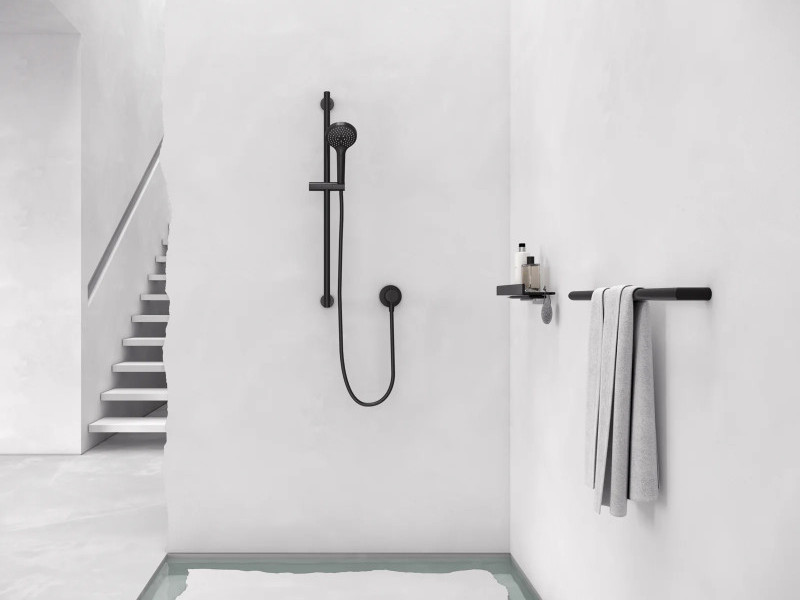
Chrome remains a safe bet: it’s easy to maintain and goes with everything. Matt black and brushed stainless steel have become very popular in Belgian bathrooms in recent years, but there’s one thing to bear in mind: limescale and fingerprints show up more clearly on matt black, so hard water requires a little more attention. The key principle is that the finish of the shower head must match that of the mixer tap, the drain and the fittings. A matt black shower head on a chrome mixer tap stands out immediately.
Hansgrohe or Grohe: two brands available at Facq
The two German brands dominate the market for high-quality showerheads, and Facq works with both. Hansgrohe sets the standard for rain-effect showers and the sensory experience, with AirPower for spray comfort and EcoSmart for water savings. Grohe offers the best value for money on multi-function showers and shower columns, with DreamSpray for consistent spray and EcoJoy for water savings. Over ten years, both require little maintenance and retain their spray performance, provided they are regularly descaled. This justifies their price compared to a €15 shower head, which will be half-clogged after a year in hard water.
Frequently asked questions
What flow rate should you choose for a good, economical shower head?
Between 6 and 8 l/min for most households. This strikes a balance between economy and a comfortable shower experience. A standard shower head has a flow rate of 12–15 l/min. Below 5 l/min, the flow feels too weak and you end up standing under the water for longer, which negates the savings.Does a rain shower head work with low water pressure?
Large ceiling-mounted shower heads require 2 to 3 bar to provide a good flow. In an older Belgian home with low water pressure, it’s better to opt for a hand shower or a model with aeration technology, such as Hansgrohe AirPower, which remains comfortable even at 1 bar. Check your water pressure with a pressure gauge before buying a large ceiling-mounted shower head.How can I prevent limescale build-up on my shower head in Belgium?
Choose a model with soft silicone jets: running your finger over them at the end of your shower removes the limescale before it hardens. Soaking it in white vinegar from time to time completes the maintenance routine. In areas with a water hardness of over 28 °fH, a water softener protects the shower head as well as the rest of the plumbing system.Can I change my shower head myself?
On a hand-held shower, yes, without any tools. The connection is standard in Belgium (15 x 21 thread). Simply unscrew the old one, screw in the new one – it takes just five minutes. A fixed shower head recessed into the ceiling, on the other hand, is installed during a renovation where the water supply is routed through the ceiling.Does a budget shower head cool the water down?
No, in fact the opposite is true with a good-quality model. The larger, aerated droplets retain their heat better than the fine mist produced by lower-end shower heads. You use less hot water without compromising on comfort.