Which shower should I choose for my bathroom?

Replacing a bath with a shower, rethinking an ageing cabin, or starting from scratch in a complete renovation: these are all situations where the options seem numerous and the choices complex.
The essentials
Choosing your shower comes down to four fundamental questions:Book an appointment
1. What type of installation suits my space and the level of work I am prepared to undertake?
2. Which panel expresses the style I am looking for?
3. Which tap fittings (rain shower head or thermostatic column) will transform my daily routine?
4. And how do I intend to use it: alone, as a family, or with accessibility in mind?
The walk-in shower has today become the benchmark in Belgium, for its freedom of movement, its clean aesthetics and its compatibility with all styles, from small spaces to the most ambitious projects.
At Facq, our advisers will guide you through this choice at one of our 17 EXPOcenters in Belgium. With a free appointment to see, touch and compose your ideal shower.
Why rethink your shower or replace your bath?
Before choosing a shower, it is worth asking a more fundamental question: why is now the right time? The answer shapes the rest of the project.
Replacing your bath with a shower: a lifestyle choice
In Belgium, more and more homeowners are making this choice — and often they do so late, regretting not having done it sooner. The bath takes up a considerable amount of space in a room where every centimetre counts. Replacing it with a walk-in shower means regaining space, light, and often the impression of a completely reimagined room.
It is also a practical choice: the shower is more accessible on a daily basis, easier to maintain, and suited to all ages. A level-access shower designed from the outset with care remains comfortable and accessible for decades — it is a lasting added value for your property.
The transformation effect
Removing an inset bath and installing a walk-in shower in the same space produces one of the most striking visual effects in bathroom renovation. The room instantly appears larger, more airy, more contemporary — even without touching the walls or existing tiling.
Renovating an existing shower: when change becomes necessary
Not because the shower is technically out of service, but because you deserve better in your daily life.
The good news: renovating a shower does not necessarily mean tearing everything out. An extra-flat tray to replace an old deep base, a new glass panel on the existing fittings, or simply a thermostatic column in place of an old mixer. Each element can be rethought independently, according to your priorities and the extent of the work you wish to undertake.
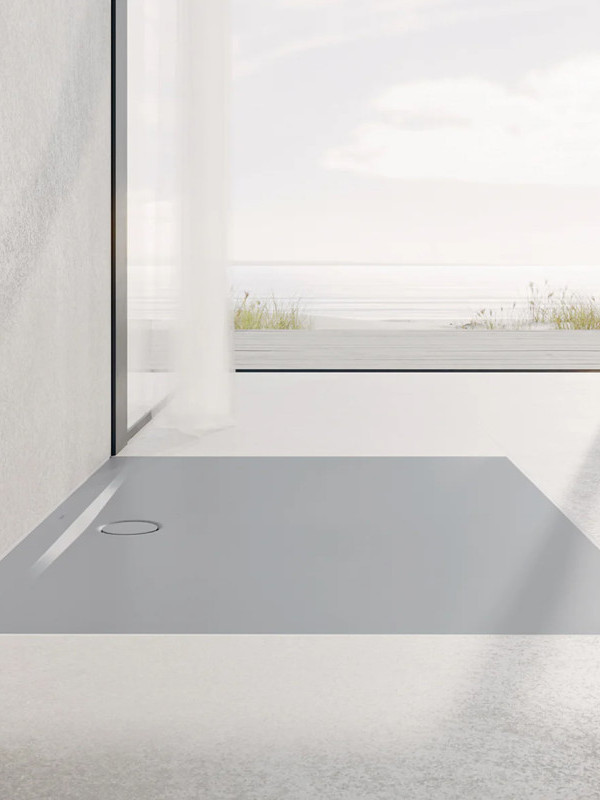
Shower types: finding the one that suits your space
Each shower type responds to a different space configuration and level of work. The key is to identify what is feasible in your home — and then project onto it the style you want.
| Shower type | Suitable if... | Level of work | Visual effect |
| Walk-in shower (screed) | Complete renovation or new build | Significant | Maximum — continuous floor/wall, very clean look |
| Extra-flat shower tray | Partial renovation, existing floor to keep | Minimal | Similar to walk-in, quick installation |
| Integrated shower cabin | Quick replacement, no waterproofing work needed | None | Modern and clean, all-in-one turnkey solution |
| Corner shower | Optimising a corner, small area (< 6 m²) | Moderate | Space-saving, visual opening at the centre |
| Niche / linear shower | Large area, strong architectural ambition | Significant | Spa or hotel effect, very high-end |
The walk-in shower: why it has become the benchmark
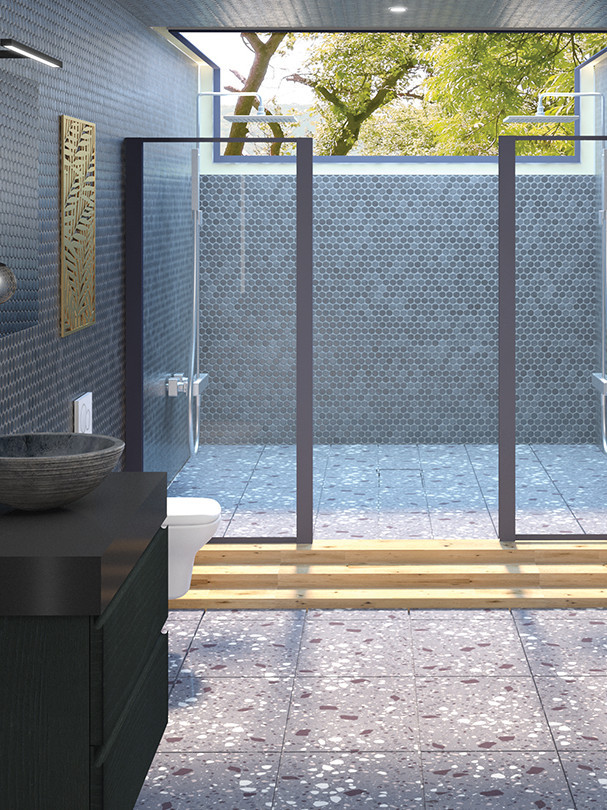
The walk-in shower is no longer a luxury: it has become the solution that the majority of Belgians choose when renovating. And for good reasons. It removes all entry barriers, creates visual continuity with the rest of the room, and adapts to all styles: from clean minimalism to Japanese wabi-sabi, through spa style or Art Deco.
It is also the most long-lasting solution: accessible at all ages, easy to maintain, and adding value to your property. A well-designed walk-in shower today will still be the right choice in twenty years’ time.
Small space, big impact
An 80 × 80 cm walk-in shower with an extra-flat tray, a fixed glass panel and a unified floor/wall cladding visually transforms the smallest bathrooms. The secret: eliminate visual breaks. The fewer interruptions in the space, the more the room breathes.
The extra-flat tray: the ally for renovations without demolition
If a screeded base is not possible (existing floor, flat, technical constraints), the extra-flat tray is the answer. Current models in enamelled steel or solid surface go down to less than 4 cm in thickness — visually almost indistinguishable from a screed. They are installed on existing fittings in a single day, with no dust and no noise.
At Facq, brands such as Kaldewei (enamelled steel, guaranteed for decades) or Geberit (ultra-thin drainage systems) offer trays that combine a slim profile with outstanding robustness. The choice of material depends primarily on your style and usage — our advisers will guide you in person.
The integrated shower cabin: the turnkey solution
It is often underestimated in design projects — wrongly. The integrated cabin has one decisive argument: zero waterproofing work, zero coordination between multiple trades. Everything is designed together (tray, panels, door, taps). It is perfectly suited to small bathrooms, studio flats, or projects where speed of execution is the priority.
In 2026, high-end cabins from brands such as Hüppe have taken a major aesthetic leap: extra-clear glass, ultra-thin profiles, solid surface tray. The visual boundary with a bespoke walk-in shower has narrowed considerably.
Corner shower, niche shower: when space dictates the form
The niche or linear shower is set into a wall recess. It creates a very strong architectural effect, close to the hotel or spa style. It requires floor space and pairs beautifully with an integrated linear drain. It is the choice for projects where the shower becomes the centrepiece of the bathroom.
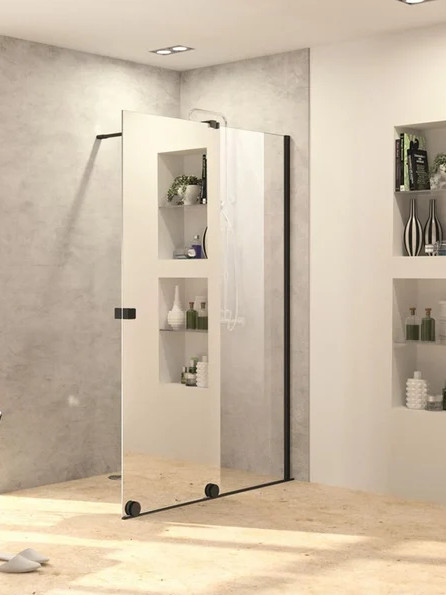
The shower panel: glass, style and privacy : the choice that changes everything
The shower panel is what you see when you walk into the bathroom. It determines the atmosphere, the level of privacy, and the daily cleaning required. And it is often where projects really take on their visual identity.
Transparent glass: maximum openness
Transparent glass is the choice for visual continuity. It removes all visual barriers between the shower and the rest of the room, enlarges the perceived space and lets light flow throughout. It is the most requested solution for spa-style bathrooms, niche showers and all projects where you want the room to breathe.
Its only requirement: maintenance. In Belgium, the water is hard — a nano-coating treatment (available as an option from Hüppe or Duscholux) is strongly recommended. It considerably reduces visible marks and turns the weekly clean into a simple wipe with a squeegee.
Frosted or satin glass: privacy and diffused light
Satin glass is the choice for balance. It filters the gaze without blocking light — ideal for family or shared bathrooms, where a degree of privacy is desirable without visually partitioning the space. The gradient effects offered by some brands (clear glass at the top, satin at the bottom) are particularly appreciated for their subtlety.
Textured glass: the detail that expresses a style
Textured glass panels have been the major trend in recent years. The Reed pattern (vertical reeds) creates a unique play of light and pairs beautifully with wabi-sabi, Art Deco or biophilic styles. Some shower brands also offer gradient effects and panels with natural wood profiles, an approach that connects the shower space to nature.
The key: choose textured glass as a deliberate style element, not as a way to hide imperfections. It must complement your palette of materials and finishes — not clash with it.
Fixed panel (walk-in) or door: what this choice really reveals
The fixed walk-in panel is the most aesthetically clean option. A single piece of glass, with no rail, no visible mechanism, no sealant to renew. It is suited to showers at least 90 cm wide and creates an incomparable sense of openness. The brands Hüppe and Duscholux offer walk-ins with profiles as thin as 4 mm — virtually invisible.
The door (sliding, pivot or bi-fold) is better suited to smaller formats and spaces where containing water splashes is a priority. The sliding door is particularly clever in confined spaces: it requires no room to open.
�� Facq tip: If space allows, always favour the fixed panel: fewer mechanisms = less maintenance, less to replace, and a visual result that remains impeccable years after installation.
Shower head and thermostatic column: the experience that makes the difference
You can have the most beautiful shower in the world, but if the water jet is disappointing, so is the experience. The shower head and tap fittings are the elements most directly linked to how you feel every day. They are also where it is often the simplest and most important to invest in quality.
The shower head: choosing your sensory experience
The rain effect: a large shower head (25 to 30 cm in diameter), with soft, enveloping jets that cover the whole body. The experience closest to a spa or hotel shower. Ideally installed on the ceiling or on a long arm to make the most of the effect. Hansgrohe is the reference here: their technology mixes air and water for a broad, gentle jet without excessive consumption.
Massage / multifunction jets: several combinable jet modes, to alternate between an invigorating morning shower and a targeted massage after sport. Grohe offers in this range accessible multifunction shower heads that adapt to most existing installations.
Smart economy: shower heads with a built-in aerator that mix air and water for a comfortable jet while significantly reducing consumption. A choice consistent with environmental concerns in Belgium, with no compromise on perceived comfort.
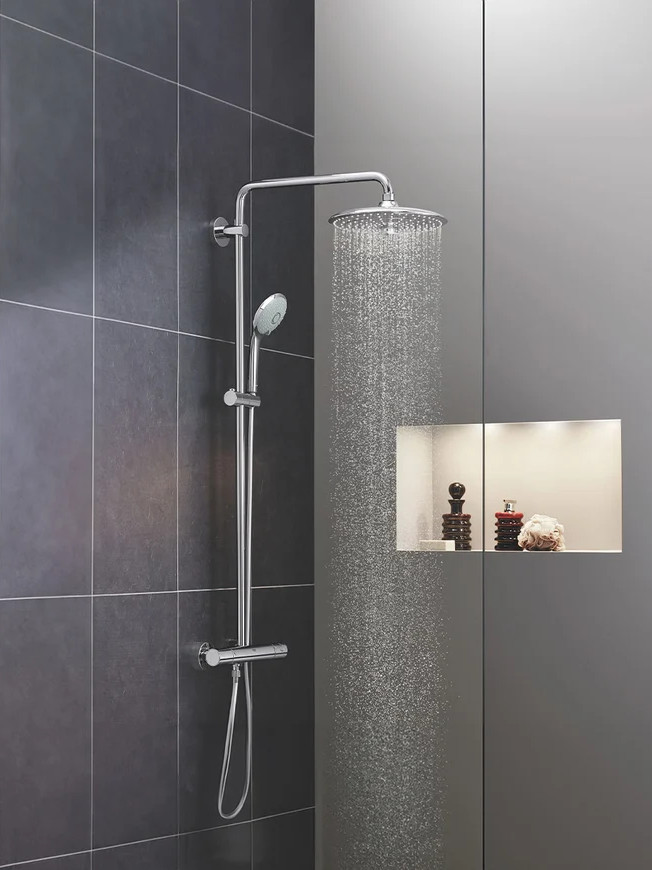
Good to know: A shower head is the simplest element to change in an existing installation. It is often the first upgrade our advisers recommend during a partial renovation: immediate impact on the experience, virtually no work required.
The thermostatic column: the comfort you can’t give up
In Belgium, where water pressure varies in the majority of properties built before the 1980s, this is particularly relevant. The thermostatic column is not a gadget: it is a comfort decision that those who have adopted it never question.
Two levels of installation depending on your project: the wall-mounted column (which connects to the existing supply, with no additional work) is perfectly suited to a partial renovation. The concealed thermostatic unit (body in the wall, only the front plate visible) is the premium solution for a new build or complete renovation. The tap fittings disappear into the wall, leaving only the front plate visible. Hansgrohe and Grohe offer modular systems where the front plates are interchangeable, allowing you to update the style without touching the plumbing.
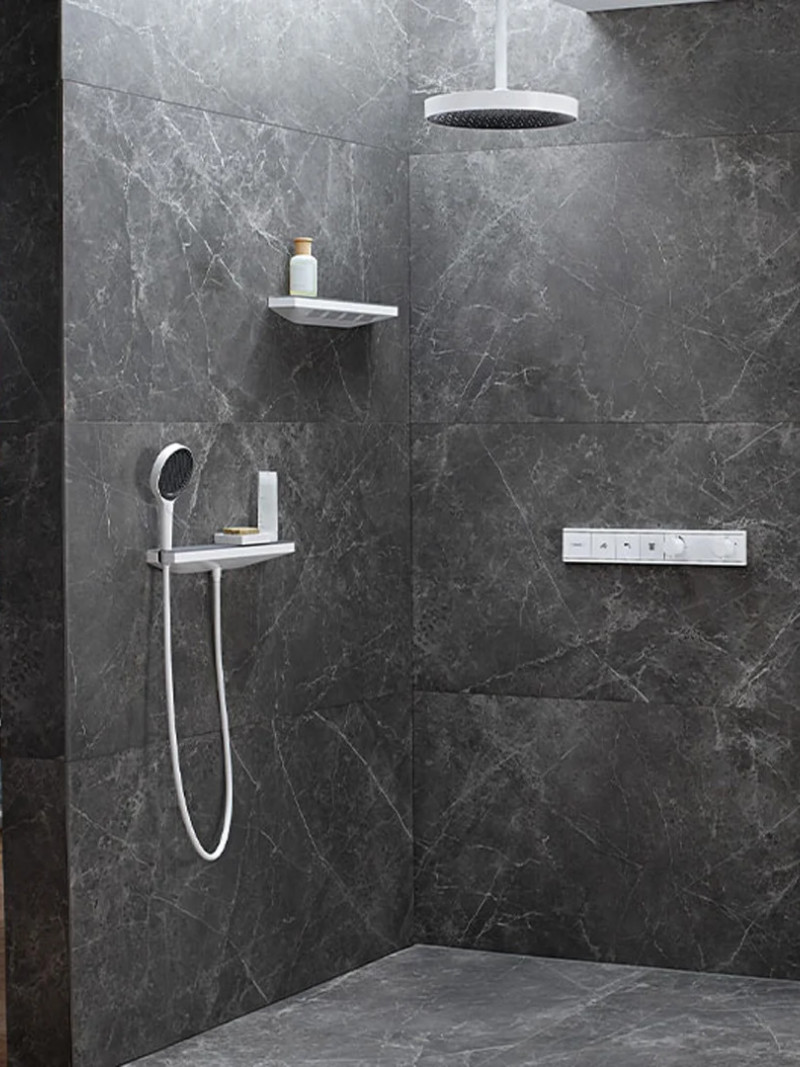
The decisive argument: A concealed thermostatic unit with a matt black front plate and a ceiling rain shower head in the same finish is the combination that transforms an ordinary bathroom into a spa experience. No need for a large space — just consistency and the right choices.
Specific uses: families, PMR and shower for two
The family bathroom: a shower that lasts and reassures
In a family bathroom, the shower needs to work for everyone: children, adults, people with varying mobility. The priorities change: it is not necessarily about maximum clean lines, but about robustness, ease of maintenance and a degree of preventive accessibility.
A level-access walk-in shower meets all three criteria at once. Anti-slip finishes, enamelled steel trays (virtually scratch-proof) and panels without a low-profile rail (which trap limescale) radically simplify maintenance over the years. Adding a discreet grab rail (the Keuco ranges offer rails of impeccable elegance) anticipates the future without compromising today’s design.
PMR shower: accessibility and design are no longer mutually exclusive
The accessible PMR shower of 2026 bears no resemblance to the functional, austere image of the past. Belgian standards (150 × 150 cm turning space, zero threshold, grab rail) integrate perfectly into ambitious contemporary designs.
A level-access walk-in shower is, by definition, PMR-compatible. A fold-down teak wall seat, a Keuco brushed stainless steel grab rail, a shower control at an adapted height: these elements form part of the aesthetic range and do not flag up accessibility — they make it natural.
Belgian reference: In Wallonia, Brussels and Flanders, renovation grants are available for home adaptation work related to PMR accessibility. A Facq adviser can guide you on the procedures during your EXPOcentre appointment.
The shower for two: a project of space and shared comfort
This type of configuration naturally takes the form of an architectural niche: with no dividing panel, a central linear drain and a continuous finish. The effect is close to a spa, the sensation of freedom is incomparable, and it is a configuration that significantly adds value to a property.
Brands available at Facq: points of reference
Facq works with a carefully selected range of partner brands : all available to discover and compare in the EXPOcenter. Here are the key points to understand the speciality of each, without going into detail on references that change from season to season.
| Brand | What it offers | Why choose it |
| Hansgrohe | Premium showerheads and taps — AirPower technology for the rain effect | The global reference for the rain shower. Choosing Hansgrohe means choosing the maximum sensory experience in the shower. |
| Grohe | Wide range of taps, thermostatic columns — accessible and reliable | The best combination of quality, durability and range of finishes. Ideal for cohesive complete projects. |
| Hüppe | Design panels and cabins — ultra-thin profiles, extra-clear glass | When the panel needs to disappear visually. Specialist in clean walk-in solutions and bespoke configurations. |
| Duscholux | Bespoke panels with integrated fitting service in Belgium | The only brand to offer measuring + installation by its own technicians. Ideal for atypical configurations. |
| Geberit | Drainage systems and technical trays — invisible linear drains | When the drain needs to be architectural. Geberit channels are a visual signature in their own right. |
| Kaldewei | Enamelled steel trays — the most durable on the market | Kaldewei enamelled steel is guaranteed for decades. For those who want a tray that does not age. |
| Keuco | PMR accessories and grab rails — elegance and functionality | The brand that reconciles accessibility and aesthetics. Each Keuco grab rail is a design object in its own right. |
| Duravit | Design trays and ceramics — solid surface, organic shapes | For projects where each element is conceived as an object. Duravit combines signature design and flawless enamel quality. |
One piece of advice that applies across all these brands: what matters is not the brand chosen, but the consistency of the system. The tray, panel, taps and accessories must speak the same language. A matt black finish throughout, or a guiding thread in brushed brass from the tap to the towel bars: this is the level of consistency that our Facq advisers help you build in the EXPOcenter.
Durability and maintenance: thinking about your shower for the long term
A well-chosen shower should remain beautiful and pleasant to use for years, without its maintenance becoming a burden. This dimension is often underestimated at the project stage, yet it is decisive for satisfaction at 5 or 10 years.
Choosing materials that age well
- Enamelled steel: non-porous, scratch-resistant, resistant to household products and heat. Its surface does not yellow or tarnish. It is the material that ages best in a shower, with no special maintenance required.
- Solid surface (mineral resin): no joints, repairable by sanding in the event of a scratch, maintained with clear water. Very homogeneous ageing.
- Stoneware (for wall and floor finishes): very resistant, but the joints are the weak point. Opt for epoxy joints or joint-free cladding systems for the inside of the shower.
- Acrylic: economical and lightweight, but more susceptible to scratches and yellowing over time. Best reserved for projects with a shorter expected lifespan.
The number one enemy in Belgium: limescale
Belgian water is hard: TH above 20°f in most provinces. Without precautions, limescale builds up on glass panels and taps within weeks. Two complementary approaches:
- Nano-coating treatment on glass: offered as an option by some brands, it makes the surface hydrophobic (drops slide off), so limescale does not stick.
- PVD finishes on tap fittings: unlike conventional chrome plating, the PVD coating (physical vapour deposition) resists acidic household products and repeated rubbing. Matt black or brushed brass PVD finishes remain impeccable years later.
�� Best practice: Ventilating the bathroom after each shower remains the simplest and most effective measure against moisture, mould and limescale. A high-performance mechanical ventilation system (MVS) is the invisible investment that protects all your equipment over the long term.
Frequently asked questions
Q1. Is it better to replace your bath with a walk-in shower?
In the majority of cases, yes — and those who take the plunge never regret the decision. The walk-in shower reclaims the space occupied by the bath, immediately modernises the room, makes maintenance easier and suits all ages. The only reason to keep a bath is genuine and frequent use: if you take a bath at least once or twice a week and it truly matters to you. In all other cases, the walk-in shower is the best long-term investment for your bathroom.Q2. Walk-in shower in 4 m²: is it really possible?
Yes, provided the space is well designed. An 80 × 80 cm extra-flat tray in a corner, a fixed glass panel with a sliding door (which requires no room to open) and a unified floor/wall finish: in a 4 m² bathroom, this configuration creates a significantly more spacious impression than a standard cabin. The secret is to eliminate visual breaks: the more the eye glides without interruption, the larger the room appears.Q3. Which shower panel is the easiest to maintain?
The easiest panel to maintain is the fixed walk-in panel in nano-coating-treated glass: no side joints, no low-profile rail to accumulate limescale, and glass that wipes clean with a squeegee. Frosted or textured versions have the added advantage of making water marks far less visible than on transparent glass. Best avoided over time: panels with untreated aluminium profiles, where limescale builds up in the corners and eventually dulls the whole installation.Q4. Thermostatic or standard mixer: what is the real difference?
The difference is felt every day. A standard mixer requires you to adjust the temperature at each use and in Belgium, where water pressure varies (flushing the toilet, washing machine running), this adjustment can be sudden and unpleasant. The thermostatic mixer memorises your preferred temperature and maintains it automatically. After a week of use, it becomes hard to go back. It is the equivalent of automatic climate control in a car: you wonder how you managed before.Q5. How do I choose between a central drain and a linear drain?
The central drain is simpler to install and suits all standard trays. The linear drain is the choice for an ambitious project: it allows large-format tiling without cutting, a very strong architectural effect, and easier PMR accessibility. It requires the screed to slope in a single direction. If you are undertaking a complete renovation, the linear drain is an investment that genuinely changes the final visual result — our Facq advisers can help you assess whether your configuration allows for it.
Compose your ideal shower at a Facq EXPOcenter
See a walk-in panel in full size. Touch an enamelled steel tray. Actually experience the effect of a rain shower head. Compare finishes side by side. No online guide can replace this experience. In one of our 17 EXPOcenters in Belgium, our advisers will accompany you to turn your vision into a concrete project — free appointment, no commitment.Book an appointment