Melamine or solid wood furniture: a comprehensive comparison for the bathroom

The choice between the two isn’t based on how they look in the shop, but on what lies beneath the surface: the panel’s composition, how the edges are protected, and how much you’re prepared to spend on a piece of furniture that will last. Here’s what really sets these two materials apart, with price guides from Facq.
Laminate and solid wood: what exactly are we talking about?
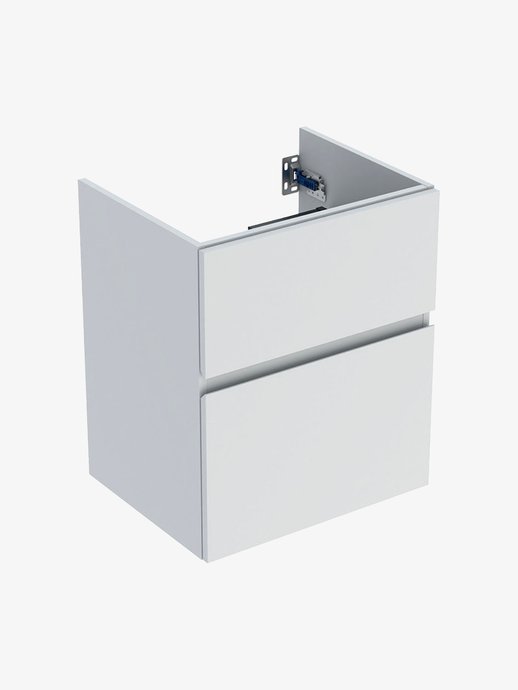
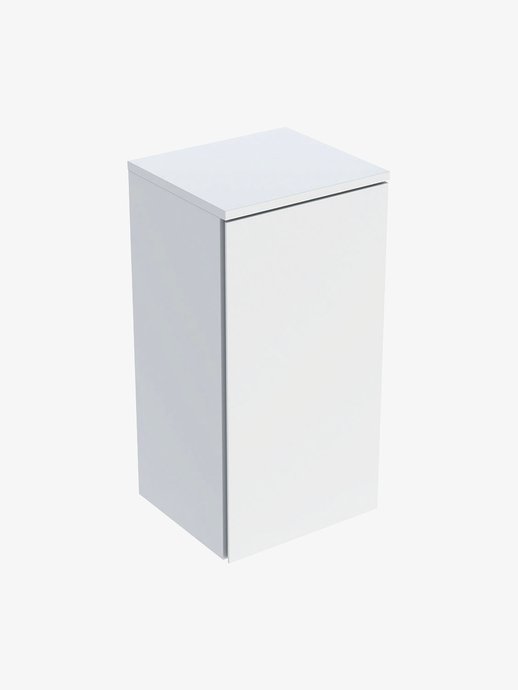
Melamine-faced board is a particleboard or MDF panel onto which a decorative sheet of paper impregnated with melamine resin is heat-pressed. The bonding process creates a hard, smooth and easy-to-clean surface, printed to imitate the grain of oak or walnut, or a solid colour. This is how Geberit itself describes its Caluna range, sold at Facq: ‘the wood-textured melamine oak surfaces give the room a natural look’. Melamine is therefore not wood, but a printed finish on a reconstituted board substrate.
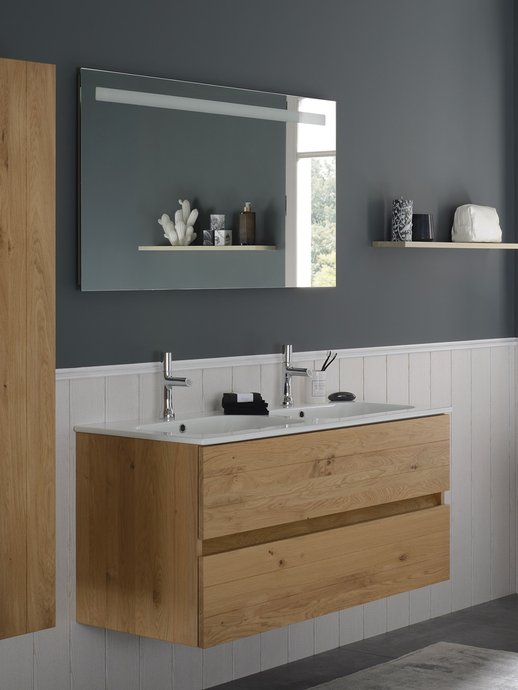
Solid wood, by contrast, is a solid piece of wood, cut directly from the trunk, without any particles or binding glue. Each plank retains its grain, knots and natural variations in colour. We detail the wood species best suited to the bathroom (teak, oak, chestnut) in our comprehensive guide to solid wood furniture.
A third term that often crops up and causes confusion is lacquered. Unlike melamine, this does not involve printed paper but rather several layers of paint or varnish applied directly to a substrate, resulting in a matt, satin or gloss finish. Lacquered finishes also pair very well with solid wood in the same piece of furniture – a combination we explain in our guide to combining solid wood and lacquered finishes.
Moisture resistance: the real tipping point
It is here that the two materials differ most markedly, and not in the way one might expect.
The particleboard used as a substrate for melamine-faced panels is classified in accordance with European standard EN 312. A P2 board is intended for use in dry conditions, such as a bedroom or living room. A P3 board (sometimes called ‘water-resistant’, recognisable by the greenish tint of its core) is designed to withstand occasional exposure to ambient humidity, which is typical of use in a bathroom. The printed surface is highly water-resistant as long as it remains intact. The weak point is the edges: the cut edges of the panel, where the decorative paper ends. If these are not sealed with a heat-bonded edge band, water seeps into the exposed panel and causes it to swell irreversibly. This is almost always where a medium-quality melamine-faced cabinet begins to deteriorate – at the base of a vanity unit or on a poorly fitted door.
Solid wood behaves differently: it reacts to humidity, swelling and shrinking slightly with the changing seasons, without suffering any damage provided it has been treated with a water-repellent product suitable for its species. Exotic woods such as teak contain natural oils that enhance this resistance; European woods such as oak require more regular treatment.
In both cases, good ventilation remains the furniture’s best ally. A bathroom without an effective mechanical ventilation system will damage entry-level melamine-faced units within a few years, and will eventually cause poorly maintained solid wood to lose its lustre.
Durability and repairability: what happens after ten years of use
That is the real difference between the two materials – even more so than the purchase price.
A solid wood piece of furniture can be sanded and refinished several times. A deep scratch, a door marked by a falling object: a light sanding followed by a fresh coat of oil or varnish is enough to repair the damage, time and again throughout the piece’s lifetime. This is what enables a well-maintained piece of solid oak furniture to last twenty to thirty years without losing its appearance.
Melamine-faced board can, at best, only withstand very light sanding. As soon as the decorative paper is damaged, the bare board underneath becomes visible, and there is no way to conceal this with a surface treatment. A deep scratch or chip on melamine-faced board remains visible forever, which generally leads to the piece of furniture being replaced entirely rather than repaired.
Weight is also a factor, particularly for wall-mounted units, which are in high demand in Belgian bathrooms because of the sense of lightness they bring to a small room. A solid wood unit is significantly heavier than a melamine-faced unit of the same dimensions, which means reinforced wall fixings are required, particularly on a non-load-bearing partition rather than a load-bearing wall. This is something you should check with your fitter before choosing the wall-hung version of a solid wood model.
Day-to-day maintenance: two different approaches
Routine maintenance is straightforward in both cases: a damp cloth, soapy water, and thorough drying after cleaning. The differences become apparent in the medium term.
With melamine-faced surfaces, simply avoid abrasive products that could scratch the printed surface, and, above all, wipe up any standing water immediately around the handles and at the base of the unit, where the edges are most exposed.
On solid wood, periodic treatment with oil or water-repellent varnish—once or twice a year, depending on the type of wood—significantly extends its lifespan. Acetone and ammonia must not be used: these products irreversibly damage the wood fibres.
Actual budget: price comparison at Facq
Unsurprisingly, melamine remains the most affordable option. Solid wood falls into a completely different price bracket, which is justified by the material itself and its lifespan.
Model | Material | Brand | Guide price (including VAT) |
| Caluna mid-height column | Laminate | Geberit | From €446.20 |
| Caluna 2-drawer base unit | Laminate | Geberit | From €718.80 |
| The pupil | Solid wood (natural oak) | Sanijura | From €1,072.06 |
| Doblo | Sustainable timber | Sanijura | From €1,328.58 |
| World | Sustainable timber | Sanijura | From €2,372.81 |
| Hedgerow countryside | Solid wood (solid oak) | Sanijura | From €2,534.95 |
| Epic | Solid wood (natural oak) | Sanijura | From €5,591.41 |
The term ‘eco-friendly wood’ used by Facq for certain Sanijura ranges refers to collections that use wood sourced from sustainably managed forests, although the construction is not necessarily solid on all sides of the unit: an EXPOcenter adviser can provide details of the exact composition piece by piece.
Which material should you choose based on your profile?
There is no such thing as a wrong answer in absolute terms; there is only an answer that is ill-suited to the situation.
Melamine is well suited to rental properties, a rarely used guest bathroom, or a short-term resale project where the investment needs to be kept to a minimum. A P3 board that has been fitted correctly, with the edges properly sealed, will easily last around ten years with normal use.
Solid wood is best suited to a main bathroom, used daily by a family, in a project designed to last fifteen years or more. It is also the choice that matters when it comes to reselling: a piece of solid oak furniture that still looks pristine after fifteen years is more reassuring to a buyer than a melamine unit with swollen edges.
Frequently asked questions
Q1. Is melamine really unsuitable for a bathroom?
No, provided you choose a panel classified as P3 under the EN 312 standard, specifically designed for damp environments, and ensure that the edges are properly protected by a heat-bonded edging strip. It is the combination of these two factors that determines the panel’s long-term durability, not the melamine finish itself.Q2. Why is solid wood so much more expensive than melamine-faced board?
The cost of raw materials is a major factor: a piece of solid wood requires more raw timber, more labour for shaping, and a longer drying period before processing. Melamine, on the other hand, makes use of offcuts and recycled wood particles on a cost-effective base. The price difference directly reflects the difference in raw materials and durability.Q3. Can scratched or chipped melamine-coated furniture be repaired?
It’s very difficult. Decorative paper can only be sanded very lightly before the bare panel becomes visible. There are touch-up fillers available for small chips, but the result is rarely imperceptible. A piece of solid wood furniture, on the other hand, can be sanded and re-oiled to remove a scratch.Q4. Can a wall-mounted solid wood unit be hung on any wall?
Not without checking first. Solid wood is heavier than an equivalent piece of melamine-faced furniture, which means stronger fixings are required, particularly on a lightweight partition rather than a load-bearing brick or concrete wall. A Facq adviser or your fitter will assess this before installation.Q5. How can you tell if a piece of furniture is made of genuine solid wood when you’re in a shop?
The grain and knots never repeat exactly the same way from one board to the next, unlike the printed pattern on melamine. A light tap on the surface produces a full, dull sound on solid wood, and a more hollow sound on engineered wood. The weight of the furniture is also a good indicator: solid wood is significantly heavier for the same volume.Q6. How much should I budget for bathroom furniture at Facq?
Expect to pay between €450 and €750 (including VAT) for an entry-level to mid-range melamine cabinet, such as the Geberit Caluna range, and between €1,000 and over €5,500 (including VAT) for solid wood, depending on the size and type of wood, such as the Sanijura Eleven, Bocage or Epic ranges.