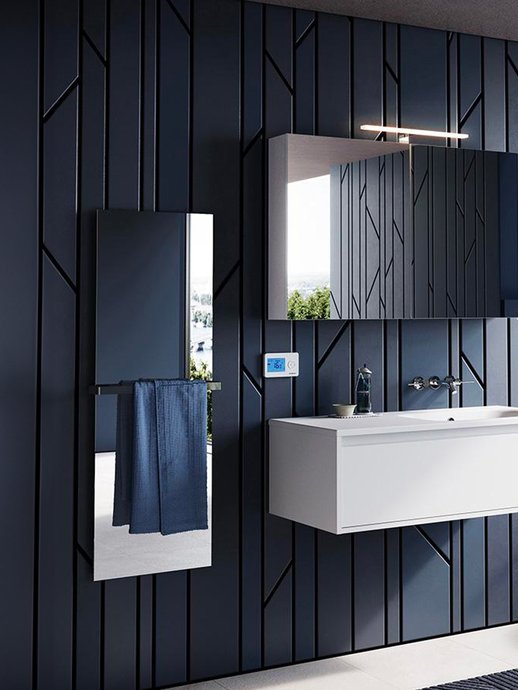
How can you incorporate a designer towel radiator without compromising on space?

The challenges of designing your bathroom
Designing a functional small bathroom requires careful thought, especially when every square metre counts. Installing a towel warmer may seem complicated, but we can help you optimise your space without compromising on comfort.
Is your bathroom lacking space? You're not alone.
Today's bathrooms are generally no larger than 4 to 5 square metres, particularly in city flats. However, this small space must accommodate all your essential equipment: washbasin, shower or bath, toilet and storage. Adding an electric towel rail may seem impossible, but it is an essential element for your everyday comfort.
A cluttered bathroom makes you feel cramped and hinders your movements. Even more problematic: poor layout reduces the efficiency of your heating. Your towel warmer loses performance if it is poorly positioned.
Avoid these design mistakes
Certain errors often occur when installing a towel dryer:
- Choosing a model that is too large for your available space
- Forget about walkways (leave at least 70 cm in front of each piece of equipment)
- Place the device behind a door or in a hard-to-reach corner.
- Ignoring safety distances from water sources
- Selecting a power rating that is unsuitable for the volume of your room
Be careful not to focus solely on aesthetics. A stylish towel warmer that is the wrong size will compromise your comfort and make it difficult to use on a daily basis.
Air must circulate for efficient heating.
The performance of your towel warmer largely depends on its environment. In a small space, air circulation becomes even more important.
Firstly, it ensures even heat throughout the room and prevents unpleasant cold spots. Secondly, it allows your towels to dry quickly by preventing moisture from stagnating. Finally, it limits the growth of mould, a common problem in small, poorly ventilated bathrooms.
So choose the location for your towel warmer carefully. Ideally, place it where warm air can circulate naturally, while ensuring that your hanging towels do not completely block the heat.
Select the ideal towel dryer for your limited space
Your small bathroom deserves a towel warmer that combines efficiency and elegance. We help you make the right choice from among solutions specially designed for small spaces, without compromising on performance.
Compact and vertical models: your space-saving ally
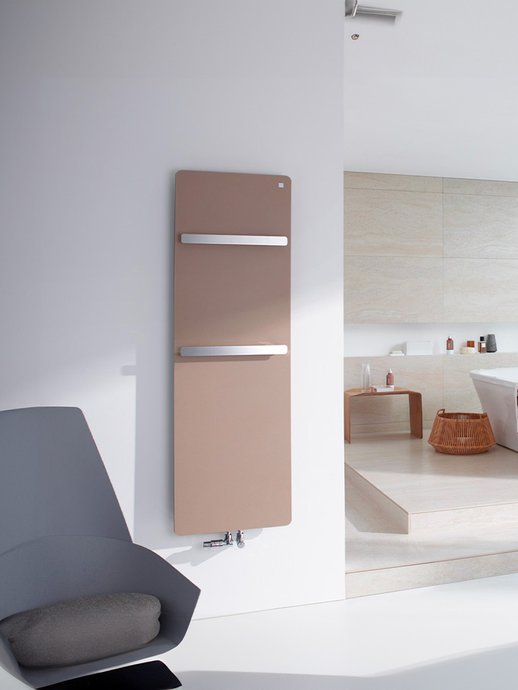
Vertical towel warmers are the smart solution for small bathrooms. Their slim design makes use of the available height while preserving floor space. Some ultra-compact models are only 40 to 46 cm wide, compared to 55 cm for standard versions.
These appliances slide easily between two elements or onto a narrow wall, creating an aesthetic solution even in the most confined spaces.
Electric or hybrid? Make the right choice
The type of towel warmer depends on your existing installation and your usage.
The electric towel dryer operates all year round, independently of your central heating system. Its simplified installation requires only an electrical connection.
The combined model combines electricity and hot water: it follows your central heating in winter, then switches to electric mode in summer. More versatile, it does, however, require two connections, which can complicate installation in a small space.
Power and dimensions: the essential criteria
To correctly size your appliance, follow these simple rules:
Power required: allow 100 to 130 watts per square metre heated. For a 5 m² bathroom, a 650-watt model (750W in practice) is ideal. This estimate varies depending on your insulation and the desired temperature.
Recommended dimensions: opt for a height of 130 to 170 cm and a width of 40 to 60 cm for small rooms. Thickness, generally between 9 and 21 cm, is also important in confined spaces.
Innovative designs: when space becomes an asset
Manufacturers are developing towel dryers with advanced features that maximise efficiency despite their compact size:
- Integrated fan: +3°C in just 15 minutes
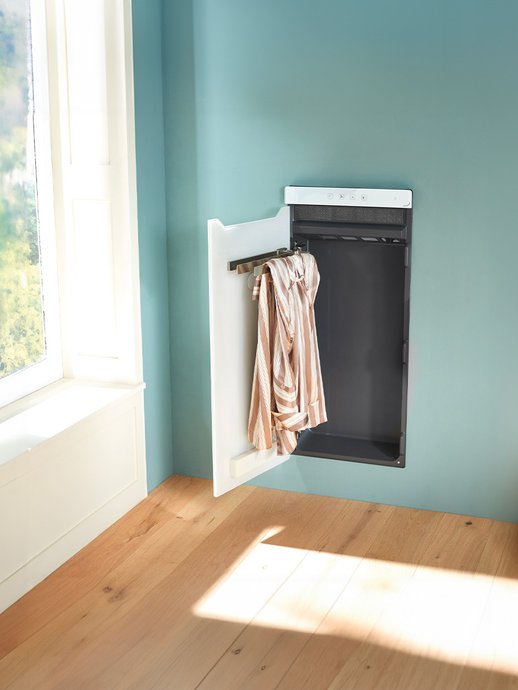
- Swivel models: easy access to towels
- Versions with mirror: visual enlargement of the space
- Connected devices: remote control to optimise comfort and consumption
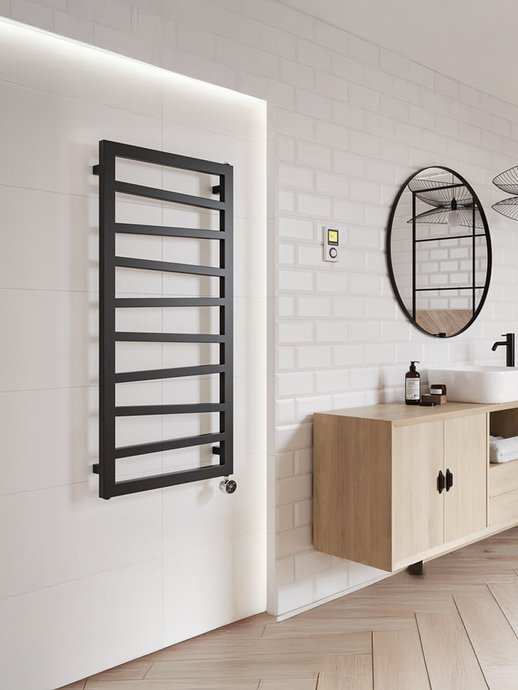
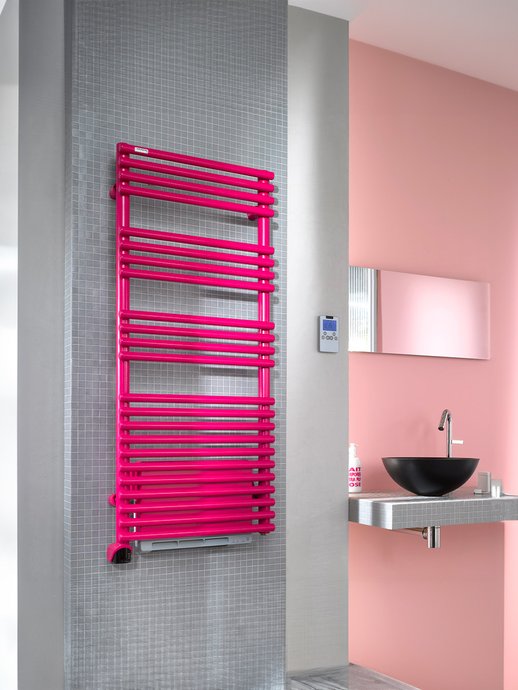
In terms of aesthetics, there are many finishes to choose from: white, black, grey, deep blue... Your towel warmer thus becomes a true decorative element, adding style even to the smallest spaces.
Install your towel dryer without losing space
The location and installation method directly determine the effectiveness of your towel warmer. We guide you through the essential steps for a successful installation that maximises your available space.
Comply with electrical safety standards
The NF C 15-100 standard establishes specific safety zones in your bathroom. Your Class I towel dryer (with earth connection) must be installed outside the volume, more than 60 cm from your bath or shower. Class II appliances (double insulation, IPX4 protection) offer greater flexibility: you can position them in zone 2, just 60 cm from the water source. This flexibility is particularly advantageous in small bathrooms.
Selecting the optimal location
Position your towel dryer under a window to create an effective thermal barrier. This installation compensates for the cold feeling of glass walls while improving the overall thermal comfort of your room. Ensure that you comply with regulatory distances: a minimum of 20 cm between the floor and the bottom of the appliance, and ideally 25 cm below the window sill.
You can also install it on a cold wall to optimise heat distribution throughout the room.
Optimise everyday use for greater comfort and savings
Get the most out of your towel warmer with a few simple steps. These adjustments not only improve your comfort, but also reduce your energy bill.
Program intelligently to save money
Programming your towel warmer is an excellent way to save energy. Set the appliance to operate mainly in the morning and evening, when you actually use your bathroom. This simple adjustment can significantly reduce your consumption.
Some models offer a particularly useful "boost" mode: the appliance heats up quickly for 2 hours and then automatically returns to the normal setting. This means you get instant heat without wasting energy for the rest of the day.
Do not overload your bars.
Resist the temptation to hang too many towels at once. For optimal drying, leave enough space between each towel and avoid stacking them on top of each other. This will allow hot air to circulate freely between the bars, ensuring even and rapid drying.
Also avoid folding towels into several layers: this significantly slows down drying and reduces the efficiency of your appliance.
Minimal maintenance for maximum service life
A few simple maintenance steps will extend the life of your towel dryer:
- Regularly dust the bars with a dry cloth.
- Occasionally check that the wall fixings are tight.
- For mixed models, bleed the hydraulic system once a year.
These small precautions will preserve the performance of your appliance and maintain its aesthetic appearance for many years. Your towel warmer will thus remain a long-lasting ally in your daily comfort.
A designer towel dryer that adapts to your space
Fitting out a small bathroom with a designer towel rail no longer requires compromises. Today's solutions combine elegance and functionality, even in the most confined spaces.
Choosing the right model makes all the difference. Vertical and compact formats maximise your space while offering optimal performance. Once correctly sized for your room, your towel warmer becomes an indispensable comfort asset.
The strategic location of your unit determines its effectiveness. Positioned under a window or on a cold wall, it improves the thermal comfort of the entire room. Simply comply with safety standards for peace of mind during installation.
Smart programming allows you to control your energy consumption without sacrificing comfort. A few regular maintenance tasks are all it takes to keep your system running efficiently for years to come.
Your designer towel rail becomes much more than just a radiator: it is a true everyday ally that optimises your space while adding that touch of elegance that makes all the difference.
Frequently asked questions
Q1. What is the ideal height for installing a towel rail?
The recommended height for installing a towel rail is 20 to 25 cm from the floor. This position allows easy access to towels while ensuring optimal safety, particularly in the event of water damage.Q2. How do I choose the power of a towel warmer for a small bathroom?
For a small bathroom, calculate approximately 100 to 130 watts per square metre heated. For example, for a 5 m² room, an appliance of approximately 650 watts (750W model) will generally be suitable, taking into account insulation and the desired temperature.Q3. What are the advantages of a vertical towel rail for small spaces?
Vertical towel rails are ideal for small spaces as they maximise the use of height while limiting floor space. Some narrow models are less than 40 cm wide, fitting perfectly into cramped configurations.Q4. How can I optimise the use of a towel dryer to save energy?
To save energy, use the timer on your towel dryer to ensure that it mainly operates during peak usage times. Avoid overloading the appliance with towels and leave enough space between them for effective drying.Q5. Can a towel warmer be installed under a window?
Yes, installing a towel warmer under a window is recommended as it creates a thermal barrier that compensates for the feeling of a cold wall. Ensure there is sufficient space between the floor and the window, with the bottom of the appliance at least 20 cm from the floor and ideally 25 cm below the window sill.