At what height should a basin or washbasin be placed on a bathroom cabinet?

Discover the type of basin that fits perfectly with your bathroom furniture.
Countertop basin versus built-in basin: two different approaches
Each type of basin has specific advantages that affect the ergonomics of your space.
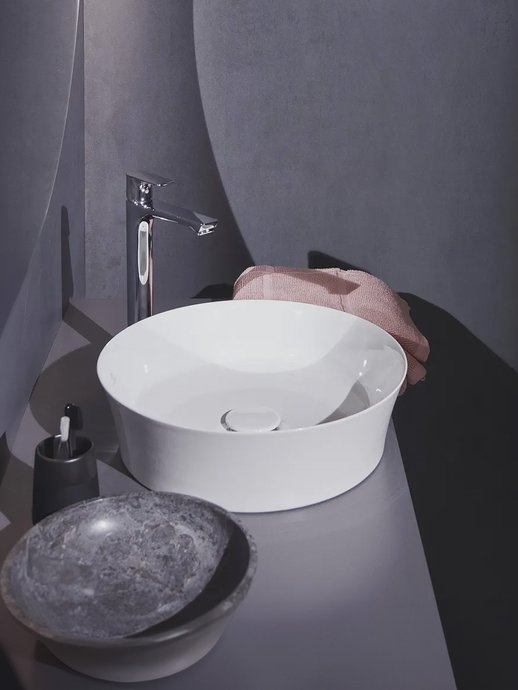
The countertop basin transforms your bathroom furniture into a real decorative feature. It sits directly on the worktop and often becomes the centrepiece of your bathroom. Installation is simple: all you need is a cut-out for the water drain, thus preserving the storage space underneath. This solution offers you an impressive choice of shapes and materials: round, oval, square, rectangular, ceramic, resin, stone, glass or even wood.
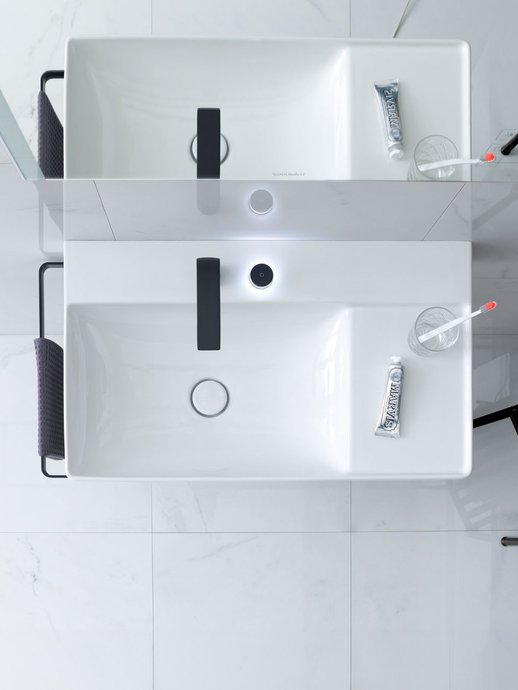
The built-in basin prioritises discretion and functionality. Integrated directly into the worktop, it makes daily maintenance considerably easier. With no protruding edges, cleaning becomes quicker and more efficient. However, it slightly reduces the storage space available in the cabinet.
Have compatible bathroom furniture
The success of your installation depends on the compatibility between the basin and the cabinet. Ensure that your cabinet has a structure that is strong enough to support the weight of the basin, particularly if you opt for materials such as natural stone or marble.
A countertop basin requires a cabinet with a suitable cut-out for drainage and a flat surface. Some cabinets are specifically designed to accommodate this type of basin. In some cases, a cut-out will need to be made in the bottom of the top drawer to allow the drain to pass through.
Built-in basins require precise cutting of the vanity unit for a perfect fit. This operation requires greater technical skill and may incur additional installation costs.
The final height depends on the choice of basin.
The design of your basin directly affects the final height of the installation. A countertop basin generally adds between 5 and 20 cm to the total height. If you choose this model, the cabinet will need to be positioned lower to maintain a comfortable height for use.
For optimal comfort, the recommended standard height is between 85 and 87 cm from the floor to the top edge of the basin. For taller individuals, this height can be adjusted to 90–92 cm.
The taps also deserve your attention. For a high countertop basin, choose a tap with a sufficiently long neck to allow your hands to pass underneath easily. Wall-mounted taps may be more practical, although this involves additional work.
Your final choice will depend on your aesthetic preferences, your storage requirements, and your space constraints.
Determine the ideal height according to your configuration
A washbasin installed at the wrong height can turn your daily routine into a source of constant discomfort. Back pain, difficulty using it, splashing... these are all inconveniences that you can avoid by taking the right measures.
Countertop basin: calculate the height of the cabinet
Your countertop basin adds between 10 and 15 cm to the final height. For optimal comfort, position your unit between 75 and 80 cm from the floor. This lower measurement compensates for the height of the basin itself.
Adding these two elements gives you an ideal total height of 85 to 87 cm from the floor to the drain. This dimension is perfect for people of average height. However, be careful: never exceed 90 cm to ensure ease of use.
Washbasin unit: comply with European standards
Furniture with integrated or built-in basins must comply with specific standards: between 82 and 87 cm from the floor to the top edge of the basin. The ideal measurement is generally between 85 and 87 cm.
Are you taller than 1.80 metres? You can adjust the height to a maximum of 90–92 cm. Above 92 cm, it becomes uncomfortable to use.
In a family with children, there are two solutions available to you: a compromise of around 80 cm or the addition of a non-slip step to maintain the standard height.
Wall-mounted and pedestal washbasins: standardised solutions
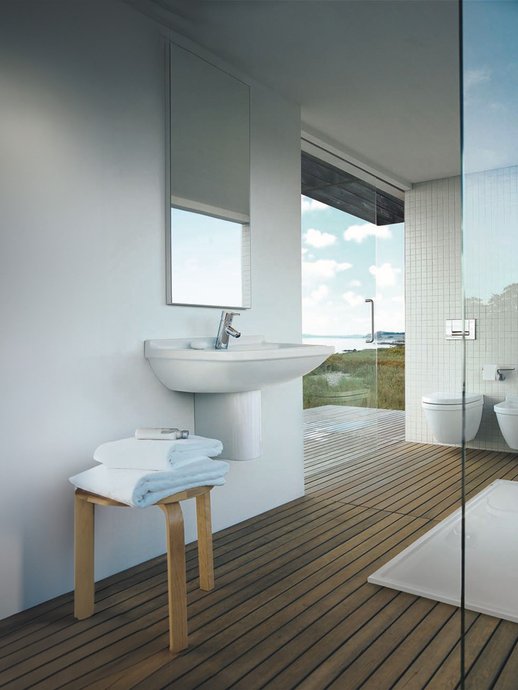
European standards set the height of a wall-mounted washbasin at approximately 83 cm, measured from the floor to the drain. This measurement ensures comfort of use for most adults.
Pedestal washbasins simplify your installation with their predefined height of 83 cm. No adjustments are necessary during assembly.
For people with reduced mobility, adapt these measures: maximum height of 80 cm, with a free space of at least 70 cm in height, 60 cm in width and 30 cm in depth under the washbasin to allow wheelchair access.
Special situations that deserve your attention
A functional bathroom adapts to the needs of all its users. We guide you through the essential adaptations to create a comfortable and safe space.
Children and their washbasin: finding the right height
Younger children have their own requirements. If you are designing a bathroom for children in your home, aim for a height of 50 cm for children under 12. But for a family bathroom, we recommend a more practical approach: install your washbasin at standard height and equip your children with a non-slip step stool. This solution avoids additional work while ensuring their independence.
Accessibility for people with reduced mobility: specific rules to follow
People with reduced mobility benefit from specific standards for their comfort and safety. The top of the washbasin should be 85 cm high. More importantly, allow for a free space of at least 30 cm deep and 70 cm high under the washbasin to allow wheelchair access.
Consider practical details as well. Soap dispensers and hand dryers should be placed between 90 and 130 cm high so that they are accessible when seated. If the mirror cannot be tilted, its lower edge should not exceed 105 cm.
Seniors and reduced mobility: combining safety and independence
Age imposes its constraints, but solutions exist. A height between 80 and 85 cm is generally suitable for seniors. For wheelchair users, lower the height to 74-76 cm.
Wall-mounted washbasins offer a considerable advantage: they free up space underneath, making it easier for carers and assistive equipment to access the area. Add strategically placed grab bars to enhance safety.
When it comes to taps, opt for lever or automatic mixers, which are easier to operate with weakened hands. A thermostatic mixer is essential to prevent burns, which is particularly crucial for people with reduced sensitivity to temperature.
Put it into practice: install your washbasin at the correct height
Successful installation requires precision and a few practical tips to ensure optimal comfort on a daily basis.
Take the right measures
The key measurement? The distance between the floor and the drain, which must be approximately 83 cm according to European standards. For your countertop basin, measure to the top edge instead: aim for a height between 85 and 87 cm.
You can adjust this height according to your height, but never exceed 92 cm to ensure comfortable use. For basins built into the cabinet, the standard height ranges from 85 to 90 cm. In a family bathroom, a compromise of around 85 cm is suitable for most users.
Do not forget the thickness of the plan.
The thickness of your vanity unit plays a crucial role in your calculations. Generally, allow for a thickness of between 3.8 and 5 cm. If you choose a countertop basin that is 10 to 15 cm high, place your unit lower, around 80 cm from the floor.
The calculation is simple: subtract the height of your basin from the desired final height. Concrete example: 13 cm basin + target height of 87 cm = cabinet to be positioned 74 cm from the floor.
Take advantage of the adjustable feet
Adjustable feet make your life easier! They allow for precise adjustments without complex modifications. Many manufacturers offer different foot heights or adjustable systems.
This solution is particularly practical in families where users are of different heights. Some models offer an adjustment range of between 15 and 30 cm.
Test before finalising
Before permanently fixing your installation, test the height! Simulate your daily activities: washing your hands, brushing your teeth, shaving. For taller people, a height of up to 90 cm may be more comfortable.
Also consider the mirror: install it approximately 20 cm above your basin, taking into account the height of your taps. This preliminary test will prevent posture problems and ensure your comfort for years to come.
Frequently asked questions
Q1. What is the standard height for a bathroom vanity unit?
The recommended standard height for a vanity unit is generally between 85 and 87 cm from the floor to the top edge of the basin. This measurement can be adjusted to 90-92 cm for taller people.Q2. How do you determine the correct height for a countertop basin?
For a countertop basin, the supporting unit should be lower, between 75 and 80 cm from the floor. Adding the height of the basin (usually 10 to 15 cm) gives an ideal total height of between 85 and 87 cm from the floor to the drain.Q3. What are the accessibility standards for a washbasin intended for persons with reduced mobility?
For persons with reduced mobility, the top of the washbasin should be located at a recommended height of 85 cm. A clear space of at least 30 cm by 70 cm under the washbasin is mandatory to allow wheelchair access.Q4. How can the height of the washbasin be adjusted for children?
In a family bathroom, it is best to install the washbasin at standard height (85–87 cm) and provide children with a non-slip stool. For a bathroom designed for children, the ideal height is around 50 cm for children under 12 years of age.Q5. What practical adjustments can be made when installing a vanity unit?
When installing, take into account the thickness of the worktop (usually 3.8 to 5 cm) in your calculations. Use adjustable feet if available to fine-tune the height. Before finalising, test the height by simulating everyday movements to ensure comfort of use.