Bathroom furniture: oak, white lacquer, concrete: the guide

Key points
1. Oak, white lacquer and concrete-effect finishes are almost always applied to the same internal structure made of water-resistant MDF; they are not three materials that are fundamentally different in terms of their construction. It is the finish that determines the durability, maintenance requirements and price.
2. The ‘concrete’ finish is not actually concrete. It is a melamine or laminate finish that replicates the texture of concrete, without the weight or porosity of the real material, and is completely unsuitable for wall-mounted furniture in damp rooms.
3. Over the past two years, matt lacquer has become more popular than gloss lacquer: it shows fewer fingerprints and ages better visually, even though gloss lacquer remains easier to clean on a day-to-day basis.
Three different finishes, but the same underlying issue
Before comparing aesthetics, it is important to clarify a point that few guides explain: in the vast majority of furniture sold today, oak, lacquer and concrete are not three structurally distinct materials. The frame is almost always made of water-resistant MDF (fibreboard treated to withstand moisture), and it is the surface finish that varies: oak-effect veneer or melamine, lacquer applied in several layers, or laminate imitating the grain of concrete. Solid wood still exists, but outside the high-end market, it remains in the minority.
This clarification changes the way we approach the choice. The question is not ‘which material is most resistant to damp’, as the body of the furniture is generally the same across different finishes. The real question concerns the surface: its resistance to knocks and marks, and how it ages visually over the years.
Oak: a balance between visual warmth and technical practicality
Oak dominates the 2026 collections, driven by a demand for natural, warm materials as an alternative to the all-white look that has long dominated the bathroom. Three different grades coexist under this single name, and there are real differences in both price and durability.
Real oak veneer involves bonding a thin layer of natural wood to an MDF base. The grain pattern is authentic; each piece of furniture is slightly different from the next; and it retains the feel of real wood. Oak-effect melamine involves printing a photographic image of the wood grain onto a synthetic resin: visually very convincing from a distance, but recognisable to the touch by a discerning eye, and significantly more affordable. Solid wood, finally, is reserved for high-end collections, featuring a genuine solid oak door panel, which is more sensitive to changes in humidity but can be repaired in the event of a deep scratch – something that is not possible with melamine.
In a bathroom, particular attention should be paid to the edges and cut-outs around handles or hinges, where moisture seeps in first if the finish is not perfectly sealed. Properly treated oak withstands the occasional splash very well; it is persistent, repeated damp in a poorly ventilated room that eventually causes any wood finish to lose its lustre.
White lacquer: matt, satin or gloss – a choice that makes all the difference
Matt lacquer, which has come a long way in the last two or three years, reverses this trade-off. It absorbs light rather than reflecting it, which hides the tiny marks left by everyday use, but its soft texture makes it more susceptible to minor scratches than a smooth gloss finish. A satin finish falls somewhere in between, making it a sensible choice for those who are undecided.
Over time, a matt lacquer finish ages better than a gloss finish, which accumulates micro-scratches from cleaning over the years and loses its original shine. This is a factor to bear in mind over a period of ten to fifteen years, not just at the time of purchase.
The concrete effect: a texture, not a material
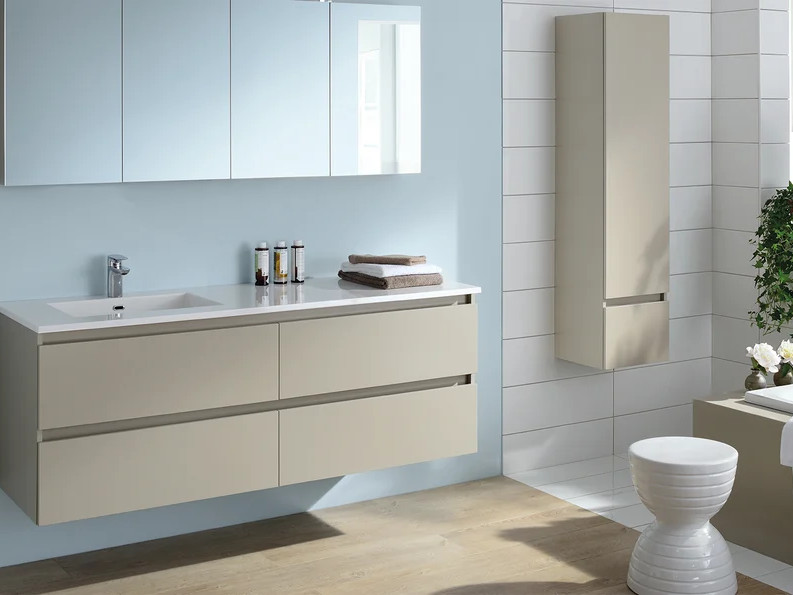
This clarification in no way detracts from the aesthetic appeal of the finish, but it does change expectations regarding maintenance: unlike genuine polished concrete, which requires regular application of a protective wax, concrete-effect furniture is maintained in exactly the same way as standard melamine, using a soft cloth and a non-abrasive cleaner. This is, in fact, one of the reasons for its success: the industrial look without the maintenance requirements of the raw material.
Finish | Moisture resistance | Interview | Visual ageing | Indicative budget |
| Solid oak | Good if treated, sensitive in the long term | Water-repellent treatment to be reapplied | Can be distressed, sanded and repaired | High |
| Oak veneer | Bonne | Soft cloth, non-abrasive product | Ageing well; keep an eye on the slices | Medium to high |
| Melamine-faced oak | Very good, sealed surface | Minimal maintenance | Consistent over time | Accessible |
| High-gloss lacquer | Very good | Clean regularly to keep it looking its best | Loses its lustre over the years | Moyen |
| Matt lacquered | Very good | Easy to clean; avoid abrasive products | Ages better, but is prone to minor scratches | Medium to high |
| Concrete effect (laminate) | Very good | Minimal maintenance, just like melamine | Very stable, current trend | Moderately accessible |
How should you decide based on your project?
For a small, windowless bathroom – which is often poorly ventilated – glossy white lacquer remains the most effective way to make the space appear larger, provided you are prepared to clean it a little more regularly. For a bathroom that also serves as a relaxation retreat, oak brings a warmth that neither lacquer nor concrete can replicate; opt for melamine if you’re on a tight budget, and for veneer if you’re looking for the authenticity of natural grain. For a bold contemporary style, a concrete-effect front panel, combined with black or brass handles, creates the sought-after industrial feel without the constraints of real polished concrete.
A combination that works well and features in several recent collections: a light oak base to add warmth, paired with lacquered fronts used sparingly to give the space structure, rather than relying on a single material throughout the entire piece of furniture.
Belgian insight Belgian bathrooms, which are often smaller and less well-ventilated than the European average, tend to accumulate more stagnant damp in the absence of effective mechanical ventilation. Whatever finish you choose, it will age better in a properly ventilated room than in a closed bathroom without mechanical extraction – a factor that is often more decisive than the choice of material itself. |
What Facq offers in these three finishes:
At Facq, Sanijura’s Sobro collection is a fine example of this approach: a single range of furniture, available in Quebec oak, grey concrete and high-gloss, satin or soft-finish lacquer, with handles in anodised aluminium or matt black depending on the desired look. The Infinie range features light oak combined with satin-lacquered base units in a variety of shades, for those who wish to play on the contrast between materials within a single ensemble. For small guest bathrooms, the Geberit Caluna range features textured melamine oak and matt or gloss white lacquered finishes in compact sizes. Duravit and Villeroy & Boch round off the range for projects seeking complete consistency between furniture, basins and taps from a single brand.
Once you have chosen the finish, you will need to decide on the width and layout of the unit based on how you actually intend to use it. Our guide How to choose the right vanity unit for your bathroom? sets out these dimensional criteria in addition to this guide to materials.
Mistakes to avoid
- Choosing a finish based solely on a photograph, without having seen the actual sample: the appearance of an oak-effect or concrete-effect melamine can vary greatly depending on the lighting in the room.
- Opting for a high-gloss lacquer finish in a busy family bathroom, without taking into account how often this finish actually needs to be cleaned.
- Neglecting the room’s ventilation whilst relying solely on the quality of the finish to provide long-term protection against damp.
- Mixing more than two different finishes on the same piece of furniture, which detracts from the desired effect rather than enhancing it.
Frequently asked questions
Q1. Is the concrete-effect finish on a bathroom unit as durable as real concrete?
It is not actual concrete, but a laminate or melamine finish that replicates its texture. Its resistance to moisture is excellent, comparable to that of standard melamine, and it is easier to maintain than real polished concrete, which would require regular application of a protective wax.Q2. Is solid oak resistant to the damp conditions in a bathroom?
Yes, provided that a water-repellent treatment is applied correctly and renewed over time. It is the build-up of damp in a poorly ventilated room, rather than the occasional splash, that ultimately damages a wooden finish in the long term.Q3. Is a matt or gloss finish better?
It depends on how it will be used. A gloss finish makes the space appear larger and is well suited to small bathrooms, but requires more frequent cleaning. A matt finish hides everyday fingerprints better and ages more gracefully over ten to fifteen years, though it is slightly more prone to minor scratches.Q4. What is the most cost-effective finish for bathroom furniture?
Melamine-faced oak and concrete-effect laminate remain the most affordable options, offering very good moisture resistance as the surface is fully sealed. Solid oak and high-end lacquered finishes are at the top end of the price range.Q5. Can a scratch on a piece of solid oak furniture be repaired?
Yes, unlike melamine or laminate. A scratch on solid oak can be sanded down and touched up locally, which, with proper care, extends the furniture’s lifespan by several decades.Q6. Can you combine several finishes on a single piece of bathroom furniture?
Yes, and this is actually a major trend in current collections: a light oak cabinet combined with lacquered fronts used sparingly helps to define the space without overwhelming it. However, it is best to limit yourself to a maximum of two finishes on any one set.