How do you choose a vanity unit that suits your bathroom?

The key points in 3 points
1. The type of washbasin – countertop, built-in or under-mounted – determines the space required and the design of the vanity unit. Each option has a direct impact on the usable surface area and daily maintenance.Book an appointment
2. Width: 60 cm for single use, 80 or 100 cm for greater comfort, and 120 to 160 cm for two people; this determines the available storage space and ergonomics.
3. The material – natural oak, white lacquer, or concrete-effect – is not merely an aesthetic choice: it represents a commitment to durability, moisture resistance and long-term maintenance.
1. Countertop, built-in or under-mounted washbasins: three types, three approaches
The first decision you need to make isn’t about style or colour: it’s about the type of washbasin. This decision determines the actual size of the unit, the amount of worktop space available, and how easy it is to keep clean on a day-to-day basis.
The countertop washbasin
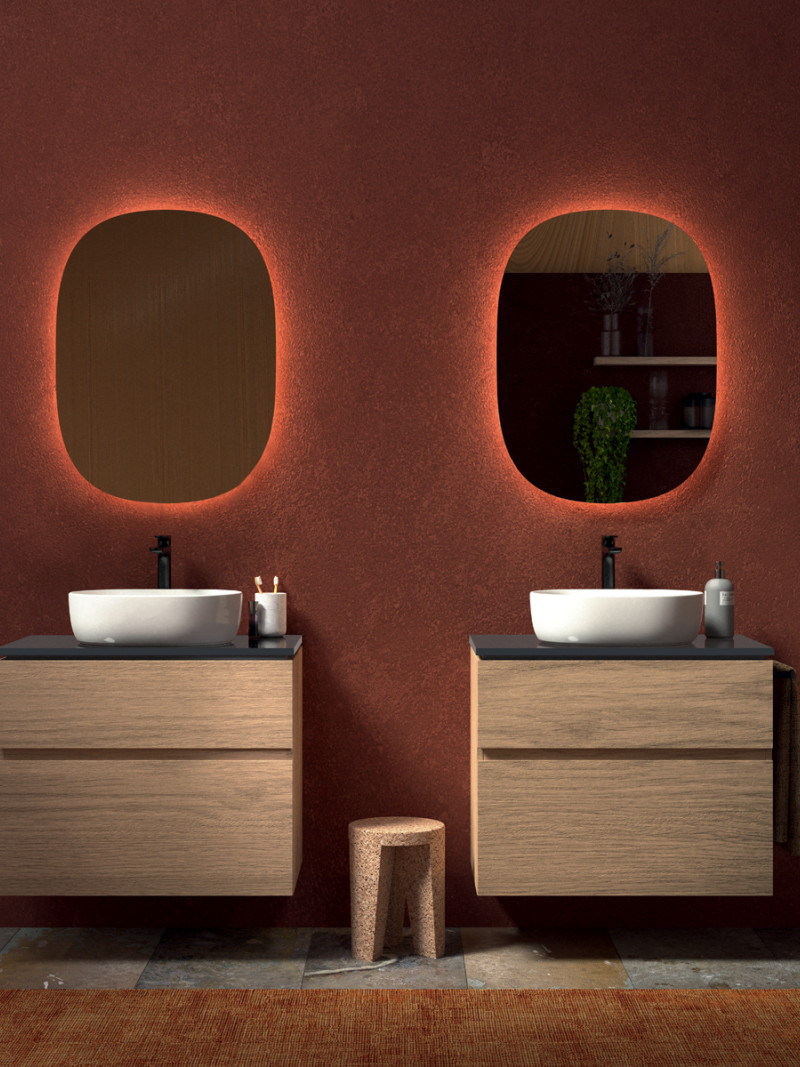
It rests on the worktop, visible in its full height. This is the most common style in contemporary and Nordic interiors. It creates a real sense of texture (ceramic, stone, composite) and positions the unit as a decorative feature in its own right.
Good to know
A countertop washbasin increases the overall height of the unit by 10 to 15 cm compared to the standard height of the cabinet. Check that this height is suitable for all users before making your choice.
The downside is that the countertop surface is reduced or eliminated on either side of the basin, and the perimeter seal must be regularly maintained to prevent mould.
The built-in washbasin (or one-piece washbasin)
The worktop and basin form a single piece: no joints, a seamless surface, and easy to clean. It is the most practical solution for everyday use, particularly in households with children or in areas prone to high humidity.
The vanity top can be made of ceramic, solid surface (synthetic resin) or tempered glass. Solid surface is now the premium standard: it absorbs very little moisture, is easy to repair in the event of minor scratches, and can be made to measure.
The under-mounted washbasin
The basin is mounted beneath the worktop, which has been cut to accommodate it. The edge of the worktop covers the rim of the basin, creating a perfectly smooth, easy-to-clean surface. This is the most visually discreet and functional solution for high-traffic living spaces.
Requirement: the worktop must be specially adapted (with precise drilling and reinforced waterproofing), and not all materials are suitable: natural stone and solid surface work well, whereas standard laminate is much less so.
Type of washbasin | Benefits | Constraints | Recommended style |
|---|---|---|---|
| For installation | Striking decorative effect, wide variety of shapes | Perimeter seal, less worktop | Contemporary, Scandinavian, loft-style |
| Built-in (one-piece) | No joints, easy to maintain, seamless surface | Less freedom in terms of design, often higher prices | Family-friendly, minimalist, accessible |
| Recessed | Smooth surface, visually very clean | A specific plan is required; the installation is more technical | Premium, minimalist, hotel-style |
2. What width do you need, depending on how you’ll be using it: on your own, as a couple or with the family?
The 60 cm unit: the go-to choice
A 60 cm unit is suitable for individual use in a bathroom measuring 4 to 6 m². It features a washbasin large enough for comfortable washing, with limited but well-organised storage space. This is the standard width found in flats and secondary bathrooms.
Be careful when choosing your washbasin: a 40 cm washbasin mounted on a 60 cm vanity unit leaves 10 cm on each side – enough to place a bar of soap, but not enough to work comfortably. Opt for a 50 to 55 cm washbasin in this configuration.
The 80 cm unit: the perfect compromise
80 cm often strikes the right balance between ease of use and a reasonable footprint. For single users, it offers plenty of worktop space and storage; a couple can take turns using it without any frustration. It is the most popular width for renovation projects, as it suits the majority of layouts.
The 100–120 cm vanity unit: dual functionality without a double basin
For two people using the bathroom at the same time, a unit measuring 100 to 120 cm with a single large basin or an elongated vanity top is often more practical and less expensive than a double unit. However, you will need to plan the plumbing in advance: a single water supply and a single drain are sufficient for these widths.
140–160 cm units: the large bathroom size
Anything over 120 cm falls into the category of double units or XXL units, which often feature two basins and two storage columns. This is the ideal layout for bathrooms measuring 9 m² or more, designed for use by two people at the same time. The challenge is to organise the space without creating a corridor-like or empty feel.
Width | Ideal use | Recommended minimum area | Recommended washbasin |
|---|---|---|---|
| 60 cm | Solo, small bathroom | 4 to 6 m² | 50 cm built-in washbasin or round countertop washbasin |
| 80 cm | Comfort for one or an alternative couple | 5 to 8 m² | Built-in washbasin, 55–60 cm |
| 100–120 cm | Couple or family (1 washbasin) | 7 to 10 m² | Long washbasin or wide oval washbasin |
| 140–160 cm | Simultaneous use, large bathroom | 9 m² and over | Double basin or integrated double vanity unit |
3. Materials and finishes: natural oak, white lacquer, concrete: a guide to sustainable choices
The material of the vanity unit is the choice that divides buyers the most. And with good reason: it’s a long-term commitment in an environment that’s particularly harsh on materials, with constant humidity, temperature fluctuations and cleaning products. Here’s what you need to know about the three main types.
Real wood and natural oak
Oak is the most commonly used wood in bathrooms, and for good reason: its natural tannins make it more resistant to moisture than most other types of wood. A piece of furniture made from solid oak or high-quality oak veneer, provided it is properly treated and well ventilated, can last 20 to 30 years without any significant warping.
What to look for: a factory-applied water-repellent finish (hard oil, polyurethane varnish or satin lacquer), expansion joints if the furniture is located near a walk-in shower, and adequate mechanical ventilation in the room (mechanical ventilation is mandatory in Belgium for new builds and major renovations).
Good to know
Natural oak changes slightly over time: it develops a patina and gains depth. Many people see this as a quality — a living characteristic of the material. Some Facq ranges are available in a ‘raw oak’ or ‘grey oak’ finish to emphasise this authentic look.
White lacquer and matt finishes
White lacquer remains the best-selling finish in Europe, and for good reason. It reflects light, makes the space appear larger, is easy to clean with a damp cloth, and goes well with all types of taps. In a matt finish, it creates a very contemporary look, reminiscent of high-end kitchens.
Pay close attention to the quality of the lacquer finish: a cheap lacquer scratches easily and will yellow within a few years due to UV exposure (particularly if the bathroom has a window). Premium brands use a multi-layer polyurethane lacquer that is impact- and UV-resistant, with a finish applied in a pressure-controlled booth.
In a very damp or poorly ventilated bathroom, low-cost white lacquer can swell and delaminate within 3 to 5 years. Always insist on a manufacturer’s warranty for the surface finish and check that the core board is made of water-resistant MDF or HDF (not standard chipboard).
Concrete-effect finishes and mineral materials
The trend for polished concrete and mineral finishes (stone-effect, slate-effect) has become a prominent feature in contemporary bathrooms. These finishes are now reproduced using high-definition digital printing on HDF panels or as thick vinyl cladding, offering a visually striking result at a fraction of the cost of genuine polished concrete.
The advantage: high resistance to scratches and moisture in industrial versions. The disadvantage: some cheap imitations show a plastic sheen when viewed in low light. To tell the difference between good and poor finishes, run your hand over the surface: the best ones have a raised micro-texture.
Subject | Sustainability in the bathroom | Interview | Indicative budget | Style |
|---|---|---|---|---|
| Natural oak | ⭐⭐⭐⭐ (if processed) | Annual (oiling) | €€€ | Natural, wabi-sabi, Scandinavian |
| Premium matt lacquer | ⭐⭐⭐⭐⭐ (if polyurethane) | Damp cloth | €€€ | Contemporary, minimalist |
| High-gloss lacquer | ⭐⭐⭐ (prone to scratches) | Damp cloth (for light cleaning) | €€ | Classic, bright |
| Premium concrete-effect | ⭐⭐⭐⭐⭐ | Very easy | €€€ | Industrial, loft, modern |
| Standard laminated MFC | ⭐⭐ (sensitive to humidity) | Damp cloth | € | Entry-level |
4. Existing plumbing: the blind spot in too many projects
People often choose their vanity unit in a showroom without first checking the position of the existing plumbing. Yet this is one of the most crucial factors — and the most costly to overlook.
Wall-mounted power supply or floor-mounted power supply?
In Belgium, the vast majority of existing bathrooms have wall-mounted taps (with hot and cold water coming out of the wall) and a floor or wall-mounted drain. The position of these taps directly determines the type of unit that is compatible:
- Wall-mounted water supply and trap: compatible with almost all vanity units. This is the ideal setup.
- Wall-mounted supply, floor drain: compatible with freestanding units and certain base units; wall-mounted units may require the drain to be repositioned.
- Underfloor supply: less common, often found in older buildings in Brussels or houses built before 1970. Almost always requires a technical enclosure or plumbing modifications.
Wall-mounted unit or freestanding unit?
Wall-mounted units are now the norm in contemporary bathrooms. They make it easier to clean the floor, create a sense of space and allow the height to be adjusted to suit the user. However, they require the load-bearing wall to be able to support the weight (between 30 and 80 kg depending on the size of the unit and its contents), and the plumbing to be correctly positioned.
When renovating, if the pipework is visible on the wall, you will either need to conceal the pipes (a major job) or fit a cover. Some manufacturers offer pipework cover systems that match the furniture — an elegant solution that avoids the need for building work.
The Facq opinion
At Facq, our advisors always check the technical feasibility before suggesting a solution. Make an appointment at the EXPOcenter with a floor plan of your bathroom and a photo of your existing plumbing — this helps avoid any unpleasant surprises when it comes to installation.
5. Storage: drawers, tall units and built-in solutions
A vanity unit isn’t just about its looks: it needs to accommodate everything the bathroom requires on a daily basis — toiletries, medicines, towels and electrical appliances. Storage space is often underestimated when buying, and overestimated in terms of its actual capacity.
Drawers vs doors: the everyday rule
Drawers are almost always preferable to doors in a vanity unit. They allow you to see and access the entire contents at a glance, store items deep inside without stacking them, and keep the interior organised using dividers. Doors, on the other hand, create blind spots at the back of the unit and mean you have to bend down to reach items at the back.
The only situation where a door is still useful is when plumbing pipes run through the unit and need to be accessed for maintenance. In this case, a door is more practical than a drawer, which would need to be dismantled.
The integrated or adjacent column
A tall unit is the natural complement to a vanity unit in medium-sized bathrooms. It can be integrated into the layout (attached to the vanity unit, in the same style) or freestanding. It offers between 80 and 150 litres of additional storage space depending on its height, often featuring a mirror or built-in lighting at the top. → See our dedicated article: Bathroom units with built-in tall storage units: what are the benefits?
In a bathroom measuring 6 to 8 m² with a single 80 cm-wide unit, a 30 cm-wide tall unit is often enough to provide additional storage without cluttering the space.
Handle-free furniture
The push-to-open system has become very popular in contemporary bathrooms. It gives the cabinet a particularly sleek look, with no protruding parts to disrupt the lines. But is it really practical? → This topic is discussed in: Handle-free bathroom cabinets: sleek aesthetics, but are they practical?
The short answer: yes, provided the mechanism is of high quality. Cheap systems lose their springiness after a few years of heavy use. Premium brands (Duravit, Sanijura, Villeroy & Boch) use anti-rebound mechanisms with adjustable tension that last 10 years or more.
6. The mirror: the element that completes the composition
A vanity unit without a matching mirror is like a kitchen without a splashback. The mirror acts as a link between the unit and the wall, and between the lower and upper parts of the room. It often occupies more visual space than the unit itself.
A single mirror or a bathroom cabinet?
This distinction is important. A standard mirror maximises the light and visual impact, but offers no storage space. A mirrored bathroom cabinet conceals storage behind the glass — the ideal solution in small bathrooms where every centimetre counts. Some models combine the two: a central mirror surrounded by open shelves or side cabinets.
Built-in lighting
A backlit mirror (with perimeter LEDs or back-diffusion) is not just a gimmick: it is the most effective lighting solution for the bathroom. The front lighting around the face eliminates the shadows cast by ceiling spotlights, and the colour temperature (between 2700 K and 4000 K) can be adjusted according to the time of day on premium models. IP44 is the minimum rating required for a lighted mirror in Zone 2 (more than 60 cm from the edge of the shower).
Key points
The two-thirds rule: for an 80 cm vanity unit, choose a mirror that is at least 70 to 80 cm wide — it should cover at least the width of the basin. A mirror that is too narrow looks unbalanced and is impractical.
In large bathrooms, a full-length mirror (from the worktop to the ceiling) is often more stylish than a standard mirror set against a tiled backdrop.
7. Washbasin units for toilets and small spaces: compact solutions
Not all spaces can accommodate a standard vanity unit. Separate toilets, adjoining walk-in wardrobes or utility rooms often require a basic washbasin, but with a compact footprint.
The 30–45 cm washbasin
A washbasin measuring 30 cm wide and 25 cm deep allows you to install a functional washbasin in a 80 x 120 cm toilet cubicle. These sizes are available as wall-mounted units (without a vanity unit, just the basin and taps) or as compact vanity units with one or two small drawers. Some models incorporate a cistern within the cabinet beneath the basin — a very clever solution for small-sized toilets.
The bathroom area in a walk-in wardrobe
Fitting out a dressing room adjoining the bathroom is a major trend in the renovation of Belgian detached houses. A compact washbasin area, a small mirrored cabinet and good ventilation are all it takes to create a comfortable dressing area, separate from the rest of the bathroom.
8. Which brand of vanity unit should you choose? Sanijura, Duravit, Villeroy & Boch
The market for vanity units is dominated by brands that vary greatly in terms of positioning, quality and price range. Here’s how to make the right choice.
Brand | Origin | Positioning | Key strength | Price range* |
|---|---|---|---|---|
| Sanijura | France | Premium accessible | Made in France, customisable colours | €€€ |
| Endured | Germany | Top-of-the-range | Collaboration with designers (Sieger, Starck), high-quality finishes | €€€€ |
| Villeroy & Boch | Germany/Luxembourg | Premium wide range | Handmade ceramics, complete collections | €€€–€€€€ |
| Keuco | Germany | Premium features | Storage systems, quality of fittings | €€€€ |
| Running | Switzerland | Sleek design | Ultra-thin SaphirKeramik, minimalist design | €€€€ |
| Facq Select brands | Belgium/Europe | Value for money | Prompt availability, local service | €€–€€€ |
* € = entry-level, €€ = mid-range, €€€ = premium, €€€€ = top-of-the-range
The Facq opinion
Facq stocks all these brands in its EXPOcenters across Belgium. Our advisors can show you the collections side by side, along with the matching basins and taps, to help you visualise the complete setup before you buy.
9. Budget and VAT: how much should you budget for a vanity unit in Belgium?
The cost of a complete vanity unit (unit + basin + taps + mirror) varies considerably depending on the brand, width and finish. Here are the realistic price ranges for 2026, excluding installation.
Project level | Vanity unit + washbasin | Plumbing fittings | Mirror | Estimated total |
|---|---|---|---|---|
| Entry-level | 300–600 € | 80–150 € | 60–120 € | 440–870 € |
| Mid-range | 600–1 200 € | 150–300 € | 120–300 € | 870–1 800 € |
| Premium | 1 200–2 500 € | 300–600 € | 300–600 € | 1 800–3 700 € |
| Top-of-the-range | 2 500–5 000 € | 600–1 500 € | 500–1 200 € | 3 600–7 700 € |
| Bespoke / luxury | €5,000 and over | €1,500 and over | €1,000 and over | €7,500 and over |
Key points
6% VAT: in Belgium, the installation of a vanity unit in a property over 10 years old qualifies for the reduced VAT rate of 6% on labour (compared to the standard rate of 21%). This can represent a saving of €200 to €600 on a complete project. This rate applies to conversion, renovation and refurbishment work — not to the purchase of products alone.
Installation: expect to pay between €150 and €400 for the installation of a vanity unit, depending on the complexity of the job (wall-mounted unit requiring plumbing alterations = higher end of the scale; freestanding unit with standard connections = lower end of the scale).
10. The 7 mistakes you must avoid at all costs
These mistakes crop up time and time again during showroom visits. Avoiding them will spare you disappointment — or extra costs.
- Choosing the width without measuring the existing plumbing. The position of the water supply pipes and the trap may limit or dictate certain cabinet widths. Measure before you choose, not after.
- Choosing a wall-mounted unit without checking the wall. A plasterboard wall (Placostil) cannot support the weight of a fully loaded wall-mounted unit. A brick or concrete wall is required, or the wall must be reinforced beforehand.
- Underestimating the overall height with a countertop basin. A 15 cm high basin on a unit 85 cm above the floor results in a worktop height of 100 cm — which is uncomfortable for children and shorter people.
- Don’t skimp on the quality of the fittings. Drawer runners and hinges are the parts that wear out the quickest. Insist on branded fittings (Blum, Grass, Häfele) with soft-close mechanisms — the difference in durability is significant.
- Choose a high-gloss finish in a room exposed to direct light. Fingerprints and water droplets are immediately visible. In well-lit bathrooms, a matt or satin finish is much more practical.
- Ignore the depth of the unit. The standard depth is 45 to 50 cm. A 35 cm (compact) unit may be necessary in a small bathroom, but this will reduce the available storage space and worktop area.
Buying the mirror separately without ensuring it matches the cabinet. Even if the mirror isn’t necessarily the same brand, it must match the cabinet in terms of width, style and finish. A round mirror with a very linear cabinet: it can work — but it’s a deliberate stylistic choice, not an oversight.
Frequently asked questions
What is the standard height of a vanity unit?
The standard height of a vanity unit (without a basin) is 85 cm in Europe. With a built-in or countertop basin, the total height of the unit ranges from 85 to 100 cm. For taller people or for ergonomic reasons, units measuring 90 cm are available from most premium brands. For children or for accessibility for people with reduced mobility, 80 cm is often recommended.Can you install a vanity unit yourself?
The installation of the unit itself is a task that an experienced DIY enthusiast can undertake. The technical aspects requiring professional expertise relate to the electrical connections (illuminated mirror, shaver socket) and, in some cases, the relocation of plumbing. In Belgium, any work on the electrical installation in a wet area must be carried out by a qualified electrician and inspected by an RGIE-approved body.How long does a good vanity unit last?
A premium-quality vanity unit, properly maintained in a well-ventilated bathroom, will last 20 to 30 years without any problems. The parts that wear out first are the fittings (slides and hinges) and the basin seals — all of which are easy to replace. The structure of the unit and the surface finish are the key indicators of long-term durability.Ceramic or solid surface washbasins: which lasts longer?
Ceramic (vitrified or glazed) is virtually indestructible provided it is not subjected to impact. It does not scratch, does not stain and retains its appearance indefinitely. Solid surface is slightly more susceptible to deep scratches but can be repaired by sanding — something that cannot be done with ceramic. Both materials are excellent; ceramic for absolute durability, solid surface for bespoke shapes and repairability.Are there any grants available for replacing a vanity unit in Belgium?
There is no specific grant available solely for replacing a vanity unit in Belgium. However, if the project forms part of a wider renovation involving adaptations for people with reduced mobility (level-access shower, vanity unit at an appropriate height), financial assistance may be available through the AVIQ in Wallonia or the Flemish Welfare Service. The 6% VAT rate on building work remains the most widely available tax benefit, applicable in all three regions for homes over 10 years old.
Further reading: creating a cohesive bathroom
Choosing a vanity unit is never a standalone decision. It forms part of a wider design scheme that includes the taps, mirror, tiling and lighting — all these elements work together, and the overall harmony is what makes the difference between a functional bathroom and one that truly reflects your personality.
The articles in this semantic hub guide you step by step through this process:
- Countertop basin vs built-in basin: how does this affect the vanity unit?
- Bathroom furniture: natural oak, white lacquer or concrete — a guide to materials
- How do you choose the right vanity unit to suit your existing plumbing?
- 60cm or 80cm bathroom cabinet: which is best for a single person versus a couple?
- Large bathroom: 140 cm or 160 cm vanity unit — how can you avoid it looking like a warehouse?
- Bathroom cabinet with built-in tall unit: what are the benefits?
- Washbasin units for toilets: the best compact solutions
- Sanijura, Duravit, Villeroy & Boch: how do you choose a bathroom furniture brand?
- Handle-free bathroom furniture: sleek design – but is it practical?
- Bathroom mirrors: round, rectangular, backlit — which one should you choose?
- How do you design a walk-in wardrobe adjoining the bathroom?