Air-to-water heat pump: how does it work, and is it the right choice for my home?

Key points
1. An air-to-water heat pump extracts heat from the outside air and transfers it to the water in your central heating system. It produces 3 to 5 kWh of heat for every 1 kWh of electricity consumed. It is this ratio – the COP – that makes all the difference compared to a boiler.
2. It is cost-effective in a well-insulated home that is heated at a low temperature (underfloor heating or low-temperature radiators, 35 to 45 °C). In a poorly insulated home with old radiators operating at 70 °C, its performance drops and the heating bill is disappointing.
3. Expect to pay between €8,000 and €18,000, including installation, at a VAT rate of 6% in 2026. In Wallonia, grants of up to €3,600 are available, but the current scheme ends on 30 September 2026. In Brussels and Flanders, different schemes apply.
How does an air-to-water heat pump work?
The principle boils down to one idea: even when it’s cold outside, the air contains energy. An air-to-water heat pump extracts this energy and concentrates it to heat the water in your system.
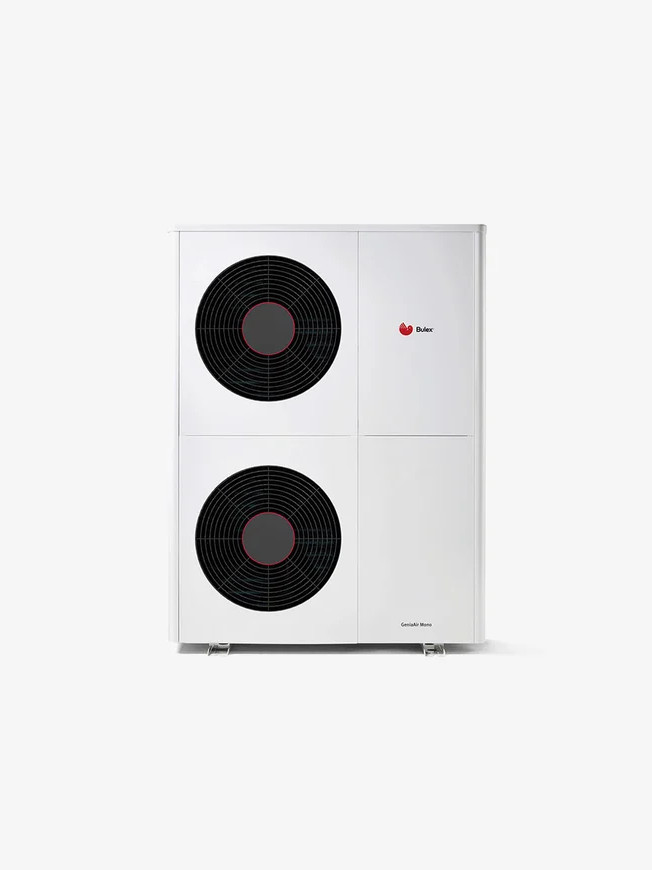
The cycle is based on four components and a refrigerant that circulates in a closed loop. The outdoor unit draws in ambient air. This air heats the refrigerant, which evaporates at a very low temperature. An electric compressor then compresses this gas, causing its temperature to rise sharply. The hot gas then transfers its heat to the water in your heating system via a heat exchanger. The refrigerant then expands, cools down, and the cycle begins again. This is exactly the same principle as a fridge, but in reverse: instead of extracting heat from a room and releasing it outside, the heat pump extracts heat from outside and releases it into the house.
The only electricity used is to run the compressor. Everything else is free energy drawn from the air. Hence the high efficiency. A gas boiler burns 1 kWh of gas to produce roughly 1 kWh of heat. A heat pump consumes 1 kWh of electricity and delivers 3 to 5 kWh of heat. This multiplier is known as the COP, or coefficient of performance.
| The key figure to look at: SCOP COP is measured under laboratory conditions. In reality, what matters for your energy bill is the SCOP – the average efficiency over an entire heating season, including cold temperatures. For the Belgian climate, a good SCOP for an air-to-water system is between 3.5 and 4.5. Above 4, the system is excellent. Always ask for the SCOP, not just the COP. |
Heat pumps generally produce water at temperatures between 35 and 55 °C. This is where it all comes down to: the warmer the water required, the higher the efficiency. At 35 °C (the temperature of an underfloor heating system), the heat pump operates within its ideal range. At 65 °C (old cast-iron radiators), it has to work harder, consumes a lot of energy, and the COP plummets. The performance of a heat pump does not depend solely on the unit itself: it depends just as much on what is at the other end of the circuit.
Air-to-water or air-to-air: they’re not the same line of work
The two are often confused, even though they serve different purposes. The distinction is simple once you think about it: an air-to-water system heats water, whilst an air-to-air system heats air.
An air-to-water heat pump transfers heat to the home’s water circuit: radiators, underfloor heating and the domestic hot water tank. It therefore replaces a boiler entirely. It is a fully-fledged central heating system.
An air-to-air heat pump blows warm air directly into rooms via indoor units (known as ‘splits’). It looks like an air-conditioning unit, and indeed it cools the room in summer. However, it does not produce domestic hot water and is not connected to any radiators. One unit is required in each room to be heated.
Air-water | Air-air | |
| Heat diffusion | Water (radiators, underfloor heating) | Supply air (wall-mounted units) |
| Domestic hot water | Oui | No (separate water heater required) |
| Replace the boiler | Oui | Non |
| Keeps you cool in summer | Yes, if it’s reversible | Yes (that’s his strong point) |
| Installation prices in Belgium 2026 | €8,000 to €18,000 | €3,000 to €12,000 |
| Wallonia/Brussels premiums | Oui | Non |
| Flanders Prize | Oui | Oui |
| Ideal for | Heating the whole house + domestic hot water | Air conditioning, auxiliary heating |
The factor that often tips the balance in Belgium is financial incentives. In Wallonia and Brussels, only air-to-water systems qualify for regional grants. Air-to-air systems are only subsidised in Flanders. If you’re planning to replace the central heating system for the whole house, go for an air-to-water system. If you’re looking to air-condition a living room and provide supplementary heating in winter, an air-to-air system makes sense. In fact, many Belgian homes end up with an air-to-water system for the main heating and an air-to-air system in a living area for the summer.
All of this reasoning (which heat generator for which property, and which radiators at the other end) forms part of a broader discussion which we set out in detail in our guide Heat pump, boiler or underfloor heating: which to choose?, which is worth reading alongside this if you are still undecided between several systems.
Is this right for my home? The real conditions
That’s the key question, and the honest answer is: it depends on your home, not on the heat pump. Three factors are crucial.
Insulation. A well-insulated house has low heating requirements, which the heat pump can meet at low temperatures, and therefore with high efficiency. Conversely, a draughty house requires a lot of heat and very hot water: the heat pump has to work overtime and the financial benefit is lost. As a guide, a property with a PEB rating of C or better is a good starting point. Below that, you need to take a closer look – or even insulate the property first.
Heat emitters. Underfloor heating is the ideal solution: it operates at 30–35 °C, which is precisely the range where the heat pump performs best. Low-temperature radiators (large surface areas, 45–55 °C) also work. Old high-temperature cast-iron radiators are a problem: either replace them, or forget about using a heat pump on its own.
The outdoor space and the neighbourhood. The outdoor unit makes some noise – which is moderate on recent models, but still noticeable. In tightly built-up areas or in dense urban environments, its location must be carefully considered so as not to disturb the neighbour’s bedroom. There must also be sufficient air clearance around the unit.
| A case where you’re not quite sure: a 1980s house, average insulation, radiators still in decent condition but not low-temperature: neither clearly suitable nor clearly unsuitable. Two options. Either a properly sized heat pump with the radiators in the worst locations gradually replaced. Or a hybrid system (heat pump + small gas boiler for backup) that switches to gas only during the few days of extreme cold. A visit to the EXPOcenter with your energy performance certificate and a photo of your radiators will help you decide quickly. |
So, how’s the Belgian winter going?
For those rare cold spells, there are two safety nets. Most units feature a backup electric heater that kicks in when needed. And some models are designed specifically for cold weather: Mitsubishi Electric’s Zubadan technology, for example, maintains a stable output even at very low temperatures, making it a good choice for the most exposed areas of Wallonia. Among the other brands distributed by Facq, Daikin’s Altherma 3 range boasts COPs of up to 5.1 and remains a benchmark on the Belgian market.
How much does it cost, and how much does it bring in?
The price of an air-to-water heat pump in Belgium will range from €8,000 to €18,000 in 2026, including installation, with a reduced VAT rate of 6 per cent now applying to all homes. The difference is mainly due to the capacity and the choice between heating only or heating combined with domestic hot water production.
Configuration | Indicative budget (including VAT, fixed) |
| Air-to-water heating only, small detached house | €8,000 to €11,000 |
| Air-to-water heating + domestic hot water | €11,000 to €15,000 |
| High-capacity air-to-water systems or complex construction projects | €15,000 to €18,000 |
| Hybrid (heat pump + gas boiler as a backup) | €8,000 to €13,000 |
The savings are reflected in your energy bill. Whereas a boiler consumes 1 kWh to produce 1 kWh of heat, a SCOP 4 air-to-water heat pump consumes only a quarter of that. Your heating bill is reduced by a factor of three to four, depending on the installation and the property. The payback period depends on the price of electricity, the type of gas you are replacing and any grants received, but it is generally measured in years, not decades, provided the property is suitable.
Insurance premiums in Belgium in 2026: the Walloon window is closing
Financial support schemes change quickly and vary from region to region. Three things to bear in mind before committing.
In Wallonia, the temporary support scheme in force since February 2025 runs until 30 September 2026. An air-to-water heat pump qualifies for a basic grant of €600 (heating or combined), multiplied according to your income bracket, with a maximum of €3,600. A home energy audit is compulsory to submit an application. From 1 October 2026, this scheme will be replaced by a zero-interest loan scheme (the enhanced Rénopack), and direct grants as they currently exist will be phased out. If you are eligible, you can book the audit now.
In Brussels, the Renolution grants support air-to-water and geothermal systems, but the 2026 timetable and amounts should be checked at the time of your project, as the scheme has been suspended on occasion.
In Flanders, the Mijn VerbouwPremie provides funding for air-to-water systems, and it is the only one of the three Regions to also provide funding for air-to-air systems.
| Belgian note: The installation must be carried out by a certified professional (RESCert in Wallonia) in order to qualify for grants. The amounts vary depending on household income. A Facq adviser can assess your situation and advise on the best timing during an appointment at the EXPOcenter, particularly given the Walloon deadline of September 2026. |
Frequently asked questions
Q1. What is the practical difference between air-to-air and air-to-water?
The air-to-water system heats the water in your central heating circuit and supplies radiators, underfloor heating and the domestic hot water tank: it replaces a boiler. The air-to-air system blows warm air into rooms via wall-mounted units and provides air conditioning in summer, but does not produce domestic hot water and is not connected to any radiators. To heat an entire house, choose the air-to-water system. To cool and heat one or two rooms, choose the air-to-air system. In Wallonia and Brussels, only the air-to-water system qualifies for grants.Q2. Is underfloor heating essential for a heat pump?
No, but you need low-temperature heat emitters. Underfloor heating is ideal (30–35 °C). Low-temperature radiators are also suitable (45–55 °C). What won’t work are old high-temperature radiators: the pump would have to produce water at 70 °C, its efficiency would plummet and your energy bill would soar. In a renovation where underfloor heating isn’t an option, replacing the radiators with low-temperature ones is the solution.Q3. Can an air-to-water heat pump also cool the house in summer?
Yes, if it is reversible. In cooling mode, it circulates cool water through the underfloor heating (gentle cooling, 2 to 4 °C lower) or through fan coil units (a more pronounced effect). Underfloor cooling is silent and draught-free, but provides a more moderate cooling effect than a proper air-conditioning system. For a more pronounced cooling effect, air-to-air systems remain more effective.Q4. How much will I actually save?
A correctly sized air-to-water heat pump in a suitable home reduces the heating bill by a factor of three to four compared with a conventional boiler, because it produces 3 to 4 kWh of heat per kWh of electricity. The actual saving depends on the price of electricity, the energy source it is replacing and the quality of the installation. The SCOP is the best indicator: aim for a figure of 3.5 to 4.5 for the Belgian climate.Q5. Can my old, uninsulated house accommodate a heat pump?
It’s difficult as things stand. A poorly insulated house requires a lot of heat and very hot water, both of which reduce efficiency. There are two options: first insulate (roof, walls, window frames), then install the heat pump – which is the logical order – or opt for a hybrid system that combines a heat pump with a backup gas boiler, as a transitional solution. An assessment of your heating systems and your Energy Performance Certificate (EPC) will help you understand your current situation.Q6. Will the heat pump be noisy for my neighbours?
The outdoor unit produces a moderate amount of noise, comparable to a slightly noisy fridge a few metres away. Recent models have improved significantly. In terraced properties or in town, the location matters: avoid placing it under a bedroom window on the neighbour’s side, and ensure there is adequate space around it for airflow. Careful planning resolves the issue in the vast majority of cases.