What colour should you choose to light your bathroom?
The colour of a light bulb is measured in kelvins (K), a scale ranging from warm white to very cool white. This choice, often left until the very last moment of a renovation project, directly influences your morning routine: the precision of a shave, how your foundation actually looks, or simply whether you feel like staying in the room in the evening.
The kelvin: a scale that is simpler than it seems
The kelvin measures the colour of white light, from the most orange to the most bluish. Three reference points are all you need to make sense of it.
Between 2700 and 3000K, the light is warm, similar to that of a standard incandescent bulb or a candle. It creates a relaxed atmosphere that flatters the skin, but it casts a yellowish tinge over everything, including colours that one might wish to judge objectively.
Between 4000 and 4500K, the light is neutral, comparable to an overcast sky in the middle of the day. It is a good compromise for general everyday use, without being too one way or the other.
Between 5,000 and 6,500K, the light is cool, similar to daylight in full sunshine. It reproduces colours most faithfully, making it the benchmark for any task that requires the precise assessment of a shade.
Temperature | Atmosphere | Recommended use |
| Two thousand seven hundred to three thousand K | Warm, orange-coloured | Atmosphere, a relaxing bath, the end of the day |
| 4000-4500K | Neutral | General everyday use, driving |
| Five thousand to six thousand Kelvin | Cold, almost daylight | Mirror, shaving, make-up |
Why is this choice important in a bathroom?
In most Belgian homes, particularly in pre-war terraced houses, the bathroom is often the room with the least natural light: it has few windows, and sometimes none at all. Without natural light to counteract the overly artificial tone of the lighting, the colour of the light bulb becomes the room’s sole visual reference point, from morning until night.
This is where a second criterion comes into play – one that is almost always overlooked, yet more important than the kelvin value itself when assessing the quality of light: the colour rendering index (CRI). It measures, on a scale of 0 to 100, how faithfully a light source renders colours compared to natural light. Two bulbs with the same colour temperature can have very different CRI values: one with a CRI of 95 will show the true complexion of a face, whilst the other, with a CRI of 75, will make it appear dull or slightly greenish, without any indication of this being visible to the naked eye on the packaging.
When it comes to mirror lighting, aiming for a CRI of 90 or above makes a real difference: you can reliably assess a lipstick, a shirt or a skin irritation that needs monitoring. Below 80, it is best to use the bulb for mood lighting only, and never for tasks requiring precision.
What temperature should you set depending on the area of the room?
A bathroom is better off using different lighting in different areas, rather than having a single ceiling light for the whole room.
Around the mirror, a neutral to cool light (4000 to 5000K) with a high CRI remains the most practical choice. This is the area where precision matters most, whether for shaving or applying make-up. Wall lights positioned on either side of the mirror, at face height, also prevent the harsh shadows that a ceiling spotlight casts under the nose and chin.
For the general lighting in the room, a warmer light (2700 to 3000K) creates a more comfortable atmosphere, particularly in the evening. The same principle applies in a living room or bedroom.
Above the shower or bath, warm lighting is also preferable: this is the time of day least suited to a cold, clinical white.
The most common mistake is to mix two very different colour temperatures within the same field of view – a 3000K ceiling light next to a 6000K mirror, for example. The eye immediately perceives the discrepancy, much like two different shades of white on the same wall. It is better either to standardise the colour temperature throughout the room or to clearly separate the areas using independent circuits.
The effect of light on materials and colours in the bathroom
The colour of the light does not just change the atmosphere: it literally alters the way the materials chosen for the room are perceived.
Warm lighting brings out the wood, terracotta and beige tones, making them appear deeper and more enveloping. It is a good choice for a wabi-sabi style or a bathroom decorated in terracotta shades. On the other hand, it tones down whites, greys and blues, which may appear dull or slightly yellowed under this type of lighting.
Cool lighting has the opposite effect: it brings out whites, mineral greys and slate-grey blues, and makes lacquered or polished concrete surfaces appear sharper. However, it tends to make light wood or terracotta shades appear cooler, causing them to lose some of their visual warmth.
Before choosing the colour of the lighting, it is therefore worth reconsidering the style and materials chosen for the bathroom as a whole. Terracotta tiles that looked good under warm lighting in the shop may look quite different once laid under a cool ceiling light at home.
Mirrors and bathroom cabinets: where the colour of light matters most
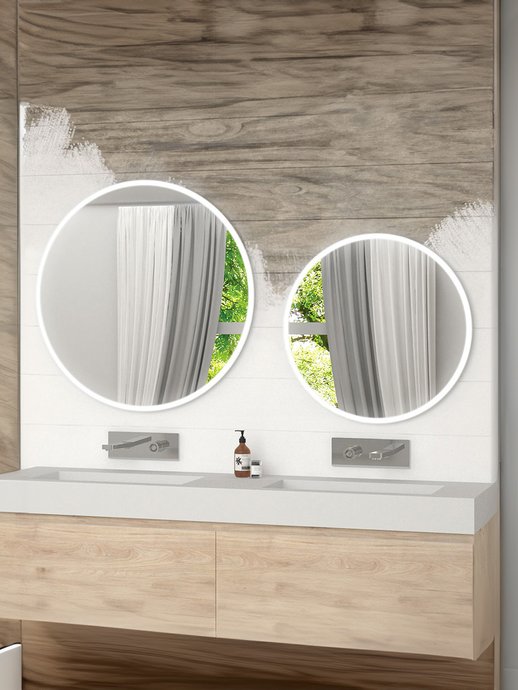
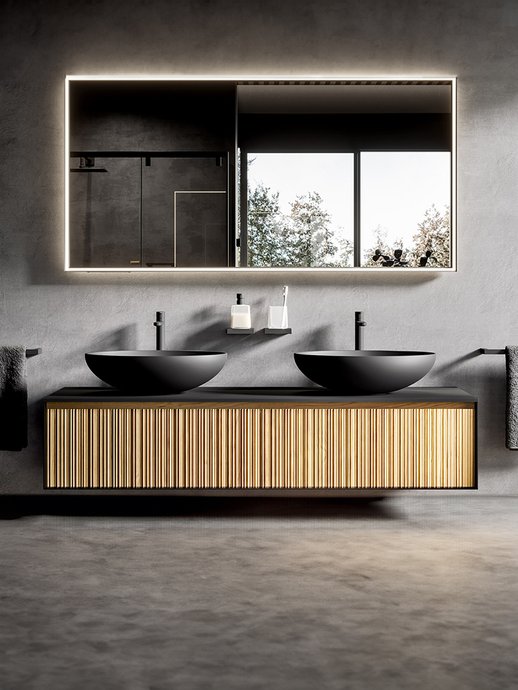
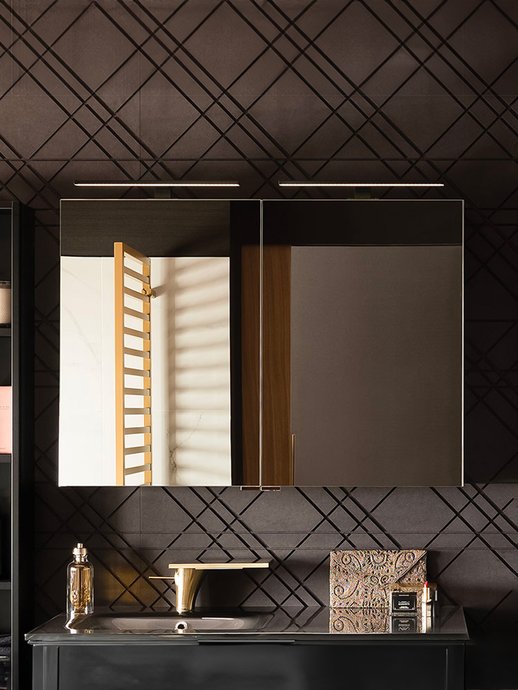
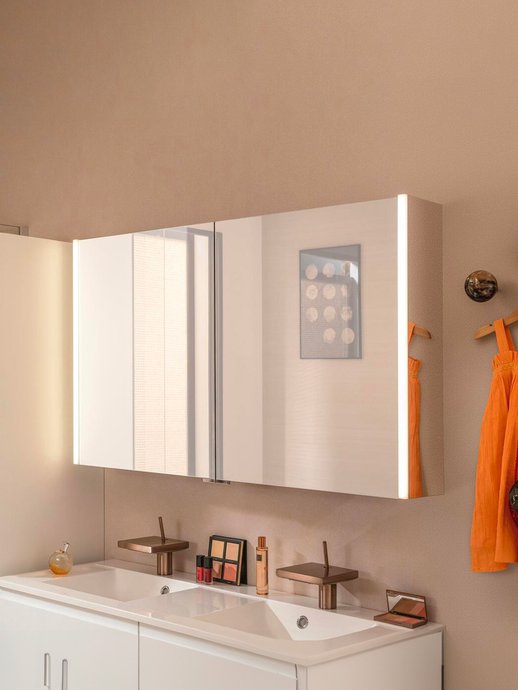
It is around the mirror that the choice of colour temperature has the greatest practical impact on everyday life, as this is where we assess our complexion, hairstyle or outfit before heading out. Bathroom cabinets and mirrors with built-in lighting have largely replaced the single ceiling spotlight for this very reason: the light source is closer to the face, which reduces shadows and allows for finer adjustment.
At Facq, several products feature LED lighting in this area, such as the D-motion bathroom cabinets from Delpha or the Reflet mirrors from Sanijura. The exact settings for colour temperature and CRI vary depending on the model: this is something you should check with an advisor at the EXPOcenter, where you can compare the actual lighting effects in front of a mirror rather than in a photograph.
The choice between a closed cabinet and a simple mirror with storage often arises at the same time as the question of lighting – a topic we cover in detail in our guide bathroom cabinet: 5 criteria for making the right choice and in our comparison bathroom cabinet or mirror with built-in storage.
Frequently asked questions
Q1. What colour temperature should you choose when applying make-up or shaving?
A neutral to cool light, between 4,000 and 5,000K, with a colour rendering index (CRI) of at least 90. This combination accurately reproduces the true colours of the skin and the products, unlike warm light, which casts a yellow tint over everything and masks the minor imperfections that a close shave is designed to detect.Q2. What is the colour rendering index (CRI) and why is it important?
The CRI measures, on a scale of 0 to 100, how faithfully artificial light renders colours compared to natural light. Two light bulbs with the same colour temperature may have very different CRI values: at 90 or above, colours and skin tones are rendered accurately; below 80, they often appear dull or slightly off.Q3. Can you combine different colour temperatures in the same bathroom?
Yes, provided they are clearly separated by area and circuit: cool light around the mirror, warm light for the overall ambience. The problem arises when two very different colour temperatures are mixed within the same field of vision, creating a visual dissonance that is immediately noticeable.Q4. Does the colour of the light really change the appearance of the tiles or furniture?
Yes, quite clearly. Warm lighting brings out the wood and terracotta tones but tones down whites and blues. Cool lighting does the opposite: it enhances white, mineral grey and polished concrete, but makes light wood or terracotta shades appear cooler.Q5. Why is the colour of light more important in Belgium than in a sunnier country?
This is because many Belgian bathrooms, particularly in older terraced properties, have few or no windows. Without natural light to correct a poorly chosen artificial colour, electric lighting becomes the room’s sole visual reference, from morning to night, all year round.Q6. Do Facq mirrors and bathroom cabinets allow you to adjust the colour temperature?
Several products, such as Delpha’s D-motion cabinets or Sanijura’s Reflet mirrors, feature adjustable LED lighting. The precise settings vary depending on the model: a Facq adviser at the EXPOcenter will show you the available options and how they actually look in front of a mirror.