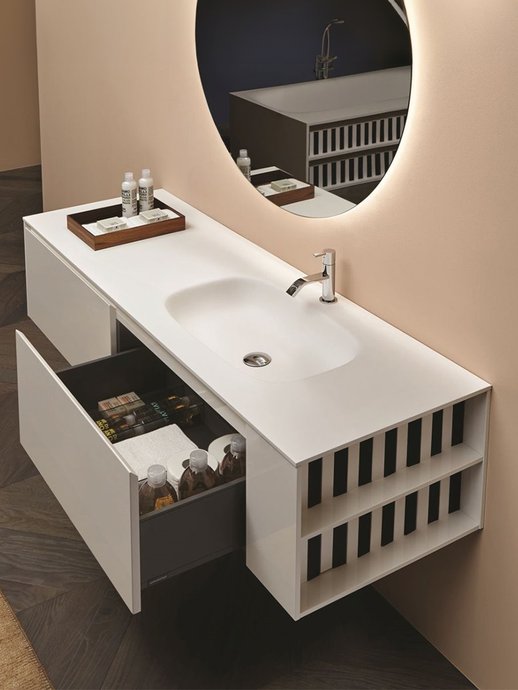
Large bathroom: How can you fit in a 140 cm or 160 cm unit without cluttering the space?
A large bathroom cabinet measuring 140 cm or 160 cm can transform your space, but it can also overwhelm it if the layout is not well thought out. Even in a large bathroom, an imposing piece of furniture that is poorly positioned can create a feeling of clutter.
However, with the right design strategies, these pieces of furniture can become major assets. Whether it's wall-mounted furniture that frees up floor space or freestanding furniture that offers more storage, each configuration has specific advantages for your large, modern bathroom.
We help you optimize your space with practical advice on choosing dimensions, smart layouts and suitable finishes.
Assess your actual needs before arranging a 140 cm or 160 cm piece of furniture.
Before choosing between a 140 cm or 160 cm unit, several technical parameters determine the feasibility of the project in a large bathroom.
Analyse the layout of your large bathroom
The first step is to locate the water supply and drainage points. Their position, whether on the floor or wall, will influence the depth of the drawers and the overall layout of the large bathroom cabinet. The type of wall also determines the choice between wall-mounted and floor-standing units: a load-bearing concrete wall can easily support wall fixings, while a plasterboard partition requires reinforcement before a wall-mounted unit can be installed.
The circulation space is a fundamental criterion. At least 80 cm should be allowed in front of the washbasin to ensure comfortable use, although this space can be reduced to a minimum of 60 cm in certain configurations. This distance ensures sufficient freedom of movement without creating clutter, even with a large cabinet.
Define the number of users and daily usage
The composition of the household directly influences the choice of dimensions. For a single person, a single basin is more than enough. On the other hand, a large family will benefit from a double basin, which makes morning routines easier. Double basin units require a width of between 120 and 135 cm, which corresponds perfectly to the dimensions of a 140 cm or 160 cm unit.
Daily habits also play a role: storage space for hygiene products, space for laundry, surface area for placing items. Each user brings their own specific constraints to the layout design.
Accurately measure the available space
Note the exact location of the window, door and water supply points using a tape measure. This information will guide your choice of furniture to suit the space available. For a functional family bathroom, allow for at least 4 to 5 m², bearing in mind that an area of 6 to 8 m² offers more design possibilities.
140 cm or 160 cm cabinet: choosing the right size
The choice between 140 cm and 160 cm depends on the available space and the desired configuration for the washbasin countertop.
When to choose a 140 cm piece of furniture
A 140 cm unit is suitable for medium-sized bathrooms. This size allows for a double basin with adequate storage space. The width allows for two separate basins to be installed while maintaining fluid circulation around the unit. For couples or families of three, this format offers a balanced compromise between functionality and floor space.
The advantages of a 160 cm piece of furniture in a large space
On the other hand, a 160 cm unit shows its full potential in a large, modern bathroom. This generous width provides more storage space and optimal comfort. The additional worktop surface makes it easier to store hygiene products and accessories. The wider drawers can easily accommodate towels and electrical appliances.
Compare actual space requirements and visual impression
The standard depth varies between 40 and 50 cm for built-in basins, while countertop basins require 50 to 60 cm. A 160 cm cabinet with a depth of 45 cm occupies 0.72 m² of floor space. However, the impression of bulkiness depends more on the type of installation than on the actual dimensions.
Double basin: optimise comfort without overloading
Double basin units require a minimum width of between 120 and 135 cm. The recommended distance between the centre of each basin is between 60 and 90 cm. A 140 cm unit allows for a 70 cm gap between basins, creating two separate areas without feeling cramped. At 160 cm, the gap reaches 80 cm, making it more comfortable for simultaneous use.
Choosing between wall-mounted and floor-standing units for a large 140 cm or 160 cm unit
The nature of the wall and the desired style will determine whether you choose wall-mounted or floor-standing bathroom furniture for a large 140 cm or 160 cm bathroom cabinet.
Advantages of wall-mounted furniture in a large bathroom
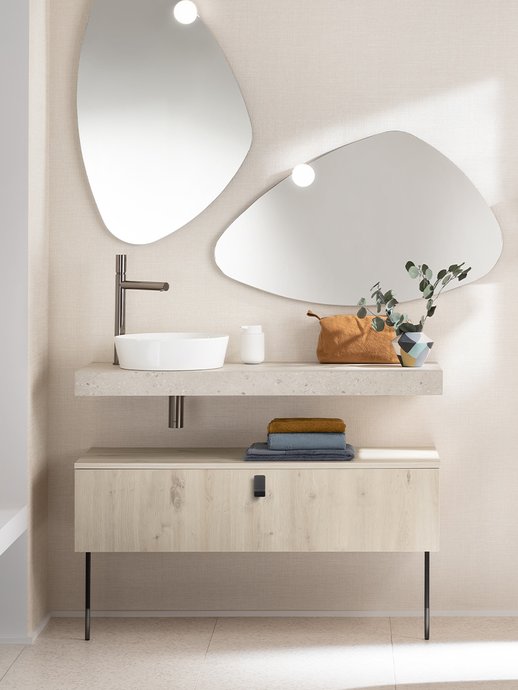
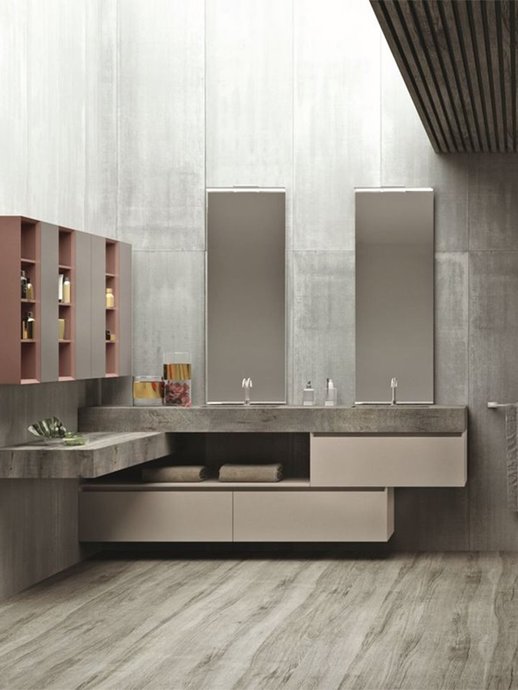
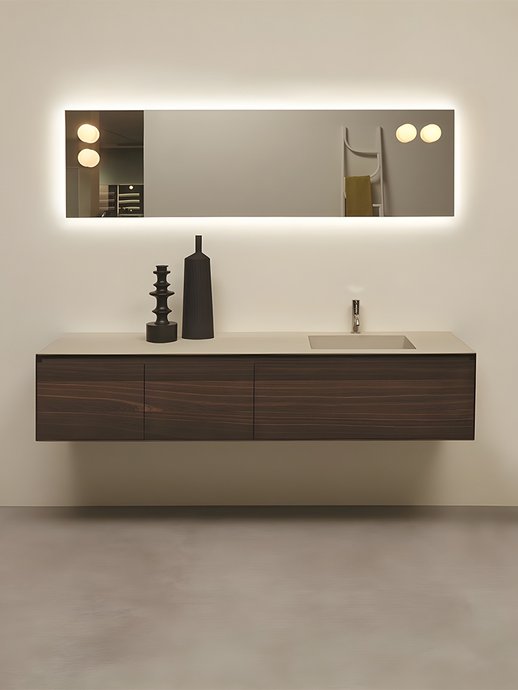
Wall-mounted furniture creates an impression of space and visual lightness. This configuration makes it easier to clean the floor and improves air circulation, reducing the risk of damp. A single-basin wall-mounted unit weighs around 50 kg, while a double-basin model weighs at least 70 kg. Therefore, installation requires a load-bearing or brick wall. The height can be adjusted to suit the user's needs, unlike floor-standing models.
Freestanding furniture: stability and extra storage space
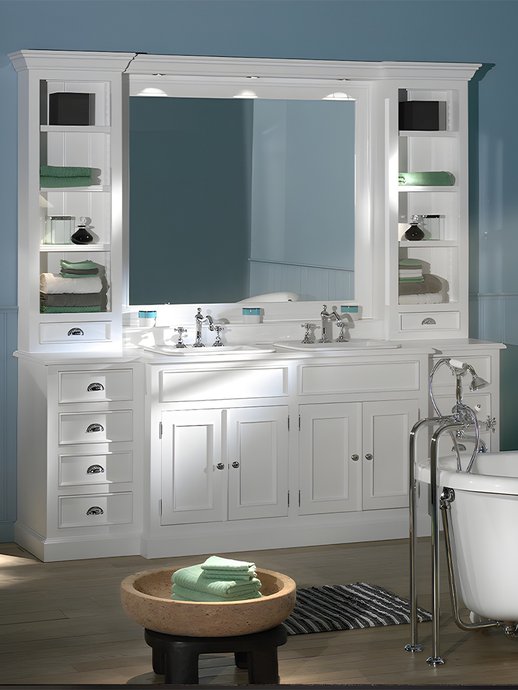
On the other hand, freestanding furniture offers simpler installation and greater storage capacity. Its natural stability is particularly suited to large pieces of furniture measuring 140 cm or 160 cm. This option is essential when walls cannot support the necessary wall fixings. Deep drawers can hold more products and accessories.
Which style best suits your space?
Wall-mounted furniture fits perfectly into a large, modern bathroom with clean lines. Floor-standing models, on the other hand, harmonise with classic or traditional bathrooms.
Layout configurations to avoid clutter
Several configurations allow you to incorporate a large 140 cm or 160 cm bathroom cabinet without creating visual clutter.
Centred layout to balance the space
The centred layout structures the space around a main axis. In a large, modern 7 m² bathroom, symmetry around a central axis organises the bathtub, double sink and built-in storage. This approach creates a harmonious visual balance.
Allow at least 70 cm in front of the unit for ease of movement. Also leave 20 cm on either side of the basin.
Installation along a main wall
The linear layout aligns all sanitary fixtures and furniture along a single wall. This configuration is suitable for long bathrooms and maximises circulation space. The L-shaped layout uses two perpendicular walls, while the U-shaped layout uses three walls.
Create distinct functional areas
The division into zones defines dedicated spaces: toilet area with vanity unit, shower area and storage area. Each zone meets specific needs without interfering with the others.
The storage columns complement the main unit without overloading it. A minimum horizontal spacing of 15 cm between the vanity unit and the column ensures comfortable access.
Materials and design for a large, modern and minimalist bathroom
Aesthetic choices influence the perception of space as much as the layout of a large 140 cm or 160 cm bathroom cabinet.
Light finishes to visually enlarge
Light finishes such as white, beige and light grey create a feeling of spaciousness in a large, modern bathroom. Glossy surfaces reflect light and enhance brightness. Matt lacquers and bold colours characterise the modernity of the design.
Solid wood in large bathrooms
Solid oak is the iconic material for bathroom furniture. Teak offers natural resistance to mould thanks to its hardness. Mango and mindi wood bring warmth and authenticity. A special water-repellent treatment protects the solid wood from moisture.
Clean lines and minimalist design
Minimalist design favours straight lines and geometric shapes. Wall-mounted furniture without visible handles accentuates the clean look. Basins with sharp edges blend harmoniously into this style.
Orchestrating volumes for a perfectly controlled large hall
You now have all the information you need to arrange your large bathroom cabinet without overcrowding the space. Whether you opt for a 140 cm or 160 cm model, wall-mounted or free-standing, the key is careful planning. Taking precise measurements, choosing the right materials and creating separate functional areas will transform your large modern bathroom into a harmonious and practical space, combining sleek aesthetics with optimal everyday comfort.
Frequently asked questions
Q1. What is the minimum width required to install a double basin?
To install a double basin, a minimum width of 120 to 135 cm is required. A 140 cm cabinet allows for a 70 cm gap between the basins, while a 160 cm model provides an 80 cm gap between the centres of the basins, ensuring optimal comfort for simultaneous use.Q2. How much space should be left in front of bathroom furniture?
We recommend leaving at least 70 to 80 cm in front of the furniture to ensure ease of movement and comfortable use. In some configurations, this space can be reduced to a minimum of 60 cm, but this is less comfortable for everyday movements.Q3. What are the advantages of wall-mounted furniture over floor-standing furniture?
Wall-mounted furniture creates a feeling of space and visual lightness, makes it easier to clean the floor and allows you to adjust the height as needed. However, it requires a solid load-bearing wall. Floor-standing furniture is easier to install, offers greater stability and has a higher storage capacity.Q4. What materials are recommended for moisture-resistant bathroom furniture?
Solid oak, teak and mango wood are the preferred choices. Teak offers natural resistance to mould thanks to its hardness. All solid woods must be treated with a specific water-repellent treatment to protect them from moisture and ensure their durability.Q5. What is the minimum floor space required for a functional family bathroom?
A functional family bathroom requires at least 4 to 5 m². However, a floor space of 6 to 8 m² offers more design options and allows for the comfortable installation of a large 140 cm or 160 cm cabinet with a double basin.