
Bathroom ideas: styles, inspiration and trends for designing your space
At EXPOcenter, we see a lot of clients who turn up with around twenty photos on their phones. They’re all lovely, and they often cover five different styles. It’s a good start. The next step is to identify the recurring elements across the photos – such as a particular shade of wood, a matt black finish or a doorless shower – and translate these into existing products in the right dimensions for your room. That’s what we do here, style by style.
Seven style ideas, broken down into practical options
1. The Scandinavian style: light oak, matt white and light
This is the style we’re asked for most often, and for one simple reason: it works in almost all Belgian bathrooms, including small and less well-lit ones. The light-coloured wood adds warmth, the matt white reflects light without being too bright, and the whole design ages well.
The formula is quite simple: a light oak or light veneer vanity unit, a matt white worktop, chrome or matt white taps and fittings, light-coloured walls and linen textiles. We’ve set out the perfect colour and material combinations in our Scandinavian-style inspiration: the light oak and matt white vanity unit. At FACQ, Sanijura’s Bocage range in natural oak (from €2,534.95 incl. VAT for the 100 cm version) or the Lateral 2.0 range in light hickory are perfect examples of this style.
2. The industrial style: black metal and untreated wood
The designer draws on the aesthetic of workshops and lofts: black metal structures, wood with visible knots, metro-style tiles with dark grouting, and occasionally polished concrete. The style has become much more understated in recent years. There is less exposed pipework and more clean lines.
To achieve this look without making the room feel dark, our inspiration industrial style: combining black metal and untreated wood explains how to balance the two materials. In terms of products, the Ultra Cadra range by Delpha in textured untreated oak and matt black (from €1,500.40 incl. VAT for the 120 cm version) and a shower enclosure with black profiles, such as the Urban Black Edition by Huppe (from €1,489.57 incl. VAT), set the tone all on their own.
Our advice: in a room smaller than 5 m², stick to black for the trim (mouldings, taps, mirror frames) and avoid large black areas on the walls.
3. Japandi: calm, wood and sandy tones
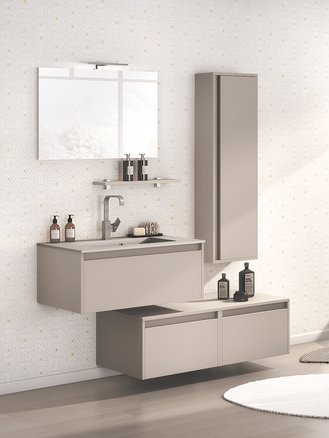
Japandi blends Scandinavian and Japanese aesthetics. Fewer objects, low-profile designs, shades of sand, clay or greige, and wood with simple lines. It’s a style that suits people who want a soothing bathroom without it feeling like a hotel spa.
It is created using a unit with plain fronts in a mineral shade, a countertop basin with soft-edged rims, large-format tiles with a stone or plaster finish, and warm lighting (2,700 to 3,000 K). The Sand range by Detremmerie, in sand colour (from €1,990.45 incl. VAT for 100 cm), or the D-motion range by Delpha in matt clay (from €956.63 incl. VAT for 90 cm) are good places to start.
4. Minimalist contemporary style: smooth façades and clean lines
Minimalist contemporary is the ‘no-style’ style found in many new-build properties in Belgium: wall-mounted units with handle-free fronts, wall-hung toilets, walk-in showers, and a limited colour palette. It is popular because it does not go out of fashion quickly and is easy to maintain.
Its weakness is its coldness. This can be remedied with a single warm element: a wooden worktop, a wall of zellige tiles, or taps with a brushed stainless steel or bronze finish. The Delpha C40 range in matt black (from €1,013.50 incl. VAT for the 120 cm version) offers a more graphic take on this style.
5. The natural style: sage green, wood and plants
The natural (or biophilic) style brings the outdoors into the bathroom: soft greens, wood, stone and plants that can tolerate damp. It works very well in a bathroom with a window, but not quite as well in a windowless room where plants struggle.
The Sanijura Mundo range in sage green (from €1,089.00 incl. VAT in 80 cm) is typical of this trend. It is paired with beige or light terracotta tiles, chrome or brushed brass taps, and one or two plants that thrive in humid conditions, such as the Boston fern or pothos.
6. Retro in the style of a mansion
This is the most ‘Belgian’ idea on the list. Many mansions and middle-class houses in Brussels, Liège, Ghent and Namur still feature cement-tile floors, mouldings and ceiling heights of over 3 metres. It’s often a shame to renovate them into ultra-contemporary bathrooms.
The retro style draws on this heritage: cement tiles or patterned floor tiles, freestanding furniture or pieces with moulded fronts, taps with cross-bar handles in brushed brass or brushed gold, and a freestanding bath where space allows. Blue stone, the limestone typical of Belgium, makes for a beautiful washbasin top in this style. It simply requires a mild, acid-free cleaning product, as it does not tolerate limescale or aggressive descaling agents. Burgbad’s Style II range, in a two-tone oak and matt blue finish (from €1,970.18 incl. VAT for the 120 cm version), offers a more contemporary take on this style.
7. The spa bathroom
A spa-style bathroom is less about style than it is about function: the aim is for the room to be a place to relax, not just to wash. It features a walk-in shower with a large shower head, possibly a freestanding bath, a heated towel rail, dimmable lighting and a wall niche for bottles.
She can pull off almost any style (Japandi and natural styles suit her particularly well). The lion’s share of the budget goes on the shower and fittings: a Hansgrohe or Grohe thermostatic shower column, an ultra-slim shower tray or a tiled walk-in shower. The rest can be kept simple.
The seven styles at a glance
Style | Furniture | Taps and fittings | Coating | Recommended play |
| Scandinavian | Light oak, matt white | Chrome, matt white or matt black | Light, matt | All of them, even the small ones |
| Industrial | Black metal and untreated wood | Matt black, brushed stainless steel | Metro with dark-coloured joints, concrete | 5 m² or more, well-lit |
| Let's go | Shades of sand, clay and wood | Brushed stainless steel, matt black | Large-format stone-effect tiles | All |
| Minimalist contemporary | Hanging, without handles | Chrome or matt black | Large plain format | New-build, small rooms |
| Nature | Sage green, wood | Chrome-plated, brushed brass | Beige, light terracotta | With a window |
| Retro mansion | On legs, moulded | Brass, brushed gold, latticework | Cement tiles, blue stone | High ceilings |
| Spa | Depending on the style chosen | Thermostatic, large head | Large format, few joints | 6 m² or more, preferably |
Trends for 2026: what’s here to stay and what to use in moderation
A bathroom lasts between fifteen and twenty years. We therefore advise you to distinguish between long-term trends and seasonal fads.
What we believe will stand the test of time: wood and warm colours (oak, walnut, sandy shades), which have replaced the all-white look of the 2010s; matt finishes on taps and fittings – in black, brushed stainless steel or bronze, often with a PVD coating, which is more scratch-resistant; walk-in showers at ground level, which are more practical and easier to adapt as you get older; rounded shapes on mirrors, basins and the corners of bathroom units; and large-format tiles, which minimise grout lines and therefore reduce the need for maintenance.
What to use in moderation: very bold colours over large areas (a sage-green piece of furniture, yes; four sage-green walls, that’s riskier when it comes to selling the property); polished gold, which shows marks easily and quickly looks dated; terrazzo and terracotta everywhere, which can feel overwhelming in a small room. These trends remain interesting when used on a single item, but not throughout the whole room.
One Belgian peculiarity to bear in mind: in areas with hard water, such as Brussels and Brabant, matt black finishes and frameless shower screens show white marks more quickly. That’s no reason to avoid them, though. A squeegee after showering and a shower screen with an anti-limescale treatment are usually enough, and a water softener helps if the water is very hard.
Frequently asked questions
What style of bathroom should you choose for a small room?
Scandinavian, Japandi and minimalist contemporary styles are the easiest to pull off in a space of less than 5 m², thanks to their light colours and smooth surfaces. A more ornate style, such as industrial or retro, is still possible, provided you limit the use of black or patterns to just one or two elements.What are the bathroom trends for 2026?
Wood and warm tones, matt finishes on taps and fittings (black, brushed stainless steel, bronze), walk-in showers at ground level, rounded shapes and large-format tiles. Soft colours such as sage green or sand are mainly used on the bathroom furniture.How much does a bathroom renovation cost in Belgium?
As a rough guide, €1,000 to €4,000 for a refresh, €4,000 to €10,000 for a partial refurbishment, and €12,000 to €25,000 or more for a full refurbishment, including materials and labour. A 6 per cent VAT rate applies to work carried out by a contractor in a property over 10 years old.Can you mix two styles in a bathroom?
Yes, and it’s actually quite common: Japandi and spa, Scandinavian and industrial, nature and retro. The rule is to stick to one dominant style and borrow one or two elements from the other – for example, matt black taps in a Scandinavian-style bathroom.How can you give your bathroom some style without breaking the bank?
Replace the elements that can be changed without affecting the tiling: taps, mirrors, lighting, towel warmers, fittings and the paintwork on the walls outside wet areas. By choosing a common finish (matt black, brushed stainless steel, brass), the change is immediately noticeable.What colour should you choose for a bathroom that won’t go out of fashion?
Warm and neutral shades (off-white, sand, greige, light wood) stand the test of time best. If you like colour, use it on something that can be changed, such as furniture, paint or textiles, rather than on the tiles.