Which bathroom suits your style and space?

This comprehensive guide helps you to clarify your vision: identify the style that truly suits you, and make the right choices of materials, colours and accessories.
The essentials:
Choosing your bathroom according to your style and space is based on three combined filters:Book an appointment
- The desired atmosphere: Japanese wabi-sabi, immersive spa, Art Deco, biophilic, terracotta or industrial
- The available floor space: the optimal solutions vary radically between less than 4 m², a standard space of 8–9 m² (the Belgian average) and a large bathroom of more than 12 m²
- Actual usage: sole user, family use, accessibility for people with reduced mobility (PRM)
In Belgium in 2026, the dominant style is warm minimalism: natural materials (stone, wood, linen), bold textures and deep colours (terracotta, sage green, chocolate brown) on a clean, uncluttered base. The key to a successful project is to align these three filters — style, space, usage — before choosing a single tile or tap.
Facq supports this project across its 17 EXPOcenters throughout Belgium, with a free, no-obligation consultation.
First of all: what truly defines your bathroom style?
Contrary to what one might think, the style of a bathroom does not start with the tiles or the vanity unit. It starts with you, with the way you live, and with what you are looking for in that moment of the day that your bathroom represents. Is it a moment of morning efficiency? An evening relaxation ritual? A shared space with children, or an entirely personal room?
The 3 key questions underpinning your project
- 1. What kind of atmosphere replenishes you? Warmth and natural materials (wabi-sabi, terracotta, biophilic)? Clean lines and bold contrasts (Art Deco, industrial, black and gold)? Sensory purity (spa, minimalist)?
- 2. How many people use this bathroom? Solo or family use, children present, accessibility for people with reduced mobility: everyday use dictates a large proportion of the design constraints.
- 3. What is your actual floor space? Not the ideal surface area — the actual one, with its nooks, plumbing constraints, and any roof slopes. Style must work with the space, never against it.
Belgian benchmark: In Belgium, the average bathroom measures 8 to 9 m². This is the reference configuration for this guide. It applies to the majority of homes, whether a Brussels terraced house, a Liège apartment or a new-build in Brabant Wallon.
The 6 bathroom styles dominating Belgium in 2026
In 2026, the Belgian market is operating under the sign of warm minimalism: calming, textured spaces that speak to the senses without overloading the eye. But within this general framework, stylistic sensibilities remain highly varied. Here are the six profiles that stand out most clearly, each with its key materials, atmosphere and the lifestyle profile it corresponds to.
| Style | Atmosphere | Ideal for | Key materials |
| Wabi-sabi Japanese | Serene imperfection | Adults seeking a refuge | Linen, raw concrete, cerused wood, irregular stone |
| Spa bathroom | Immersive well-being | Lovers of everyday relaxation | Marble, teak, frosted glass, white stone |
| Art Deco | Geometric glamour | High-ceilinged spaces | Brass, fan-shaped tiles, black, gold |
| Biophilic design | Integrated nature | Those sensitive to eco-design | Natural stone, live wood, plants, light |
| Terracotta & warmth | Mediterranean cocoon | Those who dare to use colour | Terracotta, ochre, matt copper, linen |
| Industrial / concrete | Urban loft aesthetic | Confident contemporary design | Polished concrete, black metal, glass, stainless steel |
Japanese wabi-sabi bathroom: the beauty of imperfection
In Belgium, this style adapts remarkably well to existing homes. A raw concrete wall, a few accessories in natural linen and a tap in a brushed finish are enough to create the atmosphere without a complete rethink.
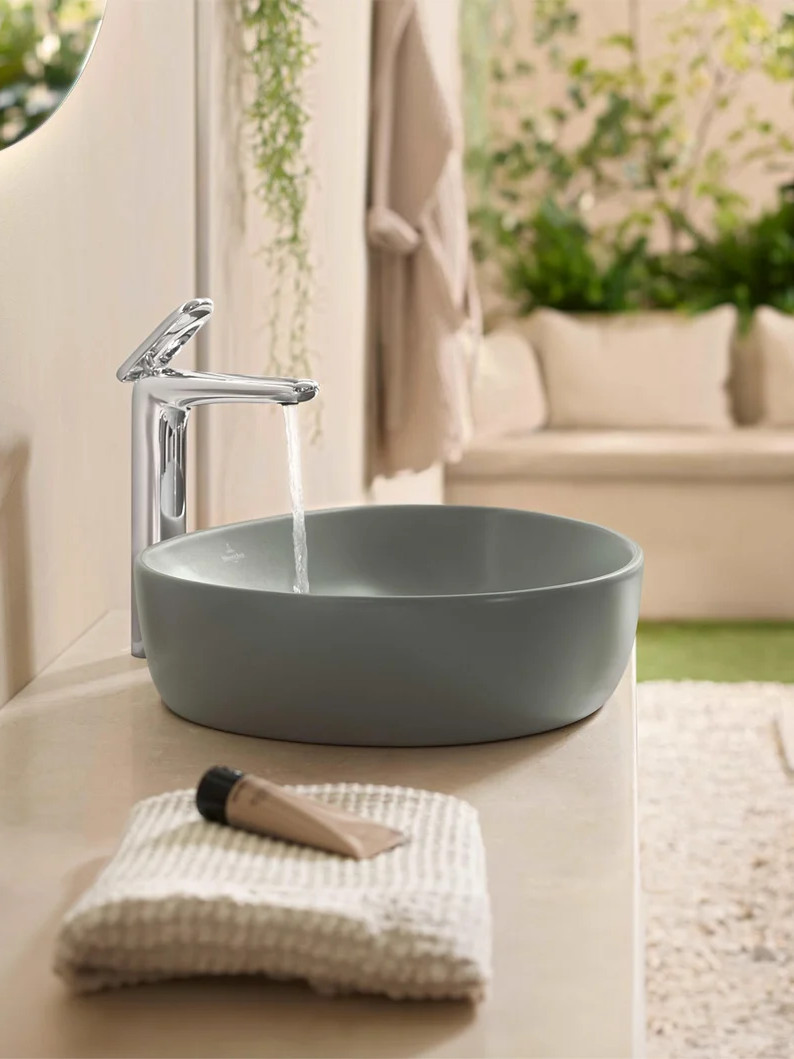
How to create a spa bathroom at home
A walk-in shower integrated into a wet room concept, a freestanding bath, soft lighting on a dedicated circuit, jointless materials — the spa bathroom transforms an everyday moment into a care ritual. It requires space (ideally at least 8 m²), but some principles apply from as little as 5 m²: a unified floor-to-wall finish, zero visual breaks, thermostatic taps with remote pre-heating.
Marble (natural or as a composite alternative) remains the reference material for this universe. Its subtle veining and timeless elegance make it a choice you will not regret in 10 years’ time.
Art Deco bathroom: brass, golden accessories and geometry
The return of Art Deco in Belgian bathrooms is not a passing trend — it is a response to the weariness of all-white schemes. Fan-shaped or herringbone tiles, brushed brass taps, a mirror with a gilded geometric frame, a matt black washbasin: the codes come together with clockwork logic.
This style requires height to express itself: something many pre-war Belgian homes naturally offer. In a recent apartment, one or two well-chosen Art Deco elements establish the identity without weighing it down.
Biophilic bathroom: integrating nature into your design
The key in Belgium? Managing humidity. A high-performance ventilation system is not a luxury — it is the essential precondition for plants to last and natural materials to age well.
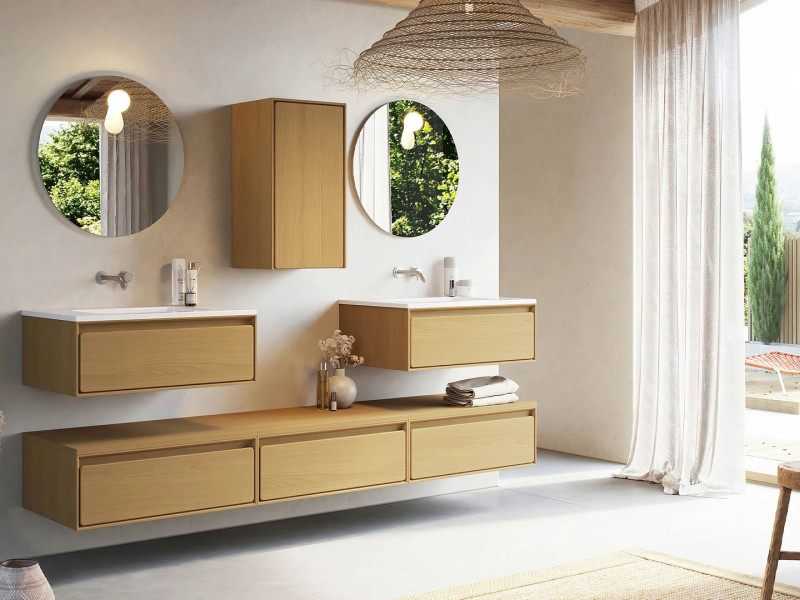
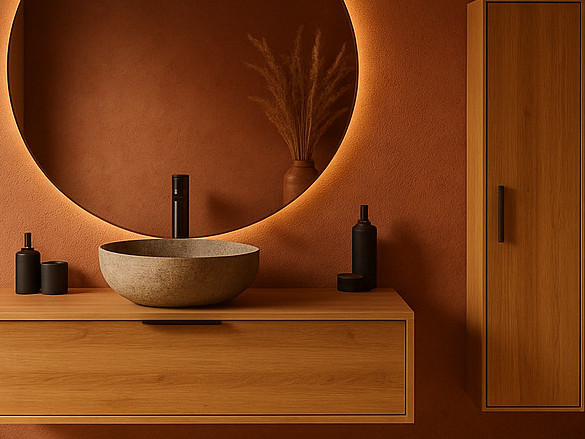
Terracotta bathroom: how to handle this trend with care
Neighbouring shades (warm ochre, soft brown, weathered rust) pair naturally with the matt copper and bronze finishes that are animating 2026 taps and fittings.
Adapting your style to your space: the real challenge of the project
A style does not impose itself on a space: it enters into dialogue with it. This is often where projects go wrong: you fall in love with a bathroom photographed in a 30 m² New York loft, you reproduce the design codes in 6 m², and the result resembles neither the inspiration nor yourself. Here is how to avoid this trap according to the main typologies of Belgian spaces.
| Floor space | Typical constraints | Priority solutions | Absolutely avoid |
| < 4 m² | Limited light, restricted circulation | Wall-mounted furniture, walk-in shower, unified floor/wall finish, large mirror | Bathtub, partitions, dark colours on all walls |
| 4–7 m² | Standard surface, intensive use | Combined bath-shower, recessed niches, layered lighting, suspended furniture | Bulky floor-standing furniture, uncoordinated accessories |
| 8–12 m² | Real comfort, wide choice possible | Separate shower + bathtub, bespoke furniture, central signature element | Leaving an unconsidered empty area, under-using the height |
| > 12 m² | Risk of a cold or soulless space | Zoning into distinct areas, architectural lighting, deep materials, textures | Furniture that is too small, single light source, palette that is too pale |
The small bathroom (less than 5 m²): the rules that change everything
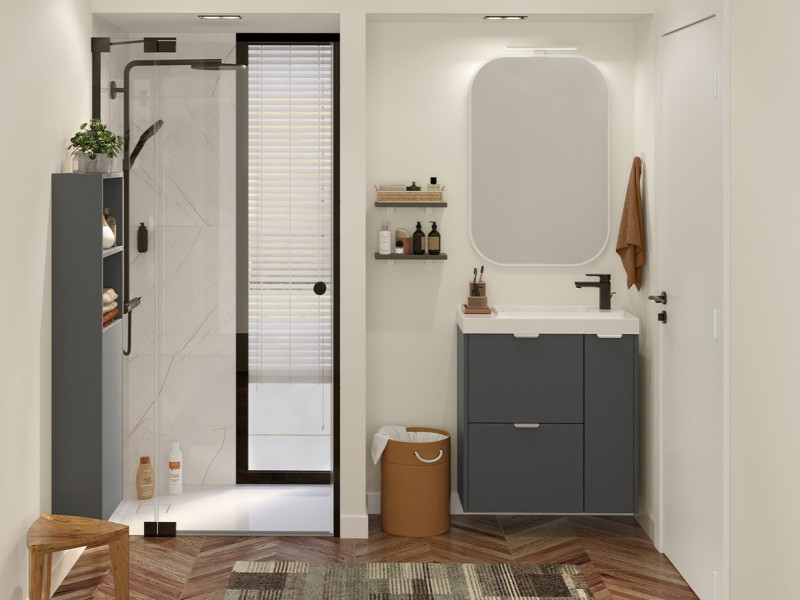
In a constrained space, every decision counts double. Wall-mounted furniture frees up the floor and creates a visual line that enlarges the room. The walk-in shower, without a screen where possible, removes a mental as much as a physical barrier. A unified finish — the same material from floor to wall, no more than two materials — avoids the visual fragmentation that makes the space feel even smaller.
Colour? Contrary to popular belief, a small bathroom can accommodate a strong shade: provided it is applied to just one wall, in continuity with a light floor. The contrast draws the eye and creates depth.
�� Facq tip: In compact homes (Antwerp apartments, Brussels studios), opt for wall-recessed taps. You free up the space around the washbasin and gain a considerable visual effect for a limited additional cost.
Large bathroom (more than 10 m²): how to design it without it feeling cold
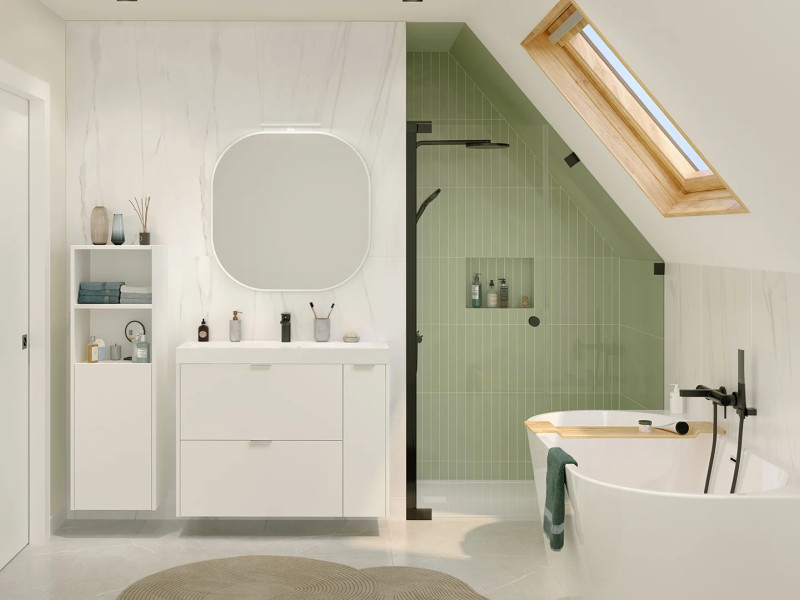
Mansard bathroom: turning the constraint into an asset
Family bathroom: functionality and design are not mutually exclusive
This is one of the biggest challenges: a bathroom used by 2 adults and 2 children, with different routines and needs. The double washbasin is indispensable. Storage must be accessible to children but lockable for adults. And the style? The mistake would be to abandon it in the name of practicality.
Textured finishes resist marks better than smooth surfaces. Medium shades hide limescale better than pure white. One or two signature elements — brass taps, a design mirror — elevate the whole without any additional maintenance effort
Materials and colours: the combinations that really work
Once style and space have been defined, the question of materials and colours remains. This is the stage that either brings a project to life or ruins it. In 2026, the Belgian market confirms two strong trends: the layering of textures and a reduced but bold palette.
The 3-level rule: 60 / 30 / 10 %
- Level 1 — Base (60%): wall and floor finish. A neutral or slightly tinted choice: off-white, grey stone, warm beige, pale limestone. This is what endures and supports everything else.
- Level 2 — Body (30%): vanity unit, shower tray, bathtub. This is where the style makes its statement: a confident colour, a distinctive material. This level can be changed without starting from scratch.
- Level 3 — Accents (10%): taps, mirror, accessories. Taps in brushed brass, matt copper or matt black change everything at a controlled cost.
Trending bathroom colours for 2026: beyond white
White is not disappearing — it is being nuanced. Pure white gives way to off-white, sand and linen. And around this base, accent colours are making themselves known: deep sage green, slate blue-grey, soft terracotta, chocolate brown, burgundy red. Shades that age well — meaning they do not become tiresome after two years.
The black and gold combination deserves a special mention: it is the most sought-after pairing in Belgium for an elegant bathroom. It demands rigour: too much gold and the effect tips over. But used in moderation, it creates an incomparable visual signature.
Mix & match materials: polished concrete, wood and metal
The combination of polished concrete + natural wood + brushed metal has become a reference in Belgium. Polished concrete provides continuity (no grouting) and a tactile texture. Wood brings warmth. Metal provides structure. Together, they create a sophistication that neither would achieve alone.
The golden rule: do not exceed 3 distinct materials in the same space. Beyond this, the eye no longer knows where to settle, and the feeling of richness turns into visual confusion.
Accessories and lighting: the 20% that make 80% of the perceived difference
A bathroom project can be 80% perfect and yet prove disappointing because of the remaining 20%: mismatched accessories, harsh single-source lighting, towel rails bought in a sale with no consistency of finish. In a room as small as a bathroom, details carry considerable weight.
How to choose the lighting for your bathroom (IP standards and atmosphere)
The bathroom has long suffered from a single central ceiling light that flattens everything. In 2026, the approach is changing: we talk of layered lighting. Task lighting around the mirror (IP44 minimum in zone 2). Soft ambient light on a separate circuit. Accent lighting on an architectural feature: a niche, a stone wall, the bathtub.
In Belgium, electrical standards impose precise IP zones. Zone 0 (inside the bath/shower): IP67 minimum. Zone 1 (above): IP45. Zone 2 (within 60 cm around): IP44. These requirements direct you towards products designed to last in humid conditions. → How to light your bathroom properly (IP standards, atmosphere, LED)
Coordinated accessories: why consistency changes everything
Towel rails, soap dispensers, hooks, toothbrush holders: their inconsistency of finish is one of the first things the eye detects. A chrome towel rail + a white plastic dispenser + matt black taps: the stylistic message collapses entirely.
The simple rule: choose a single metallic finish (brass, chrome, matt black, bronze) and apply it consistently to all accessories. This is the most effective decision you can make to raise the perceived quality of your bathroom by a notch.
Special cases: accessibility, home automation and the Belgian market
Accessible bathroom for people with reduced mobility (PRM): design without aesthetic compromise
Designing an accessible bathroom (whether in anticipation of the future or to meet an immediate need) no longer means sacrificing aesthetics. The PRM standards (150 cm diameter circulation space, no thresholds, grab bars) integrate perfectly into highly accomplished designs. A level-access walk-in shower is both the PRM solution par excellence and the premium option for a spa bathroom.
In Belgium, renovation grants can cover part of the accessibility work (housing adaptation allowance depending on region). A Facq expert can guide you during your EXPOcenter appointment.
Bathroom home automation: what really exists and what is actually useful
A connected bathroom is not limited to gadgets. In 2026, a few genuine innovations are changing everyday life: remote shower controls (pre-heating with no cold blast), thermostatic taps with temperature memory, mirrors with colour-temperature-adjustable lighting, and toilets with more water-efficient flushing systems.
The common-sense rule: only integrate home automation where it genuinely simplifies a real everyday action. Well-designed home automation becomes invisible — you enjoy the comfort without thinking about it.
Frequently asked questions
Q1. What bathroom style is trending in Belgium in 2026?
In 2026, the dominant style in Belgium is warm minimalism: uncluttered spaces enriched with textures, natural materials and deep colours (terracotta, sage green, chocolate brown). Japanese wabi-sabi and spa inspiration are the two most sought-after variants. Art Deco is making a strong comeback in homes with high ceilings, while the biophilic style is winning over renovators who are mindful of their well-being and ecological footprint.Q2. How do you choose a bathroom when you have less than 5 m²?
In a small bathroom, the three priorities are: wall-mounted furniture (frees up the floor and visually enlarges the space), a unified floor-to-wall finish (eliminates visual breaks), and a walk-in shower without a screen if possible. A single feature wall in a bold colour adds depth without overwhelming the space. Wall-recessed taps are the most cost-effective investment in this type of configuration.Q3. Can you mix styles in a bathroom?
Yes, provided you define a dominant style and add complementary elements — never competing ones. A spa base (stone, clean lines) with a few Art Deco brass accessories works very well. What fails: two styles in equal measure that cancel each other out. The practical rule is to let one style account for 70% of the visual choices, and reserve 30% for external influences.Q4. What materials should you choose for a long-lasting bathroom in Belgium?
For a bathroom built to last, favour: stone-effect composites (they imitate marble while offering better resistance to humidity and scratches), polished concrete with a quality impregnation, furniture in matt lacquer or wood treated for humidity, and taps in a PVD finish — these hold up considerably better than standard chrome plating against household products and Belgium’s hard water.Q5. What budget should you plan for a bathroom in Belgium in 2026?
In Belgium, a bathroom of 8 to 9 m² with a shower, double washbasin and toilet represents a realistic investment of between €9,000 and €15,000 (including 6% VAT for renovation work, materials and basic installation on existing pipework). A premium version with high-end materials exceeds €18,000. Always allow 10 to 20% contingency for unforeseen costs — moving pipework and electrical adaptations are the most frequent.
