Water softener: is it really worth it in Belgium?

Key points
1. In Belgium, water hardness varies significantly from region to region: from 7°fH in the Ardennes to over 30°fH in Flemish Brabant or Brussels. In these hard-water areas, a water softener provides effective protection for appliances — boilers, taps and dishwashers — and significantly reduces the amount of detergent used.Book an appointment
2. A water softener is not a one-size-fits-all solution: in areas with naturally soft water, installing one is pointless and counterproductive. The first step before any project is to find out the hardness of your water.
3. When correctly sized and properly maintained (with regular salt refills and annual checks), a water softener pays for itself within 5 to 8 years thanks to the savings made on appliances and household cleaning products. Its actual annual cost ranges from €80 to €180, depending on the model and the size of the household.
Hard water, soft water: understanding water hardness in Belgium
Before discussing water softeners, it is important to understand what we are measuring. Water hardness refers to the concentration of dissolved minerals in the water: primarily calcium and magnesium. It is measured in French degrees (°fH): the higher the figure, the harder the water.
Water is considered soft if it has a hardness of less than 15°fH, moderately hard between 15 and 25°fH, and hard above 25°fH. At 30°fH and above, limescale builds up visibly on all appliances and significantly reduces their lifespan.
Hard water by region in Belgium: what is the real situation?
The Belgian map of water hardness reveals significant contrasts. These can be explained by geology: the Ardennes region, where the water comes from aquifers flowing through rock with low limestone content, differs radically from the Flemish provinces and Walloon Brabant, where the water comes from aquifers flowing through chalky subsoil.
Region / Province | Average hardness (°fH) | Level |
Ardennes (Namur, Luxembourg) | 5 – 12 °fH | Soft water — no need for a water softener |
Liège (city and surrounding area) | 12 – 20 °fH | Moderate water usage — to be assessed |
Hainaut (surface water) | 14 – 22 °FH | Moderate water usage — to be assessed |
Walloon Brabant | 22 – 30 °FH | Hard water — water softener recommended |
Brussels-Capital | 20 – 28 °FH | Hard water — water softener recommended |
West Flanders | 15 – 25 °FH | Moderate to hard water |
Flemish Brabant / Hageland | 25 – 35 °fH | Very hard water — water softener recommended |
Antwerp (city) | 18 – 26 °FH | Moderate to hard water |
Ghent and the surrounding area | 14 – 22 °FH | Moderate rainfall |
Belgian guide: How can you find out the water hardness at your exact address? Your water supplier will provide this information on request or via its website. In Wallonia, SWDE and IECBW publish this data by municipality. In Flanders, De Watergroep and Farys offer an online search tool. These figures are the most reliable: they reflect the water that actually reaches your home, rather than a generic regional average.
The practical effects of limescale on your appliances
Limescale isn’t just an eyesore – those white marks on your taps or shower screen. It has a direct impact on the lifespan of your appliances, their performance, and your energy bills. These effects are gradual, subtle, and often underestimated.
Water softener: what impact does it have on taps and the boiler?
Taps and fittings, and in particular thermostatic mixers, are highly susceptible to limescale. The seals and cartridges in thermostatic mixers deteriorate up to three times faster in untreated hard water.
The storage water heater (hot water tank) is perhaps the most affected of all. The water heated in the tank gradually deposits limescale on the heating element and the inner walls. A tank full of limescale consumes more energy to reach the same temperature, and its lifespan can be halved compared to a tank supplied with softened water.
The most vulnerable equipment, in order of priority:
Condensing boiler and air-to-water heat pump: heat exchangers on continuous display
Storage water heater (tank): heating element and inner wall in direct contact
Thermostatic taps: precision cartridges susceptible to mineral deposits
Dishwashers and washing machines: heating elements and circulation pumps
Shower screen and tray: visible limescale that is difficult to remove without acidic cleaning products
According to studies carried out by German manufacturers (AEG, Viessmann), a correctly sized water softener can extend the lifespan of a boiler by an average of 3 to 5 years. Across the entire Belgian heating system, the cumulative savings are considerable — and often exceed the cost of installing the unit.
How does a water softener work?
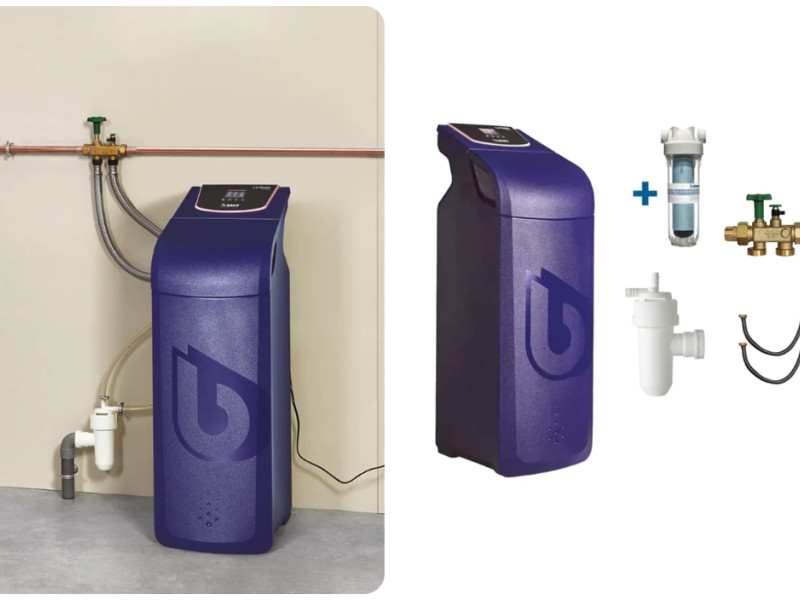
A domestic water softener works on the principle of ion exchange. Tap water passes through a synthetic resin loaded with sodium ions. The calcium and magnesium ions responsible for water hardness bind to this resin and are replaced by sodium ions, which are harmless to appliances.
The resin gradually becomes saturated and needs to be regenerated: this is the regeneration cycle, during which a saltwater solution (brine) flushes the calcium and magnesium ions out of the resin and discharges them into the drain. This cycle is triggered automatically based on water consumption measured by the built-in flow meter. The result: softened water at the outlet, protecting the entire system.
Salt-based water softener or alternative technology: what’s the difference?
Salt-based water softeners (ion exchange) are the most tried-and-tested and effective technology. However, other solutions are available, each with different operating principles and applications.
Technology | Principle | Effectiveness | Recommended use |
Salt-based water softener (ion exchange) | Resin + regeneration brine | Very high — removes 100% of limescale | Hard water > 20 °fH, equipment protection |
Water filter (activated carbon, sediment) | Mechanical or chemical filtration | Taste quality only | Drinking water, taste, colour |
Electromagnetic limescale prevention treatment | Changes in limestone crystals | Limited — limestone remains present | A light snack, on a tight budget |
Reverse osmosis | High-pressure membrane filtration | Total — almost pure water | Single-point tap (kitchen tap) |
Salt-free water softener (TAC) | Conversion of calcium ions | Moderate — partially effective | Moderately hard water, low consumption |
Good to know: Water filters and water softeners serve two completely different purposes. A filter improves the taste of your drinking water — it does not protect your appliances. A water softener protects your appliances — it does not necessarily improve the taste of your drinking water. The two are often confused, which frequently leads to people buying the wrong product.
Water softeners and maintenance: how much do they really cost per year?
This is the question Belgian homeowners ask most often after ‘Is it worth it?’. And the answer depends on several factors: the size of the appliance, the type of salt used, and how often maintenance is required.
The cost of a water softener is not limited to the purchase price: this generally ranges from €600 to €2,500 depending on the model and brand (Kinetico, BWT, Harveys and Culligan being the leading brands on the Belgian market). The real cost is the annual running cost, which includes regeneration salt, water used during cycles, and maintenance visits.
Cost centre | Frequency | Estimated annual cost |
Regeneration salt (25 kg bags) | 4 to 12 bags per year, depending on water hardness and consumption | 40 € – 120 € |
Regeneration water | Included in the water bill | 10 € – 30 € |
Annual maintenance / inspection | One visit per year is recommended | 30 € – 60 € |
Replacement of the resin (every 10–15 years) | Annual depreciation | 20 € – 40 € |
TOTAL actual annual cost | — | €80 – €180 per |
How much the water softener saves you
To be fair, the cost of a water softener should always be weighed against the savings it generates. These savings are real and well-documented; they are simply less obvious because they are spread across various areas.
Household products: a 30–50% reduction in the use of detergents, fabric softeners and limescale removers
Energy: a boiler free of limescale uses 10 to 30 per cent less energy to produce the same amount of heat
Equipment maintenance: fewer service calls for boilers, taps and dishwashers
Equipment lifespan: estimated increase of 3 to 7 years for the most sensitive devices
In a Belgian household of 3–4 people with water at 28 °fH, the payback period for a properly sized water softener is generally between 5 and 8 years. After that, the system starts to generate a net profit, year after year.
Storage or instant water heater: how does this relate to the water softener?
The choice of water heater is closely linked to the issue of water quality. This is because the two types of domestic hot water systems react differently to hard water, and their susceptibility to limescale should be a key factor in your decision.
The storage water heater (hot water tank)
A storage water heater stores a volume of preheated water: between 50 and 300 litres, depending on the model. Storing the water at a high temperature (55 to 65 °C) accelerates limescale build-up: the heated water releases calcium ions, which gradually deposit on the heating element and the inside of the tank.
In an area with hard water (> 20 °fH), the heating element in an unprotected water heater can become encrusted with limescale within 3 to 5 years, reducing its efficiency and increasing its electricity consumption. A water softener is therefore a clearly worthwhile investment: it extends the water heater’s lifespan by several years.
The instant water heater (without a storage tank)
An instant water heater (gas or electric) heats water on demand, without storing it. Its advantage over limescale lies in its design: there is no storage tank and no heating element in constant contact with the water. Limescale build-up is less of a problem in the short term.
That said, the heat exchangers in a gas instant water heater are also susceptible to limescale in areas with very hard water. Regular descaling (every 2 to 4 years, depending on the water hardness) is still recommended. And in areas where the water hardness exceeds 28 °fH, installing a water softener upstream remains advisable to protect the seals and precision components of the appliance.
Criterion | Storage tank | Instant (gas/electric) |
Sensitivity to limescale | High — continuous exposure of reinforcement and wall | Moderate — less exposed interchanges |
The benefits of a water softener | Very important — twice the lifespan | Suitable for areas with a pH of over 25 |
Maintenance without a water softener | It is recommended that the heating element be descaled every 3–5 years | Descaling of the heat exchanger every 2–4 years |
Water consumption with limescale | +15% to 30% more energy | +5 to 15% depending on hardness |
Tip from Facq: If you’re installing a new water heater in an area with hard water, this is the perfect time to consider installing a water softener at the same time. Installing them together reduces plumbing costs and protects your new equipment from day one — without the need for further work in a few years’ time.
Water softeners and bathrooms: what are the practical benefits?
In the bathroom, limescale is everywhere. And it is precisely there that it is most visible and hardest to remove. Glass shower screens, taps, shower trays and bathtubs: all these surfaces are in constant contact with water.
The shower screen: the most obvious selling point
A glass shower screen in an area with hard water will become cloudy within a few weeks. Without a water softener, the nano-coating on Hüppe or Duscholux screens (recommended in our shower selection guide) loses some of its effectiveness when exposed to water with a hardness of 28–30 °fH. With a water softener, the same treatment lasts significantly longer, and daily maintenance is as simple as a quick wipe with a squeegee.
High-end taps and fittings: protecting your investment
High-quality taps and fittings – whether they feature Hansgrohe’s matt black finishes, Grohe’s brushed brass finishes, or a concealed thermostatic mixer – represent a significant investment. PVD finishes are more resistant to limescale than traditional chrome plating, but they are not completely immune to it over time. A water softener preserves the smooth operation of the cartridges, the precision of the thermostatic mixers, and the appearance of the external finishes.
This is also why the question of a water softener should ideally be considered before a bathroom renovation project begins, rather than after the fittings have been installed. Installing a water softener after fitting high-end thermostatic taps is fine, but installing it beforehand is better.
How do you choose the right water softener for your home?
Correct sizing: the key to an effective water softener
An undersized water softener does not protect equipment effectively. An oversized unit wastes salt and water during regeneration. The correct size is calculated based on the peak flow rate (in m³/h) and the total resin capacity (in °fH × litres), expressed in grams of CaCO₃.
For a typical Belgian household of 3–4 people with water at 25°fH, a water softener with a nominal resin capacity of 25–30 litres is generally sufficient. A qualified plumber or a Facq expert can carry out this calculation based on your annual water bill and the water hardness provided by your water supplier.
Location and installation: what you need to plan for
The water softener is installed on the main water supply to the property, before the water is distributed to the various appliances. A few installation requirements to bear in mind: a dry, frost-free space of at least 60 × 60 cm (some compact models require as little as 45 × 45 cm), a nearby electrical socket for the controller, and a drain for the regeneration water.
In a block of flats, installation is subject to the owners’ association’s approval if the water softener is fitted on the communal water main. In a detached house, no administrative procedures are required — but the connection must be carried out by a qualified plumber to avoid any leaks and to ensure that the warranties on downstream equipment remain valid.
Things to check before installation:
Soft water is not suitable for watering plants (due to high sodium content) or for preparing baby bottles (paediatric recommendation). You should always install a bypass tap on the water supply for drinking or watering — this is standard practice and may be a legal requirement depending on your local council.
Water softeners in Belgium: 5 questions to ask yourself before buying
Before investing in a water softener, here are five key questions to help you determine whether now is the right time, whether this is the right product, and whether this is the right setup for your situation.
What exactly is the hardness of my water? Contact your supplier or request a water test; it’s free or inexpensive. Without this figure, any decision is purely speculative.
What sensitive appliances do I have at home? A condensing boiler, a hot water tank, thermostatic taps, a modern dishwasher: the more of these appliances you have, the more useful a water softener will be.
What is my actual budget? Not just the purchase price, but the total cost over 10 years: salt, maintenance and installation. And, on the other hand, the estimated savings on energy and equipment.
Does my property have a suitable space? A dry, frost-free utility room with drainage. Without this, installation is more complicated and potentially more expensive.
Is the quality of my drinking water a concern? If so, a point-of-use filter is more suitable than a water softener for this specific purpose.
Facq — Expert advice, with no obligation
At Facq, our advisors at the EXPOcenter don’t sell water softeners — but they understand how water quality affects the longevity of the appliances you install. If you’re renovating your bathroom or replacing your water heater in a hard water area, this is a topic we naturally discuss with you, to help you make consistent choices throughout the project.Book an appointment
Frequently asked questions
Is the water in Brussels hard? Do you need a water softener?
The water in Brussels has a hardness ranging from 20 to 28 °fH depending on the municipality and the time of year, which classifies it as ‘hard water’. It comes mainly from groundwater and surface water sources, treated by Vivaqua. In this context, a water softener is recommended to protect sensitive equipment — boilers, hot water tanks, thermostatic taps — and to reduce detergent consumption. The exact hardness at your address can be checked on the Vivaqua website.Does a water softener change the taste of tap water?
Softened water can taste slightly flatter because the calcium and magnesium ions, which contribute to the mineral taste, have been replaced by sodium ions. For those who wish to maintain high-quality drinking water, it is recommended to install a bypass tap on the kitchen water supply so that the drinking water is not treated. An activated carbon filter at the point of use can also improve the taste regardless of the hardness treatment.Can a water softener be installed in a flat in Belgium?
Technically, yes — provided the plumbing layout allows for it (accessible water supply, sufficient space, and a suitable drain). In a block of flats, installation on the communal water main requires the approval of the general meeting. If the water softener only treats the water in the flat (installation on the private circuit after the meter), no collective approval is required in most cases, but it is advisable to inform the property manager. Always have the installation carried out by a qualified plumber.How long does a water softener last, and when should it be replaced?
A high-quality water softener, if properly maintained, has a lifespan of 15 to 25 years. The base resin generally needs to be replaced every 10 to 15 years — this is the main maintenance requirement. The valves and the controller may require replacement parts after 10–12 years. An annual inspection by a professional allows the condition of the resin and the quality of the regeneration to be monitored, and enables replacements to be planned before they become urgent.Do you need a water softener if you have a heat pump?
An air-to-water heat pump does not draw water directly from the mains supply into its heating circuit — it uses a closed circuit containing treated water. A water softener is therefore not essential to protect the heat pump itself. However, if your heat pump also supplies domestic hot water (via a thermodynamic tank), and your water is hard, the water softener protects this tank in the same way as it would a conventional electric tank. This issue must be assessed on a case-by-case basis depending on your specific setup.