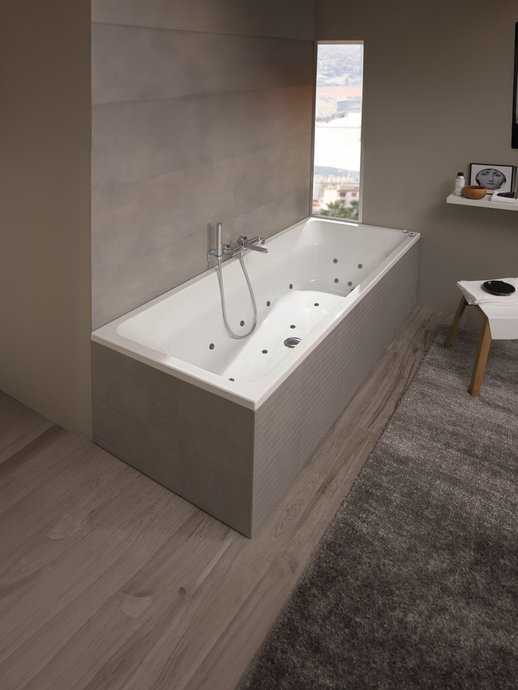
Spa bath or standard bath: which is more comfortable for a small space?

Is your bathroom short on space, but you dream of a truly relaxing experience? This is a common question: can you enjoy the benefits of a spa bath in a small space? Many people are torn between the practicality of a standard bath and the relaxation offered by massage jets.
Corner whirlpool baths make use of unused corners, whilst compact two-seater models are ideal for couples with limited space. We’ll help you make the right choice by comparing the actual space requirements and the comfort offered by each option. You’ll find that even 5 m² is sometimes enough to create a real oasis of well-being.
Classic bathtub: the practical solution for small spaces
The classic bathtub remains the most sensible choice for making the most of a small space. It adapts to almost any layout without compromising on comfort.
Dimensions to suit every requirement
A standard 170 x 70 cm bathtub is suitable for most bathrooms. However, if your space is really limited, compact sizes start at 140–160 cm in length, allowing them to be fitted even in spaces of less than 5 m². For very small spaces, clawfoot models offer a solution with a length of just 100 to 120 cm.
Always allow 60 cm of clearance to move around comfortably.
Quick and hassle-free installation
Allow a maximum of 2 to 3 hours to install a traditional bath if you’re a regular DIYer. Acrylic, which accounts for 70% of the market, makes installation much easier. Unlike older cast-iron models, one person is all that’s needed to fit it. The standard dimensions of 150 to 180 cm in length and 70 to 80 cm in width fit perfectly with existing plumbing connections.
An interview that takes just a few minutes
After each use, simply rinse with cold water and dry with a soft cloth. Acrylic can be cleaned with a standard detergent. You must avoid acidic products, vinegar or chlorine-based products, as these will cause irreparable damage to the surface.
Whirlpool bath: luxury and relaxation even in a 5m² space
Compact designs and corner configurations now make it possible to install a massage bath in a small space. These models, specially designed for small spaces, offer all the benefits of massage jets without taking up too much room in your bathroom.
These two-seater whirlpool baths are a reasonable size to fit into a standard bathroom, offering adjustable massage jets that target different areas of the body.
Corner spa bath: making the most of every inch
The corner models start at 120 x 120 cm, a size that makes use of unused corners whilst offering a generous bathing space. The 135 x 135 cm versions feature bevelled edges with integrated shower area, whilst the 140 x 140 cm models include a skirting and seat. These triangular configurations allow for installation even in a 5 m² space, unlike rectangular baths which take up an entire wall.
Air massage vs. hydromassage: which system should you choose?
The air massage features 12 jets that provide a gentle, relaxing effect. Thousands of temperate air bubbles create an enveloping massage, ideal for relieving tension. The hydromassage uses 6 jets to produce a powerful, invigorating effect. The side jets propel jets of pressurised water mixed with air, perfect for loosening muscles. The combined systems combine both technologies for a customisable experience.
Actual performance and features
To compare these two solutions, we need to look at how they actually perform when space is at a premium.
Floor space: corner models have the edge
A standard model measuring 140 x 70 cm takes up 0.98 m² of floor space, whilst the 120 x 120 cm corner spa bath requires 1.44 m² but makes use of an otherwise unused corner. It has a capacity of 218 litres, offering an ideal bathing volume despite its compact dimensions.
This difference in size makes all the difference in a small space: the corner bath frees up an entire wall for other fixtures.
Water consumption under control
A standard bath uses around 150 litres per bath. A two-seater spa bath requires between 200 and 350 litres, depending on the model. These figures are still reasonable, especially if you use it several times a week.
Peace and quiet: no more noise pollution
Modern models feature advanced insulation and damping systems that significantly reduce vibrations and noise pollution. Pumps and blowers no longer produce the noise that used to be a problem.
You can enjoy your moment of relaxation even in a flat, without disturbing your neighbours.
Durability: a long-term investment
Whirlpool baths last more than 15 years with proper maintenance. This durability justifies the higher initial investment.
Installation in a small space: key considerations
Every square metre counts in a limited space. Discover the solutions that will enable you to optimise your installation to suit your requirements.
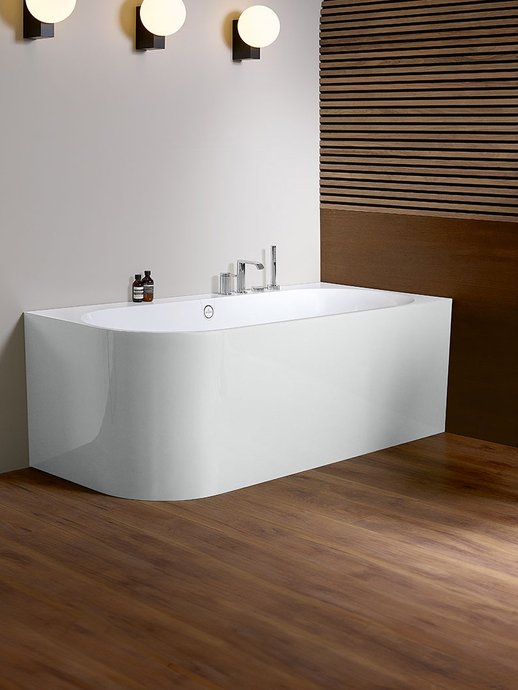
Asymmetrical design to save 30% space
The asymmetrical bath requires just 3 to 4 m² of floor space. Sizes start at 140 cm in length, with popular dimensions including 160 x 90 cm and 150 x 100 cm. This layout leaves the walkway clear and provides more space for other fixtures.
Lightweight materials: reinforced acrylic vs cast iron
Acrylic weighs between 23 and 45 kg, making it easy to install in any location. Cast iron, on the other hand, weighs between 136 and 227 kg, making it extremely difficult to move. The floor must be able to support this load, which may require reinforcement.
Swivel bath screen for dual use
The swivel bath screen features one or more rotating panels that can swivel up to 180° against the wall. The folding models fold away like an accordion, freeing up as much space as possible. This solution protects against splashes whilst keeping the floor dry.
Comparison table
Here is a summary of the key features to help you decide between these two options:
| Criteria | Classic bathtub | Whirlpool bath |
| Dimensions standards | 170 x 70 cm (standard) 140 - 160 cm (compact) 100 - 120 cm (approx.) | 120 x 120 cm (angle, minimum) 135 x 135 cm (with shower) 140 x 140 cm (including seat) |
| Minimum space required | Less than 5 m² + 60 cm of clearance at the front | 5 m² (including corner model) |
| Installation time | 2–3 hours | 1 full day (3 hours on average) |
| Water consumption | 150 litres per bath | 200–350 litres (two-seater model) 218 litres (120x120 cm model) |
| Interview | Simple: rinse with cold water and dry Mild detergent for acrylic | Appropriate maintenance required |
| Special features | None | Adjustable massage jets Air massage (12 jets, gentle effect) Hydromassage (6 chrome jets, invigorating effect) Hybrid systems available |
| Key benefits | Easy installation Affordable Easy to maintain Lightweight (acrylic) | Rest and relaxation Therapeutic massage jets Angle optimisation possible 2-seater models available |
| Main drawbacks | No massage function | High cost Complex installation Higher water consumption Heavy weight |
Turning a small space into a proper relaxation area
Each solution meets different needs. Here are a few key points to help you decide:
Choose the classic bath if you’re looking to keep costs down and want a straightforward installation. It’s ideal for everyday use without any technical complications.
Choose the whirlpool bath if you’re looking for a truly relaxing experience. The massage jets provide an unrivalled sense of calm after a hard day’s work.
Good news: even the smallest bathrooms can accommodate a whirlpool bath thanks to corner models. Installation is a bit more technical, but it’s well worth the effort to transform your bathroom into a real personal spa.
Frequently asked questions
Q1. What is the minimum size required to install a bath in a small space?
For small spaces, compact baths start at 140–160 cm in length. Freestanding models are even smaller, ranging from 100 to 120 cm in length, allowing them to be installed even in bathrooms smaller than 5 m². A minimum clearance of 60 cm in front of the bath is required to ensure comfortable movement.Q2. Can a spa bath be installed in a small bathroom?
Yes, provided you choose a suitable model. Corner or compact whirlpool baths allow you to make the most of the available space, particularly in rooms of around 5 m². It is essential to check that the floor is sturdy, that there is a suitable power supply, and to ensure there is sufficient access for installation and maintenance.Q3. What is the difference between air massage and hydromassage in a spa bath?
Air massage uses 12 jets that generate thousands of warm air bubbles for a gentle, relaxing effect, ideal for relieving tension. Hydromassage uses 6 chrome jets that propel pressurised water mixed with air, creating a strong, invigorating effect that is perfect for loosening muscles. Some models combine both technologies.Q4. How long does it take to install a whirlpool bath?
Installation takes a full day, or around 3 hours on average, and requires two people. By comparison, a standard bath can be installed in 2 to 3 hours by a single person with DIY experience.Q5. How does the water consumption of a spa bath compare to that of a standard bath?
A standard bath uses around 150 litres per bath, whereas a two-seater spa bath requires between 200 and 350 litres, depending on the model.