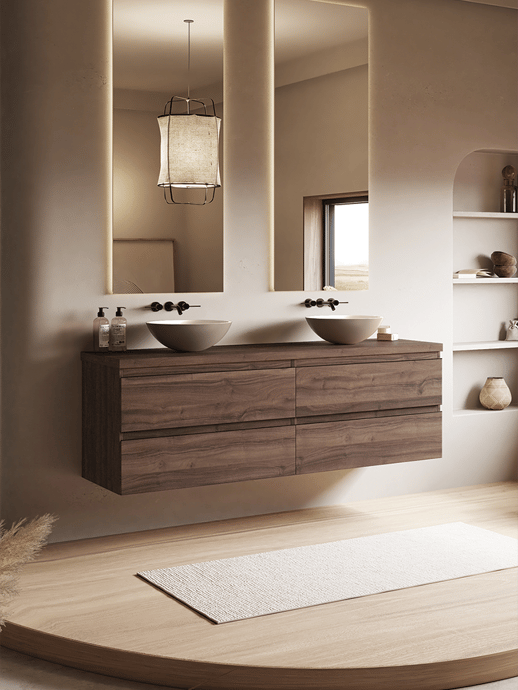
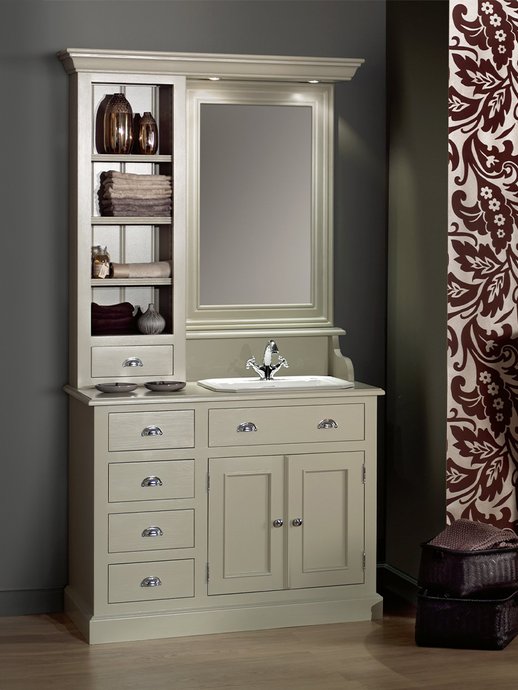
Open storage vs closed storage: how to find the right balance to avoid clutter?

Optimise the space in your bathroom with a smart layout that combines practicality and style. The question of layout arises in every home: is it better to conceal your belongings behind closed doors or make them accessible on open shelves?
This decision directly influences the atmosphere of your interior. We help you determine the ideal distribution between open and closed storage to maintain order without compromising the style of your bathroom.
Open storage: a modern and accessible solution
What is an open storage unit?
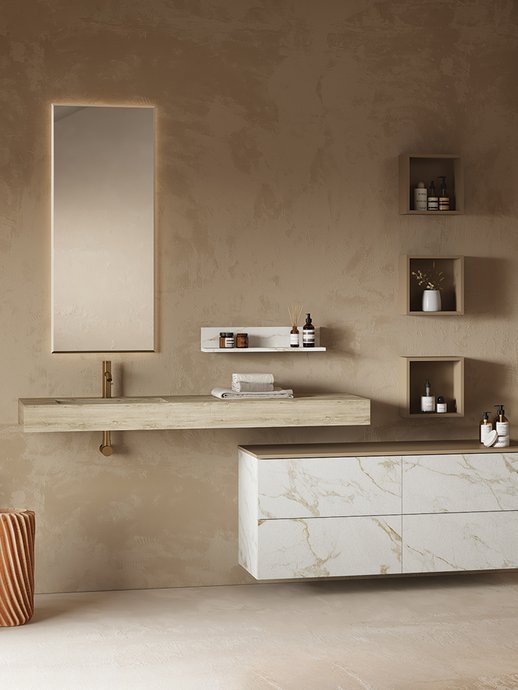
An open unit is characterised by the absence of doors or drawers to conceal the contents. Wall shelves or decorative niches are the main variants in this category. These structures offer complete visibility of stored items and allow direct access without having to open anything.
The benefits of open storage
This type of furniture creates an airiness that visually enlarges the space. In small rooms in particular, this sense of lightness is particularly appreciated compared to bulky cupboards that weigh down the atmosphere.
Open storage units transform your everyday objects into fully-fledged decorative elements. Neatly arranged hygiene products become the true stars of your interior. This also makes things easier to find: at a glance, you can immediately spot what you need.
These units also fulfil an interesting architectural function. They can delineate distinct zones in a room while preserving the general fluidity of the space. They help to create a warm and dynamic ambience.
Points to watch out for
Dust accumulates naturally more quickly on exposed surfaces, which requires more frequent maintenance to maintain an impeccable appearance. Textiles exposed to natural light may also see their colours fade over time.
Organisation becomes crucial with open structures. As the contents are entirely visible, any clutter is immediately noticeable and can disrupt the visual harmony of the room. A discipline of organisation is therefore required to maintain the desired visual effect.
Recommended locations for your open storage
The spaces above the sink are particularly well suited to open shelves. On either side of the central mirror, to the right, left or side, this solution showcases your most beautiful objects while optimising circulation in the room.
Closed storage: protection and discretion
The characteristics of a closed unit
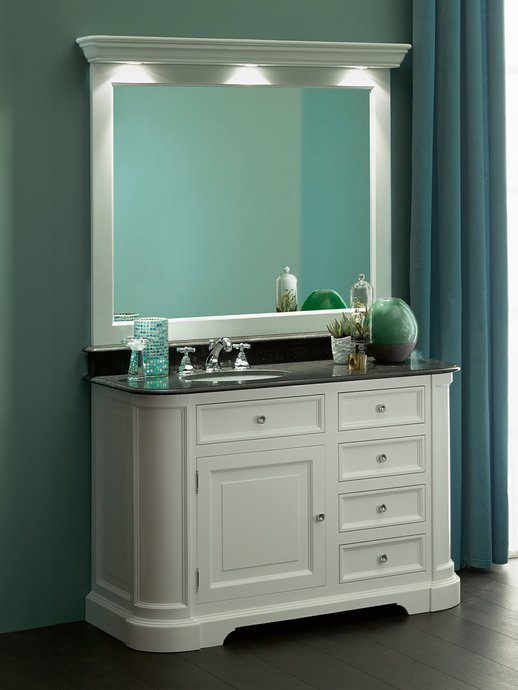
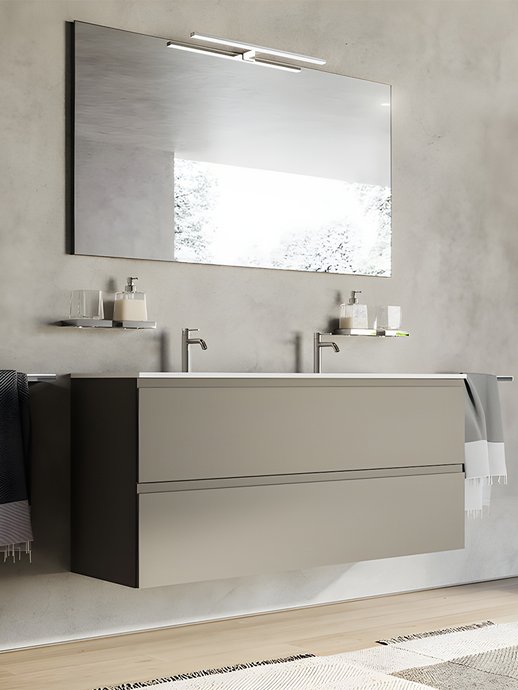
Closed furniture incorporates doors, drawers or panels that completely conceal the contents. Bathroom cabinets and units with hinged or sliding doors offer this visual protection. These structures create a physical barrier that keeps your belongings safe while maintaining a uniform appearance in the room.
Why choose closed storage?
Protection against dust is the first advantage of these solutions. This barrier is particularly effective in very bright rooms.
These units guarantee an immediate impression of order. The doors instantly conceal the contents and bring symmetry to your interior. This solution is perfectly suited to those who prefer a streamlined appearance.
Personalisation represents another major asset. Colours, materials and finishes can be adapted to suit all styles. Some models even incorporate mirrors to optimise space without adding extra elements.
Limitations to be aware of in small bathrooms
These structures can visually reduce the space, particularly in small rooms. Hinged doors require sufficient clearance to open, which limits their use in confined spaces.
Ventilation also poses a problem for stored items. These areas may become a pretext for accumulation without any real organisation.
Finding the right balance between open and closed
The 70/30 rule for closed storage: the perfect distribution
Apply this simple formula to harmonise your interior: 70% of closed storage for items with no visual appeal, 30% of open storage for your most beautiful accessories. This proportion guarantees an optimal combination of practicality and aesthetics.
The 60/40 rule for open storage: your essentials
Place your everyday items in open spaces for immediate access. Frequently used care products, clean towels or decorative objects deserve to be within easy reach. Follow this fundamental rule: never fill a shelf more than 60%. That 40% of free space makes all the difference between simple storage and a coherent layout.
Hybrid zones: the best of both worlds
Combine the advantages of both solutions. Open shelves display your most beautiful objects whilst closed cupboards conceal the rest. This mixed approach often best meets your actual needs.
Adapt according to your space
Small bathrooms benefit more from closed furniture that structures the space and lightens it visually. More spacious rooms are better suited to open shelves without creating a cluttered feel.
Our practical solutions for your interior
Use boxes and baskets in open spaces
Structure your open shelves with boxes and baskets that preserve the style of your interior. Each material brings its own advantages:
- Wicker baskets: create a natural ambience while accommodating small objects
- Fabric models: lightweight and portable, they are perfectly suited to children's bathrooms
- Transparent containers: you can see the contents at a glance and they stack to save space
- Plastic bins: durable and easy to maintain for everyday use
An elegant basket conceals dirty laundry and unsightly cables. For the bathroom, group care products and make-up in suitable boxes.
Create dedicated zones by category of objects
Assign a specific space to each activity to improve the organisation of your daily routine. This method prevents accumulation and makes tidying up easier. Assign each family member their own hook, basket or small shelf for personal accessories.
Limit the number of items on display
Carefully select what you display on your open shelves. A few well-chosen objects create a successful decorative effect, in contrast to a pile of items that creates an impression of overload. This streamlined approach enhances each displayed element.
Clean and reorganise regularly
Put every item back in its place immediately after use. Dedicate a few minutes each evening to this sorting routine to maintain order without excessive effort. Dust your open shelves every week: this simple task remains quicker than sorting through neglected drawers.
Practical comparison: which storage should you choose?
| Aspect | Open storage | Closed storage |
| Structure | Wall shelves or niches | Bathroom cabinets, furniture with doors or drawers, wall-mounted or freestanding columns |
| Access | Immediate, without any manipulation | Opening required |
| Visual effect | Feeling of space, airy appearance | Constant impression of order |
| Maintenance | Weekly dusting required | Simplified cleaning |
| Protection | Exposure to dust and light | Effective protection of items |
| Organisation | Strict discipline required | Risk of hidden accumulation |
| Space required | No opening constraints | Clearance needed for hinged doors |
| Optimal use | Decorative and frequently used items | Discreet storage and protection |
| Recommended proportion | 30% of your total storage | 70% of your total storage |
| Fill rate | Maximum 60% (keep 40% free space) | Variable according to your needs |
| Appropriate items | Decorative objects, plants | Care products, textiles |
The ideal organisation: a balance that makes all the difference
The opposition between open and closed compartments finds its solution in the right distribution. No approach alone is sufficient to create a harmonious and functional space.
The 70/30 rule guarantees you the best of both worlds: 70% of closed storage to protect your belongings from view and dust, 30% of open spaces to showcase your most beautiful objects. This distribution maintains order while preserving the style of your interior.
Remember this simple truth: a well-thought-out, airy space always surpasses a cluttered layout. Your bathroom deserves this attention, which will transform your everyday life.
Frequently asked questions
Q1. How can you keep your bathroom tidy and avoid a build-up of clutter?
To avoid chaos, start by sorting through your belongings regularly and adopt a discipline of immediate organisation after use. Create dedicated zones for each category of objects and limit the number of items on display. A daily routine of a few minutes each evening helps maintain order without excessive effort. The key is to have a defined place for every object to prevent disorderly accumulation.Q2. What proportion of open and closed storage should you prioritise?
The ideal distribution follows the 70/30 rule: 70% of closed units for items with no visual appeal or requiring protection from dust, and 30% of open storage for aesthetic and frequently used items. This proportion guarantees the right compromise between functionality and decoration while preserving an impression of order in your interior.Q3. What are the main advantages of closed storage?
It effectively protects your items from dust and light, preserving their quality in the long term. It creates a constant visual impression of cleanliness by concealing the contents behind doors. These units also simplify maintenance and offer numerous personalisation possibilities in terms of colours, materials and finishes.Q4. How can you optimise the use of open shelves without creating visual accumulation?
Never fill an open shelf to more than 60% of its capacity, leaving 40% of empty space to create visual harmony. Use boxes and baskets to structure the space and group small objects together. Carefully select the items on display, prioritising aesthetic and decorative objects, and dust regularly to maintain a neat appearance.Q5. In which zones should you prioritise open storage?
They are particularly well suited to spaces where you decorate open shelves that showcase everyday objects. They can also serve as space dividers to delineate different zones while maintaining visual fluidity throughout the room.