Kitchen mixer tap with a hand shower: what are the advantages and limitations?

Mixer tap with hand shower: what exactly are we talking about?
In a kitchen, the tap is turned on dozens of times a day. The pull-out spray adds just one thing, but it makes a big difference: you can move the spray head. The spout head detaches, pulled by a hose that slides through the body of the tap, and then returns to its place thanks to a counterweight attached beneath the sink. On most models, a button switches between a standard aerator spray and a rain spray.
If you’re still at the very beginning of your decision-making process (high or low spout, wall-mounted model, mixer tap or single-lever tap), our guide which mixer tap to choose for the kitchen covers the general criteria. Here, we’ll focus on the hand shower: what it really offers, and what it entails.
The three types of shower head
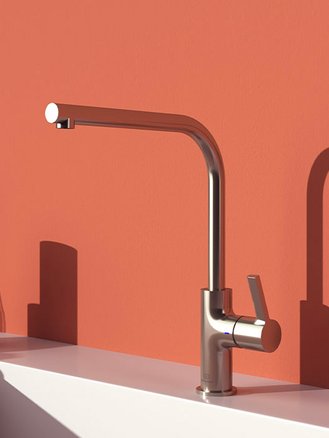
The integrated pull-out shower head is by far the best-selling model. The hose is concealed within the spout; it looks like an ordinary tap until you pull out the shower head. It is available with a high spout, which swivels over a large basin, or with a lower, straight spout, which is more discreet. The GROHE Minta with pull-out shower head or the Hansgrohe Talis M54 with sBox are typical examples.
The spring-loaded spout, also known as a ‘semi-pro’, originates from restaurant kitchens. The hose is visible, guided by a spring or an articulated arm, and the spray head detaches from a bracket. This is the most practical model for large saucepans, and also the most imposing: some are over 50 cm tall. The GROHE Essence Professional belongs to this range.
Finally, the separate hand shower is fitted into a second hole next to the tap. You see them less and less these days, because they require an extra hole to be drilled in the sink or worktop, which is fine in stainless steel but much less so in ceramic or granite.
Type of shower head | What we see | Space required | Who is it for? |
| Built-in pull-out unit, high spout | A gooseneck or L-shaped spout, with concealed flexible tubing | Hose run under the sink | Large bin, double bin, for family use |
| Built-in pull-out unit, low spout | A compact tap, with the spout at the front | Not very tall, useful under a window | Small spaces, sink under the window |
| Spring-loaded nozzle (semi-professional) | A visible spring or arm, often 50 cm high or more | Clearance above the sink | Those who cook a lot and in large quantities |
| Separate shower head | Two elements on the map | A second hole | Stainless steel sink with two pre-drilled holes |
The benefits of a hand shower in everyday life
Rinse without splashing the kitchen
The oven tray, the fridge vegetable drawer, the wok, the barbecue grill: anything wider than the sloping basin under a fixed spout, with water running down onto the worktop. With a hand shower, you simply place the item under the spray and direct the jet onto it. The same goes for the sink itself: any residue trapped in the corners or under the drainer is washed down the drain in a matter of seconds. On a double-bowl sink, a single hand shower covers both bowls.
Filling a saucepan without lifting it
We don’t talk about it much, yet it’s the one we appreciate most after a few months. A saucepan filled with 5 litres of water weighs over 6 kg with its lid on. With a hand shower, you can place it on the worktop or the drainer, fill it up there and then, and slide it over to the hob. For an elderly person or someone with a bad back, the difference is night and day. It also works for a cleaning bucket, a watering can or a filter jug that’s too tall to fit under the tap.
Two jets for two uses
The aerator spray mixes air with water: it produces minimal splashing and is ideal for filling the sink. The rain spray, which has a wider spray pattern, loosens residue from crockery and rinses vegetables without damaging them. Hansgrohe takes this idea a step further with the PowderSpray spray pattern on its Talis Select M54, which consists of very fine droplets that clean without splashing water everywhere. In terms of water consumption, rinsing more quickly means leaving the tap running for less time. Some models are designed with this in mind, such as the GROHE Eurosmart with Eco pull-out spray, which has a reduced flow rate, or the Ceralook BlueStart from Ideal Standard, which dispenses cold water when the lever is in the centre position. This means you no longer need to switch on the boiler or heat pump every time you have a glass of water.
Installation: what changes when you fit a hand shower
Replacing a standard mixer tap with a hand-shower model is usually done using the same tap hole. The 35 mm single-hole fitting is standard, and the two supply hoses connect to the stop valves already fitted under the sink. The difference lies underneath: you need to attach the counterweight to the hand shower hose at the correct height and check that it moves up and down without touching the siphon, the water supply pipes or the base of the unit. An incorrectly positioned counterweight is the main reason why a hand shower won’t retract.
There are two situations that require more work. The first is the low-pressure boiler mentioned earlier: changing the tap may mean you have to replace the boiler, or at least check the connections. The second is a thick worktop. Each manufacturer specifies in the technical data sheet the maximum thickness that the fixing bolt can pass through. If the worktop is thicker than this, a longer bolt is required, which is sold as an optional extra by most brands. With a stone, quartz or ceramic worktop, this is the first thing you should check.
How much does a kitchen mixer tap with a hand shower cost in Belgium?
The prices below are inclusive of VAT, as listed on facq.be. They are for the tap only, excluding fitting.
Model | Price including VAT | What sets it apart |
| GROHE Eurosmart with Eco pull-out shower head | 284,73 € | Lower price, a good entry point into a major brand |
| Ideal Standard Ceralook BlueStart bec haut L et douchette | from €346.75 | Cold water in the centre position (BlueStart) |
| GROHE Minta with pull-out shower head | from €398.13 | High-mounted swivel spout, highly versatile |
| GROHE Concetto with pull-out shower head | from €400.87 | Straight and cylindrical lines |
| GROHE Eurodisc with pull-out spray head | 482,57 € | Classic design |
| Hansgrohe Talis M54 210 with sBox | from €574.63 | sBox housing that guides the hose under the sink |
| Hansgrohe Talis Select M54 PowderSpray | from €747.78 | Open using the Select button, PowderSpray spray |
| GROHE Essence Professional | from €922.79 | Semi-professional spout, chrome-plated or matt black |
| GROHE Minta Touch | 1 164,95 € | Opens with a single touch – handy when your hands are dirty |
| Quooker, Flex and Fusion ranges | from €1,395.00 | Boiling water, pull-out hose on the Flex |
In summary, there are three price brackets. Between €280 and €400, you get a top-brand tap with a hand shower, a ceramic cartridge and readily available spare parts. Between €400 and €750, you’re mainly paying for the design, the finish and the comfort of the flexible hose (Hansgrohe’s sBox, with more sophisticated spray patterns). Above €900, we’re talking about semi-professional models, touch-activated controls or boiling water functions. Installation by a plumber is charged on top of these prices; it’s straightforward for a sink that’s already been drilled, but takes longer if the boiler or pipework needs to be reworked.
What we check with you at EXPOcenter
The best way to judge a hand shower is to hold it in your hand. In our EXPOcenters, you can try out the models on display, and a few simple steps are all it takes to find the right one. Pull the hand shower all the way out and let it go, several times: it should spring back on its own and slot back into place smoothly. Weigh the head in your hand, as you’ll be holding it at arm’s length over a saucepan. Switch between spray modes using your thumb, just as you would with wet or soapy hands. Finally, check the overall height of the tap in relation to your window or the shelf above the sink.
To ensure you get the best advice, please bring four pieces of information: the depth of your sink bowl, the number of holes already drilled, the height between the worktop and the window sill if the sink is fitted underneath, and a photo of the inside of the cupboard under the sink showing the boiler label, if there is one. With this information, the advisor can immediately rule out any models that won’t fit and show you the ones that are suitable, in a finish that matches the rest of your kitchen.
Frequently asked questions
Is a mixer tap with a hand shower more fragile than a standard mixer tap?
It has one additional moving part – the hose – which wears out over time. On branded models (GROHE, Hansgrohe, Ideal Standard), the hose and shower head are sold as spare parts: they can be replaced without changing the tap. The body and the ceramic cartridge have the same lifespan as on a mixer tap without a shower head.Is it possible to fit a mixer tap with a hand shower and a small water heater under the sink?
It depends on the water heater. With a pressurised water heater (sealed, with a safety group), any mixer tap with a hand shower will do. With a low-pressure boiler (open system), you’ll need a low-pressure mixer tap with three hoses, and some boiler manufacturers advise against using a hand shower. There are low-pressure models available with a hand shower, but the choice is limited. Show the boiler label to an advisor before you buy.Is a non-return valve required on a kitchen tap with a spray head in Belgium?
Yes. A hand shower may come into contact with dirty water in the sink, and Belgaqua’s technical specifications – which are applied by water suppliers – require protection against backflow into the mains supply for this type of tap. Taps with a built-in, approved non-return valve carry the Belgaqua certificate. This is checked during the compliance inspection of the installation, in new-build properties and for certain renovation works.How do you descale a kitchen tap head?
For routine maintenance, rub the silicone nubs on the head with your finger when the spray starts to veer off course: the limescale will come off by itself. Once or twice a year, unscrew the head and leave it to soak in a mixture of lukewarm water and white vinegar, then rinse. For matt black or gold finishes, do not use harsh descaling agents on the body of the tap; use them only on the detached head.Pull-out shower head or spring-loaded spout: which one should you choose?
The pull-out spray head is suitable for most kitchens: it is unobtrusive and fits under most wall units and windows. The spring-loaded spout, which is taller and more visible, is more convenient for large saucepans and in kitchens where a lot of cooking takes place. Allow a good fifty centimetres of headroom above the sink.