How to renovate your bathroom without making mistakes?

This guide is designed to help you avoid those mistakes. By helping you understand the logic of a successful project, so that you can better communicate with the professionals who will accompany you.
The essentials
Renovating your bathroom without making mistakes requires following a precise sequence: first clarify your priorities and overall budget, then design the space with an expert adviser before choosing a single product, and then entrust the work to a qualified installer who is familiar with Belgian standards (RGIE, ventilation, 6% VAT).Book an appointment
In Belgium, a well-prepared bathroom renovation takes between 1 and 3 weeks on site, with an investment of between €7,500 and €15,000 for a standard surface area of 8 to 9 m². The works may qualify for the reduced VAT rate of 6% for homes more than 10 years old, as well as regional grants depending on your situation.
Facq accompanies your project from A to Z with the Install+ service: design at the EXPOcenter, a comprehensive estimate including the works, and connection with a qualified partner installer. Free appointment at one of our 17 EXPOcenters in Belgium.
First of all: assessing the existing situation to avoid unpleasant surprises
Bathroom renovation begins well before the first hammer blow. It begins with a clear-eyed assessment of what already exists: the condition of the plumbing, the current electrical installation, the ventilation system, any potential damp in the walls. These elements, invisible to the naked eye, determine which works are mandatory and therefore a significant part of your real budget.
The plumbing: the first thing to check
Pipework more than 30 years old (lead, galvanised steel) will often need to be replaced. This is an ideal opportunity not to be missed during a renovation. Also check the drainage falls: they must comply with 1 to 2 cm per metre for correct flow, otherwise chronic blockages will follow. This is also the time to reposition a drain or plan ahead for a walk-in shower. Moving a pipe during the works costs two to three times more than planning for it at the design stage.
The electrical installation: the RGIE 2025 standards you need to know
The RGIE (General Regulation on Electrical Installations) was thoroughly revised on 1 March 2025. The requirements for bathrooms are strict and non-negotiable: a differential circuit breaker of ≤ 30 mA mandatory for all circuits, an equipotential bonding connection linking all conductive elements (pipework, bath, shower), Class II wiring only in wet zones.
Sockets are prohibited in zones 0 and 1 (in and around the shower/bath). In zone 2, they are permitted only with a differential of ≤ 10 mA. To remember: any electrical work in a bathroom must be inspected by an approved body — this is a legal obligation, not an option.
💡 Good to know: If your home is more than 25 years old and has never had its electrical installation brought up to standard, always budget for an 'RGIE compliance' item. This is often where unexpected overruns are hidden.
Ventilation: the important point in Belgium
The Belgian standard NBN D 50-001 requires a minimum air extraction rate of 50 m³/h for a residential bathroom. In practice, this means that any renovation is the ideal opportunity (often mandatory depending on the municipality) to check or install a mechanical ventilation system (VMC). Insufficient ventilation generates damp, mould, and ultimately damages the finishes and structure. It is also the most common cause of non-compliance during an EPC inspection.
Damp: treat before covering
Covering a damp problem with new tiling is the most classic and most costly mistake in the long term. If rising damp, mould or paint blistering is visible, it must be treated thoroughly before any surface finish is applied. A professional can carry out a rapid diagnosis during an initial visit.
Partial or full renovation: how to decide?
This is often the first question that causes hesitation. Just replace the unit and taps? Redo everything? The answer depends on two key factors: the structural condition of your current bathroom, and the timeframe before the next renovation.
| Situation | What it indicates | Recommendation |
| Plumbing < 20 years, compliant electrics, no damp | Sound structure, cosmetic renovation possible | Partial renovation — unit, taps, accessories |
| Plumbing > 30 years or galvanised, blackened joints, mould | Underlying problems to address | Full renovation recommended |
| Cracked tiles, yellowed shower tray, dated enclosure | End of aesthetic and functional life | Full renovation — take the opportunity to optimise everything |
| Bath used < 2 times/week, limited space | Space and comfort gains available | Replace bath with walk-in shower |
| Selling in 2–3 years | Quick ROI expected | Targeted renovation with high visual impact (shower, unit, lighting) |
| Family with children or planning for ageing | Durability and accessibility required | Full renovation with preventive accessible design |
The calculation that is often overlookedAdding electrical compliance works, new ventilation and floor screed works to a partial renovation can quickly approach the cost of a full renovation — with far less design freedom. When these technical items are necessary, you might as well take the opportunity to rethink everything. |
The 5 steps to a successful bathroom renovation project
A well-managed bathroom project always follows the same logical sequence. Departing from this sequence — for example, choosing equipment before confirming the plumbing layout — is the main source of complications and cost overruns.
Step 1: design before you choose
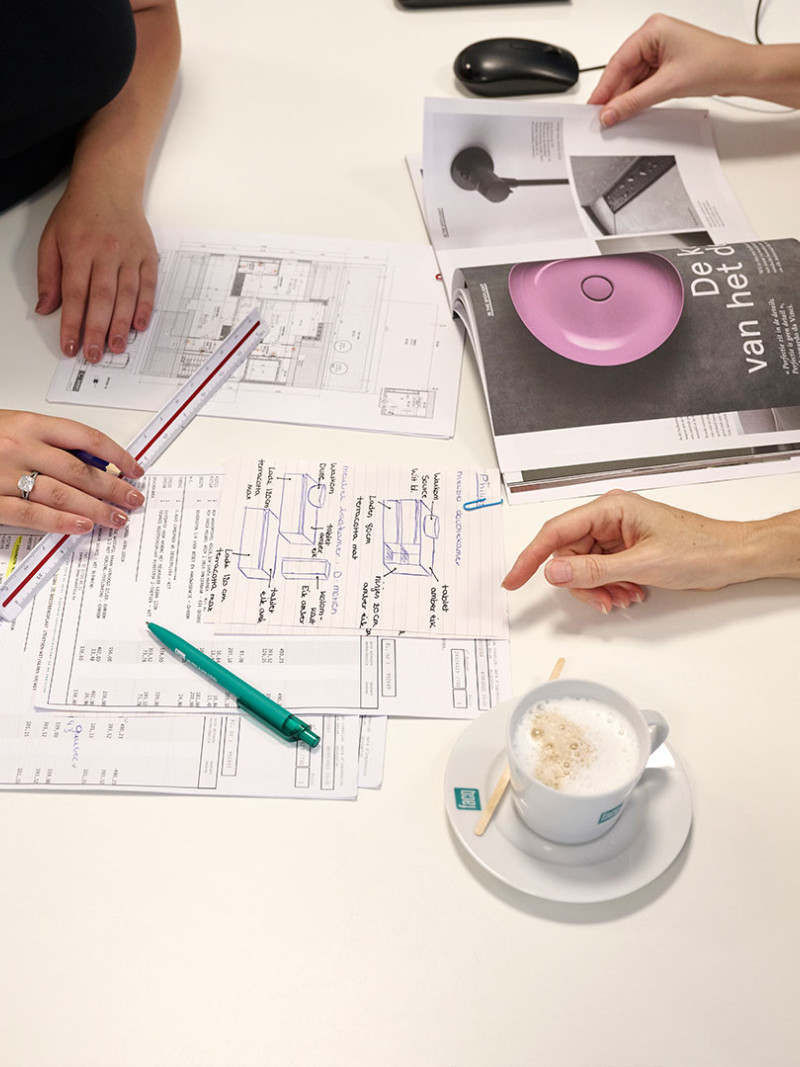
Design is much more than drawing a plan. It is the phase where the positioning of water supply points, drains, electrical sockets, and ventilation outlets is decided. These are all technical constraints that determine everything that follows. This is also the moment to clarify your priorities: do you need a double basin? A larger shower? Optimised storage space?
Designing your renovation project with an expert adviser (not alone with Pinterest photos) is a considerable saving in time and money. Facq advisers at the EXPOcenter are familiar with Belgian configurations: terraced houses, apartments with existing floor levels, loft conversions, windowless bathrooms.
Facq Install+
The Facq Install+ service starts here: an appointment at the EXPOcenter with a dedicated adviser, who accompanies you through the design process, draws up a clear plan and a comprehensive estimate including the works — before you commit to a single product.Facq Install+
Step 2: choose your equipment in the right order
Once the plan has been approved, choices follow in a specific order: (1) the shower or bath — the centrepiece that determines the layout of the space, (2) the vanity unit — based on the available width and storage requirements, (3) the WC — wall-hung or floor-standing depending on the load-bearing wall configuration, (4) the taps — in a finish that matches the accessories, (5) the lighting — often considered last, when in fact it determines the entire atmosphere.
The classic mistake is to choose in a haphazard order (an impulse mirror here, discounted taps there) only to end up with inconsistent finishes that let the whole thing down. Consistency of finish is what distinguishes a successful bathroom from an assembled one.
Step 3: find the right installer
This is often the most anxiety-inducing step. A competent Belgian bathroom installer must master three trades: plumbing, electrics (or subcontract to an approved electrician), and tiling. Finding someone who coordinates all three aspects, who knows the products you have chosen and who meets deadlines: that is rare and valuable.
The objective criteria to check: qualification certificate (electrical competency certificate for works in wet zones), references from similar projects, and ten-year professional liability insurance cover. Always request 3 quotes: not to choose the cheapest, but to understand what is included or not in each offer.
Step 4: managing the building works calmly
A complete bathroom renovation project generally takes 1 to 3 weeks, depending on the surface area and complexity of the works. The order of work is always the same: demolition and removal of rubble, plumbing (supply and drainage), electrics (RGIE compliance), waterproofing (mandatory membrane for walk-in showers), finishes (floor then walls), installation of sanitaryware, taps and lighting, finishing touches and handover.
Always allow a contingency of 10 to 15% on your budget for unforeseen costs. Particularly in older properties (> 30 years) where every wall opened up can reveal surprises. This contingency is not pessimism: it is wisdom.
Bathroom renovation does not require planning permission in any of the three Belgian regions, as long as there is no modification to the stability, volume or external appearance of the building. No prior declaration is required for interior bathroom works.
Step 5: accepting the works methodically
Grants and reduced VAT: what is available in Belgium in 2026
The landscape of financial assistance for renovation is undergoing profound change in 2025–2026. Before counting on a grant, it is essential to check the situation in your region: the rules have changed in all three regions this year.
| Renovation grants are changing rapidly. The information below is valid at the time of writing but may change. Always check the current situation with your regional authority or ask a Facq adviser at your EXPOcenter appointment. |
6% VAT: the benefit available to everyone
This is the most universal and straightforward financial benefit to obtain. For homes more than 10 years old, the VAT applicable to bathroom renovation works — materials and labour included — is reduced to 6% instead of 21%. On works of €10,000 excluding VAT, the saving reaches €1,500 — equivalent to a quality vanity unit.
Essential condition: the works must be invoiced by a professional contractor (not materials purchased directly by the homeowner). This is one of the reasons why working with a qualified installer is not only a guarantee of quality: it is also a direct tax benefit.
| Region | Situation in 2026 | What remains available |
|---|---|---|
| Wallonia | Temporary scheme until 30 Sept. 2026, then 0% loans | Ventilation grant, electrical compliance, damp treatment. No grant for sanitaryware or tiling. |
| Brussels | Renolution grants suspended — pending new government | Some communes maintain local assistance. Iriscare: up to €4,000 for accessible adaptations. |
| Flanders | Mijn VerbouwPremie: sanitaryware excluded since July 2025 | Vlaamse Aanpassingspremie (65+): 50% of invoices, max. €2,500 for accessible adaptations. |
| All 3 regions | 6% VAT for homes > 10 years old | Direct saving of 15% on the total amount of works invoiced by a professional. |
Accessible design grants: a benefit that is often overlooked
The WC: a structural choice that is often underestimated
The WC is often the last element considered in a bathroom project, when in fact it is one of the first elements on which the load-bearing wall configuration, the electrical installation (for Japanese toilets) and the positioning of other equipment depend. A particular point of attention for Belgian renovation projects.
Wall-hung WC vs floor-standing WC: the real comparison
The wall-hung WC is today the benchmark in ambitious renovation projects. It frees up the floor, makes maintenance easier (no base to clean), allows the seat height to be adjusted between 38 and 58 cm, and creates a very clean visual line. Its installation requires a load-bearing wall or a mounting frame (such as the Geberit Duofix system) that is sufficiently robust. This represents more masonry work than a floor-standing WC.
The floor-standing WC remains relevant in partial renovations where the wall cannot accommodate a mounting frame, or for tighter budgets. Current models (Duravit, Villeroy & Boch) have evolved considerably in terms of design. Some come close visually to the look of a wall-hung WC with very elongated profiles and integrated cisterns.
The Geberit wall-mounted flush system: why it has become a standard
The wall-mounted flush system (mounting frame + concealed cistern) offered by Geberit has established itself as the standard for the contemporary Belgian bathroom. The main reason: it allows water consumption to be reduced to 3/6 litres (compared to 6/9 litres for a traditional surface-mounted cistern), while creating that clean look with no visible cistern. The flush plate — the last visible element — is available in multiple finishes to match the chosen taps.
Japanese toilets with integrated bidet: suitable for the Belgian market?
Japanese toilets (or washlet toilets) are making a notable entry onto the Belgian market. Their main argument: superior hygiene at a limited water cost, and the absence of toilet paper — an environmental and economic argument that is increasingly resonant. Recent models from Duravit, Geberit or Villeroy & Boch are compatible with Belgian electrical installations (RGIE 2025) and integrate into any contemporary bathroom project.
A point of attention: they require an electrical socket in zone 2 (at least 60 cm from the outer edge of the WC), which must be planned from the design phase. A point that is often overlooked and that forces the wall to be reopened later.
The accessible bathroom: plan ahead rather than adapt later
Designing an accessible bathroom from the outset is one of the smartest decisions in a renovation project. A level-access walk-in shower is already an accessible bathroom in its basic configuration. Adding a discreet brushed stainless steel grab rail, allowing for a turning space of 150 × 150 cm and a WC at 45–50 cm height: these minor adjustments at design stage represent a very small additional cost compared to future adaptation works.
The role of the installer: why this choice is decisive
A bathroom project can be perfectly designed, with quality equipment, and still deliver a disappointing result if the installation is poorly executed. Badly applied joints, a pipe with a slightly incorrect fall, tiling with a forgotten expansion joint: these execution details are invisible at the handover and reveal themselves in the 12 to 24 months that follow.
What a good bathroom installer must master
- Plumbing: compliance with drainage falls, choice of appropriate materials (PEX, copper, multilayer), mastery of waterproofing techniques for wet zones.
- Electrics: knowledge of RGIE 2025, coordination with an approved electrician if required, mandatory inspection by an approved body at handover.
- Tiling: substrate preparation, decoupling systems to prevent cracking, epoxy grout in permanently wet zones.
- Coordination: ability to orchestrate the different trades in the right order, without unnecessary downtime that extends the duration of the works.
What to check before signing
- Qualification certificate for electrical works in wet zones.
- Professional liability insurance and, for structural works, ten-year structural warranty insurance.
- References from similar projects: ask for before/after photos and, if possible, client contact details.
- Detailed quote with a breakdown by item: not a lump sum.
The 7 mistakes that derail a renovation project
These mistakes are identified from feedback from Facq advisers at the EXPOcenter and the most common complaints in Belgian renovation projects. Avoiding them is straightforward: they are almost all the result of a lack of forward planning.
- Choosing products before confirming the plan. The taps you fell in love with may be incompatible with your plumbing configuration. Always design first.
- Underestimating mandatory technical works. Electrical compliance, ventilation, shower waterproofing: these non-visible items often represent 30 to 40% of the total budget.
- Only requesting a single quote. Without a point of comparison, it is impossible to know whether a price is reasonable — and what is or is not included.
- Forgetting to plan electrical sockets for Japanese toilets or electric towel rails. Reopening a tiled wall is expensive and damages the final result.
- Treating the tiling and not the damp. Covering a damp problem is a short-term solution. It will reappear — and often worse than before.
- Not requesting a formal handover with written record. Reservations expressed verbally have no legal value. Document everything in writing, with photos.
- Forgetting to check eligibility for 6% VAT before signing. Once the works have been invoiced, it is too late to change the rate applied.
Frequently asked questions
How much does a bathroom renovation cost in Belgium in 2026?
For a standard surface area of 8 to 9 m², budget between €7,500 and €15,000 all included (materials and labour). This budget includes the often underestimated technical works — RGIE electrical compliance, ventilation, waterproofing — which alone represent 30 to 40% of the total budget. Also allow a contingency of 10 to 15% for unforeseen costs, particularly in older properties. Good news: for any home more than 10 years old, VAT on works is reduced to 6% instead of 21%, representing a saving of €1,500 on an invoice of €10,000 excluding VAT.Is planning permission required to renovate a bathroom in Belgium?
No. Bathroom renovation does not require planning permission in any of the three Belgian regions (Wallonia, Brussels, Flanders), nor any prior declaration, provided the works do not affect the stability, volume or external appearance of the building. However, any work on the electrical installation remains subject to mandatory inspection by an approved body at the handover of works — this is a legal obligation, not an option.How do I find a good installer for my bathroom in Belgium?
A good bathroom installer must master three trades: plumbing, electrics (or subcontract to an approved electrician), and tiling. Before signing, check: their qualification certificate for electrical works in wet zones, their professional liability insurance, and their references from similar projects. Always request at least 3 detailed quotes — not to choose the cheapest, but to understand what is included in each offer. The Facq Install+ service puts you directly in touch with selected, trained partner installers, with a single quote integrating equipment and installation.Are there grants for bathroom renovation in Belgium in 2026?
The situation varies depending on your region. In Wallonia, grants exist for ventilation, electrical compliance and damp treatment, under a temporary scheme valid until 30 September 2026. In Brussels, Renolution grants are currently suspended, but some communes maintain local assistance. In Flanders, the Mijn VerbouwPremie has excluded sanitaryware since July 2025. In all three regions, accessible design projects (level-access shower, grab rails, adapted WC) qualify for specific assistance that can reach €8,000 in Wallonia via AVIQ. The most universal benefit remains the 6% VAT for homes more than 10 years old, available throughout Belgium.How long does a bathroom renovation take?
A full renovation project generally takes between 1 and 3 weeks, depending on the surface area and complexity of the works. The order of work is fixed: demolition, plumbing, electrics, waterproofing, finishes (floor then walls), installation of sanitaryware, taps and lighting, finishing touches. This timeframe can be extended in older properties, where every wall opened up can reveal surprises — an additional reason to allow a budget contingency of 10 to 15%.
Estimate your project with Facq Install+
Design, choice of equipment, connection with a qualified installer, comprehensive quote integrating materials and labour — and 6% VAT if your home is more than 10 years old. It all starts with a free appointment at one of our 17 EXPOcenters in Belgium.Book an appointment