How do you choose your shower and washbasin taps?

The essentials
Choosing bathroom taps is both a technical and an aesthetic decision. The four key questions are: 1. What type of control: standard mixer tap or thermostatic mixer? 2. What installation style: exposed, wall-mounted or concealed? 3. What finish: chrome, matt black, brushed gold or brass? 4. Which brand, depending on your budget and your requirements?Book an appointment
When it comes to the shower, a thermostatic mixer is the most significant choice for everyday comfort. For the washbasin, the height of the spout depends directly on the basin chosen. In both cases, ensuring a consistent finish across the various elements in the room is what makes the difference between a beautiful result and a truly memorable one.
At Facq, our advisors are on hand to help you make your choice at one of our 17 EXPOcentres across Belgium. Book a free appointment to see, feel and compare brands side by side.
Washbasin taps: types of mixer taps and what sets them apart
The washbasin mixer tap is the most visible feature of your bathroom unit. It is the first thing you and your guests see. However, the differences between models are not just visual: spout height, flow rate, cartridge, compatibility with the basin, etc. – all these technical factors determine whether the tap will be a pleasure or a source of frustration in everyday use.
The single-hole mixer tap: the standard, versatile solution
The single-hole mixer tap is fitted into a single 35 mm hole, which is standard on almost all vanity units and basins. Its single lever controls both the flow rate and the temperature. It is the most common solution, available in all finishes and across all price ranges.
The difference in quality between brands lies mainly in the ceramic cartridge: a high-quality cartridge (Hansgrohe, Grohe, Duravit) offers far superior control and durability compared to entry-level models. In Belgium, hard water quickly wears down poor-quality cartridges. This is yet another reason to invest in a reputable brand.
The high-spout mixer tap: for countertop basins and deep washbasins
The height of the tap spout is determined by the basin. A countertop basin between 15 and 20 cm high requires a spout of at least 180 mm to ensure comfortable, splash-free use. A spout that is too short on a tall basin is one of the most common and frustrating mistakes in everyday use.
High-spout mixer taps (180–250 mm) also create a striking visual effect: they add a sense of verticality to the unit, particularly in setups where the basin sits on a low countertop. Some models with a waterfall spout create a particularly elegant cascading water effect in spa or wabi-sabi-style settings.
Facq Advice
The golden rule: always measure the internal height of your washbasin before choosing your taps. A Facq advisor can check that the taps are compatible with your chosen washbasin and vanity unit at the EXPOcenter – a check that will save you from having to make a costly return.
The two-handle tap: retro style and precision
The two-handle tap (one for hot, one for cold) is making a strong comeback in vintage, Art Deco and industrial-style interiors. It allows for precise and independent control of temperature and flow rate – a pleasure to use that purists particularly appreciate.
Installation usually requires two drill holes (or a surface-mounted model). While technically equivalent to the single-hole version in terms of flow rate, it stands out for its striking decorative appeal. Brushed gold, brass or oxidised copper finishes are particularly well suited to this style.
Concealed basin taps: the epitome of simplicity
Wall-mounted taps eliminate any visible elements on the washbasin surface. Only the spout (and, if applicable, the lever) remains visible: recessed into the wall. The effect is minimalist and highly architectural, particularly suited to large countertop washbasins or designer pedestal basins.
This installation requires some technical preparation beforehand: the built-in body must be fitted before the walls are finished, and the distance between the water supply pipe and the basin must be precise. It is the ideal solution for full-scale renovation projects, but not for quick installations. Its long-term advantage is that there is no surface around the tap to clean.
Shower fittings: standard mixer tap or thermostatic mixer?
This is the choice that raises the most questions and has the greatest impact on your daily life. Shower fittings are all about temperature, water flow and comfort. Making the right choice here means treating yourself to a better start to every morning for years to come.
The classic shower mixer tap: simple, economical, and perfectly adequate
Its main drawback is that the temperature has to be adjusted every time it is used. In Belgium, where water pressure fluctuates (due to toilet flushing or washing machines running at the same time), this setting can be suddenly disrupted, with the risk of the water being too hot or too cold until the pressure stabilises.
The thermostatic mixer tap: comfort you won’t want to be without
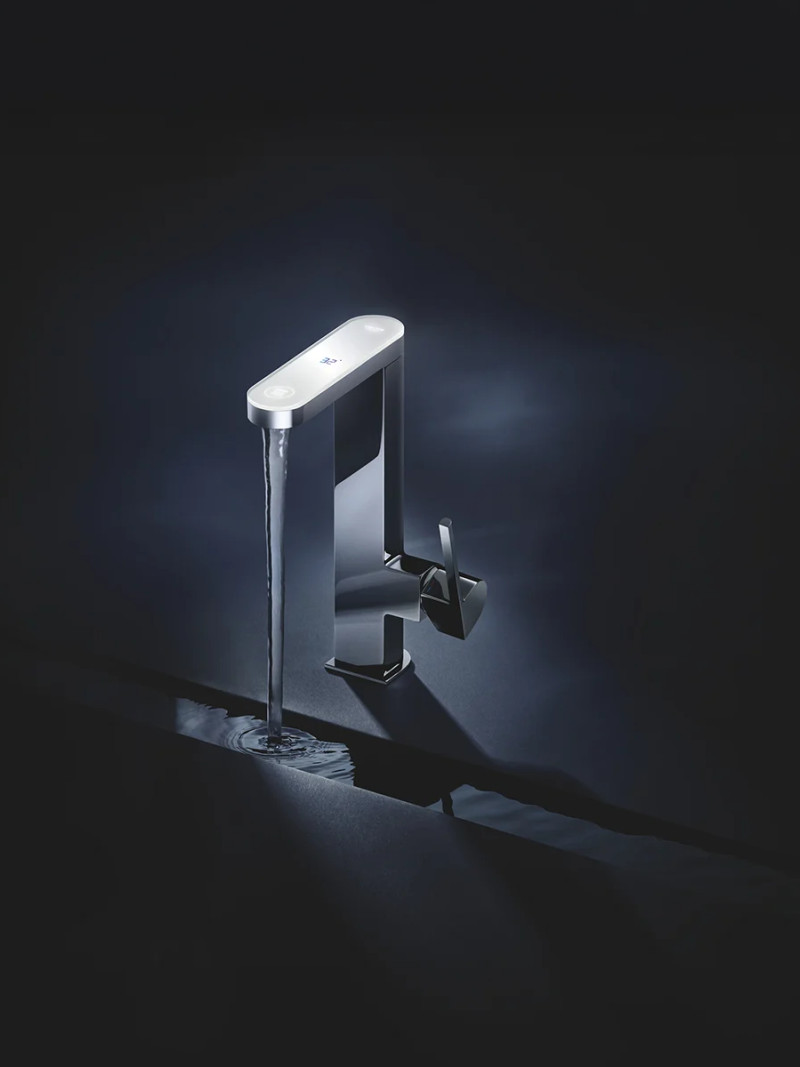
The thermostatic mixer tap remembers your preferred temperature. Once set, it is maintained automatically, regardless of fluctuations in water pressure or temperature in the mains supply. It is one of the most noticeable improvements you can make to your bathroom, offering excellent value for money given the enhanced experience it provides.
It also features a burn protection mechanism, which is mandatory in Belgium: the temperature is set to a maximum of 38°C by default (this can be unlocked to allow higher temperatures). This is a key advantage in households with children.
Thermostatic taps vs standard mixer taps
Thermostatic: Temperature is stored and maintained · Built-in anti-scald safety feature (mandatory in Belgium) · Water savings: less time spent adjusting the temperature · Higher initial cost but unrivalled everyday comfort
Traditional mixer tap: Quick and easy to install · More affordable · Suitable for partial renovations · Temperature must be adjusted each time it is used · Sensitive to fluctuations in mains water pressure.
Shower columns vs built-in thermostatic mixers: two levels of integration
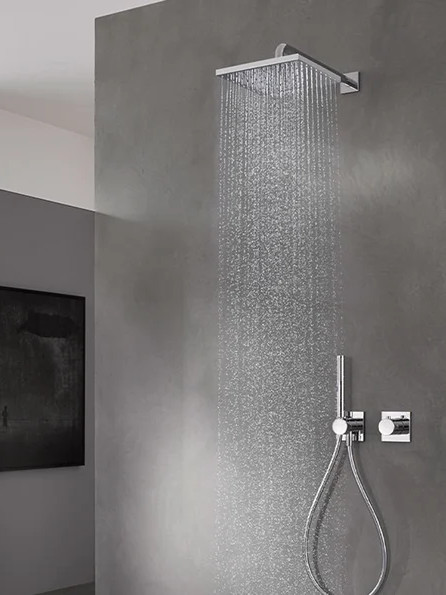
The concealed thermostatic mixer is the premium solution: the valve body is built into the wall during construction or a full renovation. Only the front panel (handles, flow selectors) remains visible on the surface. The result is unrivalled in terms of sleek design. Hansgrohe and Grohe offer modular systems where the front panel is interchangeable — you can change the style without altering the plumbing.
Finishes and materials: chrome, matt black, brushed gold, brass: how do you choose?
The finish of the taps and fittings is what sets the tone for the whole room. It should complement the furniture handles, accessories, mirror and light fittings. A single, consistent theme transforms a bathroom into a well-designed space, whereas a disparity in finishes, however subtle, subconsciously disturbs the eye.
| Finish | Atmosphere | Interview | Sustainability |
|---|---|---|---|
| High-gloss chrome | Classic, versatile, bright | Visible fingerprints — wipe frequently | Excellent, with a PVD finish |
| Black with | Contemporary, stylish, bold | Visible limescale — nano-coating recommended | Very good if PVD-coated (avoid simple plating) |
| Brushed gold / Matt gold | Luxurious, stylish, welcoming | Easy to care for — avoid acidic products | Excellent if PVD-coated — excellent durability |
| Laiton / Brushed Brass | Vintage, wabi-sabi, artisanal | Natural patina — some people prefer it | Good — ages with character |
| Brushed stainless steel | Industrial, minimalist, masculine | Very easy — smudge-proof | Excellent — the strongest material |
| Copper / Bronze | Rustic, earthy, warm | Living patina — maintenance depending on the desired effect | Good — a developing personality |
Matt black taps: truly sustainable or just a passing fad?
In just a few years, matt black has established itself as the go-to finish for contemporary bathroom design. It creates a striking contrast against white or concrete tiles and blends seamlessly with current trends: wabi-sabi, minimalism and spa-style design.
The durability of a matt black finish depends entirely on the finishing technology used. A simple black coating (lacquer or paint) will scratch, chip and lose its uniformity. A PVD (Physical Vapour Deposition) coating is a different story: it is resistant to household cleaning products, repeated rubbing and hard water. Reputable brands such as Hansgrohe (Matt Black finish) or Grohe (Hard Graphite) use PVD exclusively: it is a guarantee of durability.
Things to check before buying
Always ask whether the coloured finish is applied using PVD (Physical Vapour Deposition). PVD finishes are guaranteed by leading brands for 5 to 15 years, depending on the range. A non-PVD coating begins to deteriorate within 2 to 3 years under Belgian conditions (hard water + household cleaning products). The price difference is significant, but the durability more than justifies the investment.
Concealed plumbing fixtures: advantages, limitations and actual cost
Concealed taps and fittings offer the most striking aesthetic results. The entire valve body is concealed within the wall, with only the front panel visible. The space around the washbasin or shower is completely unobstructed. This is the choice for ambitious projects, for bathrooms designed as true living spaces.
The benefits of recessed installation
- Minimalist design: no visible pipes, no seals to replace around the tap
- Easy to maintain: fewer surfaces to clean, no limescale build-up at the base of the tap
- Stylistic flexibility: the front panel can be replaced if trends change, without altering the plumbing
- Perception of space: the room appears larger and more airy
Challenges to anticipate
- Preparatory work: the valve body must be installed before the walls are finished: this is structural work, not finishing work
- Maintenance access: provide an access hatch or ensure that the valve body is accessible from the side
- Installation specifications: the distance between the centreline of the unit and the basin or shower tray must be calculated to the nearest millimetre
- Higher cost: the valve body, front panel and installation incur an additional cost of €300 to €800 compared with a surface-mounted installation
Technical note
In Belgium, the standard water pressure is 3 to 5 bar for most homes. Built-in valve bodies are designed to operate within this range. A qualified plumber will check the pressure and flow rate before installation — Facq can put you in touch with a partner installer via the Install+ service.
Saving water with the right taps: labels, flow rates and technologies
Plumbing fixtures account for a significant proportion of a Belgian household’s daily water consumption. Current technologies make it possible to reduce this consumption by 30 to 50 per cent without compromising on comfort, and in some cases even improving it.
Labels to look out for in Belgium
| Label | What it guarantees | Maximum flow rate |
|---|---|---|
| WELL (Water Efficiency Label) | European certification with four levels (1 to 4 stars) | Level 4: ≤ 6 l/min for washbasins |
| Waterwise (UK, recognised in Belgium) | Efficient water use with certified flow rate | Reduced flow rate without compromising on comfort |
| European Ecolabel | Overall environmental performance + water savings | Varies depending on the type of product |
Water-saving technologies
- Water-saving aerator: mixes air and water to produce a comfortable spray at 5–6 l/min, compared to 12–15 l/min without an aerator. It can be fitted to any existing tap.
- Thermostatic taps: less time spent waiting for the right temperature = less water wasted. Estimated saving: 10 to 15 litres per shower.
- Water-saving shower head: the same water pressure sensation with a reduced flow rate, thanks to air-injection technology (Hansgrohe AirPower, Grohe DreamSpray).
- Motion sensor for public washbasins: intended solely for communal areas or high-traffic washrooms.
Good to know: the real impact in Belgium
A Belgian household of four people uses an average of 120 to 150 litres of water per person per day. Showers and washbasins account for around 40% of this consumption. Switching to thermostatic taps with water-saving aerators can save 15,000 to 20,000 litres per year, representing a saving of €50 to €80 on the annual water bill, depending on the province.
Bath taps: freestanding, built-in and bath-mounted
Bathroom taps are subject to different rules than those for showers or washbasins. The installation position (wall-mounted, on a bath screen, floor-mounted, or on the bath itself) entirely determines the type of tap that can be fitted, and this decision must be made well in advance of the project.
The freestanding bath: floor-mounted or centre-mounted taps
A freestanding bath is positioned in the middle of the room, without being placed against a wall. This layout means that the water supply must come from the floor or from a system built into the bath itself. Floor-standing freestanding mixer taps are the iconic solution that perfectly complements the aesthetic of a freestanding bath.
This type of installation requires some technical preparation beforehand: a floor supply pipe must be installed during the renovation, and the height of the riser pipe must be calculated to suit the chosen bath. Leading brands (Hansgrohe, Grohe, Duravit, Villeroy & Boch) offer floor-mounted taps designed to complement their ranges of baths.
Wall-mounted bath tap: the perfect balance between style and practicality
The wall-mounted tap is installed on the wall at the head of the bath. This is the standard solution for built-in baths. The spout must be positioned at the correct height to fill the bath without splashing and to reach the centre of the bath. For a standard 170 cm bath, a spout measuring 20 to 25 cm, centred over the water supply, is recommended.
Tap mounted on the bath surround or on the edge of the bath
Some bathtubs are designed with pre-drilled holes in the apron or rim to accommodate taps fitted directly onto the tub. This is the case with many Duravit and Kaldewei models. The taps are then selected to match the bathtub, in accordance with the centre-to-centre distances (180 mm or 150 mm) specified by the manufacturer.
The composition effect
A freestanding bath with a floor-mounted tap in brushed brass, set against light oak flooring in a bathroom with polished concrete walls — this combination transforms a room into an experience. Taps are no longer just an accessory: they become the aesthetic focal point of the space. Facq’s advisors can help you create this stylistic coherence at the EXPOcenter.
Hansgrohe, Grohe, Duravit: how do you choose a tap brand?
The bathroom fittings market in Belgium is dominated by a handful of major German and Swiss brands, each distinguished by their specialism, product range and design philosophy. Here are the key points to help you find your way around.
| Brand | Speciality | Positioning | Why choose it? |
|---|---|---|---|
| Hansgrohe | Premium taps and showerheads — AirPower technology | Mid-to-high / High-end | The benchmark for the shower experience. Stylish washbasin taps with a consistent range of finishes. |
| Grohe | Full range — thermostatic mixers, washbasins, kitchen | Mid-range / High-end | Best value for money on thermostatic valves. Wide range of matching finishes. |
| Endured | Fittings that complement the sanitaryware and bathtubs | Top-of-the-range | For projects where the taps and sanitaryware form a cohesive whole, designed by the same designer. |
| Keuco | High-end accessories and fittings | High-end / Luxury | A perfectly coordinated range of fittings and taps. The benchmark for stylish accessible bathrooms. |
| Villeroy & Boch | Matching ceramics and taps | Upper-mid-range | For projects combining ceramics and taps within the same brand identity. |
| Facq Select | Exclusive range — excellent value for money | Entry-level / Mid-range | Quality verified by FACQ, affordable prices, available now at EXPOcenter. |
Facq Advice
Choosing a brand is not an end in itself; it is the overall harmony of the system that matters. Washbasin taps, shower taps, accessories and furniture handles must all share the same finish. At EXPOcenter, our advisors will show you these combinations in situ – something that is impossible to assess from an online product description.
Kitchen taps: pull-out mixer tap, waterfall tap, swan-neck tap
Whilst bathroom taps and fittings are the focus of this guide, the kitchen deserves a mention as these issues often arise together in a comprehensive renovation project. The principles are similar (finish, flow rate, cartridge), but the uses differ significantly.
The pull-out mixer tap: the ultimate practical solution
The pull-out spray integrated into the spout has become the norm in busy kitchens. It allows you to rinse every corner of the sink, fill pans away from the sink, and makes cleaning easier. High-quality models (such as the Hansgrohe Talis M54 and Grohe Minta) feature a magnetic auto-return mechanism and offer excellent durability.
Cascade and swan-neck taps: for a stylish kitchen
The swan-neck mixer tap is the most common style today: its long spout makes it easier to fill containers and leaves space beneath the tap. The waterfall spout (where the water flows down in a flat curtain) is the choice for those seeking a bold design; it creates a striking visual effect but requires more regular maintenance to prevent limescale build-up in the slots.
When it comes to the kitchen, the finish should ideally complement the cabinet handles and fittings. A matt black tap in a kitchen with dark cabinet fronts, a brass swan-neck tap in a natural oak kitchen, or a polished chrome tap in a sleek white kitchen — consistency works everywhere.
Budget for taps and fittings: what to expect depending on the range?
Bathroom fittings are an investment that can last for over 20 years if they are of high quality. Here are the budget guidelines for Belgium in 2026.
| Level | Budget for washbasin taps | Shower fittings budget | Profile |
|---|---|---|---|
| Entry-level | 40 – 80 € | 60 – 120 € | Quick replacement, rental property, lifespan 5–8 years |
| Mid-range | 80 – 200 € | 150 – 350 € | Standard renovation, Grohe / Facq Select, lifespan 10–15 years |
| Top-of-the-range | 200 – 500 € | 400 – 900 € | A high-quality design, Hansgrohe / Duravit, PVD finishes, expected lifespan of 15–20 years |
| Top of the range | 500 – 1 200 € | 900 – 2 500 € | Luxury range, concealed thermostatic mixers, designer fronts, Keuco / Laufen |
| Complete flush-mounted thermostatic mixer | — | 1 500 – 4 000 € | Valve body + front panel + installation. Guide price for a full renovation project. |
VAT and subsidies in Belgium
For any property over 10 years old, VAT on the professional installation of taps and fittings is reduced to 6% (instead of 21%). This represents a saving of €150 on an installation costing €1,000 excluding VAT. The materials alone (taps and fittings bought in a shop) remain at 21%. This distinction is important when drawing up a quote — please check this with your installer.
7 mistakes to avoid when choosing your taps
- Failure to check that the tap spout is compatible with the basin. A spout that is too short on a deep basin (15 cm or more) will result in constant splashing. Always measure the internal height of the basin before choosing your taps.
- Prioritising price over finish. Cheap taps with a non-PVD finish will deteriorate within 2 to 3 years in Belgium’s damp climate. Investing in a PVD finish is justified given its 15 to 20-year lifespan.
- Choosing finishes that clash between different elements. A high-gloss chrome tap with matt black handles and brass fittings creates visual confusion. Decide on a consistent finish scheme before making any purchases.
- Choosing a concealed thermostatic valve without preparing the plumbing beforehand. The valve body must be installed before the walls are finished, as this cannot be rectified once the tiling is in place. This decision should be made during the design phase, not during the finishing phase.
- Underestimating the importance of the ceramic cartridge. Entry-level brands use cartridges that are less precise and more susceptible to limescale. Always ask about the range of cartridges available and the associated warranty.
- Forget about cleaning coloured finishes. Brushed gold, matt black and brass finishes cannot withstand standard household cleaning products (acids, bleach). Make sure you use suitable products from the moment of installation; just a few minutes a week is enough to keep them looking their best for years to come.
- Choose the taps and fittings after the tiling is complete. The built-in taps and fittings determine the drill holes, supply lines and finished heights. They should be selected at the start of the project, not right at the end.
Frequently asked questions
Q1. Can you replace a washbasin mixer tap yourself?
Technically, yes — replacing an existing single-hole mixer tap with a model of the same size is a job that a DIY enthusiast with the right tools (adjustable spanner, washers) can manage. However, any alterations to the pipework (moving the water supply, drilling into walls) must be carried out by a qualified plumber. In Belgium, work involving electricity in wet areas (zones 1 and 2 RGIE) must be carried out and inspected by a certified professional.Q2. What is the difference between a tap costing €80 and one costing €400?
The difference is real and tangible in the long term: the quality of the ceramic cartridge (precision and durability), the durability of the finish (PVD or otherwise), consistent flow and pressure, the manufacturer’s warranty (2 years vs 5 to 15 years), after-sales service and the availability of spare parts. In Belgium, mid- to high-end taps (€150–400) offer the best balance of durability and comfort over 15–20 years. Low-end taps often need replacing within 5 years.Q3. Are matt black taps really durable?
Yes — provided the finish is PVD (Physical Vapour Deposition). PVD is a metal coating applied in a vacuum, which is resistant to scratches, household cleaning products and hard water. Leading brands (Hansgrohe Matt Black, Grohe Hard Graphite) guarantee their PVD finishes for a minimum of five years. Avoid taps with a painted or black lacquered finish, as these deteriorate quickly. A simple test: the price. A decent PVD finish starts at around €150–200 for a washbasin mixer tap.Q4. What type of shower fittings are suitable for a shower shared by adults and children?
Thermostatic taps are highly recommended for families with children: the anti-scald safety feature (temperature locked at 38°C by default) provides real protection. The flow-stop function, separate from the temperature control, allows you to stop the water without losing the setting. The Hansgrohe ShowerTablet and Grohe Grohtherm models are specifically designed for this purpose — simple ergonomics, robust mechanisms.Q5. How do you care for taps with a brushed gold or brass finish?
Warm-toned finishes (brushed gold, brass, copper) are sensitive to acidic household products (vinegar, standard descaling agents), which can cause the metal to lose its shine. Opt for lukewarm water with a little mild soap — this is sufficient for routine maintenance. Wiping with a soft microfibre cloth after each use prevents limescale marks. For occasional descaling, use products specifically designed for coloured taps (available from Facq). Avoid abrasive sponges at all costs.
Design your ideal bathroom fittings at a Facq EXPOcenter
See shiny chrome, matt black PVD and brushed gold side by side. Feel the difference between a standard cartridge and a premium cartridge. Compare a concealed thermostatic mixer with a wall-mounted mixer. No online guide can replace this experience. At one of our 17 EXPOcentres in Belgium, our advisors will help you turn your vision into a concrete project — a free, no-obligation appointment.Book an appointment