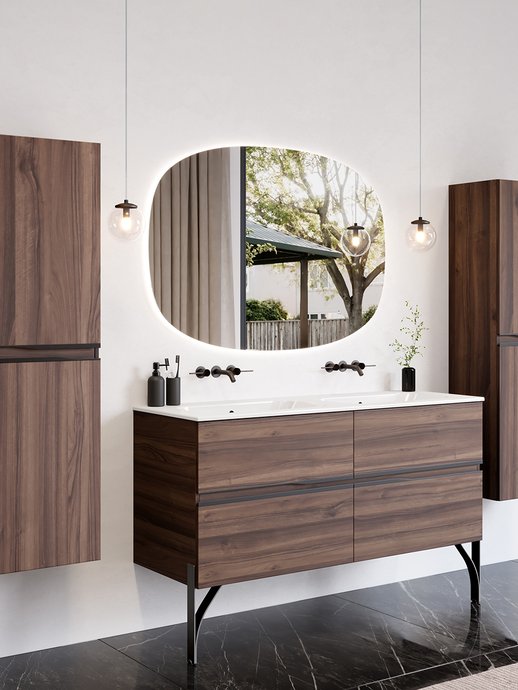
How can you make the most of your bathroom furniture with a mirror and LED lighting?

Mirrors and lighting are often the last elements to be considered in a bathroom design project, once the vanity unit, shower and tiling have been chosen. This is a mistake of practicality rather than taste: whilst these two elements account for only a small proportion of the total budget, they have a significant impact on how the space is perceived in everyday life. A high-end vanity unit under poor lighting will look dated; conversely, a simple unit, when well showcased, can give the impression of a thoughtfully designed bathroom.
The mirror: the piece that gives structure to everything else
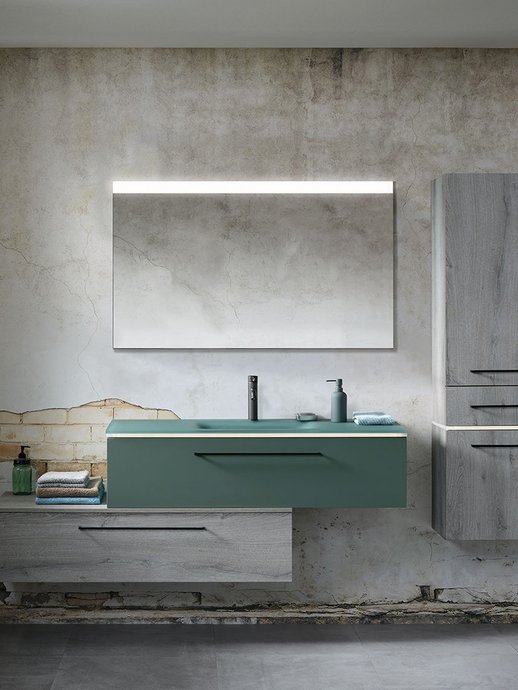
The mirror is not simply an accessory placed above the unit; it is the element that gives its visual coherence to the entire washbasin wall unit. The first rule – one that is often overlooked – concerns the width: a mirror that is significantly narrower than the unit creates an immediate visual imbalance, just as a mirror that extends well beyond each side does. The guideline is to choose a width that is identical to, or very close to, that of the unit, with a tolerance of a few centimetres depending on the desired style.
Centring deserves the same attention. On a vanity unit with a centred washbasin, the mirror is naturally centred over it. On a vanity unit with an off-centre washbasin – a common feature in layouts that include a storage column on one side – it is the washbasin that should guide the alignment of the mirror, not the unit as a whole. A centring error of this kind is immediately noticeable, even if each individual component is of high quality.
The installation height follows a simple principle: the centre of the mirror should be at eye level for the main user, with a space of 30 to 40 cm between the top of the unit or washbasin and the bottom of the mirror to ensure comfortable use without having to bend over.
LED lighting: where to position it for the best results
The most common mistake is still using a single ceiling light, which flattens faces and bathes the mirror in unflattering indirect light. The approach that works relies on multiple layers of light rather than a single source. A task light, positioned around or inside the mirror, directly illuminates the face for shaving, applying make-up or daily skincare. An ambient light, on a separate circuit and ideally dimmable, softens the rest of the room in the evening. A more discreet accent light can highlight a recess or a textured section of wall.
The positioning is just as important as the presence of light. Wall lights on either side of the mirror, at eye level, minimise shadows on the face far more effectively than lighting positioned solely above it. If ceiling spotlights are the only option, they should be positioned slightly in front of the mirror rather than directly above it, so that the light is directed towards the face rather than downwards.
The colour temperature, expressed in kelvins, has a practical impact on how the mirror is used. Warm light, around 2700 to 3000 K, is suitable for a late-evening atmosphere but slightly distorts colours when applying make-up with precision. Neutral light, between 4000 and 4500 K, remains the most versatile choice for everyday use. A cooler light, between 5,000 and 6,500 K, close to daylight, is the gold standard for shaving or precision make-up application. Models with adjustable temperature settings, which are becoming increasingly common, mean you don’t have to make a definitive choice.
Electrical zones and Belgian standards: what you need to comply with
Installing a mirror with lighting in a bathroom is not simply a matter of taste; it is also a matter of electrical safety governed by the RGIE (General Regulations on Electrical Installations), which will undergo a major revision in Belgium in 2025. The regulations divide the bathroom into zones around water points, with the level of protection increasing the closer one gets to them.
In the area closest to the shower or bath, no sockets or electrical appliances not specifically designed for this purpose are permitted. Around the washbasin, within a radius of approximately 60 cm, a minimum protection rating of IP44 is required for any fixed electrical appliance, including mirrors with built-in lighting. An electrical socket is still permitted in this area, but only if protected by a highly sensitive residual current device (RCD). Beyond this area, the restrictions are relaxed, which explains why some high-end mirrors incorporate their own socket for an electric shaver or electric toothbrush, positioned exactly at the boundary of this perimeter.
In practical terms, for the buyer, this means one simple thing: checking that the chosen mirror or cabinet has an IP44 rating as a minimum, and having the electrical connection carried out by a professional authorised to work in damp areas. It is also a good reason to buy the mirror and cabinet as a set rather than separately, to ensure that the cut-outs and power supply are incorporated into the design from the outset.
Bathroom cabinet or single mirror with LED lighting: which option is right for your bathroom furniture?
Once the issues of proportion and lighting have been sorted out, you’re left with a choice between two product ranges. The bathroom cabinet combines a mirror with enclosed storage, a real asset in a small bathroom where every centimetre of storage space counts. The single mirror with built-in LEDs, which is slimmer and often cheaper, makes the space look more spacious and is easier to install, though this comes at the cost of limited storage, which you’ll then need to provide elsewhere, such as in a tall unit or a vanity unit with drawers.
Our guide Bathroom cabinets with storage: 5 criteria to help you choose the right one sets out the dimensions, lighting and materials you should check before buying a bathroom cabinet. If you’re unsure which of these two types to choose, the comparison guide Bathroom cabinet or mirror with built-in storage: which one to choose for your needs compares the two options side by side based on intended use, budget and the number of people in your household.
The mirror frame – a detail that quickly reveals an inconsistency
A frameless mirror remains the safest bet: it blends into the background and never clashes with the rest of the finishes. However, as soon as a frame is present, its finish must match that of the taps and fittings. A brushed brass frame with chrome taps, or vice versa, is immediately noticeable, even if each element on its own is well-chosen.
The rule that generally applies in most Belgian bathrooms is to choose a single metal finish – chrome, matt black, brass or bronze and to stick to it for the taps, fittings and, if there is one, the mirror frame. A frameless mirror remains the safest option if this consistency has not yet been decided at the time of purchase.
Anti-fog: the technology that really makes a difference to everyday life
Of the features added to recent mirrors, the anti-fog function is the one with the greatest practical impact. A built-in heating system keeps the mirror’s surface slightly above room temperature, preventing condensation from forming on it after a hot shower. It’s a detail that transforms your entire morning routine: no more wiping the mirror or waiting for the mist to clear before shaving or styling your hair.
This feature is almost always combined with LED lighting on current models, with a single touch control for both functions. It uses very little power, but, like the lighting, requires an electrical connection to be incorporated into the design of the washbasin wall from the outset.
Budget and examples at Facq
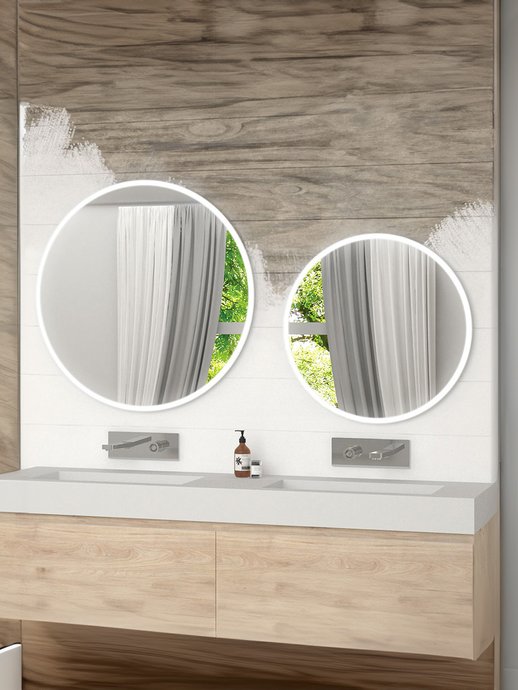
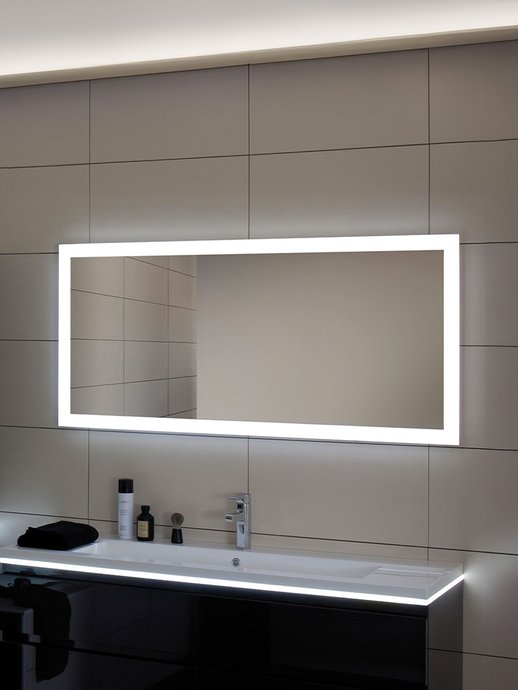
Prices vary considerably depending on whether you choose a simple mirror with LED lighting or a complete bathroom cabinet. At Facq, a mirror with LED lighting starts at around €155 for a 120 cm rectangular model, such as the Lin 20 LED Mirror. The Reflet Sun Light Mirror, which is round and features both an anti-fog function and built-in LED lighting, costs around €355. For a bathroom cabinet with storage and lighting, expect to pay from around €670 for a single-door model (Sanijura Icebox), and more for double-sided mirror versions or Delpha D-motion finishes.
One thing to bear in mind if the existing unit does not have built-in lighting: additional LED spotlights, which can be fitted directly onto or around an existing mirror, offer a low-cost upgrade – at around twenty euros each – without having to replace the entire unit.
When undertaking a complete project, buying the furniture, mirror and lighting from the same range also helps to avoid unpleasant surprises when it comes to fitting: the cut-outs, power points and finishes are all designed to work together, which simplifies the fitter’s job and reduces the risk of having to reopen a freshly tiled wall to add a forgotten socket.
Frequently asked questions
Q1. What size mirror should I choose to go with my vanity unit?
The basic rule is that the mirror should be the same width as the unit, or very close to it, and aligned with the washbasin if it is off-centre. A mirror that is significantly narrower or wider than the unit will throw the whole wall out of visual balance.Q2. What colour temperature should I choose for the mirror lighting?
Around 4,000–4,500 K for everyday, all-round use; cooler (5,000–6,500 K) for applying make-up or precision shaving; warmer (2,700–3,000 K) for a relaxing evening atmosphere. Models with adjustable temperature settings mean you don’t have to make a permanent choice.Q3. What protection rating (IP) is required for a mirror with built-in lighting in a bathroom?
A minimum IP44 rating is required in the area extending approximately 60 cm around the washbasin, in accordance with the Belgian RGIE regulations. No sockets or non-compliant appliances are permitted any closer to a shower or bath.Q4. Do you need an electrician to fit a mirror with LED lighting?
Yes. Any fixed electrical installation in a damp area must be carried out or inspected by a qualified professional, and the circuit must comply with the protection zones and ratings set out in the RGIE. This also applies to an anti-fog mirror that incorporates a heating element connected to the mains supply.Q5. A bathroom cabinet or a simple LED mirror: which is best for making the most of a small bathroom?
A single LED mirror further enhances the visual space and the impression of width. The bathroom cabinet maximises actual storage space. In a small bathroom, the choice depends mainly on whether or not there is another storage unit (tall unit, chest of drawers) that can compensate for the lack of storage in the mirror.