Double washbasin: one large mirror or two separate mirrors?

One large mirror or two separate mirrors? It’s a question of layout
Once the width of the double-basin unit has been decided for the whole family, the question of the mirror almost always arises in the same way. A single large mirror, or two separate mirrors, each centred over its own washbasin: the choice is less about aesthetics than the actual day-to-day use of the bathroom. Whether the unit is wall-mounted or freestanding, this decision should be made at the same time as the rest of the bathroom design, not as an afterthought.
A poorly chosen mirror doesn’t pose any structural problems, but you see it every day, several times a day. It’s one of the few items in the bathroom that the whole family uses at the same time, often in a rush, in the morning. You might as well choose the right one from the start rather than having to replace it a year later.
The large, single mirror above the double washbasin
A room that gains in brightness and depth
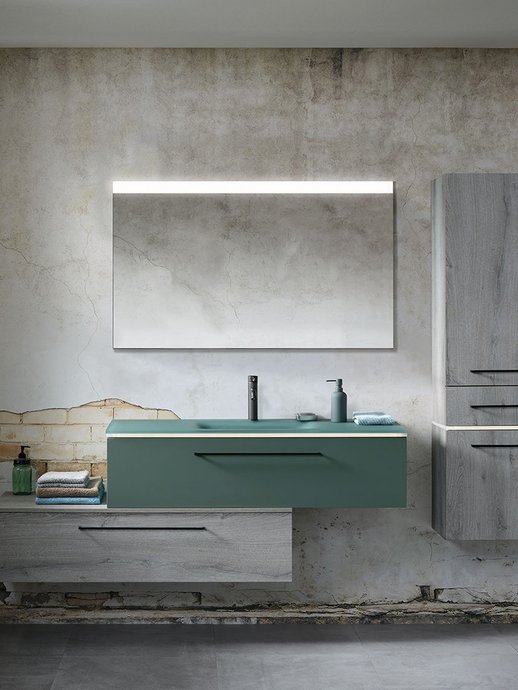
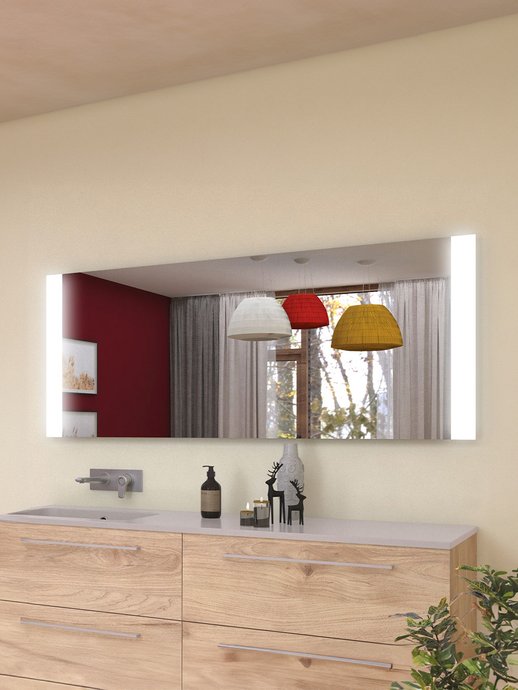
A single mirror mounted above a double washbasin is generally between 120 and 140 cm wide. Natural and artificial light is reflected continuously across this surface, creating a more pronounced sense of space than with two mirrors separated by a bare wall. This is a good option for medium-sized family bathrooms, where every centimetre of light counts.
Just one component to install, align and maintain
The large mirror also has a practical advantage: there’s just one frame to hang up, one fixing to check, and one surface to clean after splashes of toothpaste or fingerprints. For a family with young children, this detail matters more than it might seem over time.
The two separate mirrors – a space of their own for each one
No more exchanging glances in the morning
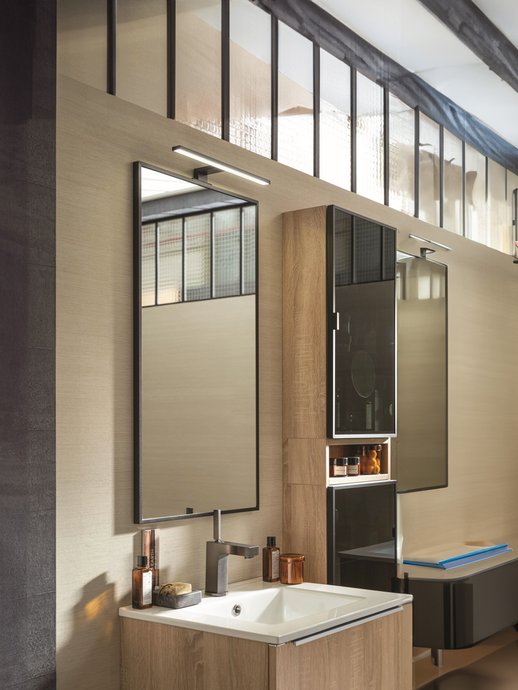
Two separate mirrors, often between 60 and 70 cm each, centred over their respective washbasins, create a private space for each person. Everyone gets ready in front of their own reflection, without intruding on their neighbour’s. This is the most common layout in bathrooms shared by a couple or by teenagers who are getting ready at the same time.
Space for lighting between the two washbasins
The space between the two mirrors is not wasted: it can be used to fit a vertical wall light, an additional light fitting or even a small shelf. This central gap becomes a real design asset, particularly in a bathroom with a more structured style than that created by a single large mirror.
Rectangular or round – the shape matters too
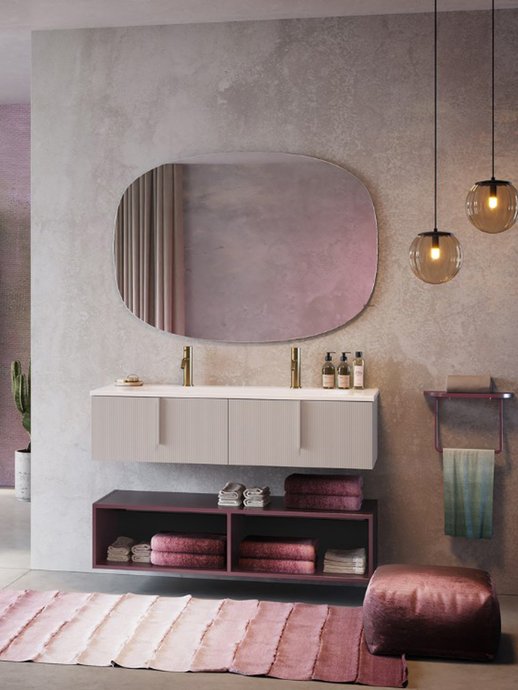
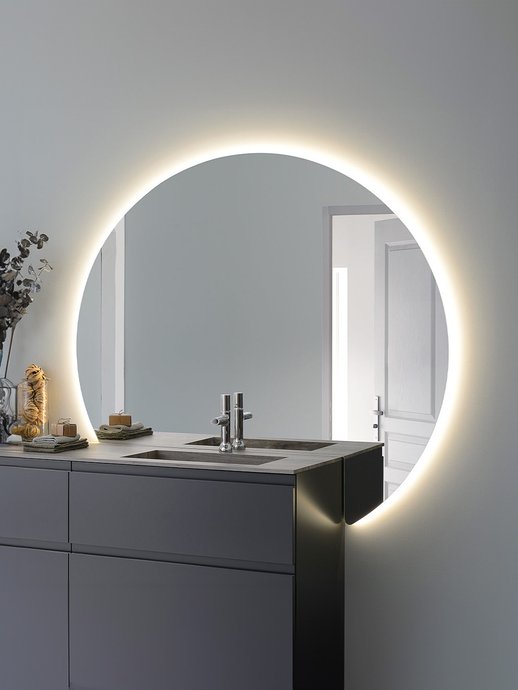
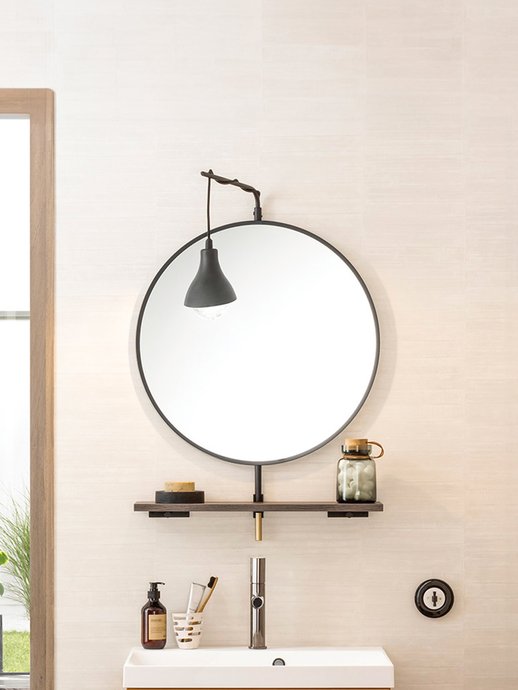
The rectangular mirror remains the most common shape above a double-bowl washbasin, as it naturally follows the line of the vanity unit. A round mirror creates a softer look and softens a room with very straight lines, but it leaves more of the wall visible around it. On a double-basin unit, two identical round mirrors work well when there is enough space between the two basins to avoid giving the impression of a cluttered room.
Choose the right size mirror to suit the width of the unit
The general rule is simple: the mirror, or pair of mirrors, must never exceed the width of the vanity unit. For a 120 cm unit, it is best to opt for a single mirror measuring 110 to 120 cm, or two mirrors measuring 55 to 60 cm each with a gap of a few centimetres between them. For a 140 cm unit, these dimensions increase to 130 or 140 cm for a single mirror, and to 65 or 70 cm per mirror for a pair.
The distance between two mirrors: a detail that matters
When choosing two mirrors, the space left between them deserves just as much attention as their size. A gap of 3 to 6 cm is enough to create a clear separation without leaving an awkward void in the middle of the vanity unit. Both mirrors must also be hung at exactly the same height: a difference of just a few centimetres is immediately noticeable and ruins the desired symmetrical effect.
As for height, the bottom of the mirror is generally positioned between 30 and 40 cm above the edge of the washbasin, to prevent water splashing. The centre of the mirror, meanwhile, is usually situated between 160 and 170 cm above the floor, a height that suits most adults. In a household where people vary greatly in height, this guideline should be used as a starting point and adjusted to suit each person’s habits.
Lighting and RGIE: things to check before installation
What the revision of the RGIE changes
Since 1 March 2025, the RGIE has only distinguished between zones 0, 1 and 2 around a bath or shower. The former zone 3 has been abolished, replaced by the concept of the space containing the water point. For a mirror installed above a double washbasin, with no bath or shower in the immediate vicinity, these restrictions are more flexible, but they do not disappear entirely if the water point is within four metres.
LED mirror, anti-fog: what to ask your electrician
A lighted mirror or anti-fog mirror is still an electrical appliance installed in a damp area. In Volume 2, the minimum protection rating required is IPX4, and the circuit must be protected by a 30 mA residual current device (RCD), as is the case for the entire bathroom. Before choosing a model with a built-in power supply, it is best to check this with a qualified electrician, particularly in renovation projects where the existing wiring is not always suitable for this type of equipment.
At the time of purchase, the IP rating is usually shown on the packaging or in the mirror’s technical specifications. A model with an IPX4 rating or higher is suitable for installation above a double washbasin. For lower ratings, it is best to install it on a dry wall, away from any damp areas.
Double-basin units and mirrors available from Facq
At Facq, the Sand range offers vanity units measuring from 60 to 140 cm, with single or double basins, featuring worktops in marble, Solid Top, concrete or ceramic. The mirrors and bathroom cabinets in the range are available in the same finishes as the cabinet fronts, creating a cohesive whole rather than a collection of mismatched pieces.
The Pupitre range, designed by Sanijura, is available in widths of 80, 100, 120 and 140 cm, with ceramic or synthetic marble tops, in single or double-bowl configurations, either centred or off-centre. In this range, the round mirror is available in two diameters, 70 or 90 cm, with optional LED lighting for bathrooms lacking natural light.
To compare the actual dimensions before deciding between a single large mirror and a pair, the Facq EXPOcenters allow you to see the units fully assembled, complete with their basins and mirrors, in a real-life setting – something no photograph can quite replicate.
Which solution should you choose, depending on the layout of your bathroom?
In an average-sized family bathroom, measuring between 4 and 6 m², a single large mirror is often the simplest choice: it makes the room appear larger without adding to the number of items mounted on a wall already occupied by the bathroom units and lighting. In a more spacious bathroom, or one clearly designed for two people using it at the same time, two separate mirrors really come into their own, with their own dedicated areas and individual light sources.
The style of the room also plays a part. A minimalist, contemporary interior goes well with a large frameless mirror, whilst a bathroom with a more structured style, featuring wall décor positioned between the two washbasins, looks better with two identical, neatly aligned mirrors.
A choice that depends, above all, on your habits
There is no one-size-fits-all answer when it comes to choosing between one large mirror and two separate mirrors. The choice depends on the width of the unit, the existing light levels in the room, the number of people getting ready there at the same time, and the budget available for lighting. What matters most is that the mirror is suited to the actual use of the bathroom, morning after morning, rather than being a mere matter of aesthetics.
Frequently asked questions
Is a large mirror suitable for all double-basin set-ups?
In most cases, yes, provided the width of the unit allows it. For a narrow unit, less than 100 cm wide, two small separate mirrors may look a bit cramped, and a single mirror is often more visually pleasing.What size mirror should you choose for a 120 cm double-basin unit?
You’ll need either a single mirror measuring 110 to 120 cm, or two mirrors, each measuring 55 to 60 cm, with a gap of a few centimetres between them.Is it possible to install an LED mirror above a double washbasin in Belgium?
Yes, provided that the RGIE regulations applicable to the room in which the mirror is located are complied with, with a minimum IPX4 protection rating and a circuit protected by a 30 mA residual current device.Do you necessarily need two identical mirrors for a double washbasin?
No, but it’s strongly recommended to ensure a symmetrical look. Two different designs, even if they’re the same size, disrupt the overall visual balance.Where can I view Facq double-basin units before buying?
At Facq’s EXPOcenters, where furniture, washbasins and mirrors are displayed fully assembled, allowing you to assess their actual proportions before making a decision.