Bathroom cupboards: mistakes to avoid for perfect, long-lasting storage

A poorly chosen bathroom cabinet isn’t immediately obvious. The problem becomes apparent three months later, when the door starts to close poorly, or three years later, when it comes away from the wall or the interior smells of damp. Most of these setbacks stem from mistakes that could have been identified before purchase, not from a faulty product.
The most costly mistakes rarely concern aesthetics: poor wall fixing to an unreinforced partition, materials not treated for damp, a low-quality door mechanism that loses its tension within a few years, or a power supply not installed before the tiling. Inside, the most common mistake is cramming everything in without any logic or prior sorting. A well-chosen and properly fitted cupboard will last fifteen to twenty years without any problems; a poorly fitted cupboard can come loose within a few months. Here are the seven most common mistakes, along with tips on how to avoid them.
Mistake No. 1: buying before taking precise measurements
This is the most common and trivial mistake. A cupboard bought on a whim, without checking the available depth or the position of existing sockets, often ends up obstructing the opening of a neighbouring drawer or encroaching on the space needed to move around in front of the washbasin. The depth deserves particular attention: between 12 and 20 cm for a standard wall-mounted model, it determines both the storage capacity and the actual space taken up in a room where every centimetre counts.
The width must also take into account the vanity unit underneath: a cabinet that is significantly narrower or wider will throw the whole arrangement off balance visually. The number of doors follows a simple rule that is often overlooked: one door for a compact model, two for a medium width, and three for large configurations with double basins. A single-door cabinet installed above a 120 cm worktop means you have to move around to reach each end – a detail that only becomes apparent when you actually use it.
The installation height requires the same attention to detail: the centre of the mirror should be at eye level, with a handy guide of around 20 cm between the top of the washbasin and the bottom of the cabinet to ensure comfortable use without having to bend over. Our guide Bathroom cabinets with storage: 5 criteria for making the right choice sets out the measurements you need to take before making a purchase, including dimensions, installation height and the space required for the doors to open.
Mistake No. 2: neglecting wall mounting
A bathroom cupboard, once filled with bottles, medicines and accessories, weighs considerably more than when empty. On a concrete or solid brick wall, this is not a problem: the fixings hold securely. On a plasterboard partition, however, fixing directly into the plasterboard without locating the metal studs or using suitable expansion plugs will sooner or later result in the fixing giving way, sometimes suddenly.
Before drilling, checking the type of wall and, in the case of a lightweight partition, locating the studs or providing additional reinforcement remains the simplest check to carry out – and yet it is the one most often overlooked. This is a factor common to almost all of the most costly installation errors: the product was fine, but the fixing wasn’t.
Mistake No. 3: forgetting about the electrical work before laying the tiles
A cabinet with LED lighting, an anti-fog feature or a built-in socket requires a power supply point to be installed in advance, rather than added as an afterthought. On a wall that has already been tiled, running a cable or creating an electrical connection often means removing some of the tiles, which is a much more labour-intensive job than originally anticipated.
This planning is doubly important in a bathroom, where the Belgian RGIE regulations strictly govern the areas where electrical installations are permitted: no sockets in the areas closest to the shower or bath, and a minimum IP44 protection rating around the washbasin. Our guide to optimising your bathroom furniture with a mirror and LED lighting sets out these areas in detail and explains the steps to follow to avoid having to reopen a freshly finished wall.
Mistake No. 4: choosing a material that is unsuitable for damp conditions
Not all bathroom cupboards are equally suited to the constant steam in the room. Untreated raw wood absorbs moisture like a sponge and swells within a few months, even without direct contact with water. Standard chipboard, whilst attractive due to its price, disintegrates at the slightest sign of moisture seeping in through a poorly protected edge. Untreated metals rust at the hinges and fixings, which is often the first visible sign of a poor choice of material.
Water-resistant MDF, solid wood that has been properly treated with oil or varnish, and toughened glass remain the best choices for a wardrobe that needs to stand the test of time. If you have any doubts about a material at the time of purchase, you can easily check at EXPOcenter, where our advisers can tell you exactly what treatment has been applied to each model.
The right material alone is not always enough. A cupboard that is kept permanently closed, in a poorly ventilated bathroom, traps moisture inside far more than an open shelf exposed to the ambient air. An interior that starts to smell musty or develop dark patches in the corners usually indicates a lack of ventilation in the room rather than a fault with the cupboard itself. Leaving the door ajar for a few minutes after a shower, until the steam has cleared, is often enough to sort out the problem.
Mistake No. 5: Underestimating the quality of the hinges and the mechanism
A wardrobe costing €150 and one costing €400 look very similar in a photograph. The difference lies in a detail that isn’t visible at first glance: the quality of the closing mechanism. Cheap hinges lose their tension after a few years of daily use; the door eventually slams shut or remains ajar. Anti-rebound mechanisms with adjustable closing force, which are found on higher-end ranges, last ten years or more without losing their effectiveness.
This is a difficult criterion to assess from an online product description, but one that is easy to test in-store: open and close the door several times; the resistance and smoothness of the movement say a lot about how long it is likely to last.
Mistake No. 6: filling the cupboard without any order or prior sorting
The most common mistake when organising the cupboard has nothing to do with the products themselves: it’s the way they’re packed away. Many people simply transfer the contents of their old cupboard straight into the new one – including out-of-date items and duplicates – without taking the opportunity to sort through them. A thorough clear-out before tidying up, item by item, allows you to spot items that have passed their use-by dates and get rid of anything you no longer need.
On open or mid-height shelves, a simple rule helps avoid a cluttered look: never fill them more than 60 per cent full. The remaining empty space isn’t wasted; it’s what makes your storage organised and easy to navigate on a day-to-day basis, rather than looking crammed. If you’re unsure whether to choose a closed cupboard or a simple mirror with storage elsewhere in the room, the comparison bathroom cupboard or mirror with built-in storage: which to choose for your items will help you decide based on the actual volume you need to store.
Mistake No. 7: failing to ensure consistency with the rest of the room
A cabinet chosen in isolation, without taking into account the taps or fittings already in place, stands out immediately once installed. A brushed brass mirror frame next to chrome taps, or vice versa, disrupts the visual coherence of the whole, even if each element taken separately is of high quality.
The simplest solution is still to choose a single metallic finish for the entire room – chrome, matt black, brass or bronze – and to stick to it for the taps, fittings and the cabinet frame, if there is one. A frameless model remains the safest option until this choice has been finalised.
The cost of a good wardrobe compared to a poor one
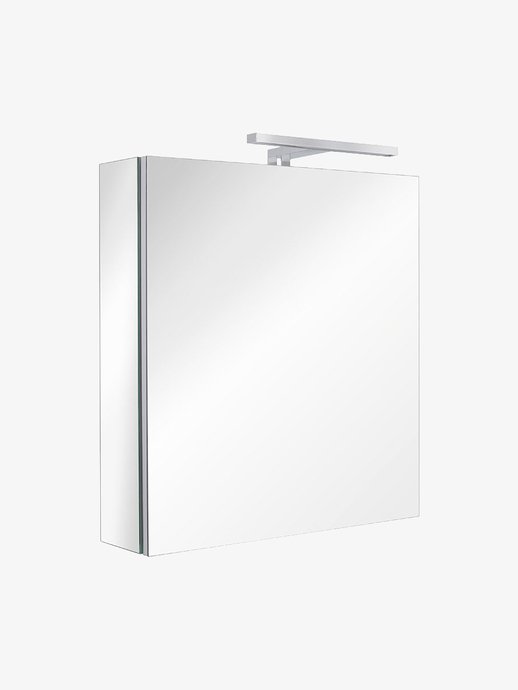
An entry-level wardrobe that is poorly fitted or poorly maintained needs replacing on average after 3 to 5 years, whereas a high-quality wardrobe that is properly fitted will easily last more than 15 years. Over this period, the model that is cheapest to buy often ends up costing more, once you factor in early replacement and, in some cases, damage caused by a fall or water ingress. At Facq, a bathroom cabinet with lighting starts at around €670 for a single-door model (Sanijura Icebox), a price that includes a mechanism and materials designed to last in a Belgian bathroom.
Simple maintenance will extend its lifespan without any particular effort: a soft cloth and a non-abrasive product for the exterior, an annual check of the fixings and hinges, and cleaning the interior at least once a season to spot any forgotten items or traces of damp before they set in.
Frequently asked questions
Q1. How can I tell if my wall can support a bathroom cupboard?
A concrete or solid brick wall can easily support a fully loaded cupboard. On a plasterboard partition, you must locate the metal studs or use suitable expansion plugs, otherwise the fixing may give way over time.Q2. Which material should you definitely avoid when choosing a bathroom cupboard?
Untreated raw timber and standard chipboard remain the two riskiest choices: the former absorbs moisture from the air and swells, whilst the latter disintegrates at the slightest sign of water ingress along a poorly protected edge.Q3. Do you need to sort out the electricity before laying the tiles?
Yes, as a rule, if the cupboard you’ve chosen has built-in LED lighting, an anti-fog function or a socket. Adding a power point after the tiles have been laid often means having to reopen part of the wall.Q4. How can you tell if a wardrobe is poor quality when you’re in a shop?
The simplest test involves the hinges: open and close the door several times. A mechanism that lacks resistance or does not return to its original position is a sign of rapid wear and tear, often within just a few years.Q5. Is it possible to overfill a bathroom cupboard?
Yes. Once a shelf is more than 60 per cent full, it becomes difficult to see what’s on it and to keep it tidy on a day-to-day basis. Sorting items beforehand, and checking use-by dates, helps avoid this problem right from the start.